Cancer Diagnostics Market Opportunity, Growth Drivers, Industry Trend Analysis, and Forecast 2026 - 2035
상품코드:1892856
리서치사:Global Market Insights Inc.
발행일:2025년 12월
페이지 정보:영문 142 Pages
라이선스 & 가격 (부가세 별도)
ㅁ Add-on 가능: 고객의 요청에 따라 일정한 범위 내에서 Customization이 가능합니다. 자세한 사항은 문의해 주시기 바랍니다.
한글목차
세계의 암 진단 시장은 2025년에 1,717억 달러로 평가되었고, 2035년까지 연평균 복합 성장률(CAGR) 9.1%로 성장하여 4,089억 달러에 이를 것으로 예측됩니다.
시장 확대의 배경에는 암 발병률 증가와 정밀한 질병 감지를 가능하게 하는 첨단 진단 기술의 보급 확대가 있습니다. 암 진단은 암의 유형, 병기, 부위를 확인하고, 조기 치료와 좋은 치료 성적을 뒷받침하는 다양한 기술, 프로세스, 검사를 포함합니다. 특히 바이오마커 기반 접근법을 중심으로 한 개인 맞춤형 의료의 혁신은 검출, 경과 관찰, 치료 선택에 변화를 가져오고 있습니다. 액체 생검과 같은 비침습적 기법은 치료 효과의 실시간 모니터링과 종양의 조기 발견을 가능하게 하여 의료진들의 채택을 촉진하고 있습니다. 첨단 영상 진단, AI 지원 진단 도구 및 실험실 기반 검사 기술은 정확성과 신뢰성을 더욱 향상시켜 전 세계 병원과 진단센터의 보급을 촉진하고 있습니다. 이러한 기술의 통합은 임상 연구와 치료의 최적화를 가속화하여 전체 시장의 성장을 뒷받침하고 있습니다.
시장 범위
개시 연도
2025년
예측 연도
2026-2035년
개시 연도 시장 규모
1,717억 달러
예측 금액
4,089억 달러
CAGR
9.1%
2025년 기준 영상진단 분야는 63.4%의 점유율을 차지했습니다. 암 환자가 증가함에 따라 조기 발견과 정밀한 치료 계획에 필수적인 진단용 영상진단에 대한 수요가 증가하고 있습니다. PET-CT, MRI, AI 지원 영상진단 등의 기술 혁신으로 정확도가 향상되어 전 세계적으로 영상진단 기술의 채택이 촉진되고 있습니다.
병원 부문은 2025년 695억 달러 시장 규모를 창출했습니다. 이 부문의 성장은 병원 수 증가, 도시화, 고급 진단 시스템을 운영할 수 있는 숙련된 인력의 확보에 의해 촉진되고 있습니다. 병원에서는 영상진단, 생검, 액체 생검 플랫폼 등 첨단 기술에 대한 접근을 제공하여 종합적인 암 진단과 환자 치료 결과를 개선할 수 있도록 돕고 있습니다.
북미 암 진단 시장은 2025년 40.5%의 점유율을 차지했습니다. 높은 암 발병률과 더불어 강력한 연구 이니셔티브와 첨단 의료 인프라가 시장 확대를 주도하고 있습니다. 제약회사, 생명공학 기업, 연구기관들이 혁신적인 진단 솔루션에 많은 투자를 하고 있으며, 이는 이 지역의 성장을 더욱 촉진하고 있습니다.
목차
제1장 조사 방법과 범위
제2장 주요 요약
제3장 업계 인사이트
생태계 분석
업계에 대한 영향요인
성장 촉진요인
업계의 잠재적 리스크&과제
시장 기회
성장 가능성 분석
규제 상황
북미
유럽
아시아태평양
기술 동향
현재 기술 동향
신기술
특허 분석
가격 분석, 2025
향후 시장 동향
Porter's Five Forces 분석
PESTEL 분석
제4장 경쟁 구도
서론
기업의 시장 점유율 분석
세계
북미
유럽
아시아태평양
기업 매트릭스 분석
주요 시장 기업의 경쟁 분석
경쟁 포지셔닝 매트릭스
주요 발전
인수합병(M&A)
제휴 및 협력 관계
신제품 발매
확대 계획
제5장 시장 추산 및 예측 : 용도별, 2022-2035
주요 동향
종양 바이오마커 검사
영상 진단
초음파 및 방사선학
맘모그래피
MRI 검사
PET 검사
CT 검사
SPECT 및 기타 영상 진단
생검
액체생검
면역조직화학
In situ hybridization
제6장 시장 추산 및 예측 : 암 유형별, 2022-2035
주요 동향
방광암
유방암
결장직장암
자궁내막암
신장암
백혈병
간 및 폐암
악성 흑색종
비호지킨 림프종
췌장암
전립선암
갑상선암
기타 암종
제7장 시장 추산 및 예측 : 최종 용도별, 2022-2035
주요 동향
병원
진단실험실
진단 영상 센터
암 연구기관
제8장 시장 추산 및 예측 : 지역별, 2022-2035
주요 동향
북미
미국
캐나다
유럽
독일
영국
프랑스
이탈리아
스페인
네덜란드
아시아태평양
중국
인도
일본
호주
한국
라틴아메리카
브라질
멕시코
아르헨티나
중동 및 아프리카
사우디아라비아
남아프리카공화국
아랍에미리트(UAE)
제9장 기업 개요
Abbott Laboratories
Becton, Dickinson and Company
Biocare Medical
Biocartis
Biomerieux
Bio-Rad Laboratories
Danaher Corporation
Exact Sciences Corporation
F-Hoffmann-La Roche
GE HealthCare Technologies
Guardant Health
Hologic
Koninklijke Philips
QIAGEN
Siemens Healthineers
Sysmex Corporation
Thermo Fisher Scientific
LSH
영문 목차
영문목차
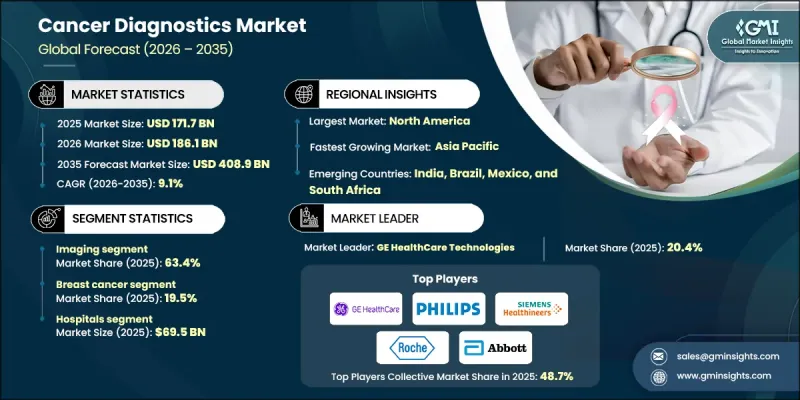
The Global Cancer Diagnostics Market was valued at USD 171.7 billion in 2025 and is estimated to grow at a CAGR of 9.1% to reach USD 408.9 billion by 2035.
Market expansion is fueled by the rising prevalence of cancer and the growing adoption of advanced diagnostic technologies that enable precise disease detection. Cancer diagnostics encompass a wide range of technologies, processes, and tests designed to identify the type, stage, and location of cancer, supporting early treatment and better outcomes. Innovations in personalized medicine, particularly biomarker-driven approaches, are transforming detection, monitoring, and therapy selection. Non-invasive methods such as liquid biopsies allow real-time monitoring of treatment responses and early detection of tumors, driving adoption among healthcare providers. Advanced imaging, AI-assisted diagnostic tools, and lab-based testing techniques are further enhancing accuracy and reliability, encouraging widespread uptake in hospitals and diagnostic centers globally. The integration of these technologies is also accelerating clinical research and treatment optimization, supporting overall market growth.
Market Scope
Start Year
2025
Forecast Year
2026-2035
Start Value
$171.7 Billion
Forecast Value
$408.9 Billion
CAGR
9.1%
The imaging segment held a 63.4% share in 2025. The rising number of cancer cases is increasing demand for diagnostic imaging, which is essential for early detection and precise treatment planning. Innovations such as PET-CT, MRI, and AI-assisted imaging are improving accuracy, boosting the adoption of imaging technologies worldwide.
The hospitals segment generated USD 69.5 billion in 2025. The growth of this segment is driven by increasing hospital numbers, urbanization, and the availability of skilled personnel to operate advanced diagnostic systems. Hospitals also offer access to advanced technologies, including imaging, biopsies, and liquid biopsy platforms, supporting comprehensive cancer diagnostics and improved patient outcomes.
North America Cancer Diagnostics Market held a 40.5% share in 2025. High cancer prevalence, coupled with strong research initiatives and advanced healthcare infrastructure, is driving market expansion. Pharmaceutical companies, biotechnology firms, and research institutions are heavily investing in innovative diagnostic solutions, further supporting growth in the region.
Key players in the Global Cancer Diagnostics Market include Guardant Health, Abbott Laboratories, Thermo Fisher Scientific, Biocare Medical, Bio-Rad Laboratories, Biomerieux, Danaher Corporation, Siemens Healthineers, Hologic, QIAGEN, GE HealthCare Technologies, Becton Dickinson and Company, Biocartis, F. Hoffmann-La Roche, and Koninklijke Philips.
Companies in the Global Cancer Diagnostics Market are implementing multiple strategies to strengthen their market presence and competitive positioning. They are investing heavily in R&D to develop next-generation diagnostic solutions, including AI-assisted imaging, liquid biopsy platforms, and biomarker-focused tests. Strategic collaborations, partnerships, and acquisitions help expand geographic reach and technological capabilities. Firms are also enhancing product portfolios by introducing innovative, high-precision diagnostic tools that improve early detection and treatment monitoring. Additionally, companies are targeting emerging markets, optimizing manufacturing processes, and offering comprehensive customer support and training to increase adoption in hospitals and diagnostic centers, while maintaining strong regulatory compliance and supply chain efficiency.
Table of Contents
Chapter 1 Methodology and Scope
1.1 Market scope and definitions
1.2 Research design
1.2.1 Research approach
1.2.2 Data collection methods
1.3 Data mining sources
1.3.1 Global
1.3.2 Regional/country
1.4 Base estimates and calculations
1.4.1 Base year calculation
1.4.2 Key trends for market estimation
1.5 Primary research and validation
1.5.1 Primary sources
1.6 Forecast model
1.7 Research assumptions and limitations
Chapter 2 Executive Summary
2.1 Industry 3600 synopsis
2.2 Key market trends
2.2.1 Regional trends
2.2.2 Application trends
2.2.3 Cancer type trends
2.2.4 End use trends
2.3 CXO perspectives: Strategic imperatives
2.3.1 Key decision points for industry executives
2.3.2 Critical success factors for market players
2.4 Future outlook and strategic recommendations
Chapter 3 Industry Insights
3.1 Industry ecosystem analysis
3.2 Industry impact forces
3.2.1 Growth drivers
3.2.1.1 Rising prevalence of cancer globally
3.2.1.2 Several initiatives undertaken by government and other organizations to spread disease awareness
3.2.1.3 Growing number of diagnostic laboratories in developing countries
3.2.1.4 Technology advancements in cancer diagnostics
3.2.2 Industry pitfalls and challenges
3.2.2.1 High capital investment coupled with high costs associated with diagnostic imaging systems
3.2.2.2 Risk related with high radiation exposure affecting use of CT scanner
3.2.3 Market opportunities
3.2.3.1 Regional expansion in emerging markets
3.2.3.2 Integration of AI and digital pathology
3.3 Growth potential analysis
3.4 Regulatory landscape
3.4.1 North America
3.4.2 Europe
3.4.3 Asia Pacific
3.5 Technology landscape
3.5.1 Current technological trends
3.5.2 Emerging technologies
3.6 Patent analysis
3.7 Pricing analysis, 2025
3.8 Future market trends
3.9 Porter's analysis
3.10 PESTEL analysis
Chapter 4 Competitive Landscape, 2025
4.1 Introduction
4.2 Company market share analysis
4.2.1 Global
4.2.2 North America
4.2.3 Europe
4.2.4 Asia Pacific
4.3 Company matrix analysis
4.4 Competitive analysis of major market players
4.5 Competitive positioning matrix
4.6 Key development
4.6.1 Mergers and acquisitions
4.6.2 Partnerships and collaborations
4.6.3 New product launches
4.6.4 Expansion plans
Chapter 5 Market Estimates and Forecast, By Application, 2022 - 2035 ($ Mn)
5.1 Key trends
5.2 Tumor biomarkers tests
5.3 Imaging
5.3.1 Ultrasound and radiology
5.3.2 Mammography
5.3.3 MRI scan
5.3.4 PET scan
5.3.5 CT scan
5.3.6 SPECT and other imaging
5.4 Biopsy
5.5 Liquid biopsy
5.6 Immunohistochemistry
5.7 In situ hybridization
Chapter 6 Market Estimates and Forecast, By Cancer Type, 2022 - 2035 ($ Mn)
6.1 Key trends
6.2 Bladder cancer
6.3 Breast cancer
6.4 Colon and rectal cancer
6.5 Endometrial cancer
6.6 Kidney cancer
6.7 Leukemia
6.8 Liver and lung cancer
6.9 Melanoma
6.10 Non-Hodgkin lymphoma
6.11 Pancreatic cancer
6.12 Prostate cancer
6.13 Thyroid cancer
6.14 Other cancer types
Chapter 7 Market Estimates and Forecast, By End Use, 2022 - 2035 ($ Mn)
7.1 Key trends
7.2 Hospitals
7.3 Diagnostic laboratories
7.4 Diagnostic imaging centers
7.5 Cancer research institutes
Chapter 8 Market Estimates and Forecast, By Region, 2022 - 2035 ($ Mn)