정밀 발효 유제품 단백질 시장 : 시장 기회, 성장 요인, 업계 동향 분석 및 예측(2025-2034년)
Precision Fermentation Dairy Proteins Market Opportunity, Growth Drivers, Industry Trend Analysis, and Forecast 2025 - 2034
상품코드:1885850
리서치사:Global Market Insights Inc.
발행일:2025년 11월
페이지 정보:영문 190 Pages
라이선스 & 가격 (부가세 별도)
ㅁ Add-on 가능: 고객의 요청에 따라 일정한 범위 내에서 Customization이 가능합니다. 자세한 사항은 문의해 주시기 바랍니다.
한글목차
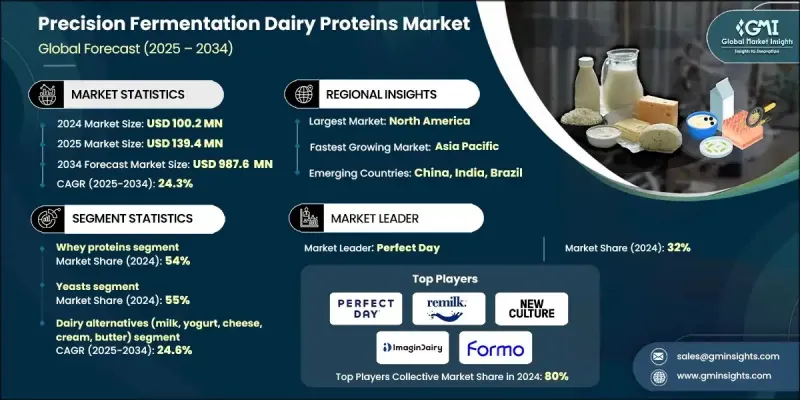
세계의 정밀 발효 유제품 단백질 시장은 2024년에 1억 20만 달러로 평가되었고, 2034년까지 연평균 복합 성장률(CAGR) 24.3%로 성장할 전망이며 9억 8,760만 달러에 이를 것으로 예측됩니다.
발효과학과 합성생물학의 비약적 진보로 기존의 가축 시스템에 의존하지 않고 우유단백질을 창출할 수 있어 환경부하의 저감 및 기존의 낙농과 관련된 윤리적 우려에 대한 대응을 도모함으로써 이 분야는 계속 발전하고 있습니다. 동물 유래의 유제품이 가지는 특유의 영양적 및 기능적 이점으로부터, 제조업체는 그 특성을 충실히 재현하는 대체 원료를 모색하고 있습니다. 유제품을 사용하지 않고 환경 부하가 낮은 옵션에 대한 수요가 높아지는 가운데, 동물 유래가 아닌 유청이나 카제인을 사용한 강화 제품은 성능 및 영양면에서의 우위성과 비용면에서의 이점을 제공합니다. 이러한 단백질을 사용할 수 있는 공인 가공업자는 유당이 없는 옵션과 탄소 실적를 줄인 제품을 제공할 수 있습니다. 소비자의 관심이 높아짐에 따라, 특히 규제의 진전이 신제품 발매와 연동하는 지역에서 발효 플랫폼 전체에서 투자의 기세가 증가하고 있습니다. 승인 범위가 확대됨에 따라 국제적인 채용이 진행되고 있으며, 정밀 발효 유제품 단백질은 현재 세계 유제품 원료 분야의 일부만을 차지하고 있지만 상업적 성장은 가속화되고 있습니다.
시장 범위
시작 연도
2024년
예측 연도
2025-2034
시작 시 가치
1억 20만 달러
예측 금액
9억 8,760만 달러
CAGR
24.3%
유청 단백질 부문은 2024년에 54%의 점유율을 차지하였으며, 2034년까지 연평균 복합 성장률(CAGR) 24.1%로 성장할 것으로 예측됩니다. 베타락토글로불린과 알파락토알부민은 그 구조를 잘 이해하고 있으며, 생산 효율이 높고, 음료, 냉동 디저트, 영양 보조 식품 등의 용도로 효과적으로 기능하기 때문에 이 분야에서의 혁신을 계속 견인하고 있습니다. 이러한 단백질은 우수한 유화성, 발포성 및 용해성을 갖추고 있기 때문에 널리 사용되는 많은 유단백질 블렌드의 직접적인 대안으로 작용합니다.
효모 기반 시스템은 2024년에 55%의 점유율을 차지했으며, 2025-2034년까지 연평균 복합 성장률(CAGR) 23%로 성장할 것으로 예측됩니다. 코마가타에라 파피 이 및 사카로미세스 세레비시 에 등의 종은 높은 단백질 수율과 대규모 발효 시설과의 호환성으로 인해 상업 생산의 핵심으로 계속되고 있습니다. 사상균과 고생산성의 유전자 재조합 세균을 포함한 기타 미생물 플랫폼은 일반적인 인식이 나뉘는 가운데 개발 파이프라인을 계속 지원하고 있습니다.
북미의 정밀 발효 유제품 단백질 시장은 2024년 4,510만 달러 규모를 기록했으며, 2034년까지 4억 4,500만 달러에 이를 것으로 예측됩니다. 이 지역의 확장은 강력한 생명 공학 능력, 기능성 영양에 대한 광범위한 관심, 여러 용도 분야 및 생물 종 카테고리에서 신속한 전개에 의해 지원됩니다.
목차
제1장 조사 방법 및 범위
제2장 주요 요약
제3장 업계 인사이트
생태계 분석
공급자의 상황
이익률
각 단계에서의 부가가치
밸류체인에 영향을 주는 요인
혁신
업계에 미치는 영향요인
성장 촉진요인
동물 유래가 아닌 진짜 유제품에 대한 수요 증가
지속가능성 및 온실가스 배출량 감소
합성 생물학 및 바이오프로세싱의 진전
업계의 잠재적 위험 및 과제
높은 설비 투자 비용 및 바이오리액터의 운영 비용
진화해 분단된 세계의 규제의 길
시장 기회
기존의 유제품 제조업체 및 소비재 대기업과의 공동 창조
영양, 의료 및 반려동물 분야로의 사업 확대
성장 가능성 분석
규제 상황
북미
유럽
아시아태평양
라틴아메리카
중동 및 아프리카
Porter's Five Forces 분석
PESTEL 분석
가격 동향
지역별
단백질 유형별
장래 시장 동향
기술 및 혁신 동향
현재의 기술 동향
신흥 기술
특허 상황
무역 통계(HS코드)(참고 : 무역 통계는 주요 국가에서만 제공됨)
주요 수입국
주요 수출국
지속가능성 및 환경면
지속가능한 대처
폐기물 감축 전략
생산에 있어서의 에너지 효율
환경에 배려한 대처
탄소발자국 고려
제4장 경쟁 구도
서문
기업의 시장 점유율 분석
지역별
북미
유럽
아시아태평양
라틴아메리카
중동 및 아프리카
기업 매트릭스 분석
주요 시장 기업의 경쟁 분석
경쟁 포지셔닝 매트릭스
주요 발전
합병 및 인수
제휴 및 협업
신제품 발매
사업 확대 계획
제5장 시장 추계 및 예측 : 단백질 유형별(2021-2034년)
주요 동향
유청 단백질
β-락토글로불린
α-락트알부민
글리코마크로펩티드
카제인 단백질
알파카제인
β-카제인
카파카제인
기타 우유 단백질
제6장 시장 추계 및 예측 : 미생물 유형별(2021-2034년)
주요 동향
효모
사카로마이세스 세레비시에
코마가타에라 파피이(피키아 파스토리스)
균류(사상균 및 기타)
아스페르길루스속
트리코델마속
박테리아
대장균(유전자 재조합주)
유산균(유전자 재조합주)
조류 및 기타 신규 숙주
제7장 시장 추계 및 예측 : 용도별(2021-2034년)
주요 동향
유제품 대체품(우유, 요구르트, 치즈, 크림, 버터)
스포츠 영양 및 단백질 보충제
베이커리 및 과자류
영아 영양 및 의료용 영양 식품
즉음음료 및 기능성 식품
반려동물 식품
영양보조식품
기타
제8장 시장 추계 및 예측 : 지역별(2021-2034년)
주요 동향
북미
미국
캐나다
유럽
독일
영국
프랑스
스페인
이탈리아
기타 유럽
아시아태평양
중국
인도
일본
호주
한국
기타 아시아태평양
라틴아메리카
브라질
멕시코
아르헨티나
기타 라틴아메리카
중동 및 아프리카
사우디아라비아
남아프리카
아랍에미리트(UAE)
기타 중동 및 아프리카
제9장 기업 프로파일
Perfect Day
Remilk
Imagindairy
New Culture
Formo
Change Foods
Those Vegan Cowboys
All G Foods
Every(formerly Clara Foods)
Motif FoodWorks
Standing Ovation
Eden Brew
Vivici
AJY
영문 목차
영문목차
The Global Precision Fermentation Dairy Proteins Market was valued at USD 100.2 million in 2024 and is estimated to grow at a CAGR of 24.3% to reach USD 987.6 million by 2034.
The field continues to advance as breakthroughs in fermentation science and synthetic biology make it possible to create dairy proteins without relying on traditional livestock systems, reducing environmental impact and addressing ethical concerns linked to conventional dairy farming. Because dairy sourced from animals offers distinct nutritional and functional benefits, manufacturers are looking for alternative ingredients that closely replicate those qualities. As demand for dairy-free and low-impact options increases, fortified products made with animal-free whey and casein deliver performance, nutrition, and cost advantages. Licensed processors able to use these proteins can offer lactose-free options and products with a reduced carbon footprint. Investment momentum is growing across fermentation platforms as consumer interest expands, particularly in regions where regulatory progress aligns with new product launches. Adoption is rising internationally as approvals broaden, and although precision-fermented dairy proteins currently represent a small portion of the global dairy ingredients sector, commercial growth is accelerating.
Market Scope
Start Year
2024
Forecast Year
2025-2034
Start Value
$100.2 Million
Forecast Value
$987.6 Million
CAGR
24.3%
The whey proteins segment held a 54% share in 2024 and is projected to grow at a CAGR of 24.1% through 2034. Beta-lactoglobulin and alpha-lactalbumin continue driving innovation in this space because their structures are well understood, they are efficient to produce, and they work effectively in applications such as beverages, frozen desserts, and nutritional formulations. Their strong emulsifying, foaming, and solubility characteristics allow them to function as direct substitutes for many widely used dairy protein blends.
The yeast-based systems accounted for a 55% share in 2024 and are expected to grow at a CAGR of 23% between 2025 and 2034. Species such as Komagataella phaffii and Saccharomyces cerevisiae remain central to commercial production due to high protein yields and compatibility with large-scale fermentation facilities. Other microbial platforms, including filamentous fungi and engineered bacteria with high productivity, continue to support development pipelines despite varying public perceptions.
North America Precision Fermentation Dairy Proteins Market generated USD 45.1 million in 2024 and is anticipated to reach USD 445 million by 2034. Expansion in the region is supported by strong biotechnology capabilities, widespread interest in functional nutrition, and rapid deployment across multiple application and organism categories.
Major companies active in the Precision Fermentation Dairy Proteins Market include New Culture, Remilk, Vivici, Perfect Day, All G Foods, Change Foods, Formo, Imagindairy, Standing Ovation, Eden Brew, Motif FoodWorks, Those Vegan Cowboys, and Every. Key strategies used by leading companies in the Precision Fermentation Dairy Proteins Market center on scaling production capacity, securing regulatory approvals, and forming long-term partnerships with food and beverage manufacturers. Many firms invest heavily in strain engineering and fermentation optimization to reduce production costs and increase protein yields. Companies also focus on developing versatile proteins that integrate easily into mainstream product formulations. Strategic collaborations with ingredient suppliers and co-manufacturers help accelerate commercialization, while targeted market entries timed with regulatory milestones lower launch risks. Branding, consumer education, and sustainability-focused messaging further help strengthen market presence and differentiate offerings in a competitive landscape.
Table of Contents
Chapter 1 Methodology & Scope
1.1 Market scope and definition
1.2 Research design
1.2.1 Research approach
1.2.2 Data collection methods
1.3 Data mining sources
1.3.1 Global
1.3.2 Regional/Country
1.4 Base estimates and calculations
1.4.1 Base year calculation
1.4.2 Key trends for market estimation
1.5 Primary research and validation
1.5.1 Primary sources
1.6 Forecast model
1.7 Research assumptions and limitations
Chapter 2 Executive Summary
2.1 Industry 360° synopsis
2.2 Key market trends
2.2.1 Regional
2.2.2 Product type
2.2.3 Microorganism type
2.2.4 Application
2.3 TAM Analysis, 2025-2034
2.4 CXO perspectives: Strategic imperatives
2.4.1 Executive decision points
2.4.2 Critical success factors
2.5 Future Outlook and Strategic Recommendations
Chapter 3 Industry Insights
3.1 Industry ecosystem analysis
3.1.1 Supplier landscape
3.1.2 Profit margin
3.1.3 Value addition at each stage
3.1.4 Factor affecting the value chain
3.1.5 Disruptions
3.2 Industry impact forces
3.2.1 Growth drivers
3.2.1.1 Rising demand for animal-free yet real dairy
3.2.1.2 Sustainability and lower greenhouse gas emissions
3.2.1.3 Advances in synthetic biology and bioprocessing
3.2.2 Industry pitfalls and challenges
3.2.2.1 High capex and operating bioreactor costs
3.2.2.2 Evolving and fragmented global regulatory pathways
3.2.3 Market opportunities
3.2.3.1 Co-creation with legacy dairy and CPG majors
3.2.3.2 Expansion into nutrition, medical and pet segments
3.3 Growth potential analysis
3.4 Regulatory landscape
3.4.1 North America
3.4.2 Europe
3.4.3 Asia Pacific
3.4.4 Latin America
3.4.5 Middle East & Africa
3.5 Porter's analysis
3.6 PESTEL analysis
3.7 Price trends
3.7.1 By region
3.7.2 By Protein type
3.8 Future market trends
3.9 Technology and Innovation landscape
3.9.1 Current technological trends
3.9.2 Emerging technologies
3.10 Patent Landscape
3.11 Trade statistics (HS code) ( Note: the trade statistics will be provided for key countries only)
3.11.1 Major importing countries
3.11.2 Major exporting countries
3.12 Sustainability and environmental aspects
3.12.1 Sustainable practices
3.12.2 Waste reduction strategies
3.12.3 Energy efficiency in production
3.12.4 Eco-friendly initiatives
3.13 Carbon footprint consideration
Chapter 4 Competitive Landscape, 2024
4.1 Introduction
4.2 Company market share analysis
4.2.1 By region
4.2.1.1 North America
4.2.1.2 Europe
4.2.1.3 Asia Pacific
4.2.1.4 LATAM
4.2.1.5 MEA
4.3 Company matrix analysis
4.4 Competitive analysis of major market players
4.5 Competitive positioning matrix
4.6 Key developments
4.6.1 Mergers & acquisitions
4.6.2 Partnerships & collaborations
4.6.3 New Product Launches
4.6.4 Expansion Plans
Chapter 5 Market Estimates and Forecast, By Protein Type, 2021-2034 (USD Million) (Kilo Tons)
5.1 Key trends
5.2 Whey proteins
5.2.1 Beta-lactoglobulin
5.2.2 Alpha-lactalbumin
5.2.3 Glycomacropeptide
5.3 Casein proteins
5.3.1 Alpha-casein
5.3.2 Beta-casein
5.3.3 Kappa-casein
5.4 Other dairy proteins
Chapter 6 Market Estimates and Forecast, By Microorganism Type, 2021-2034 (USD Million) (Kilo Tons)
6.1 Key trends
6.2 Yeasts
6.2.1 Saccharomyces cerevisiae
6.2.2 Komagataella phaffii (Pichia pastoris)
6.3 Fungi (filamentous & others)
6.3.1 Aspergillus spp.
6.3.2 Trichoderma spp.
6.4 Bacteria
6.4.1 Escherichia coli (engineered strains)
6.4.2 Lactic acid bacteria (engineered strains)
6.5 Algae and other novel hosts
Chapter 7 Market Estimates and Forecast, By Application, 2021-2034 (USD Million) (Kilo Tons)