Clean Label Ingredients Market Opportunity, Growth Drivers, Industry Trend Analysis, and Forecast 2025 - 2034
상품코드:1876816
리서치사:Global Market Insights Inc.
발행일:2025년 11월
페이지 정보:영문 210 Pages
라이선스 & 가격 (부가세 별도)
ㅁ Add-on 가능: 고객의 요청에 따라 일정한 범위 내에서 Customization이 가능합니다. 자세한 사항은 문의해 주시기 바랍니다.
한글목차
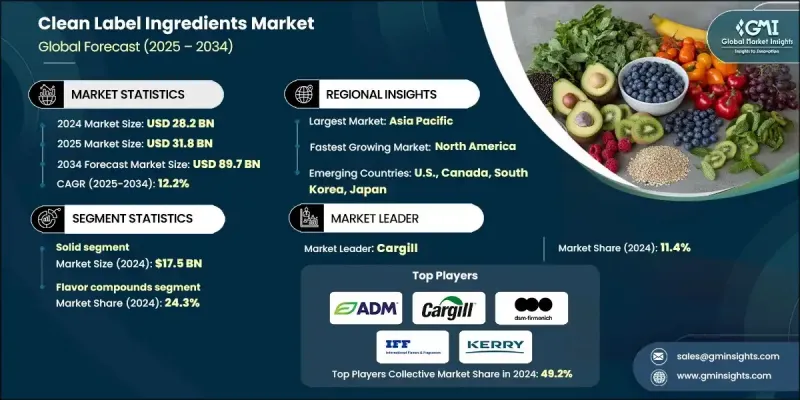
세계의 클린 라벨 성분 시장은 2024년에 282억 달러로 평가되었고, 2034년까지 연평균 복합 성장률(CAGR) 12.2%로 성장하여 897억 달러에 이를 것으로 예측되고 있습니다.
시장의 급속한 성장은 투명성, 천연 유래, 최소한의 가공을 거친 식품에 대한 소비자의 강력한 수요에 기인합니다. 클린 라벨 성분란 인공첨가물, 색소, 방부제, 합성화학물질을 포함하지 않은 천연의 단순한 원료를 말합니다. 안전과 건강을 중시하는 건강 지향적 소비자를 중심으로 깨끗하고 추적 가능한 식품 공급원에 대한 선호가 중요한 구매 요인으로 작용하고 있습니다. 전 세계적인 건강 지향적 트렌드와 식품 첨가물 및 표시 관련 정부 규제 강화가 맞물려 합성 원료에서 천연 유래 대체 원료로의 전환을 촉진하고 있습니다. 제조업체들은 변화하는 소비자의 기대와 지속가능성 목표에 부합하기 위해 유기농, 식물성, 비GMO 원료를 사용한 제품 재설계에 박차를 가하고 있습니다. 또한, 천연 추출 및 발효 기술의 발전으로 풍미, 기능성, 보존성을 손상시키지 않고 보다 깨끗하고 안정적인 원료 프로파일을 구현할 수 있게 되었습니다. 이러한 복합적인 트렌드, 건강에 대한 인식 증가, 규제의 진화, 천연 가공 기술의 혁신이 결합되어 세계 클린 라벨 성분 시장이 재편되고 있습니다.
시장 범위
개시 연도
2024년
예측 기간
2025-2034년
시작 금액
282억 달러
예측 금액
897억 달러
CAGR
12.2%
고체 형태 부문은 2024년 175억 달러의 매출을 기록했습니다. 분말 단백질, 과립형 방부제, 결정성 감미료, 탈수된 향미 화합물 등의 고체 원료는 안정성, 취급 용이성, 식품 제조 공정 전반에 걸친 적응성 때문에 주류가 되었습니다. 이러한 형태는 제조업체에게 장기 보존성, 정확한 복용량 관리, 대규모 식품 생산 시스템과의 원활한 통합을 제공합니다. 베이커리, 제과, 가공식품 카테고리와 같은 주요 응용 분야에서는 고형 원료가 일관성과 풍미를 유지하는 데 중요한 역할을 하기 때문에 수요가 지속적으로 높은 수준을 유지하고 있습니다.
2024년 기준, 향료 화합물이 24.3%의 점유율을 차지했습니다. 식물, 과일, 채소, 허브에서 추출한 천연 향료는 인공 첨가물을 사용하지 않고 복잡하고 진정한 맛을 구현하고자 하는 음료의 배합에 필수적인 요소로 자리 잡고 있습니다. 소비자들이 천연 향료를 품질, 안전성, 감각적 만족감과 연관 짓는 경향이 강해지면서 에센셜 오일, 발효유래 화합물, 식물 추출물의 사용이 빠르게 확대되고 있습니다.
북미 클린 라벨 성분 시장은 최소한의 가공을 거친 자연스럽고 투명한 원료를 찾는 소비자 선호에 힘입어 2025년부터 2034년까지 연평균 12.4%의 성장률을 보일 것으로 예측됩니다. 이 지역 시장 성장은 건강, 웰빙, 지속가능성을 중시하는 주요 브랜드에서 클린 라벨 배합을 채택하는 사례가 증가함에 따라 뒷받침되고 있습니다. 천연 보존 기술, 추출 기술, 배합 기술의 혁신을 통해 제품의 성능 향상과 순도 유지를 동시에 실현하고 있습니다. 또한, 기업들은 지속 가능한 조달을 우선시하고 재생 가능한 원료에 대한 투자를 확대하는 한편, 유기농 원료의 유형을 확대함으로써 소비자의 기대와 규제 기준에 대응하고 있습니다.
세계 클린 라벨 성분 시장에서 활동하는 주요 기업으로는 A&B Ingredients, Cargill, DSM-Firmenich, Limagrain Ingredients, Kerry Group, ADM, Ingredion, Corbion, International Flavors & Fragrances Inc. (IFF), Brisan Group, Tate & Lyle, and Novozymes 등이 있습니다. 주요 시장 기업들은 클린 라벨 성분 시장에서 입지를 강화하기 위해 다양한 전략을 채택하고 있습니다. 여기에는 식품 제조업체와의 전략적 제휴, 지역 생산 시설 확장, 제품 포트폴리오 확장을 위한 틈새 천연 원료 기업 인수 등이 포함됩니다. 지속적인 연구개발 투자를 통해 기업은 진화하는 소비자 트렌드에 대응하는 혁신적이고 지속 가능한 클린라벨 제제를 도입할 수 있게 되었습니다.
목차
제1장 조사 방법과 범위
제2장 주요 요약
제3장 업계 인사이트
생태계 분석
공급업체 상황
이익률
각 단계 부가가치
밸류체인에 영향을 미치는 요인
파괴적 변화
업계에 대한 영향요인
성장 촉진요인
업계의 잠재적 리스크&과제
시장 기회
성장 가능성 분석
규제 상황
북미
유럽
아시아태평양
라틴아메리카
중동 및 아프리카
Porter's Five Forces 분석
PESTEL 분석
기술과 혁신 상황
현재 기술 동향
신기술
가격 동향
지역별
제품별
향후 시장 동향
특허 상황
무역 통계(HS코드)(주 : 무역 통계는 주요 국가에 한해 제공됩니다)
주요 수입국
주요 수출국
지속가능성과 환경면
지속가능한 대처
폐기물 감축 전략
생산 에너지 효율
친환경 이니셔티브
탄소발자국 고려
제4장 경쟁 구도
서론
기업의 시장 점유율 분석
지역별
북미
유럽
아시아태평양
라틴아메리카
중동 및 아프리카
기업 매트릭스 분석
주요 시장 기업의 경쟁 분석
경쟁 포지셔닝 매트릭스
주요 발전
인수합병(M&A)
제휴 및 협업
신제품 발매
사업 확대 계획
제5장 시장 추산·예측 : 형태별, 2021-2034
주요 동향
고형
분말 및 과립
결정 및 플레이크 상태
정제 및 압축제
액체
용액 및 시럽
에멀전 및 현탁액
농축액
반고체
페이스트 및 농축물
겔 및 점성 용액
왁스 및 고체 분산체
제6장 시장 추산·예측 : 카테고리별, 2021-2034
주요 동향
보존료 및 항균제
유기산(구연산, 아세트산, 젖산)
정유 화합물
식물 추출물 유래 항산화제
소금 및 미네랄계 보존료
착색료·안료
안토시아닌 및 베타레인
카로티노이드 및 잔토필
클로로필 유도체
광물 및 점토계 착색료
향료(Flavor) 화합물
정유 및 올레오레진
천연 향료 엑기스
식물 유래 방향제
미각 조정제 및 증강제
감미료
고감미도 감미료((stevia, monk fruit)
당 알코올(에리트리톨, 자일리톨)
희소 당류(알룰로오스, 타가토스)
천연당 대체품
단백질 및 아미노산
식물성 단백질 농축물
단백질 분리물 및 가수분해물
필수 아미노산 블렌드
생리활성 펩티드
질감 형성제
증점제
겔화제
안정화 시스템
고결 방지제
기타
제7장 시장 추산·예측 : 최종 이용 산업별, 2021-2034
주요 동향
음료 업계
무알코올 음료
주류
기능성 음료 및 스포츠 드링크
유제품 베이스 음료
식품 제조
베이커리 및 시리얼 제품
제과 및 스위트
가공식품 및 레토르트 식품
스낵 및 컨비니언스 제품
유제품 및 대체품 산업
전통 유제품
식물 유래 유제품 대체품
발효유 제품
냉동 유제품 디저트
고기 및 단백질 산업
가공 육류
식물 유래 고기 대체품
수산물 및 해양 제품
프로테인 보충제 및 바
전문 영양
유아용 영양 식품
임상 및 의료 영양
스포츠 및 퍼포먼스 영양
고령자용 영양
외식산업·케이터링
레스토랑 및 패스트푸드 체인
시설용 케이터링
식품 원료 공급
기타
제8장 시장 추산·예측 : 지역별, 2021-2034
주요 동향
북미
미국
캐나다
유럽
독일
영국
프랑스
스페인
이탈리아
기타 유럽
아시아태평양
중국
인도
일본
호주
한국
기타 아시아태평양
라틴아메리카
브라질
멕시코
아르헨티나
기타 라틴아메리카
중동 및 아프리카
사우디아라비아
남아프리카공화국
아랍에미리트(UAE)
기타 중동 및 아프리카
제9장 기업 개요
A&B Ingredients
ADM
Brisan Group
Cargill
Corbion
DSM-Firmenich
Ingredion
International Flavors &Fragrances Inc.(IFF)
Kerry Group
Limagrain Ingredients
Novozymes
Tate &Lyle
LSH
영문 목차
영문목차
The Global Clean Label Ingredients Market was valued at USD 28.2 billion in 2024 and is estimated to grow at a CAGR of 12.2% to reach USD 89.7 billion by 2034.
The market's rapid growth is attributed to the strong consumer demand for transparency, natural sourcing, and minimally processed food products. Clean label ingredients refer to natural and simple ingredients that are free from artificial additives, colors, preservatives, and synthetic chemicals. The preference for clean and traceable food sources has become a significant purchasing factor, especially among health-conscious consumers who prioritize safety and wellness. Global trends toward healthier eating habits, coupled with stricter government regulations regarding food additives and labeling, are encouraging the transition from synthetic ingredients to naturally derived alternatives. Manufacturers are increasingly reformulating products with organic, plant-based, and non-GMO ingredients to align with evolving consumer expectations and sustainability goals. In addition, technological advances in natural extraction and fermentation are enabling cleaner, more stable ingredient profiles without compromising flavor, functionality, or shelf life. These combined trends, health awareness, regulatory evolution, and innovation in natural processing are reshaping the global clean label ingredient landscape.
Market Scope
Start Year
2024
Forecast Year
2025-2034
Start Value
$28.2 Billion
Forecast Value
$89.7 Billion
CAGR
12.2%
The solid form segment generated USD 17.5 billion in 2024. Solid ingredients such as powdered proteins, granulated preservatives, crystalline sweeteners, and dehydrated flavor compounds dominate due to their stability, easy handling, and adaptability across food manufacturing processes. These forms provide manufacturers with extended shelf life, precise dosing control, and seamless integration into large-scale food production systems. Demand remains high across key applications, including bakery, confectionery, and processed food categories, where solid ingredients play a vital role in maintaining consistency and taste.
The flavor compounds segment captured 24.3% share in 2024. Natural flavoring agents sourced from botanicals, fruits, vegetables, and herbs are becoming indispensable for food and beverage formulations that aim to achieve complex and authentic taste profiles without artificial additives. The use of essential oils, fermentation-derived compounds, and plant-based extracts is expanding rapidly as consumers increasingly associate natural flavor with quality, safety, and sensory satisfaction.
North America Clean Label Ingredients Market is expected to record a CAGR of 12.4% between 2025 and 2034, driven by consumer preference for minimally processed, natural, and transparent ingredients. The region's market growth is supported by the rising adoption of clean label formulations across leading brands that focus on health, wellness, and sustainability. Technological innovations in natural preservation, extraction, and formulation are improving product performance while maintaining purity. Moreover, companies are prioritizing sustainable sourcing, investing in renewable raw materials, and expanding organic ingredient portfolios to meet consumer expectations and regulatory standards.
Leading companies operating in the Global Clean Label Ingredients Market include A&B Ingredients, Cargill, DSM-Firmenich, Limagrain Ingredients, Kerry Group, ADM, Ingredion, Corbion, International Flavors & Fragrances Inc. (IFF), Brisan Group, Tate & Lyle, and Novozymes. Key market players are adopting a range of strategies to strengthen their foothold in the Clean Label Ingredients Market. These include strategic partnerships with food manufacturers, expansion of regional production facilities, and acquisition of niche natural ingredient companies to broaden product portfolios. Continuous investment in research and development allows firms to introduce innovative and sustainable clean-label formulations that cater to evolving consumer trends.
Table of Contents
Chapter 1 Methodology & Scope
1.1 Market scope and definition
1.2 Research design
1.2.1 Research approach
1.2.2 Data collection methods
1.3 Data mining sources
1.3.1 Global
1.3.2 Regional/Country
1.4 Base estimates and calculations
1.4.1 Base year calculation
1.4.2 Key trends for market estimation
1.5 Primary research and validation
1.5.1 Primary sources
1.6 Forecast model
1.7 Research assumptions and limitations
Chapter 2 Executive Summary
2.1 Industry 360° synopsis
2.2 Key market trends
2.2.1 Form trends
2.2.2 Category trends
2.2.3 End Use industry trends
2.2.4 Regional trends
2.3 TAM Analysis, 2025-2034
2.4 CXO perspectives: strategic imperatives
2.4.1 Executive decision points
2.4.2 Critical success factors
2.5 Future outlook and strategic recommendations
Chapter 3 Industry Insights
3.1 Industry ecosystem analysis
3.1.1 Supplier landscape
3.1.2 Profit margin
3.1.3 Value addition at each stage
3.1.4 Factor affecting the value chain
3.1.5 Disruptions
3.2 Industry impact forces
3.2.1 Growth drivers
3.2.1.1 Rising consumer demand for transparency & natural ingredients
3.2.1.2 Regulatory push for cleaner labels & reduced synthetic additives
3.2.1.3 Health & wellness trends driving premium product demand
3.2.2 Industry pitfalls and challenges
3.2.2.1 Higher costs of natural vs synthetic ingredients
3.2.2.2 Technical challenges in maintaining product functionality
3.2.3 Market opportunities
3.2.3.1 Emerging applications in plant-based & alternative proteins
3.2.3.2 Advanced processing technology adoption
3.3 Growth potential analysis
3.4 Regulatory landscape
3.4.1 North America
3.4.2 Europe
3.4.3 Asia Pacific
3.4.4 Latin America
3.4.5 Middle East & Africa
3.5 Porter's analysis
3.6 PESTEL analysis
3.7 Technology and Innovation landscape
3.7.1 Current technological trends
3.7.2 Emerging technologies
3.8 Price trends
3.8.1 By region
3.8.2 By product
3.9 Future market trends
3.10 Patent landscape
3.11 Trade statistics (HS code)( Note: the trade statistics will be provided for key countries only)
3.11.1 Major importing countries
3.11.2 Major exporting countries
3.12 Sustainability and environmental aspects
3.12.1 Sustainable practices
3.12.2 Waste reduction strategies
3.12.3 Energy efficiency in production
3.12.4 Eco-friendly initiatives
3.13 Carbon footprint consideration
Chapter 4 Competitive Landscape, 2024
4.1 Introduction
4.2 Company market share analysis
4.2.1 By region
4.2.1.1 North America
4.2.1.2 Europe
4.2.1.3 Asia Pacific
4.2.1.4 LATAM
4.2.1.5 MEA
4.3 Company matrix analysis
4.4 Competitive analysis of major market players
4.5 Competitive positioning matrix
4.6 Key developments
4.6.1 Mergers & acquisitions
4.6.2 Partnerships & collaborations
4.6.3 New product launches
4.6.4 Expansion plans
Chapter 5 Market Estimates and Forecast, By Form, 2021-2034 (USD Billion) (Kilo Tons)
5.1 Key trends
5.2 Solid
5.2.1 Powder & granular
5.2.2 Crystalline & flake
5.2.3 Tablet & compressed forms
5.3 Liquid
5.3.1 Solutions & syrups
5.3.2 Emulsions & suspensions
5.3.3 Concentrated liquids
5.4 Semi-solid
5.4.1 Pastes & concentrates
5.4.2 Gels & viscous solutions
5.4.3 Wax & solid dispersions
Chapter 6 Market Estimates and Forecast, By Category, 2021-2034 (USD Billion) (Kilo Tons)