전기자동차용 반도체 시장 : 기회, 성장 요인, 업계 동향 분석 및 예측(2025-2034년)
Electric Vehicle Semiconductors Market Opportunity, Growth Drivers, Industry Trend Analysis, and Forecast 2025 - 2034
상품코드:1871132
리서치사:Global Market Insights Inc.
발행일:2025년 10월
페이지 정보:영문 180 Pages
라이선스 & 가격 (부가세 별도)
ㅁ Add-on 가능: 고객의 요청에 따라 일정한 범위 내에서 Customization이 가능합니다. 자세한 사항은 문의해 주시기 바랍니다.
한글목차
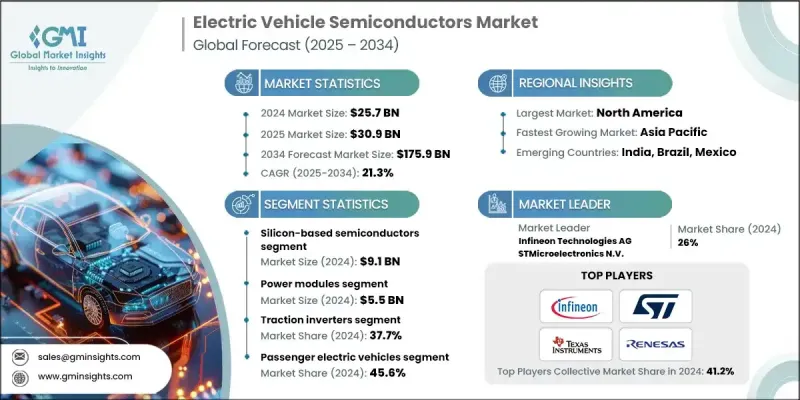
세계의 전기자동차용 반도체 시장은 2024년 257억 달러로 평가되었고, 2034년까지 연평균 복합 성장률(CAGR)은 21.3%를 나타낼 것으로 예측되며 1,759억 달러에 달할 전망입니다.
탄소 중립과 온실가스 배출 감축을 위한 글로벌 전환이 전기차(EV)의 광범위한 채택을 주도하면서 시장이 확대되고 있습니다. 전 세계 정부 및 규제 당국은 엄격한 배출 규제를 시행하는 동시에 전기차 사용 촉진을 위한 인센티브, 환급금 및 보조금을 도입하고 있습니다. 소비자들은 기존 내연기관 차량보다 지속 가능한 이동 수단을 점점 더 선호하며 수요를 더욱 부추기고 있습니다. 이러한 전기차 채택 급증은 전기차의 기술적 기반이 되는 첨단 반도체에 대한 수요를 가속화시켰습니다. 이들은 효율적인 파워트레인 제어, 에너지 최적화, 인포테인먼트 및 안전 시스템을 가능하게 합니다. 지속가능성 요구사항은 전기차 생태계 내 반도체 혁신을 주도하는 주요 동력이 되었습니다. 업계는 기존 실리콘 기반 반도체에서 실리콘 카바이드(SiC) 및 갈륨 나이트라이드(GaN)와 같은 차세대 소재로의 주요 전환을 겪고 있습니다. 이러한 광대역갭 반도체는 우수한 에너지 효율, 빠른 스위칭, 향상된 열 관리 기능을 제공하여 전기차의 고출력 작동을 처리하는 데 필수적입니다. 차량 전력 시스템을 더 소형화, 경량화, 효율화할 수 있는 능력은 주행 거리, 충전 속도 및 전반적인 성능을 향상시킵니다. 자동차 제조사와 반도체 기업들은 기존 소재를 대체하기 위해 SiC 및 GaN 기술을 신속히 통합하여 경쟁 우위를 강화하고 진화하는 글로벌 전기차 수요에 대응하고 있습니다.
시장 범위
시작 연도
2024년
예측 연도
2025-2034년
시작 금액
257억 달러
예측 금액
1,759억 달러
CAGR
21.3%
실리콘 기반 반도체 부문은 2024년 91억 달러의 매출을 기록했습니다. 이 부문의 강력한 입지는 확립된 글로벌 제조 역량에 기반한 실리콘 기술의 성숙도와 비용 효율성에 기인합니다. 이러한 반도체는 신뢰성 있는 성능, 확장성 및 기존 자동차 시스템과의 호환성을 제공하여 대량 생산되는 전기차 모델의 선호 옵션으로 자리매김하고 있습니다. 전력 관리 시스템 및 차량 제어 장치에서의 광범위한 사용은 전기차 산업이 확장됨에 따라 시장적 중요성을 지속적으로 강화하고 있습니다.
전력 모듈 부문은 2024년 55억 달러의 매출을 기록했습니다. 전력 모듈에 대한 수요는 에너지 변환 및 열 조절을 향상시키는 소형 고효율 패키지로 여러 전력 장치를 통합할 수 있는 능력에서 비롯됩니다. 이 기능은 하이브리드 및 완전 전기차 모두에서 전기 구동계, 충전 시스템 및 인버터에 전력을 공급하는 데 필수적입니다. 시스템 신뢰성 향상과 열 손실 감소에 대한 지속적인 관심은 전력 모듈을 전기차 반도체 혁신의 최전선에 위치하게 합니다.
미국의 전기자동차용 반도체 시장은 2034년까지 연평균 복합 성장률(CAGR) 21.8%로 확대될 전망입니다. 연방 및 주 차원의 인센티브, 전기차 의무화 정책, 소비자 채택 증가가 성장을 강력히 뒷받침합니다. 국내 자동차 제조사들은 구동계 효율성, 성능 컴퓨팅, 자율주행 통합을 강화하기 위해 SiC 기반 파워 칩을 점점 더 많이 도입하고 있습니다. 미국은 또한 CHIPS 법에 의해 지원되는 현지 반도체 생산의 혜택을 누리며, 이는 혁신과 공급망 회복탄력성을 촉진합니다. 자동차 제조사, 반도체 기업, 기술 공급업체 간의 협업은 배터리 관리 시스템, 자율 주행 프로세서, 고성능 충전 모듈 부문의 차세대 발전을 주도하며, EV 생태계 내 지속적인 경쟁력을 보장하고 있습니다.
전기자동차용 반도체 시장의 주요 기업으로는 Wolfspeed, Inc., NXP Semiconductors N.V., STMicroelectronics N.V., Texas Instruments Inc., Infineon Technologies AG, Microchip Technology Inc., Analog Devices, Inc., Renesas Electronics Corporation, ON Semiconductor Corporation, Power Integrations, Inc., Melexis N.V., Monolithic Power Systems, Inc., ROHM Co., Ltd., Toshiba Electronic Devices & Storage, Allegro MicroSystems, Inc., ams OSRAM AG, StarPower Semiconductor Ltd., Samsung Semiconductor, Inc., Sanken Electric Co., Ltd., BYD Semiconductor Co., Ltd. 등이 있습니다. 전기차 반도체 시장의 선도 기업들은 경쟁 우위를 강화하고 기술적 영향력을 확대하기 위한 전략적 계획을 시행하고 있습니다. 이들은 SiC 및 GaN과 같은 광대역갭 소재의 발전을 가속화하기 위해 연구개발 투자를 확대하며, 더 높은 성능과 에너지 효율을 목표로 하고 있습니다. 기업들은 새로운 전기차 플랫폼 전반에 걸쳐 반도체 통합을 확보하기 위해 자동차 OEM 업체들과 장기 공급 파트너십을 체결하고 있습니다. 정부 정책의 지원을 받는 제조 현지화는 공급 안정성과 비용 경쟁력을 강화하고 있습니다.
목차
제1장 조사 방법과 범위
제2장 주요 요약
제3장 업계 인사이트
생태계 분석
공급자의 상황
이익률
비용 구조
각 단계에서의 부가가치
밸류체인에 영향을 주는 요인
혁신
업계에 미치는 영향요인
성장 촉진요인
세계의 지속가능성 목표에 따른 전기차(EV)의 급속한 보급
전력 전자 기술 발전(SiC 및 GaN 기술)
전기화를 위한 정부 인센티브 및 규제 의무
자율주행 및 커넥티드 전기차에 대한 수요 증가
전기자동차 충전 인프라 확충
업계의 잠재적 억제요인 및 과제
첨단 반도체의 높은 제조 및 연구개발 비용
세계의 공급망 제약 및 반도체 부족
성장 가능성 분석
규제 상황
북미
유럽
아시아태평양
라틴아메리카
중동 및 아프리카
Porter's Five Forces 분석
PESTEL 분석
기술과 혁신의 상황
현재의 기술 동향
신흥기술
가격 동향
과거 가격 분석(2021-2024년)
가격 동향의 요인
지역별 가격 변동
가격 예측(2025-2034년)
가격 전략
신흥 비즈니스 모델
규정 준수 요건
지속가능성 대책
지속 가능한 재료의 평가
탄소발자국 분석
순환형 경제의 도입
지속가능성 인증 및 기준
지속가능성 ROI 분석
세계 소비자 의식 분석
특허 분석
제4장 경쟁 구도
소개
기업의 시장 점유율 분석
지역별
북미
유럽
아시아태평양
라틴아메리카
중동 및 아프리카
시장 집중도 분석
주요 기업의 경쟁 벤치마킹
재무실적 비교
수익
이익률
연구개발
제품 포트폴리오 비교
제품 라인의 폭
기술
혁신
지역별 프레즌스 비교
세계 전개 분석
서비스 네트워크 커버리지
지역별 시장 침투율
경쟁 포지셔닝 매트릭스
선도 기업
도전 기업
추종 기업(Followers)
틈새 시장 기업(Niche players)
전략적 전망 매트릭스
주요 발전(2021-2024년)
합병 및 인수
제휴 및 협력 관계
기술 발전
확대 및 투자 전략
지속가능성에 대한 노력
디지털 전환의 대처
신흥/스타트업 경쟁의 정세
제5장 시장 추계 및 예측 : 기술 유형별(2021-2034년)
주요 동향
실리콘 기반 반도체
실리콘 카바이드(SiC) 반도체
갈륨 나이트라이드(GaN) 반도체
초광대역갭 반도체
제6장 시장 추계 및 예측 : 제품 유형별(2021-2034년)
주요 동향
전력 모듈
개별 전력 장치
전원 관리 IC
마이크로컨트롤러 및 프로세서
센서 IC
게이트 드라이버 IC
통신 및 인터페이스 IC
메모리 & 스토리지 IC
기타
제7장 시장 추계 및 예측 : 용도별(2021-2034년)
주요 동향
트랙션 인버터
온보드 충전기(OBC)
DC-DC 컨버터
무선 전력 전송
초급속 충전 시스템
기타
제8장 시장 추계 및 예측 : 최종 용도별(2021-2034년)
주요 동향
승용 전기자동차
상용 전기자동차
특수용도 전기자동차
EV 충전 인프라
기타
제9장 시장 추계 및 예측 : 지역별(2021-2034년)
주요 동향
북미
미국
캐나다
유럽
독일
영국
프랑스
스페인
이탈리아
네덜란드
아시아태평양
중국
인도
일본
호주
한국
라틴아메리카
브라질
멕시코
아르헨티나
중동 및 아프리카
사우디아라비아
남아프리카
아랍에미리트(UAE)
제10장 기업 프로파일
Allegro MicroSystems, Inc.
Alpha and Omega Semiconductor Ltd.
ams OSRAM AG
Analog Devices, Inc.
BYD Semiconductor Co., Ltd.
Diodes Incorporated
Infineon Technologies AG
IXYS Corporation
Melexis NV
Microchip Technology Inc.
Monolithic Power Systems, Inc.
NXP Semiconductors NV
ON Semiconductor Corporation
Power Integrations, Inc.
Powerex, Inc.
Qorvo, Inc.
Renesas Electronics Corporation
ROHM Co., Ltd.
Samsung Semiconductor, Inc.
Sanken Electric Co., Ltd.
StarPower Semiconductor Ltd.
STMicroelectronics NV
Texas Instruments Inc.
Toshiba Electronic Devices &Storage
Wolfspeed, Inc.
HBR
영문 목차
영문목차
The Global Electric Vehicle Semiconductors Market was valued at USD 25.7 Billion in 2024 and is estimated to grow at a CAGR of 21.3% to reach USD 175.9 Billion by 2034.
The market is expanding as the global shift toward carbon neutrality and lower greenhouse gas emissions drives widespread adoption of electric vehicles (EVs). Governments and regulatory authorities worldwide are enforcing strict emission regulations while introducing incentives, rebates, and subsidies to promote EV usage. Consumers increasingly prefer sustainable mobility alternatives over traditional combustion vehicles, further boosting demand. This surge in EV adoption has led to an accelerated requirement for advanced semiconductors, which serve as the technological backbone of electric vehicles. They enable efficient powertrain control, energy optimization, infotainment, and safety systems. Sustainability mandates have become a primary force shaping semiconductor innovation within the EV ecosystem. The industry is undergoing a major transition from conventional silicon-based semiconductors to next-generation materials such as silicon carbide (SiC) and gallium nitride (GaN). These wide-bandgap semiconductors provide superior energy efficiency, faster switching, and improved thermal management, essential for handling high-power operations in EVs. Their ability to make vehicle power systems more compact, lightweight, and efficient enhances range, charging speed, and overall performance. Automakers and semiconductor companies are rapidly integrating SiC and GaN technologies to replace legacy materials, increasing their competitive advantage and addressing the evolving global EV demand.
Market Scope
Start Year
2024
Forecast Year
2025-2034
Start Value
$25.7 Billion
Forecast Value
$175.9 Billion
CAGR
21.3%
The silicon-based semiconductors segment generated USD 9.1 Billion in 2024. The strong position of this segment is attributed to the maturity and cost-efficiency of silicon technology, supported by established global manufacturing capabilities. These semiconductors deliver reliable performance, scalability, and compatibility with current automotive systems, making them the preferred option for mass-produced EV models. Their extensive use in power management systems and vehicle control units continues to strengthen their market relevance as the EV industry scales.
The power modules segment generated USD 5.5 Billion in 2024. The demand for power modules stems from their ability to consolidate multiple power devices into compact, high-efficiency packages that enhance energy conversion and thermal regulation. This functionality is vital for powering electric drivetrains, charging systems, and inverters in both hybrid and fully electric vehicles. The continuous focus on achieving higher system reliability and reducing thermal losses keeps power modules at the forefront of EV semiconductor innovation.
U.S. Electric Vehicle Semiconductors Market will grow at a CAGR of 21.8% by 2034. Growth is strongly supported by federal and state-level incentives, EV mandates, and growing consumer adoption. Domestic automakers increasingly incorporate SiC-based power chips to enhance drivetrain efficiency, performance computing, and autonomous driving integration. The U.S. also benefits from local semiconductor production supported by the CHIPS Act, fostering innovation and supply chain resilience. Collaboration among automakers, semiconductor firms, and technology providers is driving next-generation developments in battery management systems, autonomous processors, and high-performance charging modules, ensuring sustained competitiveness within the EV ecosystem.
Key players active in the Electric Vehicle Semiconductors Market include Wolfspeed, Inc., NXP Semiconductors N.V., STMicroelectronics N.V., Texas Instruments Inc., Infineon Technologies AG, Microchip Technology Inc., Analog Devices, Inc., Renesas Electronics Corporation, ON Semiconductor Corporation, Power Integrations, Inc., Melexis N.V., Monolithic Power Systems, Inc., ROHM Co., Ltd., Toshiba Electronic Devices & Storage, Allegro MicroSystems, Inc., ams OSRAM AG, StarPower Semiconductor Ltd., Samsung Semiconductor, Inc., Sanken Electric Co., Ltd., and BYD Semiconductor Co., Ltd. Leading companies in the Electric Vehicle Semiconductors Market are implementing strategic initiatives to reinforce their competitive edge and expand their technological footprint. They are increasing R&D investment to accelerate advancements in wide-bandgap materials like SiC and GaN, targeting higher performance and energy efficiency. Firms are entering long-term supply partnerships with automotive OEMs to secure semiconductor integration across new EV platforms. Localization of manufacturing, supported by government policies, is enhancing supply stability and cost competitiveness.
Table of Contents
Chapter 1 Methodology and Scope
1.1 Market scope and definition
1.2 Research design
1.2.1 Research approach
1.2.2 Data collection methods
1.3 Data mining sources
1.3.1 Global
1.3.2 Regional/Country
1.4 Base estimates and calculations
1.4.1 Base year calculation
1.4.2 Key trends for market estimation
1.5 Primary research and validation
1.5.1 Primary sources
1.6 Forecast model
1.7 Research assumptions and limitations
Chapter 2 Executive Summary
2.1 Industry snapshot
2.2 Key market trends
2.2.1 Packaging type trends
2.2.2 Material trends
2.2.3 Application trends
2.2.4 Regional
2.3 TAM Analysis, 2025-2034 (USD Billion)
2.4 CXO perspectives: Strategic imperatives
2.4.1 Executive decision points
2.4.2 critical success factors
2.5 Future outlook and strategic recommendations
Chapter 3 Industry Insights
3.1 Industry ecosystem analysis
3.1.1 Supplier Landscape
3.1.2 Profit Margin
3.1.3 Cost structure
3.1.4 Value addition at each stage
3.1.5 Factor affecting the value chain
3.1.6 Disruptions
3.2 Industry impact forces
3.2.1 Growth drivers
3.2.1.1 Rapid EV adoption driven by global sustainability goals
3.2.1.2 Advancements in power electronics (SiC & GaN technologies)
3.2.1.3 Government incentives and regulatory mandates for electrification
3.2.1.4 Growing demand for autonomous and connected EVs
3.2.1.5 Expansion of EV charging infrastructure
3.2.2 Industry pitfalls and challenges
3.2.2.1 High manufacturing and R&D costs of advanced semiconductors
3.2.2.2 Global supply chain constraints & chip shortages
3.3 Growth potential analysis
3.4 Regulatory landscape
3.4.1 North America
3.4.2 Europe
3.4.3 Asia Pacific
3.4.4 Latin America
3.4.5 Middle East & Africa
3.5 Porter's analysis
3.6 PESTEL analysis
3.7 Technology and innovation landscape
3.7.1 Current technological trends
3.7.2 Emerging technologies
3.8 Price trends
3.8.1 Historical price analysis (2021-2024)
3.8.2 Price trend drivers
3.8.3 Regional price variations
3.8.4 Price forecast (2025-2034)
3.9 Pricing strategies
3.10 Emerging business models
3.11 Compliance requirements
3.12 Sustainability measures
3.12.1 Sustainable materials assessment
3.12.2 Carbon footprint analysis
3.12.3 Circular economy implementation
3.12.4 Sustainability certifications and standards
3.12.5 Sustainability ROI analysis
3.13 Global consumer sentiment analysis
3.14 Patent analysis
Chapter 4 Competitive Landscape, 2024
4.1 Introduction
4.2 Company market share analysis
4.2.1 By region
4.2.1.1 North America
4.2.1.2 Europe
4.2.1.3 Asia Pacific
4.2.1.4 Latin America
4.2.1.5 Middle East & Africa
4.2.2 Market Concentration Analysis
4.3 Competitive benchmarking of key players
4.3.1 Financial performance comparison
4.3.1.1 Revenue
4.3.1.2 Profit margin
4.3.1.3 R&D
4.3.2 Product portfolio comparison
4.3.2.1 Product range breadth
4.3.2.2 Technology
4.3.2.3 Innovation
4.3.3 Geographic presence comparison
4.3.3.1 Global footprint analysis
4.3.3.2 Service network coverage
4.3.3.3 Market penetration by region
4.3.4 Competitive positioning matrix
4.3.4.1 Leaders
4.3.4.2 Challengers
4.3.4.3 Followers
4.3.4.4 Niche players
4.3.5 Strategic outlook matrix
4.4 Key developments, 2021-2024
4.4.1 Mergers and acquisitions
4.4.2 Partnerships and collaborations
4.4.3 Technological advancements
4.4.4 Expansion and investment strategies
4.4.5 Sustainability initiatives
4.4.6 Digital transformation initiatives
4.5 Emerging/ startup competitors landscape
Chapter 5 Market Estimates and Forecast, By Technology Type, 2021 - 2034 (USD Million)
5.1 Key trends
5.2 Silicon-based semiconductors
5.3 Silicon Carbide (SiC) semiconductors
5.4 Gallium Nitride (GaN) semiconductors
5.5 Ultra-wide bandgap semiconductors
Chapter 6 Market Estimates and Forecast, By Product Type, 2021 - 2034 (USD Million)
6.1 Key trends
6.2 Power modules
6.3 Discrete power devices
6.4 Power management ICs
6.5 Microcontrollers & processors
6.6 Sensor ICs
6.7 Gate driver ICs
6.8 Communication & interface ICs
6.9 Memory & storage ICs
6.10 Others
Chapter 7 Market Estimates and Forecast, By Application, 2021 - 2034 (USD Million)
7.1 Key trends
7.2 Traction inverters
7.3 Onboard Chargers (OBC)
7.4 DC-DC converters
7.5 Wireless power transfer
7.6 Ultra-fast charging systems
7.7 Others
Chapter 8 Market Estimates and Forecast, By End Use, 2021 - 2034 (USD Million)
8.1 Key trends
8.2 Passenger electric vehicles
8.3 Commercial electric vehicles
8.4 Specialized electric vehicles
8.5 EV charging infrastructure
8.6 Others
Chapter 9 Market Estimates and Forecast, By Region, 2021 - 2034 (USD Million)