자동차 엣지 컴퓨팅 게이트웨이 시장 : 기회, 성장 요인, 업계 동향 분석 및 예측(2025-2034년)
Automotive Edge Computing Gateway Market Opportunity, Growth Drivers, Industry Trend Analysis, and Forecast 2025 - 2034
상품코드:1871101
리서치사:Global Market Insights Inc.
발행일:2025년 10월
페이지 정보:영문 209 Pages
라이선스 & 가격 (부가세 별도)
ㅁ Add-on 가능: 고객의 요청에 따라 일정한 범위 내에서 Customization이 가능합니다. 자세한 사항은 문의해 주시기 바랍니다.
한글목차
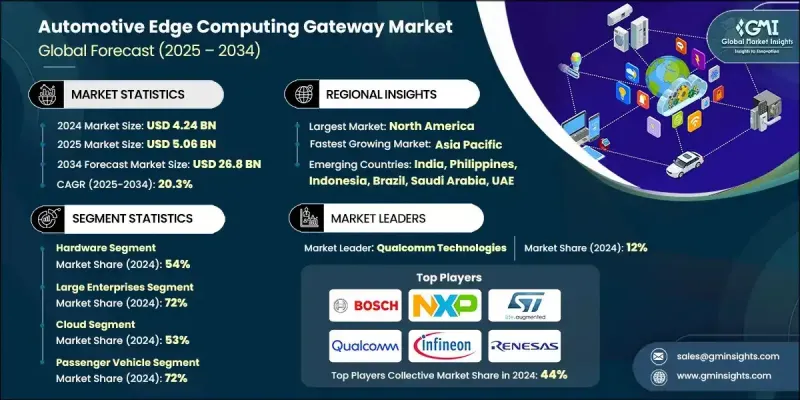
세계의자동차 엣지 컴퓨팅 게이트웨이 시장은 2024년에 42억 4,000만 달러로 평가되었고, 2034년까지 연평균 복합 성장률(CAGR)은 20.3%를 나타낼 것으로 예측되며 268억 달러에 달할 전망입니다.
시장 성장의 급증은 스마트 차량 내 전자 장치, 커넥티드 및 자율주행 차량의 통합 증가와 실시간 데이터 처리의 필요성에 의해 주도되고 있습니다. 더욱 엄격해진 안전 및 사이버 보안 규정, 첨단 운전자 보조 시스템(ADAS)의 급속한 도입, 전기차 및 소프트웨어 정의 차량으로의 전환이 수요를 가속화하는 핵심 요인입니다. 자동차 엣지 게이트웨이는 차량 내 핵심 컴퓨팅 노드 역할을 수행하며, 센서, 전자 제어 장치(ECU), 클라우드 플랫폼 간 원활한 데이터 교환을 지원함과 동시에 저지연, 고신뢰성, 안전한 통신을 보장합니다. 팬데믹은 반도체 공급망의 취약점을 드러내며, 현지화된 칩 제조, 엣지 컴퓨팅 인증, 복원력 있는 백업 시스템에 대한 투자를 촉발했습니다. 또한 커넥티드 모빌리티, 전기차, 지능형 차량 관리의 확장은 V2X(Vehicle-to-Everything) 통신 및 AI 기반 예측 분석을 가능하게 하는 엣지 컴퓨팅 장치에 대한 투자를 주도했습니다.
시장 범위
시작 연도
2024년
예측 연도
2025-2034년
시작 금액
42억 4,000만 달러
예측 금액
268억 달러
CAGR
20.3%
하드웨어 부문은 54%의 점유율을 차지했으며, 2034년까지 연평균 20.4%의 성장률을 보일 것으로 예상됩니다. 차량은 실시간 데이터 관리, ADAS 지원 및 자율 주행 기능 구현을 위해 고성능 컴퓨팅 부품에 점점 더 의존하고 있습니다. 마이크로컨트롤러, 시스템 온 칩(SoC) 모듈, 레이더 및 라이더 인터페이스 IC, GPU, AI 가속기는 방대한 센서 데이터를 즉시 처리하는 데 필요한 연산 능력을 제공합니다.
대기업 부문은 72%의 점유율을 차지했으며, 2025-2034년 연평균 복합 성장률(CAGR) 19.9%로 성장할 것으로 전망됩니다. 대기업들은 방대한 재정 자원, 선진적인 연구개발(R&D) 역량, 대규모 차량 군에 고성능 컴퓨팅 시스템을 통합할 수 있는 능력으로 주도적 위치를 차지하고 있습니다. 규모의 경제 효과 또한 이러한 기업들이 전 세계적으로 안전하고 확장 가능하며 고속의 엣지 컴퓨팅 솔루션을 배포할 수 있게 합니다.
미국의 자동차 엣지 컴퓨팅 게이트웨이 시장은 85%의 점유율을 차지했으며, 2024년에는 10억 9,000만 달러 시장 규모를 창출했습니다. 성장 동력은 센서, 카메라, 텔레매틱스 시스템에서 발생하는 방대한 데이터 스트림을 생성하는 커넥티드 및 자율주행 차량의 증가입니다. 엣지 컴퓨팅은 실시간 처리를 가능하게 하여 안전성 향상, 대역폭 최적화, 사용자 경험 개선에 핵심적 역할을 합니다. 자동차 제조사와 기술 공급업체들은 지연 시간 문제를 해결하고 신속한 의사 결정을 가능하게 하기 위해 점점 더 많은 엣지 게이트웨이를 도입하고 있습니다.
세계의 자동차 엣지 컴퓨팅 게이트웨이 시장의 주요 기업으로는 NXP, 인피니언, ST 마이크로 일렉트로닉스, 화웨이, 콘티넨탈, 보쉬, NVIDIA, 퀄컴, 덴소, 르네사스 일렉트로닉스 등이 있습니다. 자동차 엣지 컴퓨팅 게이트웨이 시장의 기업들은 혁신, 전략적 파트너십, 제품 다각화를 통해 시장 입지를 강화하고 있습니다. 커넥티드 및 자율주행 차량의 처리 능력 향상을 위해 AI 기반 엣지 플랫폼과 고성능 하드웨어에 대규모 투자를 진행 중입니다. 자동차 제조사 및 기술 공급업체와의 협력을 통해 확장 가능하고 안전한 엣지 솔루션의 도입이 가속화되고 있습니다. 또한 에너지 효율적인 컴퓨팅 모듈 연구개발에 주력하며 지연 시간과 대역폭 사용을 최적화하고 있습니다.
목차
제1장 조사 방법
시장 범위와 정의
조사 설계
조사 접근
데이터 수집 방법
데이터 마이닝 소스
세계
지역별/국가별
기본 추정치와 계산
기준연도 계산
시장 추정에서의 주요 동향
1차 조사 및 검증
1차 정보
예측 모델
조사의 전제조건과 제한 사항
제2장 주요 요약
제3장 업계 인사이트
생태계 분석
공급자의 상황
이익률 분석
비용 구조
각 단계에서의 부가가치
밸류체인에 영향을 주는 요인
혁신
업계에 미치는 영향요인
성장 촉진요인
커넥티드 및 자율주행 차량의 부상
V2X(Vehicle-to-Everything) 통신 확대
AI와 고급 분석의 통합
정부규제 및 안전기준
업계의 잠재적 억제요인 및 과제
높은 하드웨어 및 통합 비용
시스템 통합의 복잡성
시장 기회
전기자동차 및 스마트 차량의 급속한 보급
아시아태평양 신흥 시장
클라우드 및 반도체 제공업체와의 제휴
서비스형 엣지(EaaS) 모델
성장 가능성 분석
규제 상황
북미
유럽
아시아태평양
라틴아메리카
중동 및 아프리카
Porter's Five Forces 분석
PESTEL 분석
기술과 혁신의 상황
현재의 기술 동향
신흥기술
가격 동향
지역별
제품별
생산 통계
생산 거점
소비 허브
수출과 수입
코스트 내역 분석
특허 분석
지속가능성과 환경면
지속가능한 실천
폐기물 감축 전략
생산에서의 에너지 효율
환경에 배려한 대처
탄소발자국에 관한 고려 사항
중요한 업계의 갭과 과제점의 분석
기술적 통합상의 과제
레거시 시스템 통합의 복잡성
멀티 프로토콜 상호 운용성의 과제
실시간 성능 요건
경제적 및 사업적 장벽
도입 비용의 높이
ROI 불확실성과 회수기간에 대한 우려
비즈니스 모델 변혁의 과제
표준화와 규정 준수의 갭
범용 표준 및 API 부족
사이버 보안 규정 준수의 복잡성
크로스 벤더 상호 운용성의 과제
스킬 및 인력 부족의 분석
엣지 AI 및 머신러닝의 전문 지식 부족
자동차 소프트웨어 통합 스킬
사이버 보안 및 규정 준수 전문가
제4장 경쟁 구도
소개
기업의 시장 점유율 분석
북미
유럽
아시아태평양
라틴아메리카
중동 및 아프리카
주요 시장 기업의 경쟁 분석
경쟁 포지셔닝 매트릭스
전략적 전망 매트릭스
주요 발전
합병 및 인수
제휴 및 협력관계
신제품 발매
확대계획과 자금조달
제5장 시장 추계 및 예측 : 차량별(2021-2034년)
주요 동향
승용차
해치백 자동차
세단
SUV
MPV(다목적차)
상용차
소형 상용차(LCV)
중형 상용차(MCV)
대형 상용차(HCV)
제6장 시장 추계 및 예측 : 컴포넌트별(2021-2034년)
주요 동향
하드웨어
SoC 프로세서
마이크로컨트롤러
네트워크/통신 모듈
인터페이스 모듈/센서
기타
소프트웨어
OS
암호화 소프트웨어
OTA 및 진단 소프트웨어
기타
서비스
통합 서비스
유지보수 및 지원 서비스
컨설팅 및 맞춤형 서비스
규정 준수 서비스
제7장 시장 추계 및 예측 : 도입 형태별(2021-2034년)
주요 동향
온프레미스
클라우드
하이브리드
제8장 시장 추계 및 예측 : 용도별(2021-2034년)
주요 동향
자율주행
예측 유지보수
인포테인먼트 시스템
안전 시스템
차량 분석
기타
제9장 시장 추계 및 예측 : 기업 규모별(2021-2034년)
주요 동향
중소기업
대기업
제10장 시장 추계 및 예측 : 지역별(2021-2034년)
주요 동향
북미
미국
캐나다
유럽
독일
영국
프랑스
이탈리아
스페인
러시아
북유럽 국가
아시아태평양
중국
인도
일본
호주
한국
필리핀
인도네시아
싱가포르
라틴아메리카
브라질
멕시코
아르헨티나
중동 및 아프리카
남아프리카
사우디아라비아
아랍에미리트(UAE)
제11장 기업 프로파일
세계 기업
Amazon
AMD
Cisco
Huawei
Infineon
NVIDIA
NXP Semiconductors
Qualcomm Technologies
Renesas Electronics
STMicroelectronics
지역별 기업
Aptiv
Autotalks
Bosch
Continental
Denso Corporation
Mobileye
Siemens
Valeo
ZF Friedrichshafen
신흥 기업
BlackBerry Limited(QNX)
Hewlett Packard Enterprise(HPE)
HBR
영문 목차
영문목차
The Global Automotive Edge Computing Gateway Market was valued at USD 4.24 Billion in 2024 and is estimated to grow at a CAGR of 20.3% to reach USD 26.8 Billion by 2034.
The surge in market growth is driven by the increasing integration of smart in-vehicle electronics, connected and autonomous vehicles, and the need for real-time data processing. Stricter safety and cybersecurity regulations, rapid adoption of Advanced Driver Assistance Systems (ADAS), and the shift toward electric and software-defined vehicles are key factors accelerating demand. Automotive edge gateways serve as crucial computing nodes within vehicles, facilitating seamless data exchange between sensors, Electronic Control Units (ECUs), and cloud platforms, while ensuring low latency, high reliability, and secure communication. The pandemic exposed vulnerabilities in semiconductor supply chains, prompting investments in localized chip manufacturing, edge computing certifications, and resilient backup systems. Additionally, the expansion of connected mobility, electric vehicles, and intelligent fleet management has driven investments in edge computing units enabling Vehicle-to-Everything (V2X) communication and AI-powered predictive analytics.
Market Scope
Start Year
2024
Forecast Year
2025-2034
Start Value
$4.24 Billion
Forecast Value
$26.8 Billion
CAGR
20.3%
The hardware segment held a 54% share and is forecasted to grow at a CAGR of 20.4% through 2034. Vehicles increasingly depend on high-performance computing components to manage real-time data, support ADAS, and enable autonomous functionalities. Microcontrollers, system-on-chip (SoC) modules, radar and lidar interface ICs, GPUs, and AI accelerators provide the computational power needed to process vast sensor data instantly.
The large enterprises segment held a 72% share and is projected to grow at a CAGR of 19.9% during 2025-2034. Large organizations lead due to extensive financial resources, advanced R&D capabilities, and the ability to integrate high-performance computing systems across extensive vehicle fleets. Economies of scale also enable these companies to deploy secure, scalable, and high-speed edge computing solutions on a global scale.
U.S. Automotive Edge Computing Gateway Market held 85% share and generated USD 1.09 Billion in 2024. Growth is fueled by the rise of connected and autonomous vehicles, which produce significant data streams from sensors, cameras, and telematics systems. Edge computing enables real-time processing, critical for enhancing safety, optimizing bandwidth, and improving user experience. Automakers and technology providers are increasingly deploying edge gateways to address latency challenges and enable faster decision-making.
Key players in the Global Automotive Edge Computing Gateway Market include NXP, Infineon, STMicroelectronics, Huawei, Continental, Bosch, NVIDIA, Qualcomm, Denso, and Renesas Electronics. Companies in the Automotive Edge Computing Gateway Market are leveraging innovation, strategic partnerships, and product diversification to strengthen their market presence. They are investing heavily in AI-enabled edge platforms and high-performance hardware to enhance processing capabilities for connected and autonomous vehicles. Collaborations with automakers and technology providers are accelerating the deployment of scalable and secure edge solutions. Firms are also focusing on R&D for energy-efficient computing modules, optimizing latency and bandwidth usage.
Table of Contents
Chapter 1 Methodology
1.1 Market scope and definition
1.2 Research design
1.2.1 Research approach
1.2.2 Data collection methods
1.3 Data mining sources
1.3.1 Global
1.3.2 Regional/Country
1.4 Base estimates and calculations
1.4.1 Base year calculation
1.4.2 Key trends for market estimation
1.5 Primary research and validation
1.5.1 Primary sources
1.6 Forecast model
1.7 Research assumptions and limitations
Chapter 2 Executive Summary
2.1 Industry 3600 synopsis, 2021 - 2034
2.2 Key market trends
2.2.1 Regional
2.2.2 Component
2.2.3 Application
2.2.4 Deployment Mode
2.2.5 Vehicle
2.2.6 Enterprise Size
2.3 TAM Analysis, 2025-2034
2.4 CXO perspectives: Strategic imperatives
2.4.1 Executive decision points
2.4.2 Critical success factors
2.5 Future outlook and strategic recommendations
Chapter 3 Industry Insights
3.1 Industry ecosystem analysis
3.1.1 Supplier landscape
3.1.2 Profit margin analysis
3.1.3 Cost structure
3.1.4 Value addition at each stage
3.1.5 Factor affecting the value chain
3.1.6 Disruptions
3.2 Industry impact forces
3.2.1 Growth drivers
3.2.1.1 Rise of Connected and Autonomous Vehicles
3.2.1.2 Expansion of Vehicle-to-Everything (V2X) Communication
3.2.1.3 Integration of AI and Advanced Analytics
3.2.1.4 Government Regulations and Safety Standards.
3.2.2 Industry pitfalls & challenges
3.2.2.1 High Hardware and Integration Costs
3.2.2.2 Complexity of System Integration.
3.2.3 Market opportunities
3.2.3.1 Rapid Adoption in Electric and Smart Vehicles
3.2.3.2 Emerging Markets in Asia-Pacific
3.2.3.3 Partnerships with Cloud and Semiconductor Providers
3.2.3.4 Edge-as-a-Service (EaaS) Models
3.3 Growth potential analysis
3.4 Regulatory landscape
3.4.1 North America
3.4.2 Europe
3.4.3 Asia Pacific
3.4.4 Latin America
3.4.5 Middle East & Africa
3.5 Porter's analysis
3.6 PESTEL analysis
3.7 Technology and Innovation landscape
3.7.1 Current technological trends
3.7.2 Emerging technologies
3.8 Price trends
3.8.1 By region
3.8.2 By Products
3.9 Production statistics
3.9.1 Production hubs
3.9.2 Consumption hubs
3.9.3 Export and import
3.10 Cost breakdown analysis
3.11 Patent analysis
3.12 Sustainability and environmental aspects
3.12.1 Sustainable practices
3.12.2 Waste reduction strategies
3.12.3 Energy efficiency in production
3.12.4 Eco-friendly initiatives
3.12.5 Carbon footprint considerations
3.13 Critical industry gaps & pain points analysis
3.13.1 Technical integration challenges
3.13.1.1 Legacy system integration complexity
3.13.1.2 Multi-protocol interoperability issues
3.13.1.3 Real-time performance requirements
3.13.2 Economic & business barriers
3.13.2.1 High implementation costs
3.13.2.2 ROI uncertainty & payback period concerns