


세계의 플라스틱 포장 시장은 2024년 3,957억 달러로 평가되었으며, 2025-2034년 연평균 복합 성장률(CAGR) 3.8%로 확대될 것으로 예상됩니다.
플라스틱 포장 수요는 주요 산업, 특히 헬스케어 및 전자상거래의 급속한 확대로 인해 증가하고 있습니다. 의약품 분야는, 제품의 안전성과 수명을 확보하는 선진 포장 솔루션의 필요성을 촉진하고 있습니다. 의약품 및 의료기기에 대한 수요의 고조가 시장을 더욱 강화하고 있습니다. 또한 전자상거래에 대한 의존도 증가가 특히 출하 제품을 위한 가볍고 내구성 있는 보호 보장의 필요성을 부추기고 있습니다. 플렉시블 파우치 및 보호 필름은 그 강도와 높은 장벽성으로 인해 인기를 누리고 있어 디지털 소매 공간에 이상적입니다. 고리형 올레핀 폴리머(COP), 고리형 올레핀 코폴리머(COC), 폴리에틸렌 테레프탈레이트(PET) 등의 고성능 폴리머에 대한 개발 투자에 의해 경량이고 배리어성이 높은 포장 솔루션의 개발이 촉진될 것으로 기대되고 있습니다.
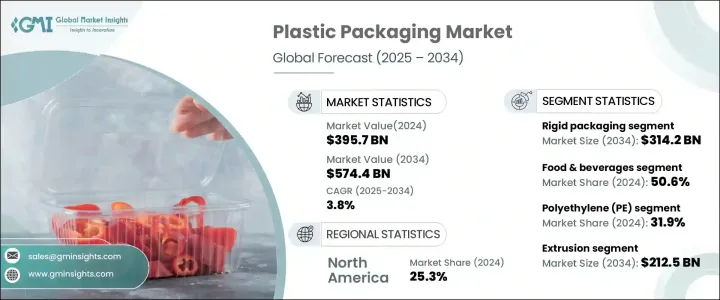
시장은 제품 유형별로 경질 포장과 연질 포장으로 분류됩니다. 경질 포장 분야는 2034년까지 3,142억 달러에 이를 것으로 예측되고 있으며, 지속가능성, 재활용 재료, 바이오 베이스 재료에 초점을 맞춘 기술 혁신이 진행되고 있습니다. 첨단 디자인은 재료 사용량을 줄이면서 내구성을 향상시키고 있습니다. 기업은 식품, 식음료, 헬스케어 등 다양한 업계에서 소비자와의 인터랙션을 강화하기 위해 스마트 포장 기술을 도입하고 있습니다.
| 시장 범위 | |
|---|---|
| 시작 연도 | 2024년 |
| 예측 연도 | 2025-2034년 |
| 시작 금액 | 3,957억 달러 |
| 예측 금액 | 5,744억 달러 |
| CAGR | 3.8% |
최종 용도에 따라 시장은 음식, 건강, 산업, 소비재, 기타 산업으로 구분됩니다. 2024년 점유율은 식음료가 50.6%를 차지했습니다. 기업은 안전성, 신선도 및 지속가능성을 우선시하고 있으며, 고배리어 성능의 소재가 인기를 끌고 있습니다. 리필 가능한 용기 및 재사용 가능한 용기는 규제기준 및 지속가능성 목표를 준수하기 위해 소비자 재생(PCR) 후 재료와 함께 점점 더 사용되고 있습니다.
시장은 소재별로 폴리에틸렌(PE), 폴리프로필렌(PP), 폴리에틸렌테레프탈레이트(PET), 폴리염화비닐(PVC), 폴리스티렌(PS), 바이오플라스틱, 기타로 나뉘어져 있습니다. 폴리에틸렌(PE)은 2024년 시장 점유율에서 31.9%를 차지했으며, 식품 포장에서는 여전히 지배적인 재료입니다. 수지 기술의 진보로 강도, 유연성 및 재활용성이 향상되고 있습니다. 제조사들은 지속가능성 목표를 달성하기 위해 재생 PE를 채택하고 있으며, 재활용성을 높이고 순환형 경제를 지원하기 위해 단일 소재 PE 패키징이 보급되고 있습니다.
기술별로는 사출성형, 압출성형, 블로우성형, 열성형, 기타 방법이 있습니다. 압출 성형 분야는 생산 프로세스의 진보로 효율이 향상되어 2034년까지 2,125억 달러에 달할 것으로 예측되고 있습니다. 개발업체는 압출 기술을 이용하여 우수한 장벽 특성을 가진 다층 필름 제품을 개발하고 있습니다.
2024년 플라스틱 포장 시장 점유율은 북미가 25.3%를 차지했습니다. 이 지역에서는, 환경 친화적이고 고성능인 포장 솔루션에 대한 수요가 강하고, 기업은 바이오 베이스나 소비자 재생(PCR) 후의 플라스틱에 투자하고 있습니다. 미국 시장에서만 2034년까지 1,198억 달러에 이를 것으로 예상되며, 이는 다양한 산업에서 비용 대비 효과가 높고 경량이며 재활용 가능한 재료에 대한 요구가 높아지고 있기 때문입니다.
The Global Plastic Packaging Market was valued at USD 395.7 billion in 2024 and is expected to expand at a 3.8% CAGR between 2025 and 2034. Demand for plastic packaging is increasing due to the rapid expansion of key industries, particularly healthcare and e-commerce. The pharmaceutical sector is driving the need for advanced packaging solutions that ensure product safety and longevity. Rising demand for medicines and medical equipment has further strengthened the market. Additionally, the increasing reliance on e-commerce has fueled the need for lightweight, durable, and protective packaging, particularly for shipped products. Flexible pouches and protective films have gained popularity due to their strength and high-barrier properties, making them ideal for the digital retail space. Investments in high-performance polymers, such as cyclic olefin polymers (COP), cyclic olefin copolymers (COC), and polyethylene terephthalate (PET), are expected to enhance the development of lightweight and high-barrier packaging solutions.

The market is categorized by product type into rigid and flexible packaging. The rigid packaging segment is projected to reach USD 314.2 billion by 2034, with innovations focused on sustainability, recycled content, and bio-based materials. Advanced designs are improving durability while reducing material usage. Companies are incorporating smart packaging technology to enhance consumer interaction in various industries, including food, beverage, and healthcare.
| Market Scope | |
|---|---|
| Start Year | 2024 |
| Forecast Year | 2025-2034 |
| Start Value | $395.7 Billion |
| Forecast Value | $574.4 Billion |
| CAGR | 3.8% |
Based on end-use, the market is segmented into food and beverages, healthcare, industrial, consumer goods, and other industries. The food and beverage industry accounted for a 50.6% share in 2024. Companies are prioritizing safety, freshness, and sustainability, with high-barrier performance materials gaining traction. Refillable and reusable containers, along with post-consumer recycled (PCR) materials, are increasingly used to comply with regulatory standards and sustainability targets.
The market is divided by material into polyethylene (PE), polypropylene (PP), polyethylene terephthalate (PET), polyvinyl chloride (PVC), polystyrene (PS), bioplastics, and others. Polyethylene (PE) held a 31.9% market share in 2024 and remains a dominant material in food packaging. Advances in resin technology have improved its strength, flexibility, and recyclability. Manufacturers are incorporating recycled PE to meet sustainability objectives, and mono-material PE packaging is becoming more prevalent to enhance recyclability and support a circular economy.
By technology, the market includes injection molding, extrusion, blow molding, thermoforming, and other methods. The extrusion segment is projected to reach USD 212.5 billion by 2034, with advancements in production processes improving efficiency. Manufacturers are using extrusion technology to develop multilayer film products with superior barrier properties.
North America accounted for a 25.3% share of the plastic packaging market in 2024. The region is experiencing strong demand for eco-friendly and high-performance packaging solutions, with companies investing in biobased and post-consumer recycled (PCR) plastics. The U.S. market alone is expected to reach USD 119.8 billion by 2034, driven by the increasing need for cost-effective, lightweight, and recyclable materials in various industries.