데이터센터, 마이크로그리드, 주택용 LDES(장기 에너지 저장) : 기술 동향 및 시장 전망(2026-2036년)
Long Duration Energy Storage for Datacenters, Microgrids, Houses: Technologies, Markets 2026-2036
상품코드:1880930
리서치사:Zhar Research
발행일:2025년 11월
페이지 정보:영문 394 Pages
라이선스 & 가격 (부가세 별도)
한글목차
지연 전력은 전력망 외에도 다양한 용도로 사용되고 있습니다. 이 보고서는 2046년까지 이 분야 시장 규모가 970억 달러에 달할 것으로 예측하고 있으며, 이는 신흥 LDES(장기 에너지 저장) 시장 전체의 36%를 차지할 것으로 예상하고 있습니다. 여기서 다루는 세계는 오프 그리드나 "Fringe of Grid"(그리드를 백업으로만 사용하는 경우가 드물게 있는 계통 주변부)를 포함하며, 요구 사양은 송전망용과는 크게 다릅니다. 송전망용보다 100배 많은 유닛이 필요한 반면, 각 유닛은 소형으로 설치 공간의 제약이 있고, 건물 내에서도 안전하고, 작은 설치 공간으로 적층이 가능하며, 원격지용으로 긴 수명과 고신뢰성이 요구됩니다. 본 보고서는 2046년 이전에 많은 솔라하우스에서 LDES가 대량으로 채택되고, 그 중 상당수가 Off-grid로 전환될 것으로 예측했습니다. 본 보고서는 총 10개의 장으로 구성되어 있으며, 17개의 SWOT 평가, 2026-2046년 24개의 예측 라인, 100개 이상의 기업 및 2025년까지의 연구 동향을 조사대상으로 하는 매우 정밀하게 조사된 보고서입니다.
Delayed electricity is needed for much more than grids. The new 451-page Zhar Research report, "Long Duration Energy Storage for Datacenters, Microgrids, Houses: Technologies, Markets 2026-2036" forecasts a $97 billion market for this in 2046, 36% of the total LDES market emerging. The requirements are very different in this world that includes off-grid and fringe-of-grid (only rare use of grid for backup). Expect 100 times the number needed for grids but smaller, space constrained units, variously safe even in buildings, stacked for small footprint and long-life, highly-reliable for remote locations. The authors even predict LDES in large numbers of solar houses before 2046, many off-grid. Unusually thorough, the report has 10 chapters, 17 SWOT appraisals, 24 forecast lines 2026-2046, examining over 100 companies and research advances through 2025.
The Executuve Summary and Conclusions (37 pages) is the quick read with the roadmap 2026-2046 in three lines - market, company, technology - 18 key conclusions, six of the SWOT appraisals and the 24 forecasts as tables and graphs with explanation. See many new infograms. Chapter 2. LDES Need and Design Principles (15 pages) is mostly graphics introducing stationary energy storage and LDES fundamentals, actual and proposed types of LDES, nine LDES technologies that can follow the market trend to longer duration with subsets compared. Learn how the off-grid solar house LDES is the toughest challenge but coming 2036-46, understand LDES metrics and LDES projects in 2025-6 with leading technology subsets for microgrid and similar applications. See scientific categories of LDES compared by 8 parameters, electrochemical LDES options compared but why most batteries will stay uncompetitive above 10-hour duration.
The report is balanced, realistic and independent so it has as Chapter 3. Microgrid LDES Escape Routes with 7 pages, mostly infograms and charts, covering the ways in which the demand for LDES in microgrids and similar applications down to houses will be reduced or avoided. That includes 2025 research advances including Home Energy Management Systems coping with intermittent supply.
Chapter 4. Advanced Pumped Hydro APHES (46 pages) combs through the many options avoiding pumping water up mountains. Here is pumping heavy, loaded water up mere hills, use of mines, the ocean and more. Many are suitable for the larger microgrid and similar applications but never solar buildings.
Chapter 5. Hydrogen H2ES and compressed air CAES for microgrid LDES (22 pages) examines these important options for grid LDES that are less impressive beyond but there are some microgrid projects appraised that use them. Learn the issues.
Chapter 6. Redox flow batteries RFB is 154 pages because this is currently the gold standard for microgrid and similar LDES, having the most installations, manufacturers and the strongest appropriate research pipeline, including for the more-compact hybrid RFBs. 45 manufacturers are appraised.
Chapter 7. Solid Gravity Energy Storage SGES has only 36 pages because it is a weaker contestant but five manufacturers examined and the various subsets have some prospects. Chapter 8. Advanced conventional construction batteries ACCB (48 pages) examines many emerging chemistries using conventional construction not flow battery principles. Much 2025 research is appraised. Many are fundamentally too expensive or too poor in certain performance parameters but there are possibilities too and successes to report.
Chapter 9. Liquefied Gas Energy Storage LGES: Liquid Air LAES or CO2 (43 pages) looks at this middle ground where extremely safe options using established technologies can provide LDES that has many competitive advantages for large microgrids and similar applications. LGES is more compact but pressurised carbon dioxide avoids the cryogenics. See appropriate projects, manufacturer intentions. The report then closes with Chapter 10. Thermal Energy Storage for Delayed Electricity ETES (22 pages). Delayed heat is a great success but there is less enthusiasm for thermally delayed electricity due to leakage, size and other issues. Nonetheless there is a project in Alaska and there are companies pursuing exotic forms such as thermophotovoltaics that are appraised. Learn the lessons of failures as well.
The Zhar Research report, "Long Duration Energy Storage for Datacenters, Microgrids, Houses: Technologies, Markets 2026-2036" is your essential reading for the latest research and balanced analysis of this large new opportunity. For these applications, it finds that redox flow batteries, liquid gas energy storage and some other options are the best compromises but different ones win at the extremes of AI datacenters and private houses 2026-2046.
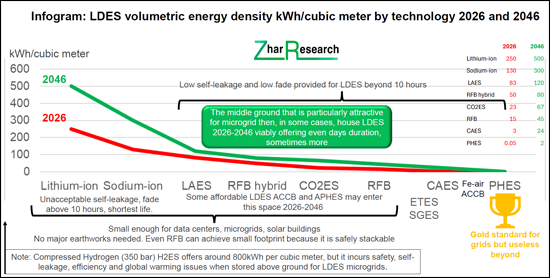
CAPTION: LDES volumetric energy density kWh/cubic meter by technology 2026 and 2046. Source: Zhar Research report, "Long Duration Energy Storage for Datacenters, Microgrids, Houses: Technologies, Markets 2026-2036".
Table of Contents
1. Executive summary and conclusions
1.1. Purpose and unique scope of this report
1.2. Methodology of this analysis
1.3. Examples of current beyond-grid LDES and similar
6.6. RFB technologies with research advances through 2025
6.6.1. Regular or hybrid, their chemistries and the main ones being commercialised
6.6.2. SWOT appraisals of regular vs hybrid options
6.7. Specific designs by material: vanadium, iron and variants, other metal ligand, halogen-based, organic, manganese with 2025 research, three SWOT appraisals
6.7.1. Vanadium RFB design and SWOT appraisal
6.7.2. All-iron and variants RFB design and SWOT appraisal
6.8. RFB manufacturer profiles
6.9. Further research in 2025
7. Solid gravity energy storage SGES
7.1. Overview including research in 2025
7.1.1. General
7.1.2. Three stages of operation
7.1.3. Three geometries
7.1.4. Pumped hydro gravity storage compared to the three SGES options
7.1.5. Basics
7.1.6. SWOT appraisal of solid gravity storage SGES for LDES
7.1.7. Parameter appraisal of solid gravity energy storage SGES for LDES
7.1.8. CAPEX challenge
7.1.9. Challenge of ongoing expenses
7.1.10. Possibility of pumping sand
7.1.11. Hydraulic piston lift instead of cable: 2025 modelling
7.1.12. Appraisal of other SGES research through 2025 and 2024
7.2. ARES USA
7.3. Energy Vault Switzerland, USA and China, India licensees
7.4. Gravitricity
7.5. Green Gravity Australia
7.6. SinkFloatSolutions France
8. Advanced conventional construction batteries ACCB