


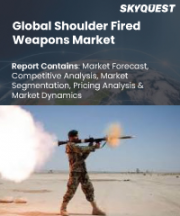
세계의 견착식 무기 시장 규모는 2024년에 75억 3,000만 달러로 평가되었으며, 2025년 78억 7,000만 달러에서 2033년까지 112억 달러로 성장할 전망입니다. 예측 기간(2026-2033년) 동안 CAGR은 4.5%로 예측됩니다.
견착식 무기 시장은 선진국과 신흥국 모두의 군사 예산 증가에 힘입어 견조한 성장세를 보이고 있습니다. 특히, 무거운 장비의 부담 없이 군부대의 작전상 유연성을 높여주는 경량 유도 시스템, 특히 휴대용 대전차 및 방공 시스템에 대한 수요가 증가하고 있습니다. 이러한 추세는 첨단 장갑차 배치의 증가로 더욱 가속화되고 있으며, 새로운 위협에 대응하기 위한 첨단 어깨 사격식 솔루션에 대한 수요가 증가하고 있습니다. 또한, 전통적인 무기에서 이러한 현대식 무기로의 전환은 비용 효율성과 전략적 우위로 인해 더욱 가속화되고 있습니다. 이러한 추세는 현대 군사 작전 및 분쟁 시나리오의 진화하는 요구 사항을 충족하는 데 있어 견착식 무기가 매우 중요하다는 것을 강조하고 있습니다.
세계 견착식 무기 시장 촉진요인
세계 견착식 무기 시장은 휴대용 대전차 시스템(MANPADS) 및 휴대용 방공 시스템(MANPADS)의 배치 증가에 의해 크게 견인되고 있습니다. 이러한 무기는 공격 정확도와 무게에 대한 우려를 최소화하면서 군부대에 높은 작전 유연성을 제공합니다. 현대전에서 첨단 장갑차가 보급됨에 따라 많은 국가들이 진화하는 위협에 대응하기 위해 이러한 시스템을 통합하는 것이 중요하다는 것을 인식하고 있습니다. 방사선 감지용 자외선 센서, 열 감지용 적외선 센서와 같은 기능은 현대의 어깨 사격식 시스템의 효과를 높입니다. 이러한 기술 발전은 다양한 작전 환경에서 정확성, 효율성, 적응성을 향상시키고, 항공기나 장갑차 등 적에 대한 군사적 방어력을 강화할 수 있습니다.
세계 견착식 무기 시장 억제요인
국제 및 국내 규제는 수출입 및 사용 감독을 통해 전 세계 견착식 무기 시장에 큰 영향을 미칩니다. 이러한 규제는 무기의 확산을 억제하고, 무허가 취득 가능성을 줄이며, 국제 무기 통제 협정 준수를 보장하는 것을 목적으로 합니다. 이러한 수출 제한은 제조업체의 시장 접근 및 판매 기회를 심각하게 제한할 수 있습니다. 또한, 견착식 무기 거래는 일반 무기의 이전을 규제하고 감시하는 것을 목적으로 하는 수많은 군비 통제 조약과 협정에 의해 관리되고 있으며, 이는 시장 역학을 제한하고 산업 성장에 영향을 미치고 있습니다.
세계 견착식 무기 시장 동향
현재 세계 견착식 무기 시장은 기업들이 사업 기반 강화와 제품 라인 확장을 위해 합병 및 인수합병을 추진하는 활발한 통합 움직임이 특징입니다. 이러한 추세는 중소형 벤더들이 시장 경쟁력을 높이기 위해 협력하는 많은 지역에서 특히 두드러지게 나타나고 있습니다. 전략적 제휴는 업무 효율성 향상뿐만 아니라 지리적 범위의 확대를 목적으로 합니다. 기업들이 다양한 기술력을 통합함에 따라 수류탄 발사기, 소총 등 첨단 무기의 개발 추진에 초점을 맞추고 있으며, 이는 시장 역학 및 혁신을 더욱 활성화시킬 것으로 예상됩니다.
Global Shoulder Fired Weapons Market size was valued at USD 7.53 Billion in 2024 and is poised to grow from USD 7.87 Billion in 2025 to USD 11.2 Billion by 2033, growing at a CAGR of 4.5% during the forecast period (2026-2033).
The shoulder-fired weapons market is experiencing robust growth driven by rising military budgets across both developed and emerging economies. There is a growing demand for lightweight guided systems, particularly man-portable anti-tank and air defense systems, which offer military forces enhanced operational flexibility without the burden of heavy weaponry. This trend is further fueled by the increasing deployment of advanced armored vehicles, creating a demand for sophisticated shoulder-fired solutions to counter emerging threats. Additionally, the shift towards these modern weapons over traditional arms is gaining momentum due to their cost-effectiveness and strategic advantages. Collectively, these dynamics highlight the critical importance of shoulder-fired weapons in meeting the evolving demands of contemporary military engagements and conflict scenarios.
Top-down and bottom-up approaches were used to estimate and validate the size of the Global Shoulder Fired Weapons market and to estimate the size of various other dependent submarkets. The research methodology used to estimate the market size includes the following details: The key players in the market were identified through secondary research, and their market shares in the respective regions were determined through primary and secondary research. This entire procedure includes the study of the annual and financial reports of the top market players and extensive interviews for key insights from industry leaders such as CEOs, VPs, directors, and marketing executives. All percentage shares split, and breakdowns were determined using secondary sources and verified through Primary sources. All possible parameters that affect the markets covered in this research study have been accounted for, viewed in extensive detail, verified through primary research, and analyzed to get the final quantitative and qualitative data.
Global Shoulder Fired Weapons Market Segments Analysis
Global Shoulder Fired Weapons Market is segmented by Assembly Type, Technology, Range, Application and region. Based on Assembly Type, the market is segmented into Projectile and Launcher. Based on Technology, the market is segmented into Guided and Unguided. Based on Range, the market is segmented into Short, Medium and Long. Based on Application, the market is segmented into Defense, Home Security and Others. Based on region, the market is segmented into North America, Europe, Asia Pacific, Latin America and Middle East & Africa.
Driver of the Global Shoulder Fired Weapons Market
The global market for shoulder-fired weapons is significantly driven by the increased deployment of man-portable anti-tank systems and man-portable air defense systems. These weapons provide military forces with greater engagement flexibility while minimizing concerns related to strike accuracy and weight. As advanced armored vehicles become more common in modern warfare, many nations recognize the importance of integrating these systems to address evolving threats. Features such as ultraviolet sensors for radiation detection and infrared sensors for heat detection enhance the effectiveness of contemporary shoulder-fired systems. These technological advancements improve precision, efficiency, and adaptability in various operational environments, strengthening military defense against aerial and armored adversaries.
Restraints in the Global Shoulder Fired Weapons Market
Restrictive international and national regulations significantly influence the global shoulder-fired weapons market by overseeing their export, import, and usage. These regulations aim to curb the spread of these weapons, reduce the likelihood of them being acquired by unauthorized parties, and ensure adherence to international arms control agreements. Such export restrictions can severely limit manufacturers' market access and sales opportunities. Furthermore, the trade of shoulder-fired weapons is governed by numerous arms control treaties and agreements intended to regulate and monitor the transfer of conventional arms, thereby constraining market dynamics and impacting industry growth.
Market Trends of the Global Shoulder Fired Weapons Market
The Global Shoulder Fired Weapons market is currently characterized by a vibrant landscape of consolidation as companies pursue mergers and acquisitions to strengthen their foothold and expand their product offerings. This trend is particularly evident in numerous regions where small and medium-sized vendors are collaborating to enhance market competitiveness. The strategic alliances are aimed at not only improving operational efficiencies but also in broadening geographical reach. As firms integrate diverse technological capabilities, there is an increased focus on advancing the development of sophisticated weaponry, including grenade launchers and rifles, which is set to further invigorate market dynamics and innovation.