



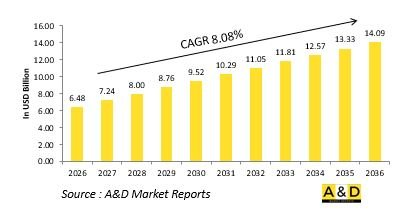
세계의 지향성 에너지 무기 시장 규모는 2026년에는 약 64억 8,000만 달러로 추정되며, 2036년까지 140억 9,000만 달러에 달할 것으로 예상되며, 2026-2036년 예측 기간 동안 CAGR 8.08%의 성장이 전망됩니다.
국방용 지향성 에너지 무기 시장은 현대 군사 기술의 최첨단 분야로 레이저, 마이크로파, 입자 빔과 같은 집속 전자기에너지를 사용하여 표적을 정밀하고 신속하게 무력화, 손상 또는 파괴하는 시스템에 초점을 맞추고 있습니다. 기존의 운동 에너지 무기와 달리 지향성 에너지 무기는 즉각적인 교전, 부수적 피해 감소, 사용 당 낮은 운영 비용이 특징입니다. 이 시스템들은 미사일 방어, 대 드론 작전, 전자 교란 등 항공, 육상, 해상 플랫폼을 넘나드는 용도로 개발되고 있습니다. 세계 각국의 국방기관이 군비의 정확성, 유연성, 확장성을 추구하는 가운데, 지향성 에너지 무기는 점점 더 많은 관심을 받고 있습니다. 이는 전통적인 위협과 비대칭 위협 모두에 대응할 수 있는 기계식, 고출력, 지속가능한 비운동 에너지 솔루션에 대한 수요 증가와 일치합니다. 그 등장은 기존의 억지력과 전투 능력을 보완하는 에너지 기반 전쟁에 대한 변혁적 발걸음을 의미합니다.
기술 혁신은 지향성 에너지 무기의 개발과 배치를 빠르게 촉진하고 있습니다. 고에너지 레이저, 소형 동력원, 빔 제어 시스템의 발전으로 사거리, 정확도, 효율이 크게 향상되었습니다. 열 관리 및 보상 광학의 획기적인 발전으로 정확도 저하 없이 지속적인 작동이 가능해졌습니다. AI와 자동 추적 시스템의 통합은 역동적인 전투 환경에서 표적 포착 및 위협에 대한 대응 능력을 강화하고 있습니다. 부품의 소형화로 지향성 에너지 시스템은 휴대성이 향상되어 지상 차량에서 항공기, 항공기, 해군 함정에 이르기까지 다양한 플랫폼에 적용할 수 있게 되었습니다. 또한, 에너지 저장 및 펄스 발생 기술의 개선으로 이러한 무기는 연속 사용의 신뢰성이 향상되었습니다. 포토닉스, 재료 과학, 디지털 제어 기술의 융합으로 지향성 에너지 시스템은 실험적인 프로토타입에서 실용적이고 배치 가능한 솔루션으로 변화하여 정밀 공격 및 방어 전투 능력의 미래를 재정의하고 있습니다.
진화하는 위협에 대응하기 위한 비용 효율적이고 신속한 대응 솔루션에 대한 수요 증가는 방위용 지향성 에너지 무기 시장의 주요 촉진요인입니다. 드론 침투, 미사일 공격, 스웜 전술의 증가로 인해 여러 표적을 동시에 무력화할 수 있는 무기에 대한 수요가 증가하고 있습니다. 지향성 에너지 시스템은 광속으로 위협에 대응할 수 있고, 후방 지원 부하를 최소화할 수 있다는 점에서 국방 현대화 계획에서 매우 매력적입니다. 정밀한 전쟁 수행과 부수적 피해 감소에 대한 관심이 높아지면서 비운동 에너지 기반의 확장형 무기 시스템으로의 전환이 더욱 가속화되고 있습니다. 국방기관은 또한 기존 시스템으로는 요격이 어려운 고속 발사체나 전자적 위협에 대응하기 위해 지향성 에너지 기술에 대한 투자를 진행하고 있습니다. 또한, 육상, 항공, 해상 방어를 통합하는 멀티 도메인 작전으로의 전환은 플랫폼 간 원활한 운용이 가능한 유연한 모듈식 에너지 무기에 대한 수요를 증가시키고 있습니다. 이러한 요인들로 인해 차세대 국방 계획에서 지향성 에너지 시스템의 전략적 중요성이 증가하고 있습니다.
방위용 지향성 에너지 무기 시장에서 각 지역의 발전은 전략적 우선순위와 기술 능력의 차이를 반영하고 있습니다. 북미는 모든 국방 분야에서 레이저 및 마이크로파 무기 시스템의 지속적인 연구, 시험 및 배치로 이 분야에서 계속 우위를 점하고 있습니다. 유럽은 방공 및 해군용 지향성 에너지 솔루션을 통합하는 공동 연구 프로그램에 집중하고 있습니다. 아시아태평양은 대(對)드론-미사일 방어용 고출력 레이저-마이크로파 시스템에 중점을 두고 역량을 빠르게 강화하고 있습니다. 중동에서는 불안정한 환경에서의 중요 인프라 보호 및 항공 위협에 대한 대응책으로 지향성 에너지 기술이 검토되고 있습니다. 라틴아메리카와 아프리카에서는 기술제휴와 방산협력을 통해 이 분야로의 진출이 서서히 진행되고 있습니다. 모든 지역에서 정부는 지향성 에너지 무기가 억지력을 재정의할 수 있는 잠재력을 인식하고 있으며, 새로운 전장 과제에 대한 정밀하고 확장 가능하며 에너지 효율적인 대응책을 제공할 수 있다고 보고 있습니다.
세계의 지향성 에너지 무기 시장에 대해 조사 분석했으며, 시장에 영향을 미치는 기술, 향후 10년간의 예측, 각 지역별 시장 동향 등의 정보를 전해드립니다.
지역별
기술별
플랫폼별
북미
촉진요인, 억제요인, 과제
PEST
주요 기업
공급업체 Tier 상황
기업 벤치마크
유럽
중동
아시아태평양
남미
미국
방위 프로그램
최신 뉴스
특허
이 시장의 현재 기술 성숙도
캐나다
이탈리아
프랑스
독일
네덜란드
벨기에
스페인
스웨덴
그리스
호주
남아프리카공화국
인도
중국
러시아
한국
일본
말레이시아
싱가포르
브라질
The Global Directed Energy Weapons market is estimated at USD 6.48 billion in 2026, projected to grow to USD 14.09 billion by 2036 at a Compound Annual Growth Rate (CAGR) of 8.08% over the forecast period 2026-2036.
The defense directed energy weapons market represents a cutting-edge frontier in modern military technology, focusing on systems that use focused electromagnetic energy-such as lasers, microwaves, or particle beams-to disable, damage, or destroy targets with precision and speed. Unlike traditional kinetic weapons, directed energy weapons offer instantaneous engagement, reduced collateral damage, and low operational costs per use. These systems are being developed for applications across air, land, and naval platforms, including missile defense, anti-drone operations, and electronic disruption. As global defense forces seek enhanced accuracy, flexibility, and scalability in their arsenals, directed energy weapons are becoming increasingly attractive. They align with the growing need for agile, renewable, and non-kinetic solutions capable of addressing both conventional and asymmetric threats. Their emergence marks a transformative step toward energy-based warfare that complements existing deterrence and combat capabilities.
Technological innovation is rapidly propelling the development and deployment of directed energy weapons. Advances in high-energy lasers, compact power sources, and beam control systems have significantly improved range, precision, and efficiency. Breakthroughs in thermal management and adaptive optics enable sustained operation without compromising accuracy. The integration of artificial intelligence and automated tracking enhances targeting and threat engagement in dynamic combat environments. Miniaturization of components has made directed energy systems more portable and adaptable to various platforms, from ground vehicles to aircraft and naval vessels. Additionally, improvements in energy storage and pulse generation have made these weapons more reliable for continuous use. The convergence of photonics, materials science, and digital control technologies has transformed directed energy systems from experimental prototypes into viable, deployable solutions, redefining the future of precision strike and defensive warfare capabilities.
The increasing need for cost-effective, rapid-response solutions against evolving threats is a primary driver of the defense directed energy weapons market. Rising incidents of drone incursions, missile attacks, and swarming tactics have created demand for weapons capable of neutralizing multiple targets simultaneously. The ability of directed energy systems to engage threats at the speed of light, with minimal logistical burden, makes them highly attractive for defense modernization programs. Growing emphasis on precision warfare and reduced collateral damage further supports the transition toward non-kinetic, scalable weapon systems. Defense forces are also investing in directed energy technologies to counter high-speed projectiles and electronic threats that traditional systems struggle to intercept. Additionally, the shift toward multi-domain operations-integrating land, air, and maritime defense-drives the need for flexible, modular energy weapons that can operate seamlessly across platforms. These factors collectively reinforce the strategic importance of directed energy systems in next-generation defense planning.
Regional developments in the defense directed energy weapons market reflect differing strategic priorities and technological capacities. North America continues to dominate the field, driven by sustained research, testing, and deployment of laser-based and microwave weapon systems across all defense branches. Europe is focusing on collaborative research programs aimed at integrating directed energy solutions into air defense and naval applications. The Asia-Pacific region is rapidly advancing its indigenous capabilities, emphasizing high-power laser and microwave systems for counter-drone and missile defense. In the Middle East, directed energy technologies are being explored to protect critical infrastructure and counter aerial threats in volatile environments. Latin America and Africa are gradually entering the domain through technology partnerships and defense collaborations. Across all regions, governments recognize the potential of directed energy weapons to redefine deterrence, offering precise, scalable, and energy-efficient responses to emerging battlefield challenges.
The Mk-II(A) Shahastra Shakti marked a major milestone in India's directed energy weapons programme in April 2026, following the successful test demonstration of the laser-based system. This indigenous 30 kW, vehicle-mounted platform developed by DRDO's CHESS division has demonstrated the ability to neutralise various aerial threats-including fixed-wing drones, swarm drones and surveillance sensors-at distances of up to 5 km. The Shahastra Shakti system incorporates six 5 kW laser beams and is equipped with advanced electronic warfare capabilities along with a 360-degree Electro-Optical/Infrared (EO/IR) sensor for accurate target engagement. Currently undergoing trials, it is expected to become operational within the next two years. DRDO is also progressing on next-generation variants with projected power levels between 50 and 100 kW, intended to counter more advanced threats such as cruise missiles, fighter aircraft and artillery rounds, thereby significantly enhancing India's directed energy weapons capabilities.
By Region
By Technology
By Platform
The 10-year directed energy weapons market analysis would give a detailed overview of directed energy weapons market growth, changing dynamics, technology adoption overviews and the overall market attractiveness is covered in this chapter.
This segment covers the top 10 technologies that is expected to impact this market and the possible implications these technologies would have on the overall market.
The 10-year directed energy weapons market forecast of this market is covered in detailed across the segments which are mentioned above.
The regional directed energy weapons market trends, drivers, restraints and Challenges of this market, the Political, Economic, Social and Technology aspects are covered in this segment. The market forecast and scenario analysis across regions are also covered in detailed in this segment. The last part of the regional analysis includes profiling of the key companies, supplier landscape and company benchmarking. The current market size is estimated based on the normal scenario.
North America
Drivers, Restraints and Challenges
PEST
Key Companies
Supplier Tier Landscape
Company Benchmarking
Europe
Middle East
APAC
South America
This chapter deals with the key defense programs in this market, it also covers the latest news and patents which have been filed in this market. Country level 10 year market forecast and scenario analysis are also covered in this chapter.
US
Defense Programs
Latest News
Patents
Current levels of technology maturation in this market
Canada
Italy
France
Germany
Netherlands
Belgium
Spain
Sweden
Greece
Australia
South Africa
India
China
Russia
South Korea
Japan
Malaysia
Singapore
Brazil
The opportunity matrix helps the readers understand the high opportunity segments in this market.
Hear from our experts their opinion of the possible analysis for this market.