


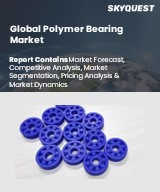
세계의 폴리머 베어링 시장 규모는 2024년에 104억 5,000만 달러로 평가되며, 2025년 109억 2,000만 달러에서 2033년까지 155억 3,000만 달러로 성장할 전망입니다. 예측 기간(2026-2033년)의 CAGR은 4.5%로 예측됩니다.
중장비 및 자동차 부문 수요 증가에 힘입어 세계 폴리머 베어링 시장은 괄목할 만한 성장세를 보이고 있습니다. 이 두 분야는 함께 큰 시장 점유율을 차지하고 있습니다. 혁신적인 실, 윤활유, 경량 소재를 포함한 기술의 발전은 성능 향상과 비용 절감을 추구하는 제조업체에게 새로운 기회를 열어주고 있습니다. 특히 산고반과 같은 자기 윤활성 폴리머 베어링은 소음과 진동 문제를 해결하여 다양한 자동차 용도에 적합합니다. 또한 베어링 설계에 전기 기계 요소의 통합은 성능 능력을 변화시키고 있습니다. 업계 관계자들이 디지털 서비스 및 자동화된 생산 공정에 대한 투자를 늘리면서 고객 참여와 전반적인 운영 효율성이 크게 향상되어 폴리머 베어링 시장의 성장 잠재력이 확대되고 있습니다.
세계 폴리머 베어링 시장 성장 촉진요인
의료 및 제약, 자동차, 섬유, 식품 가공 등 다양한 산업 분야 수요 증가로 인해 세계 폴리머 베어링 시장은 큰 폭의 성장이 예상됩니다. 자동차 산업은 차량 부품에 고분자 소재를 많이 사용하는 주요 소비 분야로 두드러집니다. 자동차 부품의 상당 부분이 플라스틱으로 제조되는 것으로 확인되어, 현대 차량에 폴리머가 얼마나 널리 사용되고 있는지 알 수 있습니다. 특히 자동차에 사용되는 플라스틱의 대부분은 폴리프로필렌, 폴리우레탄, 폴리우레탄, 폴리아미드, 폴리염화비닐(PVC)의 4가지 주요 폴리머에서 유래하여 혁신적인 폴리머 베어링 솔루션의 필요성이 더욱 커지고 있습니다.
세계 폴리머 베어링 시장 성장 억제요인
세계 폴리머 베어링 시장은 성장 잠재력을 저해하는 몇 가지 문제에 직면해 있습니다. 식품 포장 및 가공 분야에 대한 정부의 엄격한 규제는 업계의 확장 능력을 제한하고 있습니다. 또한 원자재 가격의 변동이 수익성에 악영향을 미쳐 폴리머 베어링의 가격 동향에 영향을 미치고 있습니다. 또한 페놀수지 베어링은 본질적으로 열전도율이 낮기 때문에 마찰에 의한 온도 관리를 위해 물과 윤활유의 지속적인 공급이 필요하며, 이는 시장 발전을 더욱 저해할 수 있습니다. 이러한 요인들이 복합적으로 작용하여 폴리머 베어링 산업의 발전에 도전이 되고 있습니다.
세계 폴리머 베어링 시장 동향
세계 폴리머 베어링 시장은 자동차 산업의 급격한 수요 증가가 주요 원동력으로 작용하고 있습니다. 동 업계에서는 그리스가 필요 없는 특성과 우수한 내식성 및 내피로성을 높이 평가했습니다. 폴리머 베어링은 다용도한 특성으로 인해 섬유, 포장, 식품 가공 등 다양한 최종 용도에 적합합니다. 첨단 3D 프린팅 기술의 채택은 이러한 시장 동향을 더욱 가속화하고 있습니다. 이를 통해 제조업체는 기존 소재를 능가하는 맞춤형 고성능 베어링을 생산할 수 있게 되었습니다. 이러한 혁신은 베어링의 수명을 연장할 뿐만 아니라 다양한 산업 분야에서 운영 효율성을 향상시키는 맞춤형 솔루션을 가능하게 하고, 궁극적으로 폴리머 베어링을 현대 기계에서 우선적인 선택으로 자리매김할 수 있도록 합니다.
Global Polymer Bearing Market size was valued at USD 10.45 Billion in 2024 and is poised to grow from USD 10.92 Billion in 2025 to USD 15.53 Billion by 2033, growing at a CAGR of 4.5% during the forecast period (2026-2033).
The global polymer bearing market is experiencing significant growth, driven by rising demand in the heavy machinery and automotive sectors, which together hold a substantial market share. Advancements in technologies, including innovative seals, lubricants, and lightweight materials, are unlocking new opportunities for manufacturers aiming to enhance performance while reducing costs. Notably, self-lubricated polymer bearings, like those from Saint-Gobain, address challenges in noise and vibration, making them ideal for various automotive applications. Additionally, the integration of electromechanical elements into bearing designs is transforming performance capabilities. As industry players increasingly invest in digital services and automated production processes, there is a marked improvement in customer engagement and overall operational efficiency, paving the way for expansive growth within the polymer bearing market.
Top-down and bottom-up approaches were used to estimate and validate the size of the Global Polymer Bearing market and to estimate the size of various other dependent submarkets. The research methodology used to estimate the market size includes the following details: The key players in the market were identified through secondary research, and their market shares in the respective regions were determined through primary and secondary research. This entire procedure includes the study of the annual and financial reports of the top market players and extensive interviews for key insights from industry leaders such as CEOs, VPs, directors, and marketing executives. All percentage shares split, and breakdowns were determined using secondary sources and verified through Primary sources. All possible parameters that affect the markets covered in this research study have been accounted for, viewed in extensive detail, verified through primary research, and analyzed to get the final quantitative and qualitative data.
Global Polymer Bearing Market Segments Analysis
Global Polymer Bearing Market is segmented by Material, Type of Bearing, Application, Industry and region. Based on Material, the market is segmented into Phenolics, Acetal, Nylon, Teflon, UHMWPE and Others. Based on Type of Bearing, the market is segmented into Ball bearing and Roller bearing. Based on Application, the market is segmented into Motors, Gears, Drive shaft, Idler Wheels, Wheel Pivots and X-ray robots. Based on Industry, the market is segmented into Automobile, Textile, Packaging, Medical & Pharmaceuticals and Others. Based on region, the market is segmented into North America, Europe, Asia Pacific, Latin America and Middle East & Africa.
Driver of the Global Polymer Bearing Market
The Global Polymer Bearing market is poised for significant growth due to the rising demand across various industrial sectors, including medical and pharmaceutical, automotive, textiles, and food processing. The automotive industry stands out as a major consumer of polymer materials, utilizing them extensively in vehicle components. It has been noted that a substantial portion of auto parts is manufactured from plastic, highlighting the prevalence of polymers in modern vehicles. Notably, the majority of plastics in automobiles are derived from four key polymers, namely polypropylene, polyurethane, polyamide, and polyvinyl chloride (PVC), further driving the need for innovative polymer bearing solutions.
Restraints in the Global Polymer Bearing Market
The Global Polymer Bearing market faces several challenges that hinder its growth potential. Stringent government regulations in the food packaging and processing sectors limit the industry's ability to expand. Additionally, fluctuations in raw material prices have negatively impacted profitability, influencing the price trends of polymer bearings. Moreover, the inherent low thermal conductivity of phenolic bearings, which necessitates a consistent supply of water or lubricating oil to manage temperature due to friction, may further impede market development. These factors collectively create a challenging environment for the advancement of the polymer bearing industry.
Market Trends of the Global Polymer Bearing Market
The global polymer bearing market is experiencing notable growth, driven primarily by soaring demand from the automotive industry, which values the bearings' grease-free nature and their exceptional resistance to corrosion and fatigue. Their versatility makes polymer bearings ideal for various end-use applications, including textiles, packaging, and food processing. The adoption of advanced 3D printing technologies is further propelling this market trend, enabling manufacturers to create custom, high-performance bearings that outperform traditional materials. This innovation not only enhances bearing longevity but also allows for tailored solutions that improve operational efficiency across diverse industrial sectors, ultimately positioning polymer bearings as a preferred choice in modern machinery.