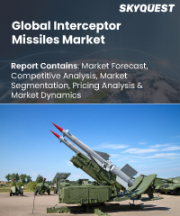
요격 미사일 시장 규모, 점유율 및 성장 분석 : 발사 플랫폼별, 유형별, 거리별, 위협 유형별, 기술별, 컴포넌트별, 용도별, 영역별, 지역별 - 업계 예측(2026-2033년)
Interceptor Missiles Market Size, Share, and Growth Analysis, By Launch Platform (Air Borne, Submarines), By Type, By Range, By Threat Type, By Technology, Component, By Application, By Domain, By Region - Industry Forecast 2026-2033
상품코드:1898586
리서치사:SkyQuest
발행일:2025년 12월
페이지 정보:영문 157 Pages
라이선스 & 가격 (부가세 별도)
한글목차
요격 미사일 시장 규모는 2024년에 105억 9,000만 달러로 평가되며, 2025년 112억 1,000만 달러에서 2033년까지 177억 4,000만 달러로 성장할 전망입니다. 예측 기간(2026-2033년)의 CAGR은 5.9%로 예측됩니다.
현대 전쟁의 정세 변화에 따라 방어 능력에 대한 중요성이 높아지면서 세계 요격 미사일 시장은 꾸준히 성장하고 있습니다. 지정학적 긴장, 영토 문제, 국가 안보 강화의 필요성이 주요 성장 요인으로 작용하고 있으며, 각국은 자국 영토와 중요 자산을 보호하기 위해 첨단 미사일 방어 시스템에 투자하고 있습니다. 그러나 이 복잡한 시스템의 높은 개발 및 유지보수 비용, 막대한 연구개발 투자의 필요성 등 시장에는 몇 가지 과제가 존재합니다. 예산 제약, 공격용 미사일 기술의 급속한 발전, 기존 방위 인프라와의 통합의 복잡성 등이 상황을 더욱 복잡하게 만들고 있습니다. 이러한 장벽에도 불구하고 시장에서의 요격 능력에 대한 수요 증가에 대응하기 위해서는 지속적인 기술 발전과 국제 협력이 매우 중요할 것입니다.
요격미사일 시장 성장 촉진요인
현대전의 변화무쌍한 정세와 미사일 기술의 광범위한 발전은 강력한 요격 미사일 시스템의 필요성을 강조하고 있습니다. 탄도미사일 위협으로 인한 위험과 무인항공기(UAV)의 이용 증가가 두드러지면서 고도화된 요격 솔루션에 대한 요구가 높아지고 있습니다. 이러한 수요는 국가 및 국제 안보를 강화하고 각국이 잠재적인 항공 공격에 효과적에 대응할 수 있는 태세를 갖추어야 할 필요성에 의해 촉진되고 있습니다. 따라서 요격 미사일 시장은 진화하는 위협으로부터 방어하는 방위군의 긴급한 요구 사항에 의해 주도되고 있습니다.
요격미사일 시장 성장 억제요인
요격 미사일 시장은 엄격한 수출 관리 규제와 기밀성이 높은 미사일 기술 이전 제한으로 인해 어려움에 직면해 있습니다. 이러한 규제는 제조업체가 지역마다 다른 복잡한 인허가 절차와 정치적 고려를 극복해야 하므로 국제 무역의 걸림돌이 될 수 있습니다. 또한 기술 이전 제한은 이들 제조업체의 사업 범위를 좁힐 수 있으며, 궁극적으로 시장 확대 및 성장 가능성에 영향을 미칠 수 있습니다. 결과적으로, 이러한 규제 장벽은 이 분야에서 사업을 운영하는 기업에게 심각한 장애물이 되고 있으며, 컴플라이언스 및 국제 협력과 관련된 복잡성을 극복하기 위한 효과적인 전략 수립이 요구되고 있습니다.
요격 미사일 시장 동향
요격 미사일 시장에서는 다양한 요격 기술을 하나의 미사일 시스템에 통합하는 경향이 두드러지게 나타나고 있습니다. 이 접근 방식은 현대의 다양한 위협에 대응하면서 요격 성공률을 높이는 것을 목표로 하고 있습니다. 충돌 파괴 방식, 폭발 파편 방식, 지향성 에너지 무기, 고폭탄 탄두를 결합하여 제조업체는 솔루션의 효과와 다용도성을 모두 높이고 있습니다. 국방 전략이 진화함에 따라 다양한 위기 시나리오에 적응할 수 있는 다면적인 미사일 시스템에 대한 수요가 증가하고 있으며, 통합 기술은 미래 요격 미사일 개발의 기초로 자리매김하여 세계 안보 구상을 강화하고 있습니다.
목차
서론
조사의 목적
조사 범위
정의
조사 방법
정보 조달
2차와 1차 데이터 방법
시장 규모 예측
시장 전제조건과 제한
개요
세계 시장 전망
공급과 수요 동향 분석
부문별 기회 분석
시장 역학과 전망
시장 규모
시장 역학
촉진요인과 기회
억제요인과 과제
Porter의 산업 분석과 영향
주요 시장 인사이트
주요 성공 요인
경쟁의 정도
주요 투자 기회
시장 에코시스템
시장의 매력 지수(2025년)
PESTEL 분석
거시경제 지표
밸류체인 분석
가격 분석
기술적 진보
규제 상황
특허 분석
세계의 요격 미사일 시장 규모 : 발사 플랫폼별 & CAGR(2026-2033)
항공기 탑재형
전투기
전투 헬리콥터
잠수함
지상 배치형
세계의 요격 미사일 시장 규모 : 유형별 & CAGR(2026-2033)
Surface to Air
Water to Air
Air to Air
세계의 요격 미사일 시장 규모 : 거리별 & CAGR(2026-2033)
단거리
장거리
중거리
세계의 요격 미사일 시장 규모 : 위협 유형별 & CAGR(2026-2033)
초음속 미사일
극초음속 미사일
아음속 미사일
세계의 요격 미사일 시장 규모 : 기술별 & CAGR(2026-2033)
지휘 통제
대항 조치 시스템
사격 관제 시스템
무기 시스템
세계의 요격 미사일 시장 규모 : 컴포넌트별 & CAGR(2026-2033)
미사일 요격, 레이더
세계의 요격 미사일 시장 규모 : 용도별 & CAGR(2026-2033)
탄도 미사일
기존 미사일
세계의 요격 미사일 시장 규모 : 분야별 & CAGR(2026-2033)
항공
수상
휴대용
차량
해양
우주
세계의 요격 미사일 시장 규모 & CAGR(2026-2033)
북미
미국
캐나다
유럽
영국
독일
스페인
프랑스
이탈리아
기타 유럽 지역
아시아태평양
중국
인도
일본
한국
기타 아시아태평양
라틴아메리카
브라질
기타 라틴아메리카 지역
중동 및 아프리카
GCC 국가
남아프리카공화국
기타 중동 및 아프리카
경쟁 정보
상위 5사의 비교
주요 기업의 시장 포지셔닝(2025년)
주요 시장 기업이 채택한 전략
최근 시장 동향
기업의 시장 점유율 분석(2025년)
주요 기업의 기업 개요
기업의 상세
제품 포트폴리오 분석
기업의 부문별 점유율 분석
매출의 전년대비 비교(2021-2023)
주요 기업 개요
Lockheed Martin Corporation(US)
BrahMos Aerospace(India)
Raytheon Technologies Corporation(US)
MBDA(France)
Boeing(US)
Rafael Advanced Defense Systems Ltd.(Israel)
Northrop Grumman Corporation(US)
BAE Systems plc(UK)
Thales Group(France)
General Dynamics Corporation(US)
Saab AB(Sweden)
Leonardo S.p.A.(Italy)
Mitsubishi Heavy Industries, Ltd.(Japan)
China Aerospace Science and Industry Corporation Limited(China)
Bharat Dynamics Limited(India)
Roketsan A.S.(Turkey)
Israel Aerospace Industries Ltd.(Israel)
Denel Dynamics(South Africa)
Hanwha Corporation(South Korea)
Tata Advanced Systems Limited(India)
UkrOboronProm(Ukraine)
Kongsberg Defence & Aerospace AS(Norway)
결론과 제안
KSA
영문 목차
영문목차
Interceptor Missiles Market size was valued at USD 10.59 Billion in 2024 and is poised to grow from USD 11.21 Billion in 2025 to USD 17.74 Billion by 2033, growing at a CAGR of 5.9% during the forecast period (2026-2033).
The global interceptor missiles market is experiencing consistent growth, driven by an increasing emphasis on defense capabilities amid modern warfare's evolving landscape. Geopolitical tensions, territorial disputes, and the imperative for enhanced national security are key growth drivers, compelling countries to invest in advanced missile defense systems to protect their territories and critical assets. However, the market faces several challenges, including the high development and maintenance costs of these complex systems, which require significant research and development investments. Budgetary constraints, rapid advancements in offensive missile technologies, and the complexities of integrating these systems with existing defense infrastructure further complicate the scenario. Despite these hurdles, ongoing technological advancements and international collaborations will be crucial to meet the rising demand for interception capabilities in the market.
Top-down and bottom-up approaches were used to estimate and validate the size of the Interceptor Missiles market and to estimate the size of various other dependent submarkets. The research methodology used to estimate the market size includes the following details: The key players in the market were identified through secondary research, and their market shares in the respective regions were determined through primary and secondary research. This entire procedure includes the study of the annual and financial reports of the top market players and extensive interviews for key insights from industry leaders such as CEOs, VPs, directors, and marketing executives. All percentage shares split, and breakdowns were determined using secondary sources and verified through Primary sources. All possible parameters that affect the markets covered in this research study have been accounted for, viewed in extensive detail, verified through primary research, and analyzed to get the final quantitative and qualitative data.
Interceptor Missiles Market Segments Analysis
Global Interceptor Missiles Market is segmented by Launch Platform, Type, Range, Threat Type, Technology, Component, Application, Domain and Region. Based on Launch Platform, the market is segmented into Air Borne (Fighter Planes, Fighter Helicopters), Submarines, Surface Based. Based on Type, the market is segmented into Surface to Air, Water to Air, Air to Air. Based on Range, the market is segmented into Short Range, Long Range, Medium Range. Based on Threat Type, the market is segmented into Subsonic Missiles, Supersonic Missiles, Hypersonic missiles. Based on Technology, the market is segmented into Command and Control, Countermeasure System, Fire Control System, Weapon System. Based on Component, the market is segmented into Radars, Missiles Interceptor. Based on Application, the market is segmented into Ballistic Missile, Conventional Missile. Based on Domain, the market is segmented into Air, Water, Portable, Vehicular, Marine, Space. Based on Region, the market is segmented into North America, Europe, Asia Pacific, Latin America and Middle East & and Africa.
Driver of the Interceptor Missiles Market
The dynamic landscape of contemporary warfare, coupled with the widespread advancements in missile technology, underscores the need for robust interceptor missile systems. As the risks posed by ballistic missile threats and the rising utilization of unmanned aerial vehicles (UAVs) become more pronounced, there is a growing imperative for sophisticated interception solutions. This demand is fueled by the necessity to enhance national and global security, ensuring that nations are equipped to counteract potential aerial assaults effectively. Consequently, the market for interceptor missiles is driven by the urgent requirements of defense forces to safeguard against evolving threats.
Restraints in the Interceptor Missiles Market
The interceptor missiles market faces challenges due to stringent export control regulations and limitations on transferring sensitive missile technologies. These restrictions can hinder international trade, as manufacturers must navigate complex export licensing processes and political considerations that vary by region. Additionally, limitations on technology transfer may confine the reach of these manufacturers, ultimately affecting their market expansion and growth potential. As a result, these regulatory barriers present significant obstacles for companies operating within this sector, requiring them to strategize effectively to overcome the complexities associated with compliance and international collaboration.
Market Trends of the Interceptor Missiles Market
The Interceptor Missiles market is witnessing a notable trend towards the integration of diverse interception technologies into single missile systems. This approach aims to enhance interception success rates while addressing an array of modern threats. By amalgamating hit-to-kill mechanisms, blast fragmentation, directed energy weapons, and high-explosive warheads, manufacturers are increasing both the effectiveness and versatility of their solutions. As defense strategies evolve, the demand for multi-faceted missile systems that can adapt to various high-stakes scenarios is rising, positioning integrated technologies as a cornerstone of future interceptor missile advancements and reinforcing global security initiatives.
Table of Contents
Introduction
Objectives of the Study
Scope of the Report
Definitions
Research Methodology
Information Procurement
Secondary & Primary Data Methods
Market Size Estimation
Market Assumptions & Limitations
Executive Summary
Global Market Outlook
Supply & Demand Trend Analysis
Segmental Opportunity Analysis
Market Dynamics & Outlook
Market Overview
Market Size
Market Dynamics
Driver & Opportunities
Restraints & Challenges
Porters Analysis & Impact
Competitive rivalry
Threat of substitute
Bargaining power of buyers
Threat of new entrants
Bargaining power of suppliers
Key Market Insights
Key Success Factors
Degree of Competition
Top Investment Pockets
Market Ecosystem
Market Attractiveness Index, 2025
PESTEL Analysis
Macro-Economic Indicators
Value Chain Analysis
Pricing Analysis
Technological Advancement
Regulatory Landscape
Patent Analysis
Global Interceptor Missiles Market Size by Launch Platform & CAGR (2026-2033)
Market Overview
Air Borne
Fighter Planes
Fighter Helicopters
Submarine
Surface Based
Global Interceptor Missiles Market Size by Type & CAGR (2026-2033)
Market Overview
Surface to Air
Water to Air
Air to Air
Global Interceptor Missiles Market Size by Range & CAGR (2026-2033)
Market Overview
Short Range
Long Range
Medium Range
Global Interceptor Missiles Market Size by Threat Type & CAGR (2026-2033)
Market Overview
Supersonic Missile
Hypersonic Missile
Subsonic Missile
Global Interceptor Missiles Market Size by Technology & CAGR (2026-2033)
Market Overview
Command and Control
Counter-Measure System
Fire Control System
Weapon System
Global Interceptor Missiles Market Size by Component & CAGR (2026-2033)
Market Overview
Missile Interceptor, Radars
Global Interceptor Missiles Market Size by Application & CAGR (2026-2033)
Market Overview
Ballistic Missile
Conventional Missile
Global Interceptor Missiles Market Size by Domain & CAGR (2026-2033)
Market Overview
Air
Water
Portable
Vehicular
Marine
Space
Global Interceptor Missiles Market Size & CAGR (2026-2033)