친환경 식품 포장 시장 규모(-2035년) : 재료 유형별, 포장 유형별, 제품 유형별, 기술별, 층별, 응용 분야별, 최종사용자별, 기업별, 지역별 - 업계 동향, 예측
Eco-friendly Food Packaging Market Till 2035: Distribution by Type of Material, Type of Packaging, Product, Technique, Layer, Areas of Application, End-User, Enterprise, and Geographical Regions: Industry Trends & Global Forecasts
상품코드:1958442
리서치사:Roots Analysis
발행일:On Demand Report
페이지 정보:영문 214 Pages
라이선스 & 가격 (부가세 별도)
한글목차
친환경 식품 포장 시장 개요
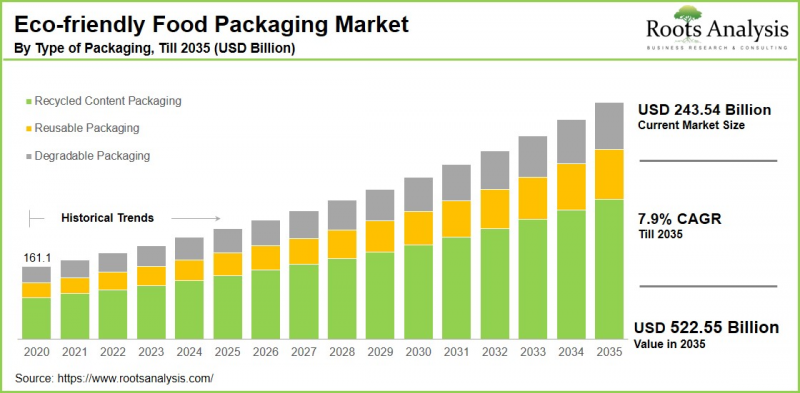
세계의 친환경 식품 포장 시장 규모는 현재 2,435억 4,000만 달러에서 2035년까지 5,225억 5,000만 달러에 달할 것으로 추정되며, 2035년까지의 예측 기간에 CAGR로 7.9%의 성장이 전망되고 있습니다.
친환경 식품 포장 시장 : 성장과 동향
친환경 식품 포장이란 환경에 안전하고 자연 분해 가능한 재료를 사용하는 것을 말합니다. 이러한 재료는 물리적, 화학적, 생물학적 위협에 의한 변조나 오염으로부터 식품을 보호하는 기능을 갖추어야 합니다. 현재 식품의 안전성을 보장하기 위해 가장 선호되는 포장 유형은 액티브 포장입니다.
친환경 식품 포장 시장은 소비자의 선호도 변화와 엄격한 환경 규제에 힘입어 큰 폭의 성장세를 보이고 있습니다. 이 시장을 형성하는 주요 동향 중 하나는 생분해성 및 퇴비화 가능한 포장재의 채택이 증가하고 있다는 점입니다. 식물 유래 섬유, 바이오폴리머 등 재생한 자원으로 만들어지는 이들 소재는 자연 분해 능력으로 매립 폐기물 및 환경 오염 감소에 기여하므로 주목받고 있습니다.
또한 기업은 지속가능성 목표에 부합하는 혁신적인 포장 솔루션 개발에 주력하고 있으며, 수성 코팅 및 재활용 가능한 배리어 기술 등이 포함됩니다. 제로 웨이스트 및 플라스틱 프리 대체 포장재에 대한 수요 증가와 재료 과학의 발전으로 친환경 식품 포장으로의 전환이 가속화되고 있습니다. 이러한 움직임은 순환 경제에 대한 중요성이 높아지고, 기업이 지속가능성을 우선시하는 것에 대한 소비자의 기대가 커지면서 더욱 가속화되고 있습니다. 이러한 요인을 고려할 때, 친환경 식품 포장 시장은 예측 기간 중 상당한 성장을 보일 것으로 예측됩니다.
세계의 친환경 식품 포장 시장에 대해 조사했으며, 시장 규모 추정과 기회 분석, 경쟁 구도, 기업 개요 등의 정보를 전해드립니다.
목차
섹션 1 리포트 개요
제1장 서문
제2장 조사 방법
제3장 시장 역학
제4장 거시경제 지표
섹션 2 정성적 인사이트
제5장 개요
제6장 서론
제7장 규제 시나리오
섹션 3 시장 개요
제8장 주요 기업의 종합적 데이터베이스
제9장 경쟁 구도
제10장 화이트 스페이스 분석
제11장 기업 경쟁력 분석
제12장 친환경 식품 포장 시장의 스타트업 에코시스템
섹션 4 기업 개요
제13장 기업 개요
섹션 5 시장 동향
제14장 메가트렌드 분석
제15장 미충족 요구 분석
제16장 특허 분석
제17장 최근 발전
섹션 6 시장 기회 분석
제18장 세계의 친환경 식품 포장 시장
제19장 시장 기회 : 재료 유형별
제20장 시장 기회 : 포장 유형별
제21장 시장 기회 : 제품 유형별
제22장 시장 기회 : 기술 유형별
제23장 시장 기회 : 층 유형별
제24장 시장 기회 : 응용 분야별
제25장 시장 기회 : 최종사용자 유형별
제26장 시장 기회 : 기업 유형별
제27장 북미의 친환경 식품 포장 시장의 시장 기회
제28장 유럽의 친환경 식품 포장 시장의 시장 기회
제29장 아시아의 친환경 식품 포장 시장의 시장 기회
제30장 중동·북아프리카(MENA) 친환경 식품 포장 시장의 시장 기회
제31장 라틴아메리카의 친환경 식품 포장 시장의 시장 기회
제32장 기타 지역의 친환경 식품 포장 시장의 시장 기회
제33장 시장 집중 분석 : 주요 기업별
제32장 인접 시장 분석
섹션 7 전략적 툴
제33장 주요 성공 전략
제34장 Porter's Five Forces 분석
제35장 SWOT 분석
제36장 밸류체인의 분석
제37장 Roots의 전략적 제안
섹션 8 기타 독점적 인사이트
제38장 1차 조사로부터의 인사이트
제39장 리포트 결론
섹션 9 부록
KSA
영문 목차
영문목차
Eco-Friendly Food Packaging Market Overview
As per Roots Analysis, the global eco-friendly food packaging market size is estimated to grow from USD 243.54 billion in the current year USD 522.55 billion by 2035, at a CAGR of 7.9% during the forecast period, till 2035.
The opportunity for eco-friendly food packaging market has been distributed across the following segments:
Type of Material
Glass
Metal
Paper & Paperboard
Plastic
Scratch-Based Materials
Type of Packaging
Degradable Packaging
Recycled Content Packaging
Reusable Packaging
Type of Product
Bags
Bottles and Jars
Boxes
Cans
Containers
Films
Pouches and Sachets
Trays
Tubes
Other products
Type of Technique
Active Packaging
Alternate Fiber Packaging
Molded Packaging
Multipurpose Packaging
Other techniques
Type of Layer
Primary Packaging
Secondary Packaging
Tertiary Packaging
Areas of Application
Beverages
Food
Type of End-user
Foodservice
Food Processing
Retail
Type of Enterprise
Large Enterprises
Small and Medium Enterprises
Geographical Regions
North America
US
Canada
Mexico
Other North American countries
Europe
Austria
Belgium
Denmark
France
Germany
Ireland
Italy
Netherlands
Norway
Russia
Spain
Sweden
Switzerland
UK
Other European countries
Asia
China
India
Japan
Singapore
South Korea
Other Asian countries
Latin America
Brazil
Chile
Colombia
Venezuela
Other Latin American countries
Middle East and North Africa
Egypt
Iran
Iraq
Israel
Kuwait
Saudi Arabia
UAE
Other MENA countries
Rest of the World
Australia
New Zealand
Other countries
Eco-Friendly Food Packaging Market: Growth and Trends
Eco-friendly food packaging involves using materials that are environmentally safe and capable of breaking down naturally. Such materials must ensure protection against tampering or contamination from any physical, chemical, or biological threats; currently, the most favored type of packaging used for food safety is active packaging.
The market for eco-friendly food packaging is witnessing significant growth, driven by shifts in consumer preferences and stringent environmental regulations. A key trend shaping this market is the increasing adoption of biodegradable and compostable packaging materials. Made from renewable sources such as plant-based fibers and biopolymers, these materials are gaining traction because of their ability to decompose naturally, which helps reduce landfill waste and environmental pollution.
Further, the companies are focusing on developing innovative packaging solutions that align with sustainability goals, which includes water-based coatings and recyclable barrier technologies. The rising demand for zero-waste and plastic-free packaging alternatives, combined with advancements in material science, is accelerating the shift toward eco-friendly food packaging. This movement is also backed by an increased emphasis on circular economy initiatives and consumer expectations for companies that prioritize sustainability in their practices. Overall, considering the above mentioned factors, the eco-friendly food packaging market is expected to grow significantly during the forecast period.
Eco-Friendly Food Packaging Market: Key Segments
Market Share by Type of Material
Based on type of material, the global eco-friendly food packaging market is segmented into glass, metal, paper & paperboard, plastic, scratch-based materials. According to our estimates, currently, the paper & paperboard sub-segment captures the majority of the market share. This is due to its broad availability, recyclability, and versatility. Paper-based materials are economical, lightweight, and easily customizable, which makes them a favored option for food packaging across different sectors.
Conversely, the scratch-based materials segment is expected to experience rapid growth throughout the forecast period. This is driven by the increasing demand for innovative, biodegradable, and compostable packaging solutions. Scratch-based materials fit well within the circular economy model, providing a sustainable alternative to conventional plastics.
Market Share by Type of Packaging
Based on type of packaging, the global eco-friendly food packaging market is segmented into degradable packaging, recycled content packaging and reusable packaging. According to our estimates, currently, the recycled content packaging segment captures the majority of the market share. This is due to the increasing focus on circular economy initiatives and the rising demand for sustainable packaging made from materials that are either post-consumer or post-industrial waste.
However, the reusable packaging segment is expected to grow at a higher CAGR during the forecast period. This growth is fueled by the growing awareness of the need to minimize single-use packaging waste and the transition towards more durable and long-lasting packaging options.
Market Share by Type of Product
Based on type of product, the global eco-friendly food packaging market is segmented into bags, bottles and jars, boxes, cans, containers, films, pouches and sachets, trays, tubes and other products. According to our estimates, currently, the containers segment captures the majority of the market share. This growth is primarily due to its widespread usage in various applications like food storage and takeout services. Containers crafted from biodegradable materials such as cardboard, paper, and bioplastics are increasingly preferred for their capacity to reduce environmental impact while maintaining food quality.
However, the bags segment is expected to grow at a higher CAGR during the forecast period. The expansion of this segment is fueled by growing consumer demand for convenient and lightweight packaging options. Eco-friendly bags, frequently constructed from materials such as recycled paper or compostable plastics, are becoming more popular due to their versatility in transporting food items and their alignment with sustainability objectives.
Market Share by Type of Technique
Based on type of technique, the global eco-friendly food packaging market is segmented into active packaging, alternate fiber packaging, molded packaging, multipurpose packaging, and other techniques. According to our estimates, currently, the active packaging segment captures the majority of the market share. This growth is primarily due to its capability to enhance food safety and quality while decreasing waste, making it a popular option among manufacturers and consumers looking for sustainable choices.
However, the molded packaging segment is expected to grow at a higher CAGR during the forecast period. Molded packaging, which encompasses products like trays and containers made from biodegradable materials, is gaining popularity due to its flexibility and effectiveness in safeguarding food products. Moreover, the rising demand for lightweight yet resilient packaging solutions that also reduce environmental impact is propelling market growth.
Market Share by Type of Layer
Based on type of layer, the global eco-friendly food packaging market is segmented into primary packaging, secondary packaging, and tertiary packaging. According to our estimates, currently, the primary packaging segment captures the majority of the market share. Primary containers refer to items that directly hold food products, such as bags, bottles, and containers. This segment is experiencing growth due to heightened consumer awareness and regulatory demands for reducing plastic usage.
However, the secondary packaging segment is expected to grow at a higher CAGR during the forecast period. The increasing focus on sustainability and environmental consciousness among consumers is boosting the demand for secondary packaging solutions that are both functional and compatible with ecological objectives.
Market Share by Areas of Application
Based on areas of application, the global eco-friendly food packaging market is segmented into beverages and food. According to our estimates, currently, the food segment captures the majority of the market share. This segment benefits from the widespread adoption of sustainable packaging solutions across different food categories, such as bakery items, dairy products, meat, fruits, and vegetables. The growth of this segment is being driven by the increasing consumer demand for fresh and minimally processed foods, along with a heightened awareness of environmental concerns.
However, the beverages segment is expected to grow at a higher CAGR during the forecast period. This growth is attributed to the rising consumer inclination toward sustainable packaging options in beverage products, which include both alcoholic and non-alcoholic varieties.
Market Share by Type of End-User
Based on type of end-user, the global eco-friendly food packaging market is segmented into foodservice, food processing and retail. According to our estimates, currently, the foodservice segment captures the majority of the market share. This growth is primarily due to the rising focus on sustainability and environmental accountability among restaurants and catering firms, which are progressively adopting eco-friendly packaging solutions to satisfy consumer demand for greener packaging options.
However, the food processing segment is expected to grow at a higher CAGR during the forecast period. This growth is propelled by an increasing emphasis on sustainable practices in food manufacturing, as processors aim to lessen their environmental impact.
Market Share by Type of Enterprise
Based on type of enterprise, the global eco-friendly food packaging market is segmented into large and small and medium enterprises. According to our estimates, currently, the large enterprise segment captures the majority of the market share. This can be attributed to their flexibility, innovative approaches, emphasis on specialized markets, and capability to adjust to evolving customer preferences and market dynamics.
Market Share by Geographical Regions
Based on geographical regions, the eco-friendly food packaging market is segmented into North America, Europe, Asia, Latin America, Middle East and North Africa, and the rest of the world. According to our estimates, currently Europe captures the majority share of the market. This increase is largely fueled by the restrictions on single-use plastics enforced by government regulations within the European Union. The European Directive has set forth guidelines for the circular economy and sustainability standards that are being adopted by businesses across Europe.
Example Players in Eco-Friendly Food Packaging Market
Amcor
Ball Corporation
BASF
Be Green
Berry Global
Billerudkorsnas
Biomass
Biopak
Canfor
Crown Holdings
CTI Paper
Daio Paper Construction
DS Smith
DuPont
Gascogne Papier
Genpak
Genus Paper and Boards
International Paper
Karl Knauer
Klabin
Oji Holdings
PacknWood
Paperfoam
Printpak
SCG PACKAGING
Sealed Air
Segezha
Sulapac
Sustainable Packaging
Swedbrand
Tetra Pak
TIPA
Tokushu Tokai Paper
Vegware
WestRock
Winpak
Eco-Friendly Food Packaging Market: Research Coverage
The report on the eco-friendly food packaging market features insights on various sections, including:
Market Sizing and Opportunity Analysis: An in-depth analysis of the eco-friendly food packaging market, focusing on key market segments, including [A] type of material, [B] type of packaging, [C] type of product, [D] type of technique, [E] type of layer, [F] areas of application, [G] type of end-user, [H] type of enterprise, and [I] geographical regions.
Competitive Landscape: A comprehensive analysis of the companies engaged in the eco-friendly food packaging market, based on several relevant parameters, such as [A] year of establishment, [B] company size, [C] location of headquarters and [D] ownership structure.
Company Profiles: Elaborate profiles of prominent players engaged in the eco-friendly food packaging market, providing details on [A] location of headquarters, [B] company size, [C] company mission, [D] company footprint, [E] management team, [F] contact details, [G] financial information, [H] operating business segments, [I] portfolio, [J] moat analysis, [K] recent developments, and an informed future outlook.
Megatrends: An evaluation of ongoing megatrends in the eco-friendly food packaging industry.
Patent Analysis: An insightful analysis of patents filed / granted in the eco-friendly food packaging domain, based on relevant parameters, including [A] type of patent, [B] patent publication year, [C] patent age and [D] leading players.
Recent Developments: An overview of the recent developments made in the eco-friendly food packaging market, along with analysis based on relevant parameters, including [A] year of initiative, [B] type of initiative, [C] geographical distribution and [D] most active players.
Porter's Five Forces Analysis: An analysis of five competitive forces prevailing in the eco-friendly food packaging market, including threats of new entrants, bargaining power of buyers, bargaining power of suppliers, threats of substitute products and rivalry among existing competitors.
SWOT Analysis: An insightful SWOT framework, highlighting the strengths, weaknesses, opportunities and threats in the domain. Additionally, it provides Harvey ball analysis, highlighting the relative impact of each SWOT parameter.
Value Chain Analysis: A comprehensive analysis of the value chain, providing information on the different phases and stakeholders involved in the eco-friendly food packaging market.
Key Questions Answered in this Report
How many companies are currently engaged in eco-friendly food packaging market?
Which are the leading companies in this market?
What factors are likely to influence the evolution of this market?
What is the current and future market size?
What is the CAGR of this market?
How is the current and future market opportunity likely to be distributed across key market segments?
Reasons to Buy this Report
The report provides a comprehensive market analysis, offering detailed revenue projections of the overall market and its specific sub-segments. This information is valuable to both established market leaders and emerging entrants.
Stakeholders can leverage the report to gain a deeper understanding of the competitive dynamics within the market. By analyzing the competitive landscape, businesses can make informed decisions to optimize their market positioning and develop effective go-to-market strategies.
The report offers stakeholders a comprehensive overview of the market, including key drivers, barriers, opportunities, and challenges. This information empowers stakeholders to stay abreast of market trends and make data-driven decisions to capitalize on growth prospects.
Additional Benefits
Complimentary Excel Data Packs for all Analytical Modules in the Report
15% Free Content Customization
Detailed Report Walkthrough Session with Research Team
Free Updated report if the report is 6-12 months old or older
TABLE OF CONTENTS
SECTION I: REPORT OVERVIEW
1. PREFACE
1.1. Introduction
1.2. Market Share Insights
1.3. Key Market Insights
1.4. Report Coverage
1.5. Key Questions Answered
1.6. Chapter Outlines
2. RESEARCH METHODOLOGY
2.1. Chapter Overview
2.2. Research Assumptions
2.3. Database Building
2.3.1. Data Collection
2.3.2. Data Validation
2.3.3. Data Analysis
2.4. Project Methodology
2.4.1. Secondary Research
2.4.1.1. Annual Reports
2.4.1.2. Academic Research Papers
2.4.1.3. Company Websites
2.4.1.4. Investor Presentations
2.4.1.5. Regulatory Filings
2.4.1.6. White Papers
2.4.1.7. Industry Publications
2.4.1.8. Conferences and Seminars
2.4.1.9. Government Portals
2.4.1.10. Media and Press Releases
2.4.1.11. Newsletters
2.4.1.12. Industry Databases
2.4.1.13. Roots Proprietary Databases
2.4.1.14. Paid Databases and Sources
2.4.1.15. Social Media Portals
2.4.1.16. Other Secondary Sources
2.4.2. Primary Research
2.4.2.1. Introduction
2.4.2.2. Types
2.4.2.2.1. Qualitative
2.4.2.2.2. Quantitative
2.4.2.3. Advantages
2.4.2.4. Techniques
2.4.2.4.1. Interviews
2.4.2.4.2. Surveys
2.4.2.4.3. Focus Groups
2.4.2.4.4. Observational Research
2.4.2.4.5. Social Media Interactions
2.4.2.5. Stakeholders
2.4.2.5.1. Company Executives (CXOs)
2.4.2.5.2. Board of Directors
2.4.2.5.3. Company Presidents and Vice Presidents
2.4.2.5.4. Key Opinion Leaders
2.4.2.5.5. Research and Development Heads
2.4.2.5.6. Technical Experts
2.4.2.5.7. Subject Matter Experts
2.4.2.5.8. Scientists
2.4.2.5.9. Doctors and Other Healthcare Providers
2.4.2.6. Ethics and Integrity
2.4.2.6.1. Research Ethics
2.4.2.6.2. Data Integrity
2.4.3. Analytical Tools and Databases
3. MARKET DYNAMICS
3.1. Forecast Methodology
3.1.1. Top-Down Approach
3.1.2. Bottom-Up Approach
3.1.3. Hybrid Approach
3.2. Market Assessment Framework
3.2.1. Total Addressable Market (TAM)
3.2.2. Serviceable Addressable Market (SAM)
3.2.3. Serviceable Obtainable Market (SOM)
3.2.4. Currently Acquired Market (CAM)
3.3. Forecasting Tools and Techniques
3.3.1. Qualitative Forecasting
3.3.2. Correlation
3.3.3. Regression
3.3.4. Time Series Analysis
3.3.5. Extrapolation
3.3.6. Convergence
3.3.7. Forecast Error Analysis
3.3.8. Data Visualization
3.3.9. Scenario Planning
3.3.10. Sensitivity Analysis
3.4. Key Considerations
3.4.1. Demographics
3.4.2. Market Access
3.4.3. Reimbursement Scenarios
3.4.4. Industry Consolidation
3.5. Robust Quality Control
3.6. Key Market Segmentations
3.7. Limitations
4. MACRO-ECONOMIC INDICATORS
4.1. Chapter Overview
4.2. Market Dynamics
4.2.1. Time Period
4.2.1.1. Historical Trends
4.2.1.2. Current and Forecasted Estimates
4.2.2. Currency Coverage
4.2.2.1. Overview of Major Currencies Affecting the Market
4.2.2.2. Impact of Currency Fluctuations on the Industry
4.2.3. Foreign Exchange Impact
4.2.3.1. Evaluation of Foreign Exchange Rates and Their Impact on Market
4.2.3.2. Strategies for Mitigating Foreign Exchange Risk
4.2.4. Recession
4.2.4.1. Historical Analysis of Past Recessions and Lessons Learnt
4.2.4.2. Assessment of Current Economic Conditions and Potential Impact on the Market
4.2.5. Inflation
4.2.5.1. Measurement and Analysis of Inflationary Pressures in the Economy
4.2.5.2. Potential Impact of Inflation on the Market Evolution
4.2.6. Interest Rates
4.2.6.1. Overview of Interest Rates and Their Impact on the Market
4.2.6.2. Strategies for Managing Interest Rate Risk
4.2.7. Commodity Flow Analysis
4.2.7.1. Type of Commodity
4.2.7.2. Origins and Destinations
4.2.7.3. Values and Weights
4.2.7.4. Modes of Transportation
4.2.8. Global Trade Dynamics
4.2.8.1. Import Scenario
4.2.8.2. Export Scenario
4.2.9. War Impact Analysis
4.2.9.1. Russian-Ukraine War
4.2.9.2. Israel-Hamas War
4.2.10. COVID Impact / Related Factors
4.2.10.1. Global Economic Impact
4.2.10.2. Industry-specific Impact
4.2.10.3. Government Response and Stimulus Measures
4.2.10.4. Future Outlook and Adaptation Strategies
4.2.11. Other Indicators
4.2.11.1. Fiscal Policy
4.2.11.2. Consumer Spending
4.2.11.3. Gross Domestic Product (GDP)
4.2.11.4. Employment
4.2.11.5. Taxes
4.2.11.6. R&D Innovation
4.2.11.7. Stock Market Performance
4.2.11.8. Supply Chain
4.2.11.9. Cross-Border Dynamics
SECTION II: QUALITATIVE INSIGHTS
5. EXECUTIVE SUMMARY
6. INTRODUCTION
6.1. Chapter Overview
6.2. Overview of Eco-friendly Food Packaging Market