Single Use Bioprocessing Market: Industry Trends and Global Forecasts, Till 2035 - Distribution by Type of Product, Scale of Operation and Key Geographical Regions
상품코드:1891251
리서치사:Roots Analysis
발행일:2025년 12월
페이지 정보:영문 220 Pages
라이선스 & 가격 (부가세 별도)
한글목차
일회용 바이오프로세싱 시장 - 개요
일회용 바이오프로세싱 시장 규모는 현재 51억 달러에서 2035년까지 155억 달러로 성장할 것으로 예측됩니다. 예측기간(2035년까지)의 CAGR은 11.7%로 예상됩니다.
일회용 바이오프로세싱 시장
시장 규모 및 기회 분석은 다음 매개변수에 따라 세분화됩니다.
제품 유형
일회용 바이오리액터
일회용 믹서
일회용 배지 백
일회용 필터
일회용 샘플링 시스템
일회용 커넥터
기타
사업 규모
전임상 및 임상
상업
지리적 지역
북미
유럽
아시아태평양
중동 및 북아프리카
라틴아메리카
일회용 바이오프로세싱 시장 - 성장 및 동향
생물제제은 치료 효과, 양호한 안전성 프로파일 및 다른 방법으로는 관리가 어려운 광범위한 질병의 적응증을 다룰 수 있는 능력으로 점점 인기가 높아지고 있습니다. 이러한 치료법의 효능은 이해관계자에게 기존의 생물제제 수탁 제조 기술의 강화를 촉구했습니다. 생산성과 유연성 향상, 수익성 개선, 시장 진입 가속화에 대한 요구는 기존의 스테인레스 스틸 설비에서 일회용 믹서 및 일회용 바이오리액터와 같은 일회용 기술로의 전환을 더욱 가속화하고 있습니다. 이러한 일회용 기술은 비교적 단기간에 받아들여져 수많은 바이오프로세스의 진보에 중요한 자원으로 부상했습니다.
또한 COVID-19 팬데믹은 바이오 의약품 산업에 일회용 기술을 채택하도록 촉구했습니다. 이러한 일회용 바이오프로세싱 기술은 개발 단계에서 설치 면적 요구 사항을 줄이고 세척 비용을 절감합니다. 또한 일회용 바이오프로세싱 기술은 기존의 바이오프로세싱 시스템과 관련된 여러 과제에 대처해 물과 에너지의 사용량 저감(약 45%), 자본 투자의 저감(40%), 바이오의약품의 처리 시간 단축(33%), 교차 오염 리스크의 저감(8%), 비용 절감 가능성 확대(30-40%)를 실현했습니다.
현재 다수의 일회용 바이오프로세싱 기업들은 일회용 바이오리액터, 일회용 믹서, 일회용 필터, 일회용 배지 백 및 용기, 일회용 샘플링 시스템, 일회용 커넥터 등 일회용 업스트림 공정 바이오프로세싱 기술 및 툴의 개발 및 제조에 종사하고 있습니다. 또한 이러한 바이오프로세스 기업 중 일부는 자사 제품에 경보 및 알림 시스템, 통합 프로세스 제어 센서, 디지털 프로세스 로그, 원격 모니터링 기능, 터치스크린 인터페이스, 강화 안전 조치 등 추가 기능을 탑재하는 데 주력하고 있습니다. 이 일회용 기술의 이용에는 추출물, 용출물과 관련된 리스크, 일회용 기술의 폐기, 멸균 및 조사의 복잡성, 수지의 불균일성 등 다양한 과제가 수반됩니다. 그러나 지속가능성에 대한 지속적인 연구 및 기타 기술 개발로 인해 일회용 바이오프로세스 시장에서의 기술공급자의 잠재적 가능성은 예측기간 내내 상당한 성장이 예상됩니다.
일회용 바이오프로세싱 시장 - 주요 인사이트
이 보고서는 일회용 바이오프로세싱 시장의 현재 상태를 자세히 분석하고 업계 내 잠재적 성장 기회를 확인합니다. 보고서의 주요 인사이트는 다음과 같습니다.
현재 500가지 이상의 일회용 업스트림 바이오프로세스 장비가 시판 중이거나 개발 중입니다. 일회용 바이오리액터, 일회용 센서, 일회용 믹서는 꾸준히 보급이 진행되고 있습니다.
또한 각 회사는 다양한 일회용 배지 백, 일회용 필터, 일회용 커넥터 및 일회용 샘플링 시스템을 개발하고 있으며, 이러한 시스템에는 다양한 주요 기능이 내장되어 있습니다.
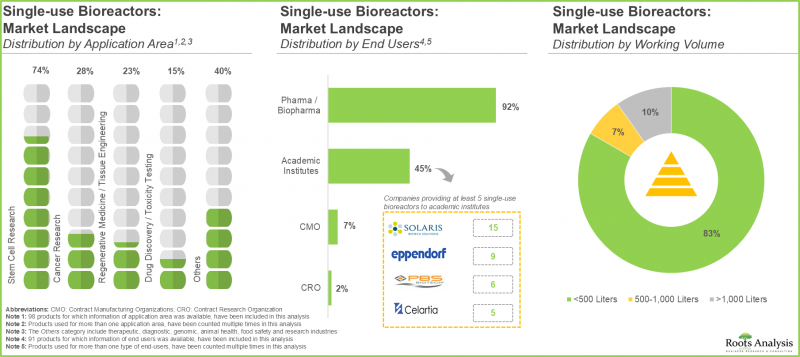
일회용 바이오리액터의 대부분은 제약, 바이오의약품 업계에서 사용되고 있으며, 그 대부분이 다양한 응용 분야에 도입되고 있습니다.
일회용 믹서의 90% 이상은 성분의 균일한 조성을 얻기 위해 액체 혼합 시스템을 채용하고 있으며, 이러한 믹서의 상당한 비율은 모든 규모의 조작에 사용할 수 있습니다.
경쟁 우위를 확보하기 위해 개발자는 각 제품에 고급 기능을 도입하는 데 주력하고 있습니다.
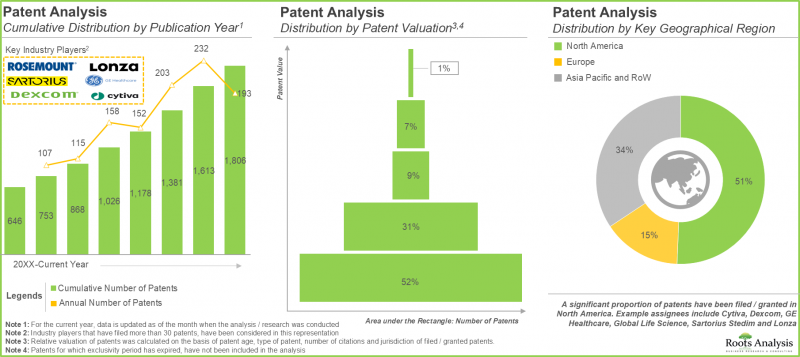
일회용 바이오프로세싱 기술과 관련된 1,800건 이상의 특허가 업계 내외의 다양한 참가 기업에 의해 출원되고 있습니다. 이는 이 분야의 연구와 혁신의 속도가 가속화되고 있음을 보여줍니다.
비용 절감 가능성 및 기타 이점으로 일회용 기술의 채택은 앞으로 더욱 확대될 것으로 예측됩니다.
사전 교정된 센서의 57%는 플로우 센서이며, 모든 일회용 센서는 감마선 조사별 멸균 기술을 채용하고 있습니다.
현재 시장 상황은 전통 기업과 신규 진출기업이 모두 존재한다는 특징이 있습니다. 대부분의 기업들은 선진지역에 본사를 두고 있습니다.
이해관계자들은 일회용 기술에 대한 수요 증가에 대응하고 각각의 제품 포트폴리오를 강화하기 위해 오랜 세월에 걸쳐 강력한 브랜드 포지션을 확립해 왔습니다.
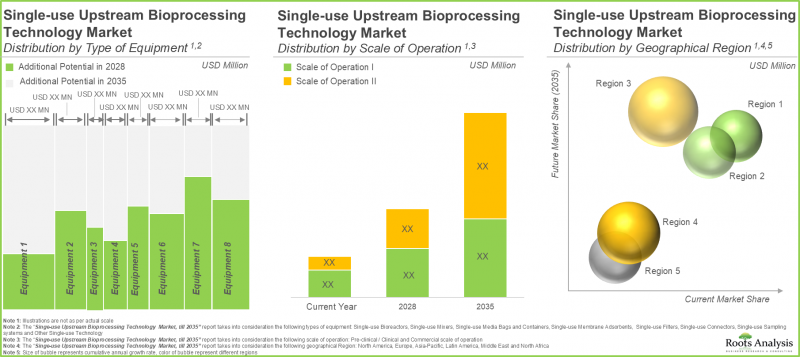
향후 10년간 시장은 CAGR 11.7%를 나타낼 것으로 예측됩니다. 이 기회는 사업 규모, 장비 유형, 지리적 지역 등 다양한 분야에 널리 분산될 전망입니다.
일회용 바이오프로세싱 시장 - 시장 부문
전임상 및 임상 규모는 프로바이오틱스 시장에서 가장 성장이 빠른 부문입니다.
운용 규모의 관점에서 세계의 일회용 바이오프로세싱 기술 시장은 전임상 및 임상규모와 상업규모로 구분됩니다. 현재 시장의 대부분(87%)은 전임상 및 임상규모가 차지하고 있습니다. 또한 임상 규모 부문은 향후 수년간 더 높은 CAGR(10%)로 성장할 전망입니다.
예측 기간 동안 일회용 필터 카트리지는 높은 CAGR로 성장할 것으로 예상
기간
제품 유형별로 세계 시장은 일회용 바이오리액터, 일회용 혼합 시스템, 일회용 배지 백, 일회용 필터, 일회용 샘플링 시스템, 일회용 커넥터, 일회용 멤브레인 흡착제, 일회용 필터 카트리지로 구분됩니다. 이러한 유형 중에서 일회용 필터 카트리지는 예측 기간 동안 가장 높은 성장률을 나타낼 것으로 예상되며, 이어서 배지 백 및 일회용 샘플링 시스템이 이어질 것으로 예측됩니다.
예측 기간 동안 일회용 필터 카트리지는 높은 CAGR로 성장할 것으로 예상
기간
제품 유형별로 세계 시장은 일회용 바이오리액터, 일회용 혼합 시스템, 일회용 배지 백, 일회용 필터, 일회용 샘플링 시스템, 일회용 커넥터, 일회용 멤브레인 흡착제 및 일회용 필터 카트리지로 구분됩니다. 이러한 유형 중에서 일회용 필터 카트리지는 예측 기간 동안 가장 높은 성장이 예상되고, 이어서 배지 백 및 일회용 샘플링 시스템이 이어질 것으로 예측됩니다.
예측기간 동안 아시아태평양이 시장 성장을 이끌 전망
지역별로 세계 시장은 북미, 유럽, 아시아태평양, 라틴아메리카, 중동 및 북아프리카로 구분됩니다. 이 중 아시아태평양이 최대 시장 점유율(35%)을 차지하고 북미(30%), 유럽(25%)이 이어질 것으로 예측됩니다.
일회용 바이오프로세싱 기술 시장의 대표적인 진출기업
Avantor
Cytiva
Eppendorf
Merck KGaA
Pall
Premas Biotech
REPROCELL
Saint-Gobain
Sartorius
Satake Multimix
Thermo Fisher Scientific
일회용 바이오프로세싱 시장 - 조사 범위
시장 규모 및 기회 분석 : 본 보고서는 (A)제품 유형, (B)운영 규모, (C)지리적 지역과 같은 주요 시장 부문에 초점을 맞춘 일회용 바이오프로세싱 시장에 대한 상세한 분석을 제공합니다.
시장 상황 1 : (A)운영 규모, (B)세포 배양 시스템 유형, (C)세포 배양 유형, (D)분자 유형, (E)주요 특징, (F)용도, (G)최종 사용자 등 여러 관련 매개변수를 기반으로 한 일회용 바이오리액터의 전체 시장 환경에 대한 상세한 평가를 제공합니다.
시장 상황 2 : 일회용 믹서의 전체 시장 상황에 대해 관련 매개 변수를 기반으로 자세히 평가합니다.
시장 상황 3 : 일회용 센서 시장 상황에 대한 자세한 평가를 다음과 같은 관련 매개변수를 기반으로 제공합니다: (A)센서 유형, (B)바이오프로세스 유형, (C)측정 범위, (D)작동 온도, (E)살균 기술, (F)사용 재료, (G)응용 분야, (H)설립 연도, (I)기업 규모, (J)지리적 전개.
기업 경쟁력 분석 : 일회용 바이오리액터에 대한 종합적인 경쟁력 분석을 (A)제품의 적용 가능성, (B)제품의 강점과 같은 요소를 바탕으로 제공합니다.
기업 프로파일 : 본 분야에서 활동하는 주요 기업의 상세한 프로파일을 제공합니다. 현재 일회용 업스트림 바이오프로세싱 기술을 제공하는 주요 바이오프로세싱 기업에 초점을 맞춰 북미, 유럽, 아시아태평양에 본사를 두고 있는 기업에 대해 (A)설립연도, (B)본사 소재지, (C)의약품 포트폴리오, (D)최근 동향, (E)미래 전망을 분석합니다.
특허 분석 : 일회용 업스트림 바이오프로세스 기술에 관하여 출원, 등록된 각종 특허의 상세한 분석을 관련 매개변수에 따라 (A)특허 유형, (B)공개 연도, (C)출원년, (D)관련 발급 기관, (E)조직 유형, (F)신흥 중점 영역, (G)특허의 경과 연수, (H)CPC 분류 기호, (I)주요 특허권리자, (J)특허 특성, (K)지역을 바탕으로 제공합니다.
브랜드 포지셔닝 분석 : 주요 업계 진출기업의 상세한 브랜드 포지셔닝을 분석합니다. 각 회사의 독자 제품에 대한 현재의 인식을 (A)제조업체의 실적, (B)제공 제품수, (C)제품의 다양성, (D)공개특허건수 등 여러 관련 요소를 고려하여 제시합니다.
비용 및 시간 절감 가능성 : 일회용 업스트림 바이오프로세스 기술별 비용 절감 및 시간 단축 가능성에 대한 자세한 분석을 수행합니다.
목차
제1장 서문
제2장 주요 요약
제3장 소개
개요
일회용 업스트림 바이오프로세스 기술의 개요
일회용 업스트림 바이오프로세스 기술의 역사적 진화
일회용 업스트림 바이오프로세스 기술 유형
일회용 업스트림 바이오프로세스 기술의 응용
일회용 업스트림 바이오프로세스 기술과 관련된 주요 과제
장래의 전망
제4장 시장 상황 : 일회용 바이오리액터
개요
일회용 바이오리액터 : 제품 리스트
일회용 바이오리액터 : 개발 전망
제5장 시장 상황 : 일회용 믹서
개요
일회용 믹서 : 제품 일람
일회용 믹서 : 개발 전망
제6장 시장 상황 : 일회용 센서
개요
일회용 센서 : 제품 일람
일회용 센서 : 개발 전망
제7장 시장 상황 : 기타 일회용 업스트림 바이오프로세스 기술
개요
일회용 배지 백과 용기
일회용 필터
일회용 샘플링 시스템
일회용 커넥터
제8장 제품 경쟁력 분석
개요
조사 방법
전제 및 주요 파라미터
제품 경쟁력 분석 : 일회용 바이오리액터
제품 경쟁력 분석 : 일회용 믹서
제품 경쟁력 분석 : 일회용 센서
제9장 북미의 일회용 업스트림 바이오프로세스 기술 제공업체 : 기업 프로파일
개요
Avantor
Cytiva
Merck KGaA
Pall
Thermo Fisher Scientific
제10장 유럽의 일회용 업스트림 바이오프로세스 기술 제공업체 : 기업 프로파일
개요
Eppendorf
Saint-Gobain
Sartorius
제11장 아시아태평양의 일회용 업스트림 바이오프로세스 기술 제공업체 : 기업 프로파일
개요
Satake Multimix
REPROCELL
Premas Biotech
제12장 특허 분석
개요
범위와 조사 방법
일회용 업스트림 바이오프로세스 기술 : 특허 분석
특허 벤치마킹 분석
특허 평가별 분석
제13장 브랜드 포지셔닝 매트릭스
개요
조사 방법
주요 파라미터
일회용 바이오리액터 개발 기업의 브랜드 포지셔닝 매트릭스
일회용 믹서 개발 기업의 브랜드 포지셔닝 매트릭스
일회용 센서 개발 기업의 브랜드 포지셔닝 매트릭스
제14장 사례 연구 : 일회용 업스트림 바이오프로세스 기술별 비용 및 시간 절약 가능성
제15장 수요 및 공급 분석
개요
주요 전제와 조사 방법
바이오의약품의 세계 수요(-2035년)
결론
제16장 시장 예측과 기회 분석
개요
예측 조사 방법과 주요 전제조건
세계의 일회용 업스트림 바이오프로세스 기술 시장(-2035년)
제17장 결론
개요
제18장 주요 인사이트
제19장 부록 1 : 표 형식 데이터
제20장 부록 2 : 기업 및 단체 일람
CSM
영문 목차
영문목차
Single Use Bioprocessing Market: Overview
As per Roots Analysis, the single use bioprocessing market is estimated to grow from USD 5.1 billion in the current year to USD 15.5 billion by 2035, at a CAGR of 11.7% during the forecast period, till 2035.
Single Use Bioprocessing Market
The market sizing and opportunity analysis has been segmented across the following parameters:
Type of Product
Single Use Bioreactors
Single Use Mixers
Single Use Media Bags
Single Use Filters
Single Use Sampling Systems
Single Use Connectors
Others
Scale of Operation
Preclinical / Clinical
Commercial
Geographical Regions
North America
Europe
Asia-Pacific
Middle East and North Africa
Latin America
Single Use Bioprocessing Market: Growth and Trends
Biologics has become increasingly popular due to their therapeutic effectiveness, positive safety profiles, and capacity to address a range of disease indications that are otherwise difficult to manage. The effectiveness of these interventions encouraged the stakeholders to enhance the conventional biologics contract manufacturing technology. The need for enhanced productivity and flexibility, improved profitability, and quicker market delivery is further accelerating the shift from conventional stainless-steel equipment to single-use technologies, such as single-use mixers and single-use bioreactors. These disposable technologies have gained acceptance in a relatively brief time frame and have emerged as a crucial resource in the advancement of numerous biotechnological processes.
Additionally, the COVID-19 pandemic has driven the biopharmaceutical sector to adopt single-use technology. These single-use bioprocessing technologies reduce the footprint requirement and remove cleaning expenses during the development phase. Moreover, single-use bioprocessing technologies can tackle several issues linked to conventional bioprocessing systems and provide numerous extra advantages, including reduced water and energy use (by approximately 45%), lower capital investment (by 40%), shorter processing time for biologics (by 33%), diminished cross-contamination risk (by 8%), and greater potential for cost savings (by 30-40%).
Currently, numerous single-use bioprocessing firms are involved in developing and producing single-use upstream bioprocessing technologies and tools, including single-use bioreactors, single-use mixers, single-use filters, single-use media bags and containers, single-use sampling systems, and single-use connectors. Additionally, several of these bioprocessing firms are concentrating on adding extra functionalities, such as alert / notification systems, integrated process control sensors, digital process logs, remote supervision capabilities, touchscreen interfaces, and enhanced safety measures, to their proprietary products. The utilization of this single-use technology comes with various challenges, including the risks associated with extractables and leachable, disposal of single-use technology, sterilization / irradiation complications, and possible inconsistencies in the resins. However, due to ongoing sustainability research and other technical developments, we believe that the potential for technology providers in the single-use bioprocessing market is expected to see significant growth throughout the forecast period.
Single Use Bioprocessing Market: Key Insights
The report delves into the current state of the single use bioprocessing market and identifies potential growth opportunities within industry. Some key findings from the report include:
Over 500 single-use upstream bioprocessing equipment are currently commercially available / being developed; single-use bioreactors, single-use sensors and single-use mixers are steadily gaining traction.
In addition, companies have developed a variety of single-use media bags, single-use filters, single-use connectors and single-use sampling systems; these systems are inbuilt with various key features.
Majority of the single-use bioreactors are being used by the pharmaceutical / biopharmaceutical industry; of these, several have been deployed across different application areas.
Over 90% of the single-use mixers use liquid / liquid mixing system to obtain uniform composition of the components; a significant proportion of these mixers can be used across all scales of operations.
In pursuit of gaining a competitive edge, developers are focusing on introducing advanced features in their respective products.
More than 1,800 patents related to single-use bioprocessing technology have been filed by various industry and non-industry players; this is indicative of the heightened pace of research and innovation in this field.
Owing to the cost saving potential and other benefits of single-use technology, the adoption of this technology is expected to ration.
57% of the pre-calibrated sensors are flow sensors; all the single-use sensors use gamma-irradiation sterilization technique.
The current market landscape features the presence of both well-established firms and new entrants; most of the companies are headquartered in developed regions.
Over time, stakeholders have established strong brand positions in order to cater to the increasing demand for single-use technology and to enhance their respective product portfolio.
The market is anticipated to grow at a CAGR of 11.7% in the coming decade; the opportunity is likely to be well distributed across different scales of operation, type of equipment and geographical regions.
Single Use Bioprocessing Market: Market Segments
Preclinical and Clinical Scale is the Fastest Growing Segment of the Probiotics Market
In terms of scale of operation, the global market for single-use bioprocessing technology market is segmented into preclinical and clinical scale, and commercial scale. Currently, majority share (87%) of the market is captured by preclinical and clinical scale. Further, the clinical scale segment is likely to grow at a higher CAGR (10%) in the coming years.
Disposable Filter Cartridges are Likely to Grow at a Higher CAGR During the Forecast
Period
Based on the type of product, the global market is segmented into single-use bioreactors, single-use mixing systems, single-use media-bags, single-use filters, single-use sampling system, single-use connectors, single-use membrane adsorbents, and single-use membrane adsorbents. amongst these types, the disposable filter cartridges are likely to witness highest growth during the forecast period, followed by media bags and single-use sampling system.
Disposable Filter Cartridges are Likely to Grow at a Higher CAGR During the Forecast
Period
In terms of the type of product, the global market is segmented into single-use bioreactors, single-use mixing systems, single-use media-bags, single-use filters, single-use sampling system, single-use connectors, single-use membrane adsorbents, and single-use membrane adsorbents. amongst these types, the disposable filter cartridges are likely to witness highest growth during the forecast period, followed by media bags and single-use sampling system.
Asia-Pacific is Likely to Propel the Market Growth During the Forecast Period
In terms of the geographical regions, the global market is segmented into North America, Europe, Asia-Pacific, Latin America and Middel East and North Africa. Amongst these, Asia-Pacific is likely to capture most of the market share (35%), followed by North America (30%) and Europe (25%).
Example Players in the Single-use Bioprocessing Technology Market
Avantor
Cytiva
Eppendorf
Merck KGaA
Pall
Premas Biotech
REPROCELL
Saint-Gobain
Sartorius
Satake Multimix
Thermo Fisher Scientific
Single Use Bioprocessing Market: Research Coverage
Market Sizing and Opportunity Analysis: The report features an in-depth analysis of the single use bioprocessing market, focusing on key market segments, including [A] type of product, [B] scale of operation, and [C] geographical regions.
Market Landscape 1: A detailed assessment of overall market landscape of single-use bioreactors based on several relevant parameters, such as [A] scale of operation, [B] type of cell culture system, [C] type of cell culture, [D] type of molecule, [E] key features, [F] application and [G] end users.
Market Landscape 2: A detailed assessment of the overall market landscape of single-use mixers based on a number of relevant parameters, such as [A] scale of operation, [B] type of mixing system, [C] type of molecule, [D] key features [E] application area, [F] year of establishment, [G] company size, and [H] geographical presence.
Market Landscape 3: A detailed assessment of the overall market landscape of single-use sensors, based on several relevant parameters, such as [A] type of sensor, [B] type of bioprocessing, [C] measurement range, [D] operating temperature, [E] sterilization technique, [F] material used [G] application area, [H] year of establishment, [I] company size, and [J] geographical presence.
Company Competitiveness Analysis: A comprehensive competitive analysis of single use bioreactors, examining factors, such as [A] product applicability and [B] product strength.
Company Profiles: In-depth profiles of prominent players engaged in this domain, that are currently involved key bioprocessing companies providing single-use upstream bioprocessing technologies, which are headquartered in North America, Europe and Asia-Pacific, focusing on [A] year of establishment, [B] location of headquarters, [C] drug portfolio, [D] recent developments and [E] an informed future outlook.
Patent Analysis: An in-depth analysis of various patents that have been filed / granted for single-use upstream bioprocessing technology, based on relevant parameters, including [A] type of patents, [B] publication year, [C] application year, [D] issuing authorities involved, [E] type of organizations, [F] emerging focus area, [G] patent age, [H] CPC symbols, [I] leading patent assignees, [J] patent characteristics and [K] geography.
Brand Positioning Analysis: A detailed brand positioning analysis of the key industry players, highlighting the current perceptions regarding their proprietary products by taking into consideration several relevant aspects, such as [A] experience of the manufacturer, [B] number of products offered, [C] product diversity, and [D] number of patents published.
Cost and Time Saving Potential: An in-depth analysis of the cost and time saving potential of single-use upstream bioprocessing technology.
Key Questions Answered in this Report
How many companies are currently engaged in this market?
Which are the leading companies in this market?
What is the current global capacity of developers?
What factors are likely to influence the evolution of this market?
What is the current and future market size?
What is the CAGR of this market?
How is the current and future market opportunity likely to be distributed across key market segments?
Reasons to Buy this Report
The report provides a comprehensive market analysis, offering detailed revenue projections of the overall market and its specific sub-segments. This information is valuable to both established market leaders and emerging entrants.
Stakeholders can leverage the report to gain a deeper understanding of the competitive dynamics within the market. By analyzing the competitive landscape, businesses can make informed decisions to optimize their market positioning and develop effective go-to-market strategies.
The report offers stakeholders a comprehensive overview of the market, including key drivers, barriers, opportunities, and challenges. This information empowers stakeholders to stay abreast of market trends and make data-driven decisions to capitalize on growth prospects.
Additional Benefits
Complimentary PPT Insights Packs
Complimentary Excel Data Packs for all Analytical Modules in the Report
15% Free Content Customization
Detailed Report Walkthrough Session with Research Team
Free Updated report if the report is 6-12 months old or older
TABLE OF CONTENTS
1. PREFACE
1.1. Overview
1.2. Scope of the Report
1.3. Research Methodology
1.4. Key Questions Answered
1.5. Chapter Outlines
2. EXECUTIVE SUMMARY
3. INTRODUCTION
3.1. Chapter Overview
3.2. Overview of Single-use Upstream Bioprocessing Technology
3.3. Historical Evolution of Single-use Upstream Bioprocessing Technology
3.4. Types of Single-use Upstream Bioprocessing Technology
3.5. Applications of Single-use Upstream Bioprocessing Technology
3.6. Key Challenges Associated with Single-use Upstream Bioprocessing Technology
3.7. Future Perspective
4. MARKET LANDSCAPE: SINGLE-USE BIOREACTORS
4.1. Chapter Overview
4.2. Single-use Bioreactors: List of Products
4.2.1. Analysis by Type of Bioreactor
4.2.2. Analysis by Scale of Operation
4.2.3. Analysis by Type of Cell Culture System
4.2.4. Analysis by Type of Cell Culture
4.2.5. Analysis by Type of Molecule Processed
4.2.6. Analysis by Key Features
4.2.7. Analysis by Application Area
4.2.8. Analysis by End Users
4.3. Single-use Bioreactors: Developer Landscape
4.3.1. Analysis by Year of Establishment
4.3.2. Analysis by Company Size
4.3.2. Analysis by Year of Establishment and Company Size
4.3.3. Analysis by Location of Headquarters
4.3.4. Leading Developers: Analysis by Number of Single-use Bioreactors
5. MARKET LANDSCAPE: SINGLE-USE MIXERS
5.1. Chapter Overview
5.2. Single-use Mixers: List of Products
5.2.1. Analysis by Scale of Operation
5.2.2. Analysis by Type of Mixing System
5.2.3. Analysis by Stage of Bioprocessing
5.2.4. Analysis by Type of Molecule Processed
5.2.5. Analysis by Key Features
5.2.6. Analysis by Application Area
5.3. Single-use Mixers: Developer Landscape
5.3.1. Analysis by Year of Establishment
5.3.2. Analysis by Company Size
5.3.3. Analysis by Location of Headquarters
5.3.4. Analysis by Year of Establishment and Location of Headquarters
5.3.5. Leading Developers: Analysis by Number of Single-use Mixers
6. MARKET LANDSCAPE: SINGLE-USE SENSORS
6.1. Chapter Overview
6.2. Single-use Sensors: List of Products
6.2.1 Analysis by Type of Sensor
6.2.2. Analysis by Stage of Bioprocessing
6.2.3. Analysis by Operating Temperature
6.2.4. Analysis by Sterilization Technique
6.2.5. Analysis by Sensor Calibration
6.2.6. Analysis by Type of Material Used
6.2.7. Analysis by Application Area
6.3. Single-use Sensors: Developer Landscape
6.3.1. Analysis by Year of Establishment
6.3.2. Analysis by Company Size
6.3.3. Analysis by Location of Headquarters
6.3.4. Leading Developers: Analysis by Number of Single-use Sensors
7. MARKET LANDSCAPE: OTHER SINGLE-USE UPSTREAM BIOPROCESSING TECHNOLOGIES