


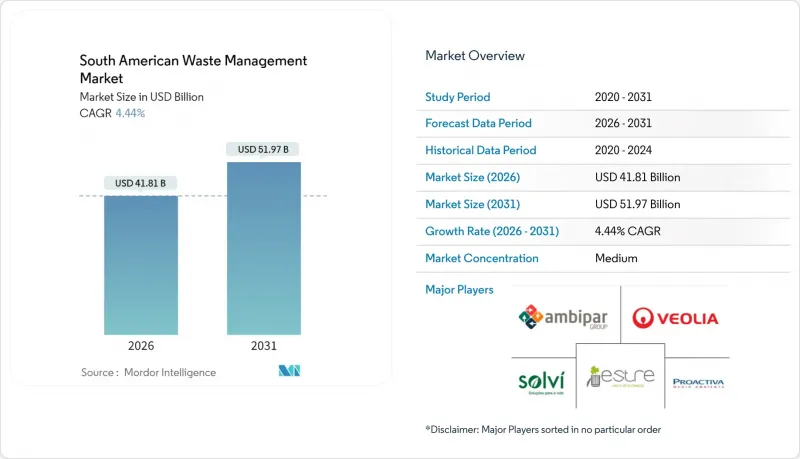
남미의 폐기물 관리 시장은 2025년 400억 3,000만 달러에서 2026년에는 418억 1,000만 달러로 성장하여 2026년부터 2031년까지 CAGR 4.44%를 기록하며 2031년까지 519억 7,000만 달러에 달할 것으로 예측됩니다.
인구 증가, 급속한 도시화, 규제 강화(특히 2024년 6월에 발표된 브라질의 국가 순환경제 전략)가 수요 전망을 뒷받침하는 한편, 그린본드의 유입은 폐기물 에너지화(WtE) 및 고도의 재활용 자산 도입을 가속화하고 있습니다. 지역 정부는 매립세를 인상하고, 생산자는 의무적인 회수 목표에 직면하고 있으며, 전통적인 폐기 모델에서 자원 회수 플랫폼으로 꾸준히 전환하고 있습니다.
남미의 도시는 수십 년 만에 가장 빠른 속도로 성장하고 있으며, 브라질의 도시 지역에서는 연간 8,300만 톤 이상의 일반 폐기물이 발생하고 있습니다. 현재 이 폐기물의 4-5%만이 공식적인 수거를 받고 있으며, 이는 큰 처리 능력의 부족을 드러내는 동시에 수거부터 처리까지 통합된 플랫폼에 매력적인 틈새 시장을 열어주고 있습니다. 메딜린과 같은 콜롬비아의 도시들은 비공식적인 수거업자 협동조합을 지자체 서비스 계약에 통합하는 모델을 시범적으로 도입하여 사회적 포용과 규모의 효율성이 공존할 수 있다는 것을 입증하고 있습니다. 지방 도시로의 인구 집중은 물류의 복잡성을 증가시키는 반면, 경로 밀도의 이점을 가져와 톤당 수집 비용을 절감할 수 있습니다. 지자체 지도자들은 새로운 매립지만으로는 증가하는 폐기물을 흡수할 수 없다는 것을 점점 더 잘 알고 있으며, 재활용과 에너지 회수 자산을 핵심으로 하는 멀티 스트림 시스템의 필요성이 더욱 커지고 있습니다.
규제 개혁이 구조적 변화를 주도하고 있습니다. 브라질의 국가 순환 경제 전략은 생산자에게 제품 재설계 및 재사용을 우선시하도록 의무화하고, 사업자에게 고처리 용량 선별 라인과 첨단 소재 재활용 시설에 대한 투자를 장려하고 있습니다. 칠레 법률 20.920호는 생산자 책임을 포장재, 전자제품, 배터리로 확대하고, 2023년부터 단계적으로 시행되는 강제 회수 목표를 설정하고 있습니다. 이러한 규제는 감사 가능한 자원 회수 지표로 컴플라이언스를 증명할 수 있는 사업자에게 경쟁 우위를 부여하고 있습니다. 광학 선별기, 바이오디게스터, 폐기물 유래 연료(RDF) 시스템 장비 공급업체들은 이러한 의무와 관련된 입찰 건수가 증가하고 있다고 보고하고 있습니다. 장기적으로는 이 법규로 인해 원자재 수입이 억제되고, 산업 수요가 현지에서 회수한 원자재로 전환될 것으로 예상됩니다.
비공식 재활용 업체는 브라질에서 회수되는 재활용 물질의 약 90%를 회수하고 있지만, 세제 및 안전 규정의 틀 밖에서 활동하고 있습니다. 상파울루 주에서 협동조합을 공식화하려는 노력은 2017년까지 길거리 수거자의 1% 미만에 불과해 사회적, 경제적, 물류적 장벽이 얼마나 큰지 알 수 있었습니다. 고부가가치 재활용품의 수집 효율은 매립지 수요를 감소시키지만, 비협조적인 선별은 재료의 품질을 떨어뜨리고 공식적인 계약자의 경로 계획을 복잡하게 만듭니다. 브라질 25개 지방 자치단체의 통합 프로그램은 수거자 주도의 선별 센터가 훈련과 장비를 제공함으로써 수거 비용을 톤당 35달러(기존 호별 수거 모델은 195.3달러)로 낮출 수 있다는 것을 보여줍니다. 그러나 성공 여부는 지자체의 안정적인 자금 지원과 투명한 수익 분배에 달려있습니다.
2025년 기준 남미 폐기물 관리 시장의 56.02%를 차지하는 주거용 폐기물은 수거업체들의 경로 계획과 자본 배분 결정의 기초가 되고 있습니다. 주택 쓰레기는 양이 많을 뿐만 아니라 유기물부터 연성 플라스틱까지 구성이 다양하기 때문에 고도의 선별 및 이송 능력이 요구됩니다. 대도시의 수거 커버율은 90% 이상이지만, 자원 회수율은 여전히 10% 미만으로, 고도의 문별 분리수거와 종량제 시험 도입의 여지를 보여주고 있습니다. 주택 폐기물의 방대한 규모는 IoT 지원 수거 컨테이너 및 트럭 배차 최적화 분석 플랫폼을 제공하는 기술 벤더에게 매력적인 시장입니다. 계량전표 데이터를 자동화하는 사업자는 청구 정확도를 향상시키는 동시에 폐기물 에너지화(WtE) 투자자가 원하는 원료 공급 보장을 실현할 수 있습니다.
상업용 폐기물은 보고타, 산티아고, 리마에서 소매 및 접객업의 성장에 힘입어 2031년까지 CAGR 6.22% 성장하며 가장 빠른 성장 동력으로 부상할 것으로 예상됩니다. 직업 위생 규제 강화로 인해 쇼핑몰과 호텔은 라이선스 업체와의 계약을 추진하고 있습니다. 브랜드 소유자의 ESG 목표는 폐쇄 루프 포장 프로그램에 대한 수요를 자극하고 있습니다. 산업폐기물 분야에서는 브라질의 수입규제령이 전략물자의 국내 재처리를 우선시하는 정책을 내놓으면서 감시가 강화되었고, 공장들은 현지 회수 파트너를 확보해야 하는 상황에 처해 있습니다. 음료 브랜드가 자사 공장 내에 포장기를 설치하고 압축 PET를 재활용업체에 직접 판매하는 '전 공정 통합' 추세가 나타나면서 중간상인의 존재감이 줄어들고 있습니다. 건설 폐기물은 여전히 서비스가 가장 부족한 분야이지만, 콜롬비아와 페루의 폐기물 처리세 인상으로 인해 파쇄 및 재사용 사업에 대한 인센티브가 생겨나고 있습니다.
The South American Waste Management Market is expected to grow from USD 40.03 billion in 2025 to USD 41.81 billion in 2026 and is forecast to reach USD 51.97 billion by 2031 at 4.44% CAGR over 2026-2031.
Population growth, rapid urbanization, and tightening regulations, especially Brazil's National Circular Economy Strategy of June 2024, anchor the demand outlook, while green-bond inflows are accelerating the deployment of waste-to-energy (WtE) and advanced recycling assets. Regional governments are raising landfill taxes, and producers face mandatory collection targets, driving a measured pivot from linear disposal models to resource-recovery platforms.
South America's cities are expanding at their fastest pace in decades, with Brazil's urban centers generating more than 83 million tons of municipal solid waste annually. Only 4-5% of this material presently undergoes formal recovery, which underscores the sizable capacity gap and opens attractive niches for integrated collection-to-treatment platforms. Colombian hubs such as Medellin are piloting models that fold informal picker cooperatives into municipal service contracts, proving that social inclusion and scale efficiencies can coexist. The concentration of population in secondary cities compounds the logistical complexity, yet also yields route-density advantages that can lower per-ton collection costs. Municipal leaders increasingly accept that new landfills alone cannot absorb climbing waste volumes, reinforcing the case for multi-stream systems anchored by recycling and energy recovery assets.
Regulatory reform is driving structural change. Brazil's National Circular Economy Strategy obliges producers to redesign products and prioritize reuse, compelling operators to invest in high-throughput sorting lines and advanced material-recycling facilities. Chile's Law 20.920 extends producer responsibility to packaging, electronics, and batteries, with enforceable collection targets that began phasing in during 2023. These rules tilt the competitive field toward players that can back up compliance claims with auditable resource-recovery metrics. Equipment suppliers of optical sorters, biodigesters, and refuse-derived-fuel (RDF) systems report increasing tenders tied to these mandates. Over the long haul, the legislation is expected to curb raw-material imports, channeling industrial demand toward locally recovered feedstock.
Informal recyclers recover nearly 90% of Brazil's recycled materials, yet operate outside tax and safety frameworks. Attempts to formalize cooperatives in Sao Paulo captured fewer than 1% of street pickers by 2017, revealing the scale of social, economic, and logistical hurdles. While their efficiency in collecting high-value recyclables relieves landfill demand, uncoordinated sorting can degrade material quality and complicate route planning for formal contractors. Integration programs in 25 Brazilian municipalities show that with training and equipment, picker-led sorting centers can cut collection costs to USD 35 per ton versus USD 195.3 for conventional curbside models. Success, however, hinges on steady municipal funding and transparent revenue-sharing.
Other drivers and restraints analyzed in the detailed report include:
For complete list of drivers and restraints, kindly check the Table Of Contents.
Residential waste streams captured 56.02% of the South American waste management market share in 2025, anchoring route planning and capital-allocation decisions for collectors. Household refuse is not only voluminous but also compositionally diverse, ranging from organics to flexible plastics, which demands sophisticated sorting and transfer capacity. Collection coverage in large cities tops 90%, yet material recovery remains below 10%, signaling room for advanced curbside segregation and pay-as-you-throw pilots. The residential stream's sheer scale is a magnet for technology vendors offering IoT-enabled collection bins and analytics platforms that optimize truck dispatch. Operators that automate weigh-ticket data improve billing accuracy and unlock feedstock assurances sought by WtE financiers.
Commercial waste is advancing at a 6.22% CAGR, emerging as the fastest-growing source through 2031 on the back of retail and hospitality expansion across Bogota, Santiago, and Lima. Stricter occupational health rules push malls and hotels to contract licensed handlers, while brand-owner ESG targets stimulate demand for closed-loop packaging programs. Industrial waste streams face rising scrutiny as Brazil's import-control decree prioritizes domestic reprocessing of strategic materials, nudging factories to secure local recovery partners. A forward integration trend is observable where beverage brands install on-site balers and sell compacted PET directly to recyclers, squeezing out intermediaries. Construction debris remains the least served, yet rising disposal taxes in Colombia and Peru present incentives for crushing and reuse businesses.
The South American Waste Management Market Report is Segmented by Source (Residential, Commercial, Industrial, and More), by Service Type (Collection, Transportation, Sorting & Segregation, and More), by Waste Type (Municipal Solid, Industrial Hazardous Waste, E-Waste, and More), and Geography (Brazil, Argentina, Chile, Colombia, Peru, and the Rest of South America). The Market Forecasts are Provided in Terms of Value (USD).