



베이스 오일 시장은 2025년 3,515만 톤에서 2026년에는 3,564만 톤으로 성장하며, 2026-2031년에 CAGR 1.40%로 추이하며, 2031년까지 3,818만 톤에 달할 것으로 예측되고 있습니다.
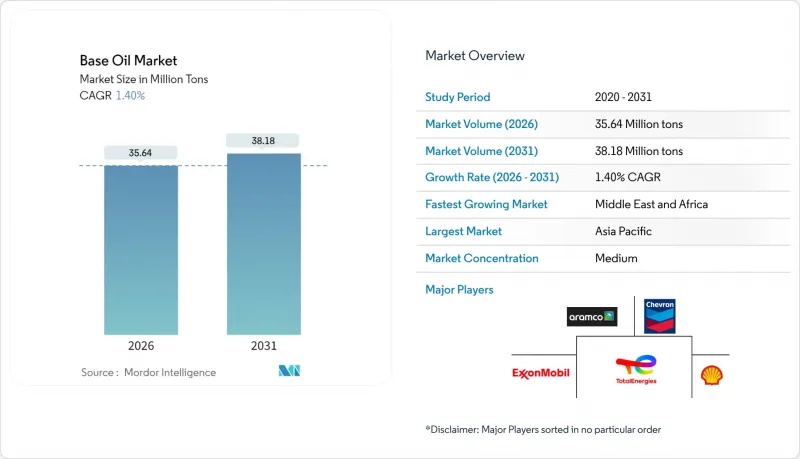
기유 시장의 꾸준한 성장은 주로 세 가지 요인에 의해 지원되고 있습니다. 첫째, 그룹 I에서 고성능 그룹 II 및 III로의 전환, 둘째, 세계 배출가스 규제 강화, 셋째, 전기자동차(EV) 구동계에서의 합성유 배합의 역할 확대입니다. 아시아태평양이 물량 측면에서 주도권을 쥐고 있는 가운데, 중동 및 아프리카이 가장 빠른 성장세를 기록해 원유 우위 지역으로공급망 재편이 점차 진행되고 있음을 보여주고 있습니다. 경쟁 우위는 수소화 처리 기술에 의존하고 있지만, 정유사들은 브렌트-두바이 가격차 축소로 인한 마진 압박과 촉매 갱신에 대한 자본 지출 증가에 직면해 있습니다. 데이터센터용 침지형 냉각수 및 순환 경제 목표를 달성하기 위한 폐쇄형 루프 재정제 구상에 새로운 기회가 생겨나고 있습니다.
아시아태평양의 제조업 호황은 기유 시장의 신규 수요의 대부분을 지원하고 있습니다. 중국은 2024년 하루 1,480만 배럴의 원유를 처리하여 금속 가공유와 유압유에 대한 견고한 수요를 창출했습니다. 통합 정유-석유화학 단지 네트워크의 확장으로 운영의 유연성이 높아져 생산자들은 가장 수익성이 높은 기초 원료 등급으로 생산을 전환할 수 있게 되었습니다. 페트로나스는 2025-2027년 전망에서 하루 200만 배럴 상당의 생산량을 계획하고 있으며, 2028년 바이오리파이너리 가동 개시를 배경으로 특수화학 분야로의 다운스트림 사업 확대를 추진하고 있습니다. 이러한 투자는 이 지역이 기유 시장에서 우위를 점하는 동시에 기존 그룹 I 생산능력의 대체를 가속화할 것입니다.
유로7 기준의 채택으로 모든 소형차 가솔린 엔진에 미립자 포집 필터 시스템 장착이 의무화됨에 따라 초저휘발성 그룹 III 원료유에 대한 수요가 증가할 것으로 예측됩니다. 중국에서 동시에 도입되는 중국 VII 표준은 저SAPS 윤활유에 대한 요구를 강화하고, 2022-2026년까지 승인된 44개의 정유 프로젝트가 국내 공급을 강화할 것으로 예측됩니다. 2025년 3월 31일 시행되는 ILSAC GF-7은 10%의 연비 향상을 요구하며, 블렌더를 고품질 기유로 유도한다(ORONITE.COM). 이에 따라 수소화 분해장치와 수소화 이성화장치에 대한 투자가 몰리면서 기유 시장의 프리미엄화가 가속화되고 있습니다.
2024년 브렌트 두바이유 스프레드가 일시적으로 마이너스로 전환되어 VGO 기반 기유 원료에 필수적인 중유황원유공급 부족을 시사했습니다. 쿠웨이트, 오만, 나이지리아의 신규 정유소이 세계 생산능력을 끌어올리면서 마진이 압박을 받고 있으며, 리옹델바셀 휴스턴 등 일부 사업자들은 2025년 초까지 정유사업에서 철수할 것으로 예측됩니다. 이 같은 상황은 기유 시장의 독립적인 기업에게 가동률 감소와 노후 설비 폐쇄를 강요하고 있습니다.
그룹 II는 성능과 비용의 균형 잡힌 특성과 잘 구축된 유통망으로 2025년에도 42.20%의 기유 시장 점유율로 1위를 유지했습니다. 쉘이 웨셀링 공장에서 진행한 30만 톤 규모의 전환 프로젝트는 수소화 분해 제품에 대한 지속적인 신뢰를 지원하는 사례입니다. 그룹 III는 절대량은 작지만 초저휘발성, 고내산화성을 요구하는 유로7 규제와 EV 냉각수 규격의 보급으로 2031년까지 연평균 복합 성장률(CAGR) 4.05%로 확대될 것으로 예측됩니다. 이에 따라 그룹 III 기유 시장 규모는 예측 기간 중 다른 등급보다 높은 성장세를 보일 것으로 예측됩니다.
그룹 I은 용해성이 요구되는 특정 고무 가공유와 금속 가공유 분야에서 존속하고 있지만, 경제성 악화로 인해 폐쇄가 계속되고 있습니다. 그룹 V는 바이오 윤활유용 2차 폴리올 에스테르 등 다양한 화학 성분을 보유하고 있으며, 혁신의 길을 보완합니다. 전반적으로 기유 시장은 더 엄격한 OEM 사양과 지속가능성 목표를 충족시키기 위해 높은 API 그룹으로 이동하고 있습니다.
본 기유 보고서는 기유 유형별(그룹 I, 그룹 II, 그룹 III, 그룹 III, 그룹 IV, 기타), 용도별(엔진오일, 변속기 기어오일, 금속가공유, 유압유압유, 그리스, 기타 용도), 지역별(아시아태평양, 북미, 유럽, 남미, 중동 및 아프리카, 아시아, 유럽, 남미, 중동 및 아프리카) 중동 및 아프리카)로 분류됩니다. 시장 예측은 수량(백만 톤)으로 제공됩니다.
아시아태평양은 2025년 생산량의 46.30%를 차지할 것으로 예상되며, 중국의 하루 1,480만 배럴의 기록적인 원유 처리량과 2025년까지 완료 예정인 인도의 19조-22조 루피 규모의 확장 계획이 이를 지원하고 있습니다. 기유 시장은 마진에 따라 연료, 화학제품, 기유 생산을 전환할 수 있는 수직 통합형 복합시설의 혜택을 누리고 있습니다. 일본과 한국은 전자기기의 열 관리를 위한 정밀 합성 기술을 공급하고, 동남아시아 국가들은 지역 산업 수요에 대응하기 위해 생산 능력을 확충하고 있습니다.
중동 및 아프리카은 2031년까지 연평균 복합 성장률(CAGR) 3.33%로 세계에서 가장 빠른 성장세를 보일 것입니다. 아부다비 국영석유회사(ADNOC)의 35억 달러 규모의 루와이스 원유 유연화 프로젝트를 통해 고황 중질유 처리 및 그룹 II, III 제품의 최적화가 가능해집니다. 유럽에서는 마진 축소와 탈탄소화로의 전환이 진행되고 있으며, 토탈에너지의 그랑퓨리 정유소는 2026년까지 원유 제로 생산 플랫폼으로 전환할 예정입니다.
북미는 셰일 오일의 경제성으로 인해 특수 PAO 및 그룹 III 프로젝트에 대한 투자를 확대. 쉐브론의 패서디나 정유소 업그레이드를 통해 처리 용량이 하루 12만 5,000배럴로 증가했으며, 제트 연료의 유연성도 향상되었습니다. 남미에서는 브라질의 석유화학 통합으로 완만한 상승이 예상되지만, 거시경제의 변동성으로 인해 대규모 투자는 억제되고 있습니다. 지역적 추세를 종합하면 원유 우위 및 수요가 풍부한 지역으로 생산 능력이 점진적으로 확산되는 반면, 전통적 중심지는 전문화를 통해 적응을 시도하고 있습니다.
The Base Oil market is expected to grow from 35.15 million tons in 2025 to 35.64 million tons in 2026 and is forecast to reach 38.18 million tons by 2031 at 1.40% CAGR over 2026-2031.
The measured growth of the base oil market is underpinned by three forces: the migration from Group I to higher-performance Group II and III stocks, tightening global emission rules, and the expanding role of synthetic formulations in electric-vehicle (EV) drivetrains. Asia-Pacific commands volume leadership, yet the Middle East and Africa records the fastest expansion, signaling a gradual realignment of supply chains toward crude-advantaged regions. Competitive positioning hinges on hydroprocessing technology, while refiners confront margin pressure from compressed Brent-Dubai spreads and rising capital outlays for catalyst upgrades. Opportunities emerge in immersion-cooling fluids for data centers and closed-loop re-refining initiatives that meet circular-economy targets.
Asia-Pacific's manufacturing boom underpins a significant share of incremental base oil market demand. China processed 14.8 million barrels per day of crude in 2024, creating robust pull for metal-working and hydraulic fluids. An expanding network of integrated refinery-petrochemical complexes increases operational flexibility, enabling producers to shift yields toward the most profitable base-stock grades. PETRONAS projects 2 million barrels of oil-equivalent output per day in its 2025-2027 outlook, with a downstream push into specialty chemicals supported by a biorefinery startup in 2028. These investments solidify the region's pre-eminence in the base oil market and accelerate the displacement of legacy Group I capacity.
The adoption of Euro 7 standards obliges automakers to fit particulate-filter systems across all light-duty gasoline engines, upping demand for ultra-low-volatility Group III stocks. China's parallel China VII framework intensifies the requirement for low-SAPS lubricants, while forty-four refining projects approved between 2022-2026 are poised to reinforce local supply. ILSAC GF-7, effective 31 March 2025, calls for a 10% fuel-economy gain, nudging blenders toward higher-quality base oils [ORONITE.COM]. Hydrocracking and hydro-isomerization units thus attract capital, accelerating the premiumization of the base oil market.
The Brent-Dubai spread turned negative at times in 2024, signaling scarce medium-sour barrels crucial for VGO-based base-oil feed. New Kuwait, Oman, and Nigeria refineries lifted global capacity, depressing margins and driving some operators, such as LyondellBasell Houston, to exit refining by early 2025. The crunch pressures independent players in the base oil market to trim runs or shutter older assets.
Other drivers and restraints analyzed in the detailed report include:
For complete list of drivers and restraints, kindly check the Table Of Contents.
Group II maintained leadership with 42.20% of the base oil market share in 2025, owing to its balanced performance-cost equation and established distribution networks. Shell's 300,000-ton conversion at Wesseling underscores sustained confidence in hydrocracked stocks. Group III, though smaller on an absolute basis, advances at a 4.05% CAGR to 2031, buoyed by Euro 7 and EV-cooling mandates that call for ultra-low volatility and high oxidation resistance. The base oil market size for Group III is thus poised to expand faster than any other grade during the forecast horizon.
Group I endures in select rubber-processing and metal-working fluids requiring solvency, yet closures continue as economics deteriorate. Group V's diverse chemistries, including secondary polyol esters for bio-lubricants, round out innovation pathways. Altogether, the base oil market is migrating toward higher API groups to meet stricter OEM specifications and sustainability goals.
The Base Oil Report is Segmented by Base-Stock Type (Group I, Group II, Group III, Group IV, and Others), Application (Engine Oils, Transmission and Gear Oils, Metalworking Fluids, Hydraulic Fluids, Greases, and Other Applications), and Geography ( Asia-Pacific, North America, Europe, South America, and Middle-East and Africa). The Market Forecasts are Provided in Terms of Volume (Million Tons).
Asia-Pacific generated 46.30% of 2025 volume, underpinned by China's record 14.8 million barrels-per-day crude runs and India's INR 1.9-2.2 lakh crore expansion program slated for completion by 2025. The base oil market benefits from vertically integrated complexes able to toggle between fuels, chemicals, and base stocks as margins dictate. Japan and South Korea supply precision synthetic technology for electronics thermal management, while Southeast Asian nations add capacity to serve regional industrial demand.
The Middle East and Africa posts a 3.33% CAGR to 2031, the fastest globally. ADNOC's USD 3.5 billion Ruwais Crude Flexibility Project enables processing heavier sour crudes, optimizing Group II and III output. Europe contends with margin compression and decarbonization pivots such as TotalEnergies' Grandpuits conversion into a zero-crude platform by 2026.
North America, bolstered by shale-oil economics, invests in specialty PAO and Group III projects; Chevron's Pasadena upgrade lifts throughput to 125,000 barrels per day while raising jet-fuel flexibility. South America enjoys moderate upside from Brazil's petrochemical integration, although macro volatility dampens large-scale investments. Collectively, geographic dynamics reflect a gradual diffusion of capacity into crude-advantaged and demand-rich locales while traditional centers adapt through specialization.