Base Oil Market by Group, Application, and Region - Global Forecast to 2030
상품코드:1927585
리서치사:MarketsandMarkets
발행일:2026년 01월
페이지 정보:영문 317 Pages
라이선스 & 가격 (부가세 별도)
ㅁ Add-on 가능: 고객의 요청에 따라 일정한 범위 내에서 Customization이 가능합니다. 자세한 사항은 문의해 주시기 바랍니다.
한글목차
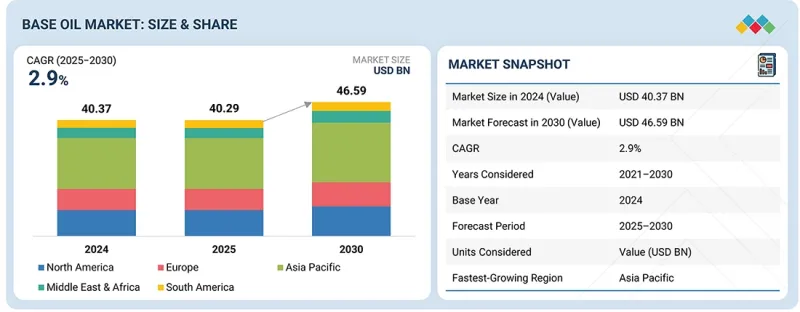
세계의 기유 시장 규모는 2025년 402억 9,000만 달러에서 2030년까지 465억 9,000만 달러에 이를 것으로 예측되며, 예측 기간에 CAGR 2.9%의 성장이 전망되고 있습니다.
시장은 주로 자동차, 산업, 선박, 발전 등 여러 부문의 윤활유 수요 증가에 영향을 받고 있습니다. 특히 신흥 경제권에서는 자동차 소유 증가, 산업의 확장, 인프라 개발의 진행이 이를 더욱 촉진하고 있습니다.
조사 범위
조사 대상 기간
2021년-2030년
기준 연도
2024년
예측 기간
2025년-2030년
단위
금액(100만 달러/10억 달러)
부문
유형, 용도, 그룹, 지역
대상 지역
아시아태평양, 유럽, 북미, 중동 및 아프리카, 남미
자동차의 고품질 윤활유에 대한 수요와 엄격한 배기가스 규제 준수에 대한 요구가 성장을 가속하고 있습니다. 또한, 특히 아시아태평양의 고급차 생산이 증가함에 따라 기유 시장은 석유 제조업체에게 큰 성장 기회를 제공합니다. 이에 따라 고급유 및 합성유와 수소화 분해, GTL(Gas To Liquid) 등 첨단 정제기술에 대한 수요가 더욱 증가하고 있습니다. 또한, 전기자동차용 유체 부문, 금속 가공 및 특수 산업용 윤활유 분야에서 기유의 새로운 용도는 시장이 제조업체에 제공하는 장기적인 성장 기회로 인해 시장 성장을 더욱 촉진하고 있습니다.
"그룹별로 보면, 그룹 III 부문이 예측 기간 동안 금액 기준으로 가장 높은 성장률을 보일 것으로 예측됩니다. "
그룹 III 부문은 예측 기간 동안 가장 높은 성장률을 달성할 것으로 예측됩니다. 이러한 성장은 주로 합성 윤활유의 품질 향상에 기인합니다. 그룹 III 기유는 우수한 점도 지수, 극히 낮은 황 함량, 우수한 열 안정성 및 산화 안정성으로 인해 상대적으로 고가입니다. 이러한 특성으로 인해 매우 엄격한 연비 기준과 배기가스 규제를 달성하는 데 적합합니다. 또한, 최신 엔진 기술의 보급, 오일 교환 주기의 연장, 고성능 자동차 및 산업용 윤활유의 인기 증가는 이 부문의 성장을 더욱 촉진하고 있습니다. 또한, 특히 아시아태평양 및 중동의 첨단 수소화 분해 및 아이소데왁스 분해 능력에 대한 투자도 이 부문의 성장을 가속하고 있습니다.
"용도별로는 자동차 오일 부문이 예측 기간 동안 가장 높은 성장률을 보일 것으로 예측됩니다. "
자동차 오일 부문이 예측 기간 동안 가장 높은 성장률을 보일 것으로 예측됩니다. 이러한 성장은 전 세계 자동차 생산량 증가와 차량 보유대수의 점진적인 증가에 기인합니다. 다른 요인으로는 엔진오일, 변속기 오일, 기어 오일, 특히 승용차 및 상용차의 엔진오일, 변속기 오일, 기어 오일에 대한 수요 증가를 들 수 있습니다. 또한, 배출가스 규제와 연비 기준의 강화로 인해 고품질 그룹 II, 그룹 III, 합성 기유를 기반으로 한 고성능 윤활유로의 전환이 촉진되고 있습니다. 또한, 터보차저, 하이브리드, 차세대 차량과 같은 첨단 엔진 기술의 채택과 오일 교환 주기의 장기화에 대한 선호는 자동차용 오일 부문의 성장을 더욱 강력하게 촉진하고 있습니다.
"아시아태평양은 예측 기간 동안 가장 높은 성장률을 보일 것으로 예측됩니다. "
아시아태평양이 예측 기간 동안 가장 빠르게 성장할 것으로 예측됩니다. 이러한 성장은 주로 중국, 인도, 동남아시아 국가들의 급속한 산업화, 도시화, 자동차 생산의 대폭적인 증가 등의 요인에 기인합니다. 자동차 소유 증가 추세와 고효율 윤활유에 대한 수요 증가로 인해 고부가가치 그룹 II 및 그룹 III 기유의 사용이 증가하고 있습니다. 또한, 배출 규제 강화, 정제 능력 향상, 최첨단 하이드로크래킹 및 아이소데왁스 기술에 대한 지속적인 투자는 모두 기유의 고급화에 기여하고 있습니다. 또한, 산업, 건설 및 운송 부문의 기유에 대한 끊임없는 수요는 아시아태평양 기유 시장의 성장을 더욱 촉진하고 있습니다.
세계의 기유(Base Oil) 시장에 대해 조사 분석했으며, 주요 촉진요인 및 저해요인, 제품 개발 및 혁신, 경쟁 구도에 대해 조사 분석하여 전해드립니다.
목차
제1장 서론
제2장 주요 요약
제3장 중요 지견
기유 시장 기업에 있어서 매력적인 기회
기유 시장 : 그룹별, 지역별
기유 시장 : 용도별
기유 시장 : 국가별
제4장 시장 개요
시장 역학
성장 촉진요인
성장 억제요인
기회
과제
미충족 요구와 화이트 스페이스
기유 시장 미충족 요구
화이트 스페이스 기회
연결된 시장과 부문간 기회
연결된 시장
부문간 기회
새로운 비즈니스 모델과 에코시스템 변화
새로운 비즈니스 모델
에코시스템 변화
Tier 1/2/3 기업의 전략적 움직임
제5장 업계 동향
Porter의 Five Forces 분석
거시경제 전망
GDP 동향과 예측
세계의 기유 업계 동향
밸류체인 분석
연구개발
원재료
제조
유통
최종 이용 산업
생태계 분석
가격 결정 분석
기유 평균 판매 가격 동향 : 지역별(2022년-2024년)
기유 평균 판매 가격 동향 : 주요 기업별(2024년)
무역 데이터
수입 시나리오(HS코드 2709)
수출 시나리오(HS코드 2709)
주요 컨퍼런스 및 이벤트(2026년)
고객의 비즈니스에 영향을 미치는 동향/혼란
투자 및 자금조달 시나리오
사례 연구 분석
기유 시장에 대한 2025년 미국 관세의 영향
시장에 영향을 미치는 주요 관세율
가격 영향 분석
주요 국가/지역에 대한 영향
최종 이용 산업에 대한 영향
제6장 기술 진보, AI에 의한 영향, 특허, 혁신, 향후 용도
주요 기술
보완 기술
기술/제품 로드맵
단기|프로세스 최적화와 환경 컴플라이언스(2025년-2027년)
중기|혁신과 지속가능변혁(2027년-2030년)
장기|순환성, 탈탄소화, 신요우도(2030년-2035년 이후)
특허 분석
향후 용도
스마트 커넥티드 기계용 윤활유 : AI를 활용한 예지보전
바이오 탄소 중립기유 : 지속가능원료 이동
고성능 전기차용 유액 : 전기자동차용 첨단 냉각과 윤활
정밀 제조·로봇용 윤활유 : 초클린, 고성능 오일
순환 형재정제 시스템 : 윤활유 클로즈드 루프 지속가능성
기유 시장에 대한 생성형 AI의 영향
제7장 지속가능성과 규제 상황
규제 상황
규제기관, 정부기관, 기타 조직
업계표준
지속가능성 이니셔티브
지속가능성에 대한 영향과 규제 정책 대처
인증, 라벨, 환경기준
제8장 고객 상황과 구매 행동
의사결정 프로세스
주요 이해관계자와 구입 기준
채택 장벽과 내부 과제
다양한 최종 이용 산업 미충족 요구
시장 수익성
잠재적인 매출
비용 역학
주요 용도 마진 기회
제9장 기유 시장 : 그룹별
그룹 I
그룹 II
그룹 III
그룹 IV
그룹 V
제10장 기유 시장 : 용도별
자동차용 오일
산업용 오일
금속 가공유
유압유
그리스
기타
제11장 기유 시장 : 유형별
광유
합성유
바이오 베이스오일
제12장 기유 시장 : 판매채널별
OEM
애프터마켓
제13장 재정제기유 시장
재정제기유에 이용되는 기술
분석
세계
북미
유럽
제14장 기유 시장 : 지역별
아시아태평양
중국
일본
인도
한국
인도네시아
태국
기타 아시아태평양
유럽
러시아
독일
프랑스
이탈리아
영국
스페인
기타 유럽
북미
미국
캐나다
멕시코
중동 및 아프리카
GCC 국가
튀르키예
이란
기타 중동 및 아프리카
남미
브라질
콜롬비아
아르헨티나
기타 남미
제15장 경쟁 구도
주요 시장 진출기업의 전략/강점
매출 분석(2024년)
시장 순위와 시장 점유율 분석(2024년)
주요 시장 기업 순위
시장 점유율 분석
브랜드/제품 비교
CHEVRON CORPORATION
EXXONMOBIL
SAUDI ARABIAN OIL CO.(SAUDI ARAMCO)
CHINA PETROCHEMICAL CORPORATION(SINOPEC)
PETROCHINA COMPANY LIMITED
기업 평가와 재무 지표
기업 평가 매트릭스 : 주요 기업(2024년)
기업 실적 : 주요 기업(2024년)
기업 평가 매트릭스 : 스타트업/중소기업(2024년)
경쟁 벤치마킹 : 스타트업/중소기업(2024년)
경쟁 시나리오
제16장 기업 개요
주요 기업
CHEVRON CORPORATION
EXXONMOBIL
S-OIL CORPORATION
MOTIVA ENTERPRISES LLC
SK ENMOVE
SAUDI ARABIAN OIL CO.
ENEOS
SHANDONG QINGYUAN GROUP CO., LTD.
HINDUSTAN PETROLEUM CORPORATION LIMITED
SHELL
AVISTA OIL DEUTSCHLAND GMBH
NYNAS AB
REPSOL
ERGON, INC.
CALUMET, INC.
CHINA PETROCHEMICAL CORPORATION/SINOPEC GROUP
ADNOC
PHILLIPS 66 COMPANY
PETRONAS LUBRICANTS INTERNATIONAL
ORLEN
GS CALTEX CORPORATION
H&R GROUP
PETROCHINA COMPANY LIMITED
PT PERTAMINA(PERSERO)
FUCHS
BAKER HUGHES COMPANY
기타 기업
FORMOSA PETROCHEMICAL CORPORATION
HF SINCLAIR CORPORATION
PBF ENERGY
ROSNEFT
TUPRAS
CROSS OIL
ENILIVE S.P.A.
HAINAN HANDI SUNSHINE PETROCHEMICAL CO., LTD.
제17장 조사 방법
제18장 부록
LSH
영문 목차
영문목차
The base oil market is projected to grow from USD 40.29 billion in 2025 to USD 46.59 billion by 2030, at a CAGR of 2.9% during the forecast period. The market is primarily influenced by the increasing demand for lubricants across several sectors, including automotive, industrial, marine, and power generation. This has been further supported by rising vehicle ownership, industrial expansion, and infrastructure development, especially in the case of emerging economies.
Scope of the Report
Years Considered for the Study
2021-2030
Base Year
2024
Forecast Period
2025-2030
Units Considered
Value (USD Million/Billion)
Segments
Type, Application, Group, and Region
Regions covered
Asia Pacific, Europe, North America, Middle East & Africa, and South America
The need for high-quality lubrication oils in vehicles and the strict need for adherence to strict emission limits also drives growth. Additionally, the base oil market is providing tremendous growth opportunities for oil manufacturers with the increasing production of premium cars, especially in Asia Pacific. This is further driving the demand for premium and synthetic oils and advanced refining technologies like hydrocracking and gas-to-liquids (GTL). Moreover, long-term growth opportunities offered by the market to manufacturers, because of upcoming base oil applications in the electric vehicle fluids sector, metalworking, and specialty industrial lubricants areas, are further driving the growth of the market.
"By group, the Group III segment is projected to grow at the highest rate, in terms of value, during the forecast period."
The Group III segment is projected to achieve the highest growth rate during the forecast period. This growth is mainly attributed to the rising quality of synthetic lubricants. Group III base oils are more costly because of their excellent viscosity index, very low sulfur content, and fine thermal and oxidative stability. These qualities make them the best fit for accomplishing very tough fuel economy and emission standards. Additionally, the rising adoption of modern engine technologies, oil drain intervals extension, and the popularity of high-performance automotive and industrial lubricants are further driving the growth of this segment. Moreover, advanced hydrocracking and isodewaxing capacity investments, especially in the Asia Pacific and the Middle East, are further driving the growth of the segment.
"By application, the automotive oil segment is projected to be the fastest-growing segment during the forecast period."
The automotive oil segment is projected to grow at the highest rate during the forecast period. This growth is owing to the rising global vehicle production and a gradually increasing vehicle parc. Other factors include rising demand for engine oils, transmission fluids, and gear oils, especially in passenger cars and commercial vehicles. Additionally, the need for stringent emission regulations and fuel efficiency standards is driving the transition to high-performance lubricants based on better-quality Group II, Group III, and synthetic base oils is being driven by the more. Moreover, the use of advanced engine technologies that include turbocharged, hybrid, and next-generation vehicles, along with the preference for longer oil drain intervals, is further contributing to the growth of the automotive oil segment quite vigorously.
"Asia Pacific is projected to grow at the highest rate during the forecast period."
Asia Pacific is projected to witness the fastest growth during the forecast period. This growth is mainly due to factors like rapid industrialization, urbanization, and a significant increase in the production of automobiles in countries like China, India, and Southeast Asia. The trend of increasing vehicle ownership, along with the need for highly efficient lubricants, is pushing the usage of higher-value Group II and Group III base oils. Besides, stricter emission rules, more refining capabilities, and continuous investments in state-of-the-art hydrocracking and isodewaxing technologies are all contributing to the upscale of base oils. Additionally, constant demand for base oils from the industrial, construction, and transport sectors is further spurring the growth of the base oil market in Asia Pacific.
Break-up of Primary Participants:
By Company Type: Tier 1 - 45%, Tier 2 - 22%, and Tier 3 - 33%
By Designation: C-Level Executives - 50%, Directors - 10%, and Others - 40%
By Region: North America - 17%, Asia Pacific - 17%, Europe - 33%, Middle East & Africa - 25%, and South America - 8%
Leading players operating in the base oil market include Exxon Mobil Corporation (US), Saudi Arabian Oil Co. (Saudi Arabia), SK Enmove (South Korea), China Petrochemical Corporation (China), PetroChina Company Limited (China), and others. These key players are significant contributors to the base oil market. These players have adopted various strategies, including agreements, joint ventures, and expansions, to increase their market share and business revenue.
Research Coverage:
The report defines market segments and projects the size of the base oil market based on type, group, application, and region. It strategically profiles the key players and comprehensively analyzes their market share and core competencies. It also tracks and analyzes competitive developments, such as expansions, partnerships, and acquisitions undertaken by them in the market.
Reasons to Buy the Report:
The report is expected to help market leaders/new entrants by providing them with the closest approximations of revenue numbers for the base oil market and its segments. This report is also expected to help stakeholders gain a deeper understanding of the market's competitive landscape, acquire valuable insights to enhance their business positions, and develop effective go-to-market strategies. It will also enable stakeholders to understand the market's pulse and provide information on key market drivers, restraints, challenges, and opportunities.
The report provides insights into the following pointers:
Analysis of drivers (Rising demand for high-performance lubricants, rapid industrialization in Asia Pacific and emerging economies), restraints (Volatility in crude oil prices, declining demand for Group I base oil), opportunities (Growth in renewable and bio-based base oils, expansion of re-refining and closed-loop recycling infrastructure for used lubricants), and challenges (EV penetration reducing long-term lubricant consumption) influencing the growth of the base oil market
Product Development/Innovation: Detailed insights into upcoming technologies, research & development activities in the base oil market
Market Development: Comprehensive information about lucrative markets across regions
Market Diversification: Exhaustive information about new products, various types, untapped geographies, recent developments, and investments in the base oil market
Competitive Assessment: In-depth assessment of market share, growth strategies, and product offerings of leading players, including Chevron Corporation (US), Exxon Mobil Corporation (US), S-Oil Corporation (South Korea), Motiva Enterprises LLC (US), SK Enmove (South Korea), Saudi Arabian Oil Co. (Saudi Arabia), ENEOS (Japan), Shandong Qingyuan Group Co., Ltd. (China), Hindustan Petroleum Corporation Limited (India), Shell (UK), Avista Oil Deutschland GmbH (Germany), Nynas AB (Sweden), Repsol (Spain), Ergon, Inc. (US), Calumet, Inc. (US), China Petrochemical Corporation (China), ADNOC (UAE), Phillips 66 Company (US), PETRONAS Lubricants International (Malaysia), ORLEN (Poland), GS Caltex Corporation (South Korea), H&R Group (Germany), PetroChina Company Limited (China), PT Pertamina (Persero), FUCHS (Germany), and Baker Hughes Company (US)
TABLE OF CONTENTS
1 INTRODUCTION
1.1 STUDY OBJECTIVES
1.2 MARKET DEFINITION
1.3 STUDY SCOPE
1.3.1 MARKETS COVERED
1.3.2 INCLUSIONS AND EXCLUSIONS
1.3.3 YEARS CONSIDERED
1.3.4 CURRENCY CONSIDERED
1.3.5 UNIT CONSIDERED
1.4 STAKEHOLDERS
1.5 SUMMARY OF CHANGES
2 EXECUTIVE SUMMARY
2.1 KEY INSIGHTS AND MARKET HIGHLIGHTS
2.2 KEY MARKET PARTICIPANTS: SHARE INSIGHTS AND STRATEGIC DEVELOPMENTS
2.3 DISRUPTIVE TRENDS SHAPING MARKET
2.4 HIGH-GROWTH SEGMENTS AND EMERGING FRONTIERS
2.5 SNAPSHOT: GLOBAL MARKET SIZE, GROWTH RATE, AND FORECAST
3 PREMIUM INSIGHTS
3.1 ATTRACTIVE OPPORTUNITIES FOR PLAYERS IN BASE OIL MARKET
3.2 BASE OIL MARKET, BY GROUP AND REGION
3.3 BASE OIL MARKET, BY APPLICATION
3.4 BASE OIL MARKET, BY COUNTRY
4 MARKET OVERVIEW
4.1 INTRODUCTION
4.2 MARKET DYNAMICS
4.2.1 DRIVERS
4.2.1.1 Rising demand for high-performance lubricants
4.2.1.2 Rapid industrialization in Asia Pacific
4.2.2 RESTRAINTS
4.2.2.1 Declining demand for Group I base oil
4.2.2.2 Volatile crude oil prices
4.2.3 OPPORTUNITIES
4.2.3.1 Expansion of re-refining and closed-loop recycling infrastructure
4.2.3.2 Growth in renewable and bio-based base oils
4.2.4 CHALLENGES
4.2.4.1 Electric vehicle penetration reducing long-term lubricant consumption
4.3 UNMET NEEDS AND WHITE SPACES
4.3.1 UNMET NEEDS IN BASE OIL MARKET
4.3.2 WHITE SPACE OPPORTUNITIES
4.4 INTERCONNECTED MARKETS AND CROSS-SECTOR OPPORTUNITIES
4.4.1 INTERCONNECTED MARKETS
4.4.2 CROSS-SECTOR OPPORTUNITIES
4.5 EMERGING BUSINESS MODELS AND ECOSYSTEM SHIFTS
4.5.1 EMERGING BUSINESS MODELS
4.5.2 ECOSYSTEM SHIFTS
4.6 STRATEGIC MOVES BY TIER 1/2/3 PLAYERS
4.6.1 KEY MOVES AND STRATEGIC FOCUS
5 INDUSTRY TRENDS
5.1 PORTER'S FIVE FORCES ANALYSIS
5.1.1 BARGAINING POWER OF SUPPLIERS
5.1.2 BARGAINING POWER OF BUYERS
5.1.3 THREAT OF NEW ENTRANTS
5.1.4 THREAT OF SUBSTITUTES
5.1.5 INTENSITY OF COMPETITIVE RIVALRY
5.2 MACROECONOMIC OUTLOOK
5.2.1 INTRODUCTION
5.2.2 GDP TRENDS AND FORECAST
5.2.3 TRENDS IN GLOBAL BASE OIL INDUSTRY
5.3 VALUE CHAIN ANALYSIS
5.3.1 RESEARCH & DEVELOPMENT
5.3.2 RAW MATERIAL
5.3.3 MANUFACTURING
5.3.4 DISTRIBUTION
5.3.5 END-USE INDUSTRIES
5.4 ECOSYSTEM ANALYSIS
5.5 PRICING ANALYSIS
5.5.1 AVERAGE SELLING PRICE TREND OF BASE OIL, BY REGION, 2022-2024
5.5.2 AVERAGE SELLING PRICE TREND OF BASE OIL, BY KEY PLAYERS, 2024
5.6 TRADE DATA
5.6.1 IMPORT SCENARIO (HS CODE 2709)
5.6.2 EXPORT SCENARIO (HS CODE 2709)
5.7 KEY CONFERENCES AND EVENTS, 2026
5.8 TRENDS/DISRUPTIONS IMPACTING CUSTOMER BUSINESS
5.9 INVESTMENT AND FUNDING SCENARIO
5.10 CASE STUDY ANALYSIS
5.10.1 SHELL CASE STUDY: EGYPTIAN IRON AND STEEL COMPANY
5.10.1.1 Shell Lubricant Solutions collaborated with Egyptian Iron and Steel Company to deliver significant savings
5.10.2 NYNAS CASE STUDY: CARL BECHEM INDIA
5.10.2.1 Optimizing food-grade lubricant performance with Nynas' base oils
5.10.3 EXXONMOBIL CASE STUDY: DALIAN HILUBO LUBRICATING OIL COMPANY
5.10.3.1 Dalian Hilubo Lubricating Oil Company used ExxonMobil's formulation expertise and mPAO base stocks to succeed in China's wind industry
5.11 IMPACT OF US 2025 TARIFFS ON BASE OIL MARKET
5.11.1 KEY TARIFF RATES IMPACTING MARKET
5.11.2 PRICE IMPACT ANALYSIS
5.11.3 IMPACT ON KEY COUNTRIES/REGIONS
5.11.3.1 US
5.11.3.2 Europe
5.11.3.3 Asia Pacific
5.11.4 IMPACT ON END-USE INDUSTRIES
5.11.4.1 Automotive
5.11.4.2 Industrial machinery and manufacturing
5.11.4.3 Marine
5.11.4.4 Aviation
5.11.4.5 Metalworking and process
6 TECHNOLOGICAL ADVANCEMENTS, AI-DRIVEN IMPACT, PATENTS, INNOVATIONS, AND FUTURE APPLICATIONS
6.1 KEY TECHNOLOGIES
6.1.1 SEPARATION PROCESS
6.1.1.1 Solvent Extraction
6.1.1.2 Dewaxing
6.1.1.3 Hydrofinishing
6.2 COMPLEMENTARY TECHNOLOGIES
6.2.1 CONVERSION PROCESS
6.2.1.1 Hydrocracking
6.2.1.2 Hydroisomerization
6.2.1.3 Hydrotreating
6.3 TECHNOLOGY/PRODUCT ROADMAP
6.3.1 SHORT-TERM (2025-2027) | PROCESS OPTIMIZATION & ENVIRONMENTAL COMPLIANCE