



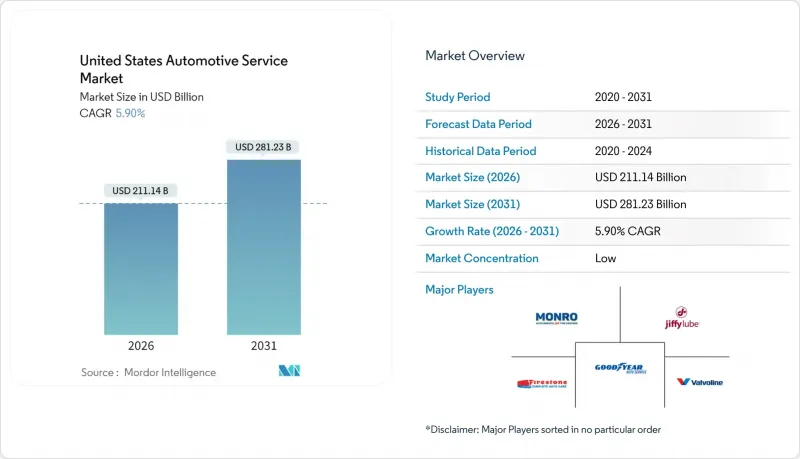
2026년 미국 자동차 서비스 시장 규모는 2,111억 4,000만 달러로 추정되며, 2025년 1,993억 8,000만 달러에서 성장하며, 2031년에는 2,812억 3,000만 달러에 달할 것으로 예측됩니다.
2026-2031년 연평균 성장률(CAGR)은 5.9%를 나타낼 것으로 예측됩니다.
견고한 수요는 평균 12.6년으로 노후화된 국내 차량 보유량, 주행거리 회복, 서비스 수요를 증가시키는 소형 상용차 이용률 상승에 기인합니다. 전동화의 가속화는 수리의 복잡성과 단가를 높이고 정기적인 유지보수 빈도를 낮추는 한편, 서비스 프로바이더는 기술자의 기술 향상과 고전압 툴에 대한 투자를 장려하고 있습니다. 디지털 예약 플랫폼, 구독형 정비 패키지, 수리권 보호법 도입으로 경쟁 전략이 재편되는 가운데, 도시 소비자층에서는 모바일 온디맨드 서비스가 인기를 끌고 있습니다. 이러한 요인들이 결합되어 미국 자동차 서비스 시장은 지속적인 매출 성장과 업무 혁신의 국면을 맞이하고 있습니다.
2024년 평균 차량 연식은 12.6년에 달하며, 6-14년 경과 차량이 가장 큰 서비스 대상층을 형성하는 구조적 추동력이 되고 있습니다. 4만 5,000달러가 넘는 신차 가격의 급등과 재고 부족으로 인해 소유주기가 길어지고, 더 많은 오너들이 차량 교체 대신 필수 유지보수를 선택하는 경향이 있습니다. 2021년 2024년까지 하이브리드차 등록대수는 181% 증가하여 향후 배터리 교체 매출의 기반을 마련하고 있습니다. 독립 수리 전문점은 2021년 회복기에 증가된 서비스 지출의 약 45%를 차지하며 이 부문의 매력을 입증했습니다. 높은 금리는 소비자의 내구성 중시 태도를 강화하여 경기 침체기에도 안정적인 부품 교체 수요를 지원하고 있습니다.
연방 고속도로국의 데이터에 따르면 2024년 2월 전국 주행거리는 전년 대비 1.4% 증가한 2,748억 마일을 기록해 COVID-19 팬데믹 이전 수준으로 완전히 회복했습니다. 장거리 트럭의 주행거리는 2050년까지 연평균 1.1%씩 확대될 것으로 예상되며, 단일 유닛 트럭의 가동률은 연평균 1.9%씩 성장할 것으로 예상되어 상용차 fleet의 정비 수요는 더욱 늘어날 것으로 전망됩니다. 주행거리 증가는 노후화된 차량군 전체의 마모를 가속화하고, 브레이크, 타이어, 유류에 대한 서비스 수요를 증가시킵니다. 팬데믹 이후 운전 수요가 급증하면서 주간 주행거리 추이가 정비공장 가동률을 나타내는 중요한 지표로 떠오르고 있습니다. 갤런당 2.85달러로 비교적 안정적인 휘발유 가격은 지속적인 이동을 지원하고 있으며, 증가하는 소비자 신용 잔액은 신차 구매 예산을 애프터마켓 서비스로 지속적으로 전환하고 있습니다.
전기자동차는 기계유와 벨트의 필요량이 적고, 정기점검의 빈도가 감소합니다. 그러나 수리 건당 평균 비용은 내연기관 차종에 비해 약 50% 정도 높은데, 이는 주로 배터리와 전자장치의 복잡성 때문인 것으로 분석됩니다. 타이어, 와이퍼 블레이드 등 파워트레인에 의존하지 않는 작업은 견고한 성장세를 유지할 것이지만, 기존 애프터마켓은 2035년까지 축소될 가능성이 있습니다. 기술자 중 일부만이 충분한 EV 교육을 받았으며, 고전압 안전 설비에 투자할 수 있는 대형 체인 및 딜러 그룹에 유리한 기술 격차가 발생하고 있습니다. 2024년 BEV 대응 독립 정비공장이 상당한 점유율을 차지했으나, 절반 이상이 전문성을 어필할 수 있는 마케팅이 부족합니다.
승용차는 2025년 기준 미국 자동차 서비스 시장의 68.74%를 차지할 것으로 예상되며, 이 부문의 방대한 차량 도입량은 지속적인 유지보수가 필요합니다. 승용차 관련 미국 자동차 서비스 시장 규모는 평균 차령이 12년을 넘어섰고, 하이브리드차의 보급이 확대됨에 따라 꾸준히 성장할 것으로 전망됩니다. 소형 상용차는 E-Commerce와 라스트마일 배송 수요에 힘입어 2031년까지 8.55%의 가장 높은 CAGR을 나타낼 것으로 예상되며, 이로 인해 정비공장의 용량 계획과 부품 재고 전략을 재검토해야할 것으로 보입니다.
현재 차량 사업자들은 다운타임을 최소화하는 예방 정비 계약을 지정하여 브레이크, 타이어, 서스펜션 부품의 예측 가능한 발주를 촉진하고 있습니다. 테슬라는 2024년까지 70개의 새로운 서비스 센터를 개설할 계획이며, 대부분 10만 평방피트(약 9,300평방미터) 이상의 규모로 승용차 및 상용차 부문의 전기자동차 판매량 증가에 대응할 예정입니다. 중형 및 대형 트럭은 비록 대수는 적지만, 엄격한 가동률 요건과 연방 안전 규정이 전문 서비스 수요를 견인하므로 수익성이 높은 분야로 남아있습니다.
2025년 기준, 기계 수리 및 정비 분야는 미국 자동차 서비스 시장의 42.67%의 매출 점유율을 유지하며 핵심을 차지할 것으로 예측됩니다. 첨단운전자보조시스템(ADAS)의 보급률 증가에 따라 전기 및 전자 관련 작업은 2031년까지 연평균 복합 성장률(CAGR) 9.02%로 확대될 것으로 예측됩니다.
정비공장에서는 이 고매출 사업을 위해 스캔 툴, 캘리브레이션 프레임, 정적 타겟에 대한 투자가 진행되고 있습니다. 복합재료 차체 구조의 영향으로 외관 및 구조 수리는 안정적이지만, 더욱 복잡해지고 있습니다. 퀵윤활체인은 EV의 오일 교환 주기 연장을 보완하고 고객의 방문 빈도를 유지하기 위해 배터리, 타이어, 경정비 업무로 다변화를 추진하고 있습니다.
The United States automotive service market size in 2026 is estimated at USD 211.14 billion, growing from 2025 value of USD 199.38 billion with 2031 projections showing USD 281.23 billion, growing at 5.9% CAGR over 2026-2031.
Robust demand comes from an aging national vehicle fleet that averages 12.6 years, a rebound in vehicle miles traveled, and rising light commercial vehicle utilization that intensifies service requirements. Accelerating electrification lifts repair complexity and ticket values, even lowering routine maintenance frequency, prompting providers to invest in technician upskilling and high-voltage tooling. Digital booking platforms, subscription-based maintenance bundles, and right-to-repair legislation are reshaping competitive strategies, while mobile on-demand services gain traction among urban consumers. Collectively, these forces position the US automotive service market for sustained revenue growth and operational transformation
Average vehicle age reached 12.6 years in 2024, creating a structural tailwind as units between six and fourteen years now form the largest service cohort. High new-vehicle prices above USD 45,000 and constrained inventories have extended ownership cycles, pushing more owners toward essential maintenance rather than replacement. Hybrid registrations swelled 181% from 2021 to 2024, setting the stage for future battery replacement revenue. Independent repair specialists captured nearly 45% of incremental service spend during the 2021 rebound, evidencing the segment's appeal. High interest rates reinforce consumer emphasis on longevity, anchoring steady parts replacement demand even during economic slowdowns.
Federal Highway Administration data show national VMT climbing 1.4% year-over-year to 274.8 billion miles in February 2024, fully matching pre-pandemic baselines. Long-haul truck mileage is projected to expand 1.1% annually through 2050, while single-unit truck activity may grow 1.9% per year, reinforcing commercial fleet maintenance needs. Higher miles intensify wear across an aging vehicle mix, boosting brake, tire, and fluid service demand. As post-pandemic driving surges, weekly mileage trends emerge as a key indicator for workshop activity. Relatively stable gasoline at USD 2.85 per gallon supports sustained travel, and rising consumer credit balances continue to divert budgets from new-car purchases toward aftermarket services.
Electric vehicles require fewer mechanical fluids and belts, trimming routine visits, yet each repair averages almost 50% higher than on an internal-combustion model, mainly due to battery and electronic complexity. Powertrain-agnostic work, such as tires and wiper blades, remains resilient, but the conventional aftermarket could contract by 2035. Only some of technicians report substantial EV training, generating a skills gap that favors large chains and dealer groups capable of funding high-voltage safety infrastructure. Independent shops servicing BEVs claimed a significant share in 2024, yet over half lack dedicated marketing to showcase that capability.
Other drivers and restraints analyzed in the detailed report include:
For complete list of drivers and restraints, kindly check the Table Of Contents.
Passenger cars accounted for 68.74% of the US automotive service market in 2025 as the segment's large installed base demanded consistent maintenance. The US automotive service market size linked to passenger cars is projected to grow steadily as the average age surpasses 12 years and hybrid penetration deepens. Light commercial vehicles, buoyed by e-commerce and last-mile delivery, are set to record the fastest 8.55% CAGR through 2031, reshaping shop capacity planning and parts inventory strategies.
Fleet operators now specify preventative maintenance contracts that minimize downtime, driving predictable parts ordering for brakes, tires, and suspension. Tesla opened seventy new service centers in 2024, many exceeding 100,000 square feet, to cater to rising EV volume across both passenger and commercial segments. Medium and heavy trucks, though smaller in count, remain lucrative due to stringent uptime requirements and federal safety regulations that drive specialized service demand.
Mechanical repair and maintenance retained a 42.67% revenue share in 2025, anchoring the US automotive service market. Electrical and electronics work is forecast to grow at a 9.02% CAGR as ADAS penetration rises by 2031.
Shops invest in scan tools, calibration frames, and static targets to capture this margin-rich business. Due to mixed-material body structures, exterior and structural repairs remain stable yet more complex. Quick-lube chains diversify into battery, tire, and light mechanical jobs to offset longer EV oil-change intervals, preserving customer frequency.
The United States Automotive Services Market Report is Segmented by Vehicle Type (Passenger Cars, Light Commercial Vehicles, and More), Service Type (Mechanical Repair and Maintenance, and More), Equipment Type (Tires, Batteries, and More), Service Channel (OEM Dealerships, Independent General Repair Shops, and More), and by U. S. Census Region. The Market Forecasts are Provided in Terms of Value (USD).