



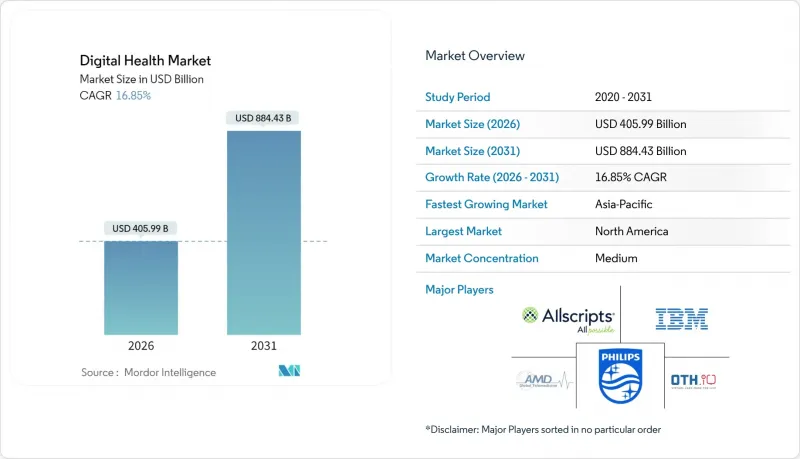
디지털 헬스 시장은 2025년 3,474억 5,000만 달러에서 2026년에는 4,059억 9,000만 달러로 성장할 것으로 예상되며, 2026년부터 2031년까지 CAGR 16.85%를 기록하며 2031년까지 8,844억 3,000만 달러에 달할 것으로 예측됩니다.
이러한 모멘텀은 일시적인 치료에서 인공지능, 사물인터넷(IoT) 센서, 첨단 분석 기술로 뒷받침되는 지속적인 데이터 기반 치료로의 전환을 반영하고 있습니다. 미국 식품의약국(FDA)은 이미 1,041개의 솔루션에 '획기적 의료기기' 지정을 부여했으며, 이 중 128개의 솔루션에 대해 상업적 사용을 승인했습니다. 이를 통해 증거 기반 디지털 치료제의 길이 더욱 넓어졌습니다. 원격의료 보험 적용 확대, 국가 디지털 헬스 전략, 고령화에 따른 원격 모니터링 수요도 성장을 견인하고 있습니다. 한편, 의료 제공자, 보험사, 제약사, 대형 테크 기업 등 다양한 이해관계자들이 완전한 M&A보다 파트너십 모델을 선호하기 때문에 이 분야는 여전히 분절된 상태로 남아있습니다. 그 결과, 통합보다는 제휴 관계가 풍부한 생태계가 형성되고 있습니다. 사이버 보안 위협과 데이터 공유의 장벽으로 인해 확장을 억제하고 있지만, 벤더들이 엔드-투-엔드 암호화, FHIR 표준 채택, 클라우드 환경 인증 등을 통해 이해관계자들의 신뢰를 얻고 있기 때문에 투자는 중단되지 않고 있습니다.
의료 시스템은 반응형 서비스 제공에서 원격 모니터링, 전자건강기록, AI 지원 진단을 일상 진료에 통합한 예방적 상시 가동형 케어 모델로 전환하고 있습니다. 팬데믹 시기의 긴급성이 투자를 가속화했지만, 경영진이 디지털 인프라를 선택이 아닌 필수로 인식하게 되면서 예산은 안정적으로 유지되고 있습니다. 더 많은 기관이 공유 데이터 플랫폼에 연결될수록 네트워크 효과가 나타나며, 추가 노드 당 유용성이 향상됩니다. 이러한 선순환을 통해 병원은 상호 운용 가능한 솔루션의 도입을 촉진하고, 임상의는 환자 생성 데이터를 치료 계획에 통합하도록 장려하며, 대면 서비스와 가상 서비스 간의 피드백 루프를 강화합니다. 디지털 헬스 시장이 확대됨에 따라 소비자 웰빙 앱은 디지털 상호 작용을 더욱 일상화하여 환자의 숙련도를 높이는 토대를 마련하고 있으며, 이는 공식적인 의료 현장으로 확산되고 있습니다.
인공지능은 현재 영상 진단 분류, 의료 코딩, 가상 스크리브링 등 병원의 핵심 업무를 지원하고 있습니다. 고정밀 IoT 센서가 지속적인 데이터 스트림을 클라우드 분석 엔진에 공급하여 병상에서 증상이 나타나기 몇 시간 전에 급성 질환을 예측할 수 있게 되었습니다. 벤더의 로드맵은 합성 데이터 생성, 자동 품질 보증, 멀티모달 추론을 강조하고 있으며, 환경 지능이 모든 환경에서 환자를 추적할 수 있는 미래를 제시하고 있습니다. 관리부서의 리더들은 생산성 향상, 청구 거부 건수 감소, 재입원 페널티 감소 등 단기적인 도입 비용에 대한 수익을 얻을 수 있기 때문에 단기적인 도입 비용을 감수하고 있습니다. 데이터세트가 확대됨에 따라 예측 알고리즘의 정확도가 향상되고, 디지털 선진 기관과 후발 기관의 성능 격차를 확대하는 자기 강화형 개선 루프가 형성됩니다.
병원 네트워크에 대한 랜섬웨어 공격은 가상 진료량이 사상 최고치를 기록하는 시점에 기밀성이 높은 환자 파일을 노출시켜 대중의 신뢰를 떨어뜨릴 수 있습니다. HIPAA와 GDPR에 따른 규제 처벌은 침해 대응 비용을 증가시키고, 이익률이 감소하는 상황에서도 이사회가 보안 지출을 우선순위에 두도록 유도합니다. 도입 팀은 강력한 암호화와 임상의의 조작성 사이에서 고민합니다. 엄격한 로그인 프로토콜은 업무 흐름을 지연시킬 수 있기 때문입니다. 보험사들은 현재 책임보험을 인수하기 전에 사이버 대응 준비에 대한 인증을 요구하고 있어, 회복탄력성은 차별화가 아닌 시장의 필수 요건이 되고 있습니다. 신속한 위협 탐지 및 제로 트러스트 아키텍처를 보장할 수 있는 벤더가 조달 주기에서 우위를 점하고 있으며, 사이버 보안 대응 준비가 디지털 헬스 시장 전반에 걸쳐 기본적인 기대치가 되고 있음을 강조하고 있습니다.
2025년 디지털 헬스 시장 매출의 38.62%를 서비스가 차지했습니다. 이는 의료기관 경영진이 복잡한 솔루션 도입과 규제 준수 관리를 외부 파트너에게 의존했기 때문입니다. 도입 지원, 변경 관리, 사이버 보안을 포괄하는 계약 형태가 일반적이며, 이를 통해 조직은 내부 IT 부서에 과중한 부담을 주지 않고 원격 중환자실(TeleICU) 프로그램이나 만성질환 관리 앱을 출시할 수 있습니다. 전문 데이터 엔지니어와 정보 과학자 부족으로 자체 개발 도입이 늦어지고 있는 시장에서 수요는 여전히 견고합니다. 그러나 2031년까지 17.74%의 가장 빠른 CAGR을 기록하는 소프트웨어로 관심이 옮겨가고 있습니다. 차트 작성 자동화, 케어 갭 알림 표시, 멀티모달 데이터 통합을 실현하는 클라우드 네이티브 플랫폼은 하드웨어 중심 모델보다 더 빠르게 확장할 수 있으며, 중규모 병원이 학술 의료 센터와 경쟁할 수 있게 해줍니다.
이러한 변화는 대규모 일회성 라이선스 계약보다 구독 가격 책정 및 지속적인 기능 출시에 유리하게 작용합니다. 벤더들은 기존 시스템에 통합할 수 있는 모듈형 API를 강조하며, 시스템 전체를 교체하는 것에 대한 불안감을 줄이고 있습니다. 알고리즘이 성숙해짐에 따라 사용자 경험이 향상되고, 임상의의 도입 기간이 단축됩니다. 이러한 장점은 업데이트율 향상과 사용자당 평균 수익 증가로 이어져 소프트웨어의 성장 궤도를 강화하는 동시에 디지털 헬스 시장의 장기적인 구조적 변화를 보여주고 있습니다.
이 보고서는 세계 디지털 헬스 시장 점유율과 주요 기업, 구성요소별(하드웨어, 소프트웨어, 서비스), 기술별(원격의료, 모바일 헬스 등), 최종사용자별(의료 제공자, 보험사, 환자 및 소비자), 지역별로 분류하여 조사하였습니다. 위 부문의 시장 규모(미화)를 제시합니다.
북미는 2025년 지출의 43.21%를 차지했으며, 이는 지불자의 관대한 상환제도, 전자건강기록(EHR) 도입 기반, 활발한 혁신 파이프라인에 힘입은 바 큽니다. 미국 식품의약국(FDA)의 획기적 의료기기 프로그램은 2024년 9월까지 1,041건의 지정을 통해 1,128건의 상업화 승인을 부여했습니다. 이를 통해 미국은 임상 검증 및 투자자들에게 신호를 보내는 기준 시장으로서의 입지를 확고히 하고, 디지털 헬스 시장에서 중심적인 역할을 강화하고 있습니다. 캐나다와 미국 간의 국경 간 원격의료 협정으로 전문의에 대한 접근성이 개선되는 한편, 멕시코의 사회 보장 확대는 도시와 농촌의 자원 격차를 관리하기 위해 모바일 분류 도구를 통합하고 있습니다.
아시아태평양은 2031년까지 18.02%의 가장 빠른 CAGR을 기록할 것으로 예상됩니다. 각국 정부가 원격의료를 보편적 의료보험 전략에 포함시키고, 휴대폰의 보급으로 방대한 잠재적 사용자층이 형성되고 있기 때문입니다. 2023년 모바일 경제의 가치는 지역 GDP에서 8,800억 달러에 달했습니다. 인도의 '아유슈만 바랏 디지털 미션'은 개인 건강기록을 국민 ID와 연동하고, 인도네시아의 JKN 제도는 가상 진료소를 통해 외딴 섬을 커버하며, 일본은 AI를 탑재한 재택 돌봄 로봇을 보조해 돌봄 인력 부족을 보완하고 있습니다. 현지어 인터페이스와 가벼운 데이터 프로토콜이 신규 사용자 보급을 가속화하고 있으며, 이 지역은 디지털 헬스 시장의 새로운 핵심으로 부상하고 있습니다.
유럽, 남미, 중동 및 아프리카에서는 정책 입안자들이 혁신과 프라이버시의 균형을 모색하는 가운데 연 5%대 초반의 성장세를 이어가고 있습니다. 독일의 DiGA 프레임워크는 인증된 앱에 대한 상환을 시행하고, 프랑스는 전국적인 전자처방전 서비스를 전개하며, 사우디아라비아의 비전 2030은 원격 중환자실(TeleICU)에 자금을 할당합니다. 규제의 다양성으로 인해 다국적 기업의 진출이 늦어지는 반면, 선도 기업들은 국경을 초월한 정신건강 플랫폼과 희귀 질환 등록 시스템에서 성장 기회를 발견하고 있습니다.
The Digital Health market is expected to grow from USD 347.45 billion in 2025 to USD 405.99 billion in 2026 and is forecast to reach USD 884.43 billion by 2031 at 16.85% CAGR over 2026-2031.
Momentum reflects a global pivot from episodic treatment toward continuous, data-driven care supported by artificial intelligence, Internet-of-Things sensors, and advanced analytics. Regulatory agencies are keeping pace: the United States Food and Drug Administration has already given Breakthrough Device designation to 1,041 solutions and cleared 128 of them for commercial use, opening more pathways for evidence-backed digital therapeutics FDA. Wider telehealth reimbursement, national digital health strategies, and demand for remote monitoring from aging populations add further lift. At the same time, the sector remains fragmented because providers, payers, pharmaceutical firms, and big-tech entrants prefer partnership models over outright M&A, resulting in an ecosystem rich in alliances rather than consolidation. Cybersecurity threats and data-sharing barriers temper expansion but have not derailed investment, as vendors continue to embed end-to-end encryption, adopt FHIR standards, and certify cloud environments to win stakeholder trust.
Health systems are moving from reactive service delivery to preventive, always-on care models that embed remote monitoring, electronic health records, and AI-assisted diagnostics in routine practice. Pandemic-era urgency jump-started investment, but budgets have held steady because chief executives now treat digital infrastructure as essential rather than optional. Network effects surface when more institutions connect to shared data platforms, raising the utility of each additional node. This virtuous cycle encourages hospitals to procure interoperable solutions and nudges clinicians to incorporate patient-generated data into care plans, tightening the feedback loop between in-person and virtual services. As the digital health market expands, direct-to-consumer wellness apps further normalize digital interactions, creating a foundation of patient familiarity that spills over into formal medical settings.
Artificial intelligence now underpins core hospital operations such as imaging triage, medical coding, and virtual scribing. High-fidelity IoT sensors feed continuous data streams into cloud analytics engines capable of forecasting acute events hours before they manifest at the bedside. Vendor road maps highlight synthetic-data generation, autopilot quality assurance, and multimodal reasoning, signalling a future where ambient intelligence follows patients across settings. Administrative leaders accept short-run implementation costs because returns show up in productivity gains, fewer claim denials, and lower readmission penalties. As datasets scale, predictive algorithms grow more accurate, creating a self-reinforcing improvement loop that widens the performance gap between digital leaders and laggards.
Ransomware attacks on hospital networks expose sensitive patient files and erode public trust just as virtual care volumes hit new highs. Regulatory penalties under HIPAA and GDPR inflate breach-response costs, nudging boards to prioritize security spending even when margins tighten. Implementation teams juggle the trade-off between bullet-proof encryption and clinician usability, because stricter log-in protocols can slow workflows. Insurers now request cyber-readiness certifications before underwriting liability policies, making resilience a market requirement rather than a differentiator. Vendors who can guarantee rapid threat detection and zero-trust architectures gain an edge in procurement cycles, underscoring how cybersecurity readiness is becoming a foundational expectation across the digital health market.
Other drivers and restraints analyzed in the detailed report include:
For complete list of drivers and restraints, kindly check the Table Of Contents.
Services accounted for 38.62% of digital health market revenue in 2025 as health-system executives relied on external partners to deploy complex solutions and manage regulatory compliance. Engagements often bundle implementation, change-management, and cybersecurity, helping organizations launch tele-ICU programs or chronic-disease apps without overloading internal IT teams. Demand stays robust in markets where shortages of specialized data engineers and informaticians slow do-it-yourself rollouts. Yet the spotlight is shifting to software, which registers the fastest 17.74% CAGR to 2031. Cloud-native platforms that automate charting, surface care-gap alerts, and synthesize multimodal data scale faster than hardware-centric models, letting mid-size hospitals compete with academic centers.
The shift favors subscription pricing and continuous feature releases instead of large, one-time license deals. Vendors emphasize modular APIs that plug into existing systems, reducing rip-and-replace anxiety. As algorithms mature, user experience improves, shortening clinician onboarding curves. These benefits translate into higher renewal rates and rising average revenue per user, reinforcing the software growth arc and signaling a long-term structural shift in the digital health market.
The Report Covers Global Digital Health Market Share & Companies and It is Segmented by Component (Hardware, Software, and Services), Technology (Telehealth, Mhealth, and More), End User (Healthcare Providers, Payers, and Patients & Consumers) and Geography. The Report Offers the Value (in USD) for the Above Segments.
North America controlled 43.21% of 2025 spending, backed by generous payer reimbursement schedules, an installed base of electronic health records, and an active innovation pipeline. The FDA's Breakthrough Devices Program provided 1,041 designations, with 128 commercial clears by September 2024, cementing the United States as the reference market for clinical validation and investor signalling, reinforcing its central role in the digital health market. Cross-border telehealth compacts between Canada and the United States improve specialist access, while Mexico's social-security expansion integrates mobile triage tools to manage urban-rural resource gaps.
Asia-Pacific posts the fastest 18.02% CAGR through 2031 as governments fold telemedicine into universal-coverage strategies and handset adoption unlocks massive addressable user pools. Mobile economy value reached USD 880 billion in regional GDP during 2023. India's Ayushman Bharat Digital Mission links personal health records to national IDs; Indonesia's JKN scheme covers remote islands with virtual clinics; and Japan subsidizes AI-based home-care robots to offset nursing shortages. Local language interfaces and lightweight data protocols accelerate adoption among first-time users, positioning the region as a rising anchor of the digital health market.
Europe, South America, and the Middle East & Africa advance at mid-single-digit rates as policymakers negotiate the balance between innovation and privacy. Germany's DiGA framework reimburses certified apps, France deploys nationwide e-prescription services, and Saudi Arabia's Vision 2030 earmarks tele-ICU funds. Regulatory heterogeneity slows multinational rollouts, yet early movers find growth pockets in cross-border mental-health platforms and rare-disease registries.