



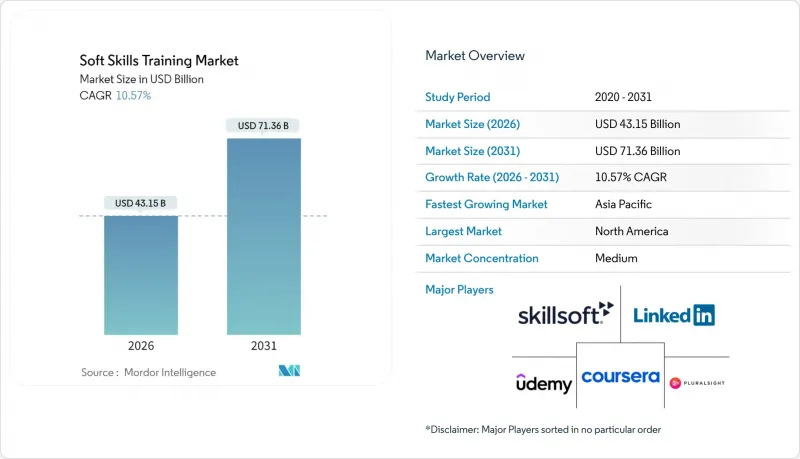
소프트 스킬 트레이닝 시장은 2025년에 390억 2,000만 달러로 평가되었으며, 2026년 431억 5,000만 달러에서 2031년까지 713억 6,000만 달러에 달할 것으로 예측됩니다.
예측 기간(2026-2031년) 동안 CAGR은 10.57%로 예상됩니다.
하이브리드형 인력의 복잡성, ESG 관련 공시 의무 강화, 정부의 기술 향상 보조금 보급과 함께 체계화된 감성지능, 협업, 리더십 프로그램에 대한 기업의 수요가 가속화되고 있습니다. 동시에 조직은 AI 기반 개인화 엔진을 학습 생태계에 통합하여 직원들이 정기적인 워크샵이 아닌 실시간 상황별 코칭을 받을 수 있도록 하고 있습니다. 특허받은 행동 분석 기술과 산업별 특화 컨텐츠를 결합할 수 있는 벤더들은 프리미엄 가격을 받고 있으며, 인적자본 보고에 대한 규제 당국의 관심은 도입이 늦어지고 있는 기업들에게 교육 예산을 공식화하도록 유도하고 있습니다. 모듈식, 합리적인 가격의 구독 모델을 통해, 서비스 소외계층인 중소기업(SME)을 타겟으로 하는 신규 진입 기업들은 지속적인 비용 제약에도 불구하고 새로운 수익원을 개척할 수 있습니다.
분산형 팀은 기술 교육만으로는 습득할 수 없는 고도의 협업 능력, 공감 능력, 포용력에 의존하고 있습니다. 싱가포르의 조사에 따르면, 직원의 68%가 하이브리드 팀을 관리하기 위해 관리직을 지향하고 있는 것으로 나타났습니다. 링크드인 러닝(LinkedIn Learning)의 '원격 리더십', MIT의 '원격 환경에서의 리더십'과 같은 과정은 관리자에게 효과적인 원격 감독에 필수적인 회복탄력성과 체계적인 커뮤니케이션 기술을 제공합니다. 의료 시스템에서는 그 시급성이 강조되고 있습니다. 의사소통의 부족이 의료사고로 이어진 사례가 있어 필수 회화 기술 교육 모듈을 도입하고 있습니다. 인더스트리 4.0으로 전환하는 제조업에서는 사람과 기계의 협업에 초점을 맞춘 리더십 개발 프로그램이 추가되고 있습니다.
스마트폰을 통해 제공되는 단시간 수업은 업무의 흐름 속에서 학습을 가능하게 하고, 생산 환경에서의 기회비용을 절감할 수 있습니다. 제조업의 커넥티드 워커 플랫폼은 직원들이 현장에서 대인관계 문제에 직면했을 때 맞춤형 프롬프트를 제공합니다. 스킬소프트의 CAISY 시뮬레이터는 말투, 단어 선택, 응답 속도를 분석하여 시나리오 기반의 피드백을 생성합니다. Udemy의 커리어 액셀러레이터는 AI가 큐레이션한 학습 경로와 구독 경제를 결합하여 가격에 민감한 학습자의 접근성을 확대합니다.
한정된 현금 흐름으로 인해 많은 중소기업들은 퍼실리테이터 비용과 직원들의 업무 중단 시간을 흡수할 수 없는 경우가 많습니다. 영국의 중견기업을 위한 보조금 프로그램은 최대 1만 파운드(약 124만 원)로 상한선을 설정하여 자금 조달의 격차를 반영하고 있습니다. 높은 비용에도 불구하고 일본 기업의 46%는 여전히 대면 교육을 선호하고 있어 디지털화에 대한 저항감을 엿볼 수 있습니다. 무료 MOOC(대규모 공개 온라인 강좌)는 입문 수준의 컨텐츠를 더욱 상품화하여 개발도상국의 가격 민감도를 높이고 있습니다.
자기 주도형 E-Learning은 학습자의 숙련도, 직무 내용, 희망 형식에 따라 학습 경로를 조정하는 AI 기반 엔진에 힘입어 12.86%의 CAGR로 가장 빠른 성장세를 보이고 있습니다. 그러나 2025년에도 오프라인 워크숍은 소프트 스킬 교육 시장에서 37.68%의 점유율을 유지했습니다. 이는 임원 프리젠테이션, 갈등해결, 액티브 리스닝 교육에서 퍼실리테이터의 즉각적인 피드백을 받음으로써 지식의 정착률을 높이기 위함입니다. 디지털과 물리적 형태의 공존은 대상 능력의 인지적 부담과 정서적 뉘앙스에 따라 학습 형태를 선택하는 생태계를 보여줍니다. 하이브리드 코스 설계는 인지적 지식 전달을 비동기식 모듈로 분리하고, 역할극과 동료 코칭을 라이브 세션으로 제한하여 참여도를 떨어뜨리지 않으면서도 비용 효율성을 높였습니다.
문맥에 맞는 제공 방식을 시도하는 조직은 완전 디지털화를 추구하는 조직보다 높은 수료율과 행동 변화 지표가 확인되고 있습니다. 마이크로소프트는 기본 컨텐츠를 온라인으로 전환한 후 1인당 교육 비용 절감 효과를 입증하는 한편, 고위 경영진을 위한 양질의 강사 주도형 부트캠프를 유지하고 있습니다. 일본 기업들은 여전히 신중한 태도를 보이고 있으며, 46.1%가 전통적인 교실형 모델을 유지하고 있습니다. 벤더가 체험형 연습을 몰입형 혼합현실 시뮬레이션으로 전환하면 잠재적 수요를 자극할 수 있습니다. 하이브리드 근무의 현실에 따라 기업들이 출장 예산을 재검토하는 가운데, 블렌디드 러닝 형태의 소프트 스킬 교육 시장 규모는 더욱 커질 것으로 예상됩니다.
커뮤니케이션 및 프리젠테이션 분야는 2025년 매출의 20.72%를 차지할 것으로 예상되며, 모든 직종과 산업에서 확고한 입지를 구축하고 있습니다. 그러나 감성지능(EQ)과 공감능력에 대한 교육은 자동화와 원격 협업으로 증폭되는 복잡한 대인관계 문제를 다루기 위해 12.41%의 CAGR로 성장하면서 높은 수익률을 유지하고 있습니다. 의료 시스템은 그 시급성을 여실히 보여주고 있으며, 의료진과 환자의 소통을 전문으로 하는 워크숍에서는 공감능력이 진단의 정확성과 환자 만족도 지표와 직결된다고 합니다. 이러한 급격한 성장은 AI 도입 추세와도 맞물려 알고리즘이 일상적인 분석을 담당하는 가운데, 인간 노동자는 공감 능력, 창의성, 비판적 사고로 차별화를 꾀하고 있습니다.
리더십 및 관리 커리큘럼은 후계자 육성 사이클에서 안정적인 지출을 지속적으로 모으고 있습니다. 적응력과 회복탄력성 훈련은 과거에는 틈새시장이었지만, 커넥티드 워커 프로그램이 지속적인 기술 향상을 요구하는 제조업 거점에서는 주류가 되어가고 있습니다. 비판적 사고 모듈을 대상으로 한 소프트 스킬 교육 시장의 규모는 직원들이 AI 결과물을 엄격하게 검증하도록함으로써 알고리즘 편향의 위험을 줄이려는 기업 이니셔티브와 일치합니다.
북미는 2025년 매출의 31.88%를 차지할 것으로 예상되며, SEC 보고 요건과 기술 및 대인관계 역량 개발을 지원하는 수십억 달러 규모의 연방 노동력 보조금에 기반하고 있습니다. 기업 구매자들은 행동 데이터를 인재 관리 대시보드에 연결할 수 있는 AI 통합 플랫폼을 선호하고 있으며, 포춘지 선정 1000대 기업의 60%에 서비스를 제공하는 Skillsoft와 같은 주요 공급업체 간의 통합을 촉진하고 있습니다.
아시아태평양은 2031년까지 CAGR 11.52%로 가장 빠르게 성장하는 지역입니다. 싱가포르의 스마트네이션 계획과 법인세 혜택으로 현지 E-Learning 시장은 2027년까지 22억 3,000만 달러 규모로 확대될 것이며, 전문직 종사자의 84%가 기술 향상에 대한 시급성을 지적하고 있습니다. 일본 기업들은 인적자본 예산을 30% 증액하고, 컨텐츠 전문 기업과 협력하여 기업용 동영상 학습 라이브러리를 구축했습니다. 지속적인 개선을 중시하는 지역 문화가 제조업과 서비스업의 도입을 촉진하고 있습니다.
유럽에서는 컴플라이언스 주도의 꾸준한 확장을 볼 수 있습니다. 2025년 2월 시행되는 EU AI법은 알고리즘 시스템을 다루는 직원의 AI 리터러시 확보를 기업에 의무화하여 간접적으로 커뮤니케이션 능력과 변화관리 능력에 대한 수요를 불러일으키고 있습니다. 기업 지속가능성 보고 지침은 이해관계자 참여 공개의 범위를 확장하고, 기업들에게 투명한 데이터 스토리텔링에 대한 교육을 촉구하고 있습니다. 훈련의 질을 표준화하는 공공부문 프로그램은 청년층 고용 경로에서 소프트 스킬 모듈의 제도화를 더욱 촉진하고 있습니다.
The soft skills training market was valued at USD 39.02 billion in 2025 and estimated to grow from USD 43.15 billion in 2026 to reach USD 71.36 billion by 2031, at a CAGR of 10.57% during the forecast period (2026-2031).
Heightened hybrid-workforce complexity, ESG-linked disclosure mandates, and widespread government upskilling grants are accelerating corporate demand for structured emotional-intelligence, collaboration, and leadership programs. Organizations are simultaneously embedding AI-driven personalization engines into learning ecosystems so that employees receive real-time, context-specific coaching instead of periodic workshops. Vendors able to combine patented behavioral-analytics technology with industry-specific content are capturing premium pricing, while regulatory attention on human-capital reporting is pushing late adopters to formalize training budgets. Market entrants that target underserved small-and-medium enterprises (SMEs) with modular, affordable subscription models can unlock incremental revenue pools despite persistent cost constraints.
Distributed teams rely on advanced collaboration, empathy, and inclusion skills that cannot be developed through technical training alone. Singapore research shows 68% of employees pursue managerial roles specifically to manage hybrid teams. Courses like LinkedIn Learning's "Remote Leadership" and MIT's "Leading in a Remote Environment" are empowering managers with the resilience and structured communication skills essential for effective remote oversight. Healthcare systems underscore the urgency; communication lapses have been linked to clinical errors, prompting the implementation of mandatory conversation-skills modules. Manufacturers transitioning to Industry 4.0 add leadership-development tracks focused on human-machine collaboration.
Bite-sized lessons delivered via smartphones allow learning in the flow of work, reducing opportunity costs in production environments. Connected-worker platforms in manufacturing push tailored prompts when employees confront interpersonal challenges on the line. Skillsoft's CAISY simulator generates scenario-based feedback by analyzing tone, word choice, and response speed. Udemy's Career Accelerators combine AI-curated pathways with subscription economics to broaden access for price-sensitive learners.
Limited cash flow leaves many SMEs unable to absorb facilitator fees or employee downtime. The UK's subsidy program caps grants at GBP 10,000 (USD 12,400) for medium-sized firms, reflecting financing gaps. Forty-six percent of Japanese companies still prefer face-to-face training despite higher costs, illustrating resistance to digital displacement. Free massive open online courses further commoditize entry-level content, increasing price sensitivity in developing regions.
Other drivers and restraints analyzed in the detailed report include:
For complete list of drivers and restraints, kindly check the Table Of Contents.
Self-paced e-learning is the fastest growing channel at a 12.86% CAGR, supported by AI-driven engines that adapt pathways to learner proficiency, job role, and preferred format. Offline workshops nevertheless maintained 37.68% of the soft skills training market share in 2025 because executive presence, conflict resolution, and active-listening drills achieve higher knowledge-retention when participants receive immediate feedback from facilitators. The coexistence of digital and physical formats signals an ecosystem in which modality selection depends on the cognitive load and emotional nuance of the target competency. Hybrid course designs now segment cognitive-knowledge transfer to asynchronous modules while reserving role-play and peer coaching for live sessions, enhancing cost-efficiency without eroding engagement.
Organizations experimenting with contextual delivery observe higher completion and behavior-change metrics than those pursuing full digitization. Microsoft documented reductions in per-capita training costs after shifting foundational content online, while maintaining premium instructor-led bootcamps for senior leadership. Japanese enterprises remain cautious, with 46.1% retaining traditional classroom models; vendors translating experiential exercises into immersive, mixed-reality simulations may unlock latent demand. The soft skills training market size for blended learning formats is expected to accelerate as firms reevaluate travel budgets against hybrid-work realities.
Communication and presentation held 20.72% of 2025 revenue, cementing its status as foundational across roles and industries. Yet, emotional intelligence and empathy courses, expanding at a 12.41% CAGR, command premium margins because they tackle complex interpersonal issues magnified by automation and remote collaboration. Healthcare systems exemplify urgency; dedicated clinician-patient communication workshops directly link empathy to diagnostic accuracy and patient-satisfaction metrics. The surge also mirrors AI adoption trends; as algorithms assume routine analytics, human workers differentiate on empathy, creativity, and critical thinking.
Leadership and management curricula continue to draw stable spend amid succession-planning cycles. Adaptability and resilience tracks, once niche, are moving mainstream in manufacturing hubs where connected-worker programs demand constant upskilling. The soft skills training market size for critical-thinking modules aligns with enterprise initiatives to mitigate algorithmic-bias risks by teaching employees to interrogate AI outputs rigorously.
The Soft Skills Training Market Report is Segmented by Delivery Mode (Online Instructor-Led, and More), Skill Type (Leadership and Management, Communication and Presentation, and More), Certification Status (Certification-Oriented Courses, and Non-Certification/Awareness Courses), Industry Vertical (IT and Telecom, Healthcare and Life Sciences, and More), and Geography. The Market Forecasts are Provided in Terms of Value (USD).
North America commanded 31.88% of 2025 revenue, anchored by SEC reporting requirements and multibillion-dollar federal workforce grants that subsidize both technical and interpersonal development. Corporate buyers favor AI-infused platforms capable of linking behavioral data to talent-management dashboards, reinforcing vendor consolidation among large providers such as Skillsoft, which serves 60% of Fortune 1000 enterprises.
Asia-Pacific is the fastest growing region with an 11.52% CAGR through 2031. Singapore's Smart Nation program and corporate tax incentives have propelled the local e-learning segment toward USD 2.23 billion by 2027, with 84% of professionals citing upskilling urgency. Japanese corporates increased human-capital budgets by 30% and partnered with content specialists to launch enterprise video-learning libraries. The regional culture of continuous improvement amplifies adoption across manufacturing and services.
Europe shows steady, compliance-driven expansion. The EU AI Act effective February 2025 obliges firms to ensure AI literacy for employees interfacing with algorithmic systems, indirectly driving demand for communication and change-management skills. The Corporate Sustainability Reporting Directive widens the scope of stakeholder-engagement disclosures, nudging companies to train staff on transparent data storytelling. Public-sector programs that standardize traineeship quality further institutionalize soft-skills modules in youth employment pathways.