



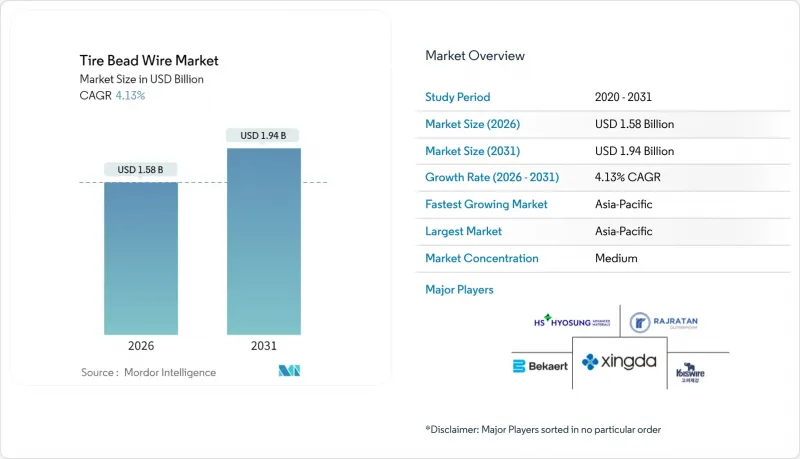
타이어 비드 와이어 시장은 2025년에 15억 2,000만 달러로 평가되며, 예측 기간(2026-2031년)의 CAGR 4.13%로 성장하며, 2026년 15억 8,000만 달러에서 2031년까지 19억 4,000만 달러에 달할 것으로 추정되고 있습니다.
타이어 비드 와이어 시장은 아시아태평양의 대규모 차량 조립 공장, 고급 보강재를 권장하는 세계 안전 규제 강화, E-Commerce 운송을 담당하는 상용차 차량의 교체 주기 가속화 등의 구조적 호재를 받고 있습니다. 연성을 향상시킨 고강도 등급이 가치를 주도하고 있으며, 이는 림 슬립 위험을 줄이고 타이어 무게를 줄이는 슬림한 비드 단면을 가능하게 하기 때문입니다. 이 특성은 승용차와 전기 밴 모두에서 회전 효율을 향상시킵니다. 각 제조업체들은 불순물을 최소화한 초순도 고탄소강을 생산하기 위해 용광로와 선재라인을 지속적으로 업그레이드하고 있습니다. 동시에 광학 검사 및 레이저 결함 검출에 대한 투자를 통해 공정 능력을 향상시켜 OEM 타이어 제조업체가 요구하는 장기 보증 주기를 실현할 수 있도록 지원하고 있습니다. 경쟁 환경은 여전히 복잡하다: 수직계열화 대기업은 장기 계약으로 철강재를 확보하는 반면, 중견기업은 여러 지역에서 조달하거나 고철을 혼합하여 가격 변동 리스크를 헤지하고 있습니다.
세계 자동차 생산의 회복으로 타이어 비드 와이어에 대한 지속적인 수요가 발생하고 있으며, 타이어 제조업체들은 2024년 신공장 건설 및 생산 능력 확장에 사상 최대 규모인 130억 달러를 투자했습니다. 멕시코의 타이어 산업은 이러한 확장을 상징하며, 요코하마 고무, 중책, 사일런 등의 기업이 신규 프로젝트에 10억 달러 이상을 투자하여 생산능력이 1억 개가 넘을 것으로 예측됩니다. 이 시설들은 주요 자동차 시장과 가까운 전략적 위치에 위치하여 물류 비용을 절감하고 엄격한 공급망 요건을 충족하는 동시에 물류 비용을 절감할 수 있습니다. 캄보디아도 중요한 제조 거점으로 부상하고 있으며, 2025년에는 타이어 제조에 대한 투자 규모가 3억 3,500만 달러에 달할 것으로 예상되며, 캄보디아는 세계 타이어 공급망에서 주요 기업으로 자리매김하고 있습니다. 생산 능력의 지역적 다각화는 비드 와이어 공급업체에게 여러 수요 센터를 창출하여 집중화 위험을 줄이는 동시에 시장 기회를 확대합니다.
항공우주 분야의 견고한 회복과 함께 고성능 비드 와이어 응용 분야에 대한 특별한 수요가 발생하고 있습니다. 항공기 타이어는 가혹한 조건에서 작동하므로 뛰어난 인장강도와 내피로성을 갖춘 비드 와이어가 요구되며, 이러한 사양은 프리미엄 가격을 가능하게 하고 타이어 산업 전반의 기술 혁신을 주도하고 있습니다. 미국 연방항공청(FAA)의 엄격한 항공기 타이어 재생 및 수리 기준(Advisory Circular AC 145-4A)에 따라 교체용 비드 와이어 부품에 대한 추가 수요도 창출되고 있습니다. 군사비 지출이 증가함에 따라 2024년 미국 국방 예산은 약 8,860억 달러에 달할 것으로 예상되며, 이는 국방 차량 및 항공기용 특수 타이어 수요를 더욱 증가시킬 것으로 예측됩니다. 이 틈새 분야의 기술 요구 사항은 종종 혁신을 주도하여 궁극적으로 상업용 타이어 응용 분야로 파급되는 경우가 많으며, 항공우주 수요는 광범위한 시장 개발의 촉매제가 되고 있습니다.
이코노미스트 인텔리전스 유닛(EIU)은 2025년과 2026년 산업 원자재 지수가 상승하여 고무 가격이 톤당 2,643달러에 달할 것으로 예측했습니다. 이로 인해 철강 원재료 비용도 상승할 것으로 예측됩니다. 고탄소 철근 가격이 에너지 관세와 연동하여 상승할 때마다 비드 와이어의 이윤율은 축소됩니다. 이는 생산자가 타이어 제조업체와 6개월 계약으로 가격을 고정하고 있기 때문입니다. 캄보디아, 베트남, 인도, 태국으로부터의 저가 타이어 수입으로 인해 2024년 내내 미국의 트럭 타이어 가격은 보합세를 보일 것으로 예측됩니다. 이는 철강재 원가 상승에도 불구하고 추가 요금을 전가할 수 없는 국내 선재 제조업체에 부담을 안겨주었습니다. 환율 변동은 불확실성을 더욱 가중시킵니다. 예를 들어 위안화의 급격한 하락은 중국의 철근 수출을 저렴하게 만들고, 하룻밤 사이에 세계 기준 가격을 재설정합니다. 2차 벤더들은 생존을 위해 금융 헤지나 스크랩 믹싱의 최적화를 위해 노력하고 있지만, 급격한 가격 상승 시에는 EBIT 마진을 완전히 보호할 수 없습니다.
2025년 기준 고강도 선재는 타이어 비드 와이어 시장의 56.63%를 차지할 것으로 예상되며, 규제 당국 및 차량 사업자가 장기 보증 기간을 중시하는 추세로 인해 2031년까지 연평균 복합 성장률(CAGR) 4.59%로 점유율을 확대할 것으로 예측됩니다. 공정 혁신이 핵심이다: 진공 탈가스 처리는 수소 다공성을 감소시키고, 칼슘 주입은 황화물 형태를 제어하여 취성파괴를 억제합니다. 시뮬레이션 연구에 따르면 TiN 함량을 중량 대비 0.003% 미만으로 낮추면 선재 인발시 파손사고를 24% 줄일 수 있으며, 스크랩율 감소와 납품 신뢰도 향상으로 이어집니다.
수요의 세분화가 진행되고 있습니다. 승용차 타이어 제조업체들은 현재 런플랫 플랫폼에 2,500MPa에서 최대 3,000MPa의 인장 강도를 요구하고 있으며, EV 제조업체들은 더 미세한 비드 게이지를 요구하고 있으며, 이를 위해서는 더욱 깨끗한 미세 구조가 필수적입니다. 항공우주용 타이어는 소량 생산이면서 60% 하중에서 100만 사이클 이상의 균열 전파 저항을 갖는 3,400MPa 와이어를 요구하고 있으며, 이 사양을 충족할 수 있는 제조업체는 극소수에 불과합니다. 일반 인장재종은 소형 이륜차, 농기계 등 비용 중심의 틈새 시장에서 여전히 수요가 있지만, 상품화에 따른 경쟁사 간 적대적 관계로 가격 하락 압력에 직면해 있습니다.
타이어 비드 와이어 보고서는 등급(고장력 및 일반 장력), 유형(레이디얼 타이어 및 바이어스 타이어), 용도(승용차 타이어, 상용차 타이어, 기타 타이어), 지역(아시아태평양, 북미, 유럽, 유럽, 남미, 중동 및 아프리카)별로 분류되어 있습니다. 시장 예측은 금액 기준(USD)으로 제공됩니다.
아시아태평양은 2025년 세계 매출의 40.02%를 차지할 것으로 예상되며, 2031년까지 연평균 복합 성장률(CAGR) 5.41%로 가속화될 것으로 예측됩니다. 이는 2024년 1-3분기 중국 타이어 산업 매출 24.28% 증가와 1,922만개 생산량 증가에 힘입은 것입니다. 타이어 비드 와이어 시장은 인도 정부의 생산 연동형 인센티브 제도(PLI)에 따른 철강 원자재 수입 관세 환급 조치의 혜택을 받고 있으며, 신규 생산 능력의 비용 장벽을 더욱 낮추고 있습니다.
북미 시장은 성숙한 시장이며, 비드 와이어의 청결도가 절대적인 조건인 프리미엄 EV 및 항공우주용 제품 라인에 집중하고 있습니다. 알세롤미탈의 앨라배마 공장은 전기모터용 적층 강판과 초순수 SWRH 선재를 모두 공급하며, 현지 조달 원료를 제공함으로써 아칸소 주에 위치한 베카트사의 운송 리스크를 줄일 수 있습니다. 이 회사는 2024년 신규 와이어 드로잉 설비에 대한 투자와 38명의 추가 고용을 실시했습니다.
유럽에서는 주로 고급 타이어 브랜드가 운영하는 독일과 폴란드에서 안정적인 생산량을 유지하고 있습니다. EU 그린딜의 엄격한 목표에 따라 비드와이어 공장은 재생에너지 전기아크로로 전환을 추진하고 있으며, 휘발성 유기화합물(VOC) 배출을 억제하는 수성 윤활유로의 전환도 추진하고 있습니다. 멕시코, 캄보디아 등 신흥지역은 2차 거점으로 자리매김하고 있습니다. 멕시코의 생산량은 2026년 이후 1억 대를 돌파할 것으로 예상되며, 이러한 변화로 인해 미국 자동차 업체들의 조달처가 다양화될 것으로 보입니다.
The Tire Bead Wire Market was valued at USD 1.52 billion in 2025 and estimated to grow from USD 1.58 billion in 2026 to reach USD 1.94 billion by 2031, at a CAGR of 4.13% during the forecast period (2026-2031).
The tire bead wire market enjoys a structural tailwind from Asia-Pacific's large-scale vehicle assembly plants, stricter global safety regulations that favor premium reinforcement materials, and an accelerating replacement cycle among commercial fleets that carry e-commerce traffic. High-tensile grades with enhanced ductility dominate value because they reduce rim-slip risk and permit narrower bead sections that save tire weight, an attribute that boosts rolling efficiency for passenger cars and electric vans alike. Manufacturers continue upgrading furnaces and wire-drawing lines to produce ultraclean high-carbon steel that minimizes inclusions; concurrent investments in optical inspection and laser flaw detection improve process capability and support the longer warranty cycles expected by original-equipment tire makers. Competitive dynamics remain mixed: vertically integrated giants secure raw-steel rod under long-term contracts, while mid-tier firms hedge volatility through multi-regional sourcing and scrap-steel blending.
Global automotive production recovery has created sustained demand for tire bead wire, with tire manufacturers investing a record USD 13 billion in new factories and capacity expansions during 2024. Mexico's tire industry exemplifies this expansion, with production capacity expected to exceed 100 million tires as companies like Yokohama, Zhongce, and Sailun allocate over USD 1 billion for new projects. The strategic positioning of these facilities near major automotive markets reduces logistics costs while meeting stringent supply chain requirements. Cambodia has emerged as another significant manufacturing hub, attracting USD 335 million in tire manufacturing investments during 2025, positioning the country as a key player in the global tire supply chain. This geographic diversification of production capacity creates multiple demand centers for bead wire suppliers, reducing concentration risks while expanding market opportunities.
The aerospace sector's robust recovery has generated specialized demand for high-performance bead wire applications. Aircraft tires operate under extreme conditions requiring bead wire with exceptional tensile strength and fatigue resistance, specifications that command premium pricing and drive technological advancement across the broader tire industry. The FAA's stringent maintenance standards for aircraft tire retreading and repair create additional demand for replacement bead wire components, as outlined in Advisory Circular AC 145-4A. Military spending increases, with the U.S. defense budget projected at approximately USD 886 billion for 2024, further support specialized tire applications in defense vehicles and aircraft. This niche segment's technical requirements often pioneer innovations that eventually cascade into commercial tire applications, making aerospace demand a catalyst for broader market advancement.
The Economist Intelligence Unit expects industrial raw-material indices to rise in both 2025 and 2026, sending rubber to USD 2,643 per tonne and pushing ferrous feedstock costs upward. Bead-wire margins shrink whenever high-carbon rod moves in tandem with energy tariffs because producers fix prices under six-month tire-maker contracts. Imports of low-priced tires from Cambodia, Vietnam, India, and Thailand kept U.S. truck-tire prices level during 2024 even as steel costs advanced, creating a squeeze for domestic wire-drawers who cannot pass through surcharges. Currency swings layer on additional unpredictability; a sudden yuan depreciation, for instance, cheapens Chinese rod exports and resets global reference prices overnight. To survive, tier-two vendors engage in financial hedging and scrap-mix optimization, but neither fully shields EBIT margins during sharp spikes.
Other drivers and restraints analyzed in the detailed report include:
For complete list of drivers and restraints, kindly check the Table Of Contents.
High-tensile wire supplied 56.63% of tire bead wire market share in 2025, and this slice will expand at 4.59% CAGR through 2031 as regulators and fleet operators favor longer warranty periods. Process innovation is central: vacuum-degassing cuts hydrogen porosity, while calcium-injection controls sulfide morphology to curb brittle failure. Simulation work shows that reducing TiN inclusions below 0.003% by weight slashes wire-drawing breakage incidents by 24%, lowering scrap rates and improving delivery reliability.
Demand granularity is shifting. Passenger-car tire makers now specify tensile strengths of 2,500 MPa and up to 3,000 MPa for run-flat platforms, while EV manufacturers request slender bead gauges that necessitate even cleaner microstructures. Aerospace tires, though low volume, demand 3,400 MPa wire with crack-propagation resistance exceeding 1 million cycles at 60% load, a specification that only a handful of mills can meet. Regular-tensile grades still occupy cost-sensitive niches such as small two-wheel applications and agricultural equipment but face downward price pressure due to commoditized competitive rivalry.
The Tire Bead Wire Report is Segmented by Grade (High-Tensile Strength and Regular-Tensile Strength), Type (Radial Tyres and Bias Tyres), Application (Passenger Vehicle Tires, Commercial Vehicle Tires, and Other Tires), and Geography (Asia-Pacific, North America, Europe, South America, and Middle-East and Africa). The Market Forecasts are Provided in Terms of Value (USD).
Asia-Pacific furnished 40.02% of global revenue in 2025 and will accelerate at a 5.41% CAGR to 2031, anchored by China's 24.28% tire-industry revenue leap and its 19.22 million-unit output surge during the first three quarters of 2024. The tire bead wire market benefits from government incentives in India that refund import duties on raw steel under the Production Linked Incentive scheme, further lowering cost barriers for new capacity.
North America, while mature, focuses on premium EV and aerospace lines where bead-wire cleanliness is non-negotiable. ArcelorMittal's Alabama mill will supply both electric-motor laminations and ultra-pure SWRH wire rod, providing local feedstock that mitigates freight risk for Arkansas-based Bekaert, which itself invested in new drawing equipment and 38 additional jobs in 2024.
Europe maintains steady volume mainly in Germany and Poland where premium tire brands operate. Stringent EU Green Deal objectives push bead-wire plants toward renewable-energy electric arc furnaces and force a transition to water-based lubricants that curb volatile-organic-compound emissions. Emerging geographies such as Mexico and Cambodia establish themselves as secondary hubs; Mexico's output will breach 100 million tires post-2026, a shift that diversifies sourcing for U.S. vehicle OEMs.