



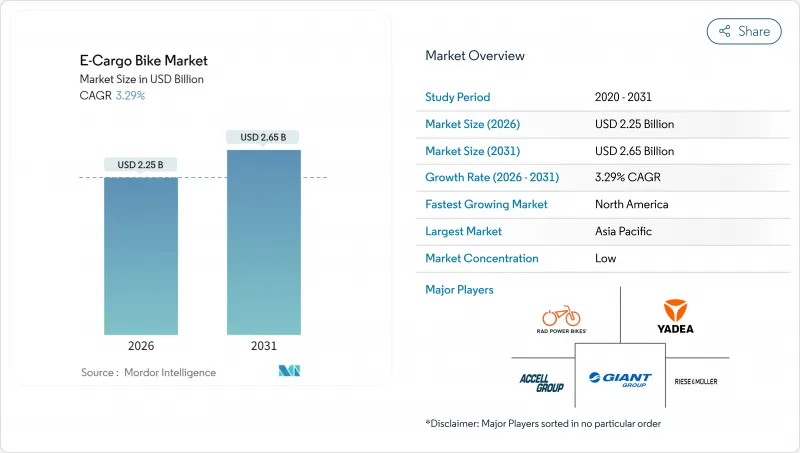
세계의 전기 화물 자전거 시장은 2025년에 21억 8,000만 달러로 평가되었고, 2026년에는 22억 5,000만 달러, 2026-2031년에 걸쳐 CAGR 3.29%로 성장하고 2031년에는 26억 5,000만 달러에 달할 것으로 전망됩니다.
이 꾸준한 성장 궤적은 틈새 마이크로 이동성 제품에서 상업 물류 인프라의 중요한 구성 요소로의 명확한 전환을 반영합니다. 배터리 비용 저하, 급속한 도시화, 배출 규제 강화가 결합되어 기존 화물 자전거와의 총 소유 비용(TCO) 차이가 줄어들고 있습니다. 도시의 저배출 구역에서는 디젤밴이 번화가 중심부로의 진입을 제한하기 때문에 플릿 운영자는 정체 요금의 회피와 스코프 3 보고 의무의 달성을 목적으로 전동화물 솔루션에 이행하고 있습니다. 도입된 자전거 1대마다 탄소 배출량과 소음의 삭감 효과가 실증되기 때문에 기업의 지속가능성 목표가 도입을 가속화하고 있습니다. 동시에 미드드라이브 모터와 통합 텔레매틱스 등의 부품 혁신에 의해 상용화물 자전거의 기능성이 확대되어 등산 성능과 플릿의 가동률이 향상되고 있습니다.
대도시의 수하물 밀도는 상승을 계속하고 좁은 도로나 도매 구역을 지체 없이 이동할 수 있는 대체 수단을 플릿 관리자에게 요구하고 있습니다. 물류 사업자에 따르면, 전동 화물 유닛은 최고 시간대의 경로를 경반보다 신속하게 완주하여 일상적인 주차 위반 벌금과 정체 요금을 절감합니다. 아마존은 유럽 각국에서 화물용 자전거를 단계적으로 대규모 도입하고 있으며, 이 솔루션이 택배 전문업체를 넘어서는 규모로 전개되는 징후를 나타내고 있습니다. 저 배출구역의 확대도 이 동향을 뒷받침하고 있습니다. 디젤 차량의 진입 요금은 전동 카고 유닛의 일일 운용 비용을 상회하는 경우가 많기 때문입니다. 배송 시간 단축, 벌금 감소, 도시 지역 접근 특권으로 인해 전기 화물 자전거 시장은 대도시 지역의 배송 네트워크 내에서 계속 확대되고 있습니다.
재정적 조치는 차량 관리 부문의 구매 판단을 용이하게 합니다. 미국 연방 세액 공제는 대상 상용 전기 화물 자전거의 구매 가격을 다루며 독일에서는 차량 구매 보조금과 충전 시설에 대한 자금이 할당됩니다. 파리와 코펜하겐을 포함한 도시에서는 이에 지방자치단체의 환급금이 늘어나고 고가동률 사업자에 있어서의 투자 회수 기간을 단축합니다. 버스 레인 우선 통행권과 차량 총 중량 규제의 면제는 직접적인 보조금 효과를 상승적으로 향상시키는 운영 비용 절감을 가져옵니다.
전동 구동 시스템은 전통적인 인력 화물 프레임과 비교하여 구매 가격을 크게 밀어 올립니다. 중소기업은 리스 옵션이 한정되어 있어 연료비 삭감에 의한 자본 지출의 상쇄를 신속하게 실시할 수 없습니다. 많은 도시들에서는 손익 분기점에 도달하기 위해서는 주당 가동 시간이 상당수 필요합니다. 금융기관은 경전동 함대를 위한 자산 담보 상품을 도입하고 있지만, 유럽과 북미 이외의 보급률은 여전히 제한적입니다. 자본 시장이 성숙할 때까지는 초기 비용면이 비용중시지역에서의 급속한 보급을 억제하는 요인이 될 것입니다.
어시스트 방식은 2025년 전기 화물 자전거 시장의 86.62% 차지할 것으로 예상됩니다. 이 방법은 운전자가 페달을 밟는 동안 더 높은 최대 출력을 허용하는 유럽 및 일본의 법적 기준과 일치합니다. 이러한 법적 명확성은 차량 소유주의 보험료와 면허 비용을 절감해 줍니다. 욱 정교해져 부하와 경사도에 따라 동력 전달을 조절하여 주행 거리를 늘립니다. 토크 센서 시스템은 더욱 세련되고 적재량과 그라디언트에 따라 출력 조정을 하여 항속 거리를 연장하고 있습니다. 스로틀 어시스트식은 북미에서 와트 수 제한이 완화됨으로써 CAGR 4.12%로 확대되고 있지만, 유럽 주요 도시에서는 여전히 엄격한 라이선싱에 직면하고 있습니다.
수요 동향은 페달 어시스트가 도시 물류의 주력이 되는 이유를 뒷받침합니다. 이 기술을 사용하면 보호된 차선 내에서 자동차 규칙을 적용하지 않고 연속 운전이 가능합니다. 페달 입력이 필수이기 때문에 평균 에너지 소비량은 스로틀 식보다 낮으며 중간 충전 요구를 지연시킵니다. 고밀도 배송 네트워크에서는 이 효율성과 규제 준수의 부담 경감이 함께 총 소유 비용을 억제하는 효과가 있습니다.
리튬 이온 배터리 팩은 2025년 총 출하량의 72.58%를 차지하고 2031년까지 연평균 복합 성장률(CAGR)3.62%로 선두를 유지할 전망입니다. 에너지 밀도의 향상에 의해 250Wh/kg의 벽을 돌파해, 동 항속 거리에서의 팩 소형화가 진행되고 있습니다. 전기자동차 라인에서 증가하는 공급량은 전자 카고 프레임과 같은 2 차 시장을 활성화하고 유리한 가격 형성 경로를 촉진합니다. LFP(인산철 리튬)계 전지는 화재 안전 규제 당국이나 라스트 마일 보험사로부터 평가되는 열 안정성을 제공하는 화학 특성에 의해 리튬 전지 패밀리 내에서 점유율을 확대하고 있습니다.
납축전지는 저가격을 무기로 아시아의 엔트리 레벨 시장에서 발판을 유지하는 것, 플릿 사업자는 통상 2회의 교환 사이클로 리튬 전지로 이행합니다. 긴 수명화로 5년간 배터리 교체 횟수가 감소하고 전력 가격이 높은 지역에서도 총 소유 비용(TCO) 면에서 리튬 배터리가 우위가 됩니다. 강화된 배터리 관리 시스템은 셀 밸런스 조정과 온도 차단 기능을 통합하여 안전성을 높이고 지자체 승인을 확대할 수 있습니다.
미드드라이브 방식은 2025년에 54.88% 시장 점유율을 획득했고 CAGR3.84%로 차이를 넓힐 전망입니다. 모터가 크랭크에 직결되어 있기 때문에 자전거의 구동계를 통해 토크가 증폭되어 급경사나 무거운 적재 시에도 파워를 유지합니다. 중량 배분의 밸런스가 잡혀 있기 때문에 적재시에도 안전한 코너링이 가능합니다. 허브 모터는 평평한 곳에서 트랙션을 유지하고 유지 보수 비용이 약간 낮다는 장점이 있지만 반복적으로 오르막을 주행 할 때 발열 문제가 발생합니다.
함대 구매자는 빈번한 발진 정지나 단거리면서 가파른 등반이 특징인 도심 루트를 위해 미드 드라이브 패키지를 선택하는 경향이 있습니다. 체인이나 기어에 대한 부하가 높기 때문에 서비스 간격은 다소 짧아지지만, 뛰어난 주행 성능과 킬로미터당 배터리 소모 감소의 이점과 대조적으로, 운영자는 이러한 절충을 받아들입니다.
아시아태평양은 2025년에 47.55%의 매출 점유율을 차지했습니다. 이것은 중국의 깊은 공급자 생태계와 상용 모터를 허가하는 일본의 규제적 여지 때문입니다. 현지 OEM 제조업체는 배터리, 모터 및 섀시를 중앙 집중식으로 통합하여 단가 인하와 설계 사이클 단축을 실현합니다. 그 결과, 이 지역은 생산 거점인 동시에 최대의 단일 수요 센터로서 기능하고 있으며, 특히 중국의 주요 도시에서는 정체 요금 제도가 전기 화물 자전거의 이용을 촉진하고 있습니다.
북미는 2031년까지 연평균 복합 성장률(CAGR)6.95%로 가장 빠르게 성장할 지역입니다. 연방세액 공제, 자치체 자금에 의한 자전거 레인망 정비, 당일 배송에 대한 소비자 기대의 고조가 더해져 강한 수요를 창출하고 있습니다. UPS나 페덱스 등의 사업자는 배출량 대시보드를 공개하고 있어 이사회 수준에서 밴에서 자전거로의 전환을 촉구하는 압력이 되고 있습니다. 환경 배려의 소구에 더해, 과거에는 노상 주차 위반 표가 이익률을 압박하고 있던 정체가 심한 도심부에서는 실용적인 이점도 함께 수요가 높아지고 있습니다.
유럽에서는 성숙하면서도 확대를 계속하는 시장 기회가 유지되고 있습니다. 통일 규격 EN 15194 인증에 의해 국경을 넘은 차량 배치가 효율화되고, 암스테르담이나 베를린 등의 도시에서는 전동 카고 오토바이에 버스 레인이나 소매점 앞의 화물 공간의 이용이 허가되고 있습니다. 규제의 명확성과 충실한 인프라가 함께 안정적인 성장을 가져오고 있습니다. 남미와 아프리카의 신흥 시장은 낮은 수준에서 시작되었지만 대출제도가 정비되어 현지조립공장이 수입관세를 인하하면 성장속도가 가속될 가능성이 있습니다.
The global e-cargo bike market is expected to grow from USD 2.18 billion in 2025 to USD 2.25 billion in 2026 and is forecast to reach USD 2.65 billion by 2031 at 3.29% CAGR over 2026-2031.
This steady trajectory reflects a clear shift from niche micromobility product to a critical component of commercial logistics infrastructure. Declining battery costs, rapid urbanization, and stricter emissions rules combine to shrink the total cost of ownership gap with conventional cargo cycles. Municipal low-emission zones now block diesel vans from dense downtown cores, so fleet operators turn to e-cargo solutions to avoid congestion fees and meet Scope 3 reporting obligations. Corporate sustainability targets accelerate adoption because every deployed bike delivers a verifiable reduction in carbon and noise. At the same time, component innovation such as mid-drive motors and integrated telematics is expanding the functional envelope of commercial cargo cycling, improving hill-climbing performance and fleet uptime.
Package density in large cities keeps rising and pushes fleet managers toward alternatives that navigate narrow streets and loading zones with fewer delays. Logistics operators report that e-cargo units complete peak-hour routes quicker than light vans, cutting routine parking fines and congestion fees. Amazon deployed a significant number of cargo bikes across European countries over time, signaling that the solution now scales beyond courier specialists. Emerging low-emission zones reinforce the trend because diesel entry fees often exceed the daily operating cost of an e-cargo unit. Faster drop times, fewer fines, and urban access privileges ensure that the e-cargo bike market continues to expand within metropolitan fulfillment networks .
Fiscal instruments make purchase decisions easier for fleet accountants. The United States federal tax credit covers the acquisition price for qualifying commercial cargo e-cycles, while Germany earmarks funds for fleet grants and charging hardware. Cities, including Paris and Copenhagen, layer local rebates on top, trimming the payback horizon for high-utilization operators. Preferential access to bus lanes and exemptions from gross vehicle-weight rules add operational savings that compound the effect of direct subsidies.
Electric drivetrains significantly increase the sticker price compared to traditional human-powered cargo frames. Small businesses often lack leasing options and cannot offset capital expenditure against fuel savings quickly. The break-even point still requires significant operating hours per week in many cities. Financial institutions are gradually rolling out asset-backed products for light electric fleets, but penetration remains limited outside Europe and North America. Until capital markets mature, upfront economics will check rapid diffusion in cost-sensitive regions.
Other drivers and restraints analyzed in the detailed report include:
For complete list of drivers and restraints, kindly check the Table Of Contents.
Pedal-assist configurations controlled 86.62% of the 2025 e-cargo bike market. The format lines up with European and Japanese legal thresholds that allow higher peak output so long as the rider is pedaling. That legal clarity lowers insurance and license costs for fleet owners. Torque-sensor systems have become more refined, adjusting power delivery by load and gradient to extend range. Throttle-assist bikes are growing at a 4.12% CAGR as North American jurisdictions relax wattage caps, yet the mode still faces tighter licensing in core European cities.
Demand patterns underscore why pedal-assist remains the workhorse for urban logistics. The technology allows continuous operation inside protected lanes without triggering motor-vehicle rules. Because pedal input remains mandatory, average energy consumption is lower than throttle alternatives, delaying mid-route charging stops. For high-density courier networks, that efficiency combines with lighter regulatory compliance to protect the total cost of ownership.
Lithium-ion packs delivered 72.58% of total shipments in 2025 and will retain the crown through 2031 at 3.62% CAGR. Energy density gains now break the 250 Wh/kg barrier, which shrinks pack size for a given range. Rising volumes from electric automotive lines feed secondary markets such as e-cargo frames, driving a favorable pricing glide path. LFP variants are winning share within the lithium family because the chemistry provides thermal stability valued by fire-safety regulators and last-mile insurers.
Lead-acid holds a foothold in entry-level Asian markets due to its low sticker price, yet fleet operators usually migrate to lithium within two replacement cycles. Longer cycle life translates into fewer battery swaps over a five-year horizon, tipping total cost of ownership toward lithium even where electricity prices are high. Enhanced battery management systems now bundle cell-balancing and temperature cutoffs, raising safety credentials and unlocking broader municipal approvals.
Mid-drive layouts secured 54.88% market share in 2025 and should widen the gap by posting a 3.84% CAGR. With the motor linked directly to the crank, torque multiplies through the bicycle drivetrain, preserving power on steep grades and under heavy cargo loads. Balanced weight distribution also means safer cornering with a full load. Hub motors keep traction on flat terrain and carry marginally lower maintenance costs, but face heat build-up when ascending hills repeatedly.
Fleet buyers gravitate toward mid-drive packages for downtown routes that feature frequent stop-start and short but steep climbs. Service intervals are slightly shorter because chains and gears experience higher loads, yet operators accept this trade-off for superior ride dynamics and lower battery drain per kilometer.
The E-Cargo Bike Market Report is Segmented by Propulsion Type (Pedal Assisted, Throttle Assisted), Battery Type (Lead Acid Battery, Lithium-Ion Battery, and More), Motor Placement (Hub (Front/Rear), Mid-Drive), Drive Systems (Chain Drive, Belt Drive), Motor Power (Below 250W, 251-350W, and More), Price Band, Sales Channel, End Use, and Geography. The Market Forecasts are Provided in Terms of Value (USD) and Volume (Units).
Asia-Pacific controlled 47.55% revenue in 2025, thanks to deep supplier ecosystems in China and regulatory headroom in Japan that approves commercial motors. Local OEMs integrate battery, motor, and chassis under one roof, driving down unit cost and shortening design cycles. As a result, the region functions both as a production hub and as the largest single demand center, especially within tier-one Chinese cities where congestion charges now favor electric cargo cycles.
North America is the fastest riser with a 6.95% CAGR to 2031. Federal tax credits, city-funded bike lane networks, and growing consumer expectations for same-day delivery combine to create a strong pull. Operators such as UPS and FedEx openly publish emission dashboards, which adds board-level pressure to pivot from vans to bikes. The environmental narrative pairs with practical advantages in gridlocked downtown cores where curbside parking tickets once ate into profit margins.
Europe maintains a mature yet still expanding opportunity. Harmonized EN 15194 certification streamlines cross-border fleet deployment, and cities such as Amsterdam and Berlin grant e-cargo bikes access to bus lanes plus loading bays outside retail stores. The combination of regulation clarity and extensive infrastructure yields stable growth. Emerging markets in South America and Africa are starting from a low base but could pick up speed once credit facilities mature and local assembly plants lower import duties.