


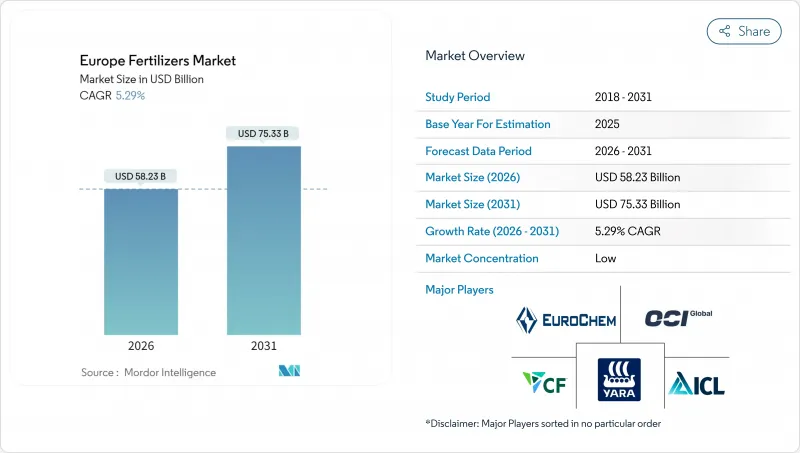
유럽 비료 시장은 2025년 553억 달러로 평가되었고, 2026년에는 582억 3,000만 달러, 2031년까지 753억 3,000만 달러에 이를것으로 예상됩니다. 2026년부터 2031년까지 연평균 복합 성장률(CAGR)은 5.29%를 나타낼 전망입니다.
견고한 수요는 유럽 연합(EU)의 공통 농업 정책(CAP) 에코 방식, 탄소 국경 조정 메커니즘(CBAM) 및 질소 공급 구조를 재구성하는 녹색 암모니아 프로젝트에 대한 투자로 인한 것입니다. 서방형 및 수용성 제품의 채택 가속, 재생에너지를 활용한 생산에 대한 투자 확대, 2024년 가격 상승 후의 곡물 제작 면적 회복이 더욱 성장을 지원하고 있습니다. 생산자는 천연가스 가격의 변동으로 인한 비용면의 역풍에 휩쓸리고 있지만, 수직 통합 및 재생 가능 원료 전략을 통해 대응하고 있습니다. 유럽 비료 시장은 분산된 집중 구조를 보여주며, 상위 5개 기업이 시장 규모의 경미한 점유율을 지배하고 있습니다.
유럽연합(EU)은 공통농업정책(CAP)의 에코스킴을 통해 질소 및 인산염의 유출을 최소화하는 영양계획을 장려하기 위해 연간 310억 유로(335억 달러)를 배분하고 있습니다. 이러한 인센티브는 환경 목표에 따른 안정화 질소, 서방형 코팅 및 정밀 비료 도구의 도입을 촉진합니다. 프랑스와 독일의 대규모 곡물 생산자는 제도 기준을 충족하기 위해 설비의 현대화를 추진하고 있으며, 질화 억제제와 우레아 분해 효소 억제제의 판매를 견인하고 있습니다. 비료 제조업체는 컴플라이언스 지원을 통한 부가가치 획득을 위해 자사 제품에 농학 서비스를 결합합니다. 본 프로그램의 성과 연동형 지불에 의해 정밀 농업 기계의 도입 회수 기간이 단축되어, 설비 갱신이 가속하고 있습니다. 데이터를 기반으로 한 시비 계획은 수율 안정성을 향상시키고 도입 기세를 더욱 강화하고 있습니다.
코페르니쿠스 위성 프로그램의 고해상도 이미지와 농장 센서를 통해 양분 효율을 극대화하는 가변율 시비가 가능해졌습니다. 데이터 구동형 관리하에서는 서방형, 액체 및 수용성 제제가 종래 제품을 웃도는 효과를 발휘합니다. 네덜란드의 온실 재배 사업자는 영양 혼합 비율을 1시간 단위로 조정하는 시비 관리 대시보드를 활용하고, 북유럽의 곡물 생산자는 피복 요소를 이용하여 질소 방출과 작물 흡수를 동기화하고 있습니다. 지역별 혼합 시설에서는 미량 영양소 프로파일을 지역 결핍 상황에 맞게 조정하여 효과를 높이고 있습니다. 생산자는 구독형 의사 결정 지원 플랫폼을 제공하고 비료를 농학 솔루션 패키지로 전환하고 있습니다. 손실 삭감이 제품 비용 상승을 상쇄하기 때문에 프리미엄 가격이 받아들여지고 특수 비료 성장에 선순환이 탄생했습니다.
네덜란드에서는 질소 시용량을 목초지에서 1헥타르당 140kg, 경작작물로 170kg으로 제한하고 있으며, 이는 기존 기준에서 약 30%의 삭감이 됩니다. 덴마크에서는 토양 유형별 할당량을 설정하고, 초과 시에는 1헥타르당 1만800달러라는 엄격한 벌금이 부과됩니다. 이에 반해 농부들은 벌크우레아 구매를 줄이고 안정화된 미립자 혼합비료의 채택을 확대하고 있습니다. 마이그레이션 단계에서는 생산자가 시비 계획을 검토함에 따라 구매를 늦추기 때문에 단기 수요가 둔화됩니다. 종래의 살포 방식은 띠상 시비로 대체되고 있어, 총 사용량은 감소 경향에 있습니다. 비료 제조업체는 고효율 제품 라인으로의 전환과 규제 대응 컨설팅 서비스의 제공이 요구되고, 추가 비용이 발생하는 한편 프리미엄 판매의 기회도 태어나고 있습니다.
단일 비료는 2025년 시점에서 유럽 비료 시장 점유율의 76.85%를 차지하며 예측 기간 중 CAGR5.58%에서 가장 성장이 빠른 부문이기도 합니다. 이 범주 내에서 질소 계열 제품은 밀, 옥수수 및 유채의 주요 영양소 공급원입니다. 복합 비료의 유럽 시장 규모는 확대 경향이 있습니다. 이는 노동력 절감과 단일 공정의 편의성이 독일과 프랑스의 대규모 농장에서 지지되기 때문입니다. 토양 검사에 의해 아연이나 붕소의 결핍이 광범위하게 확인되고 있기 때문에 특수 미량 영양소 배합 제품은 프리미엄 가격이 설정되어 있습니다. 시장 진출기업은 영양소 비율을 조정하고 배송 속도를 향상시키기 위해 지역별 배합 거점에 투자하고 복합 비료의 완만하면서도 꾸준한 확대를 지원하고 있습니다.
배출규제 강화로 양분이용효율이 요구되는 가운데 휘발성이 낮은 질산암모늄은 배출규제가 엄격한 지역에서 점유율을 확대하고 있습니다. 가격 감응도가 높은 동유럽에서는 우레아가 여전히 주류입니다. 유황 등의 2차적 거량 영양소에 대한 관심이 높아지고 있습니다. 이것은 유황 부족이 질소 흡수를 제한하기 때문입니다. 공급업체는 특수 비료 제조업체의 진입으로부터 점유율을 지키기 위해 2차 영양소를 NPK 복합 비료에 통합하고 있습니다. 전반적으로이 부문의 성장 궤도는 균형 잡힌 영양 전략과 정밀 시비 기술의 보급과 일치합니다.
2025년 시점에서 유럽 비료 시장 규모의 86.25%를 기존 배합 제품이 차지하고, 특수 배합 제품은 2031년까지 연평균 복합 성장률(CAGR)5.72%에서 가장 급속한 성장이 전망됩니다. 제어 방출 코팅 제품 시장 규모는 확대 경향에 있으며, 스페인 전역의 온실 토마토 재배에 있어서 폴리머 피복 우레아가 10%의 수율 향상 효과를 나타내고 있습니다. 수용성 등급은 점적 관개 시스템에서 영양분을 공급하는 고밀도 재배 네덜란드 온실용으로 활용됩니다. 액체 제형은 가변 속도 공중 살포 및 트랙터 살포를 지원하여 센서 데이터를 기반으로 주행 중에 조정할 수 있습니다. 서방형 제품은 공공 녹지 관리에 있어서 살포 횟수의 삭감이 요구되는 잔디 관리 분야에서 수요가 높아지고 있습니다.
기존 과립은 가격 우위와 기존 설비의 보급으로 인해 여전히 대면적 농작물로 주류입니다. 영양소 사용 제한을 강화함으로써 손실 삭감과 규제 준수를 실현하는 특수 배합 제품으로의 전환이 진행되고 있습니다. 이노베이터는 생분해성 코팅과 이중 영양소 방출 기구에 주력하여 시장 확대를 도모하고 있습니다. ESG를 의식하는 식품 브랜드는 고효율 영양소로 재배된 농산물을 선호하므로 공급망 전체의 투입 자재 선택에 영향을 미치고 있습니다. 지속적인 R&D 투자는 유럽 비료 시장에서 혁신의 견인 역할로서 본 부문의 역할을 뒷받침합니다.
유럽 비료 시장 보고서는 유형별(복합 비료와 단일 비료), 형태별(기존과 특수), 시비 방법별별(시비 관개, 잎면 살포, 토양 시용), 작물 종별(노지 작물, 원예 작물, 잔디·관상 식물), 지역별(프랑스, 독일, 이탈리아, 네덜란드 등)으로 분류되어 있습니다. 이 보고서는 시장 규모와 예측을 금액(달러) 및 수량(메트릭 톤)으로 제공합니다.
The Europe fertilizers market is expected to grow from USD 55.3 billion in 2025 to USD 58.23 billion in 2026 and is forecast to reach USD 75.33 billion by 2031 at 5.29% CAGR over 2026-2031.
Robust demand stems from the European Union's Common Agricultural Policy eco-schemes, the Carbon Border Adjustment Mechanism, and investments in announced green-ammonia projects that will reconfigure nitrogen supply. Accelerated adoption of controlled-release and water-soluble products, growing investments in renewable energy-powered production, and the rebound in cereal acreage after the 2024 price rally further support growth. Producers face cost-side headwinds from natural-gas price volatility but are responding through vertical integration and renewable feedstock strategies. The Europe fertilizers market displays a fragmented concentration, with the top five firms controlling a minor share of the market size.
The European Union allocates EUR 31 billion (USD 33.5 billion) each year through Common Agricultural Policy eco-schemes that reward nutrient plans minimizing nitrogen and phosphorus losses . These incentives encourage stabilized nitrogen, controlled-release coatings, and precision-application tools that align with environmental objectives. Large cereal growers in France and Germany are modernizing equipment to meet scheme criteria, driving sales of nitrification and urease inhibitors. Fertilizer firms bundle agronomy services with their products to capture value from compliance support. The program's performance-based payments reduce payback time on precision machinery, accelerating upgrades. Data-driven application planning also enhances yield consistency, reinforcing adoption momentum.
High-resolution imagery from the Copernicus satellite program and on-farm sensors enable variable-rate applications that maximize nutrient efficiency . Controlled-release, liquid, and water-soluble formulations outperform conventional products under these data-driven regimes. Dutch greenhouse operators use fertigation dashboards that adjust nutrient mixes hourly, while Nordic cereal growers deploy coated urea to synchronize nitrogen release with crop uptake. Regional blending facilities tailor micronutrient profiles to local deficiencies, boosting efficacy. Producers offer subscription-based decision-support platforms, turning fertilizers into bundled agronomic solutions. Premium pricing is accepted because reduced losses offset higher product costs, creating a virtuous cycle for specialty growth.
The Netherlands caps nitrogen applications at 140 kg per hectare for grassland and 170 kg per hectare for arable crops, a cut of nearly 30% from historical norms. Denmark imposes soil-type quotas with stiff fines reaching USD 10,800 per hectare for exceedance. Farmers respond by reducing bulk urea purchases and increasing stabilized granular blends. The transition period dampens near-term demand because growers delay buying while recalibrating nutrient plans. Conventional broadcast practices face replacement by banded placement, lowering total volumes. Fertilizer companies must pivot to enhanced-efficiency lines and provide compliance advisory services, incurring additional costs yet opening premium sales.
Other drivers and restraints analyzed in the detailed report include:
For complete list of drivers and restraints, kindly check the Table Of Contents.
Straight fertilizers captured 76.85% of the Europe fertilizers market share in 2025, which is also the fastest-growing segment with a CAGR of 5.58% during the forecast period. Within this category, nitrogenous products are the primary nutrient input for wheat, corn, and rapeseed. The Europe fertilizers market size for complex fertilizers is growing because labor savings and single-pass convenience resonate with large German and French farms. Specialty micronutrient blends command premiums as soil tests reveal widespread zinc and boron deficiencies. Market participants invest in regional blending hubs to tailor nutrient ratios and improve delivery speed, supporting a modest but steady expansion of complex formulations.
With enhanced emission rules pushing for nutrient-use efficiency, ammonium nitrate is gaining share in emission-sensitive zones due to its lower volatilization potential. Urea remains dominant in Eastern Europe, where price sensitivity prevails. Secondary macronutrients such as sulfur experience heightened interest because sulfur deficits limit nitrogen uptake. Suppliers bundle secondary nutrients into NPK compounds to protect their share against specialty entrants. Overall, the segment's growth trajectory aligns with the broader adoption of balanced nutrition strategies and precision application technologies.
Conventional formulations accounted for 86.25% of the Europe fertilizers market size in 2025, and specialty formulations are forecast to grow at the fastest 5.72% CAGR through 2031. The Europe fertilizers market size for controlled-release coatings is expanding as polymer-coated urea demonstrates 10% yield gains in greenhouse tomatoes across Spain. Water-soluble grades serve high-density Dutch greenhouses that feed nutrients via drip systems. Liquid formulations support variable-rate aerial and tractor applications, allowing on-the-go adjustments based on sensor data. Slow-release products thrive in turf management where public green standards favor fewer applications.
Conventional granules still dominate bulk field crops because of price advantage and embedded equipment fleets. Tightening nutrient thresholds pushes growers toward specialty formulations that reduce losses and meet compliance targets. Innovators focus on biodegradable coatings and dual-nutrient release mechanisms to broaden appeal. ESG-conscious food brands prefer produce cultivated with enhanced-efficiency nutrients, influencing input choices across supply chains. Sustained R&D investment underlines the segment's role as the innovation engine of the Europe fertilizers market.
The Europe Fertilizers Market Report is Segmented by Type (Complex and Straight), by Form (Conventional and Specialty), Application Mode (Fertigation, Foliar, and Soil), Crop Type (Field Crops, Horticultural Crops, and Turf and Ornamental), and Geography (France, Germany, Italy, Netherlands, and More). The Report Offers the Market Size and Forecasts in Terms of Value (USD) and Volume (Metric Tons).