



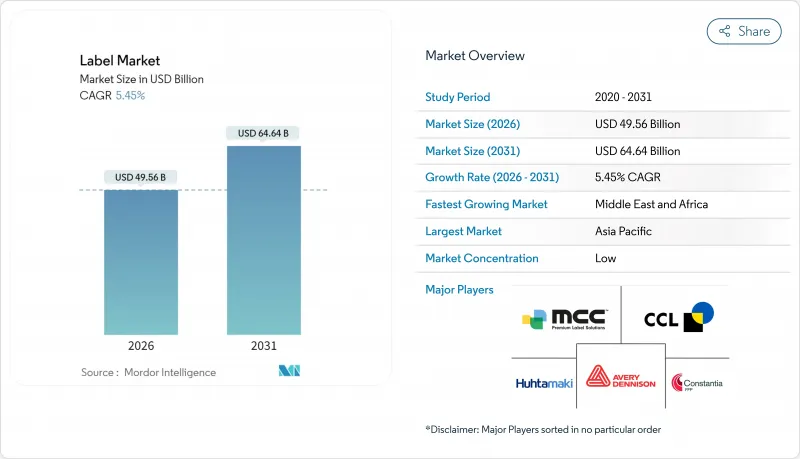
세계의 라벨 시장은 2025년 470억 달러로 평가되었고, 2026년 495억 6,000만 달러에서 2031년까지 646억 4,000만 달러에 이를 것으로 예측됩니다. 예측 기간(2026-2031년) CAGR은 5.45%로 성장이 전망됩니다.

이 꾸준한 성장 궤도는 전자상거래 확대, 지속가능성 규제, 스마트 포장 채택 등의 변화에 대응하는 업계의 능력을 반영합니다. 재생 가능 소재에 대한 규제 압력은 컨버터를 안감 구조 및 바이오 베이스 필름으로 지속적으로 이끌고 있으며, 한편 소매업체에 의한 실시간 제품 인증 수요는 접속형 포장으로의 이행을 가속시키고 있습니다. 디지털 인쇄의 경제성은 단납기 및 커스터마이즈에 적합하고, 총 생산량에 차지하는 비율은 겸손하면서도 이익률을 향상시키고 있습니다. 경쟁 우위는 RFID, NFC 및 QR 코드 솔루션을 대규모로 통합할 수 있는 기업에 유리하게 작용하며, 라벨을 공급망 가시성과 소비자 참여를 강화하는 데이터 접점으로 전환하고 있습니다. 이러한 요인들이 결합되어 특정 음료 카테고리에서 용기 직접 인쇄로 인한 대체품 위협이 존재하더라도 라벨 시장은 지속적인 성장 기반을 구축하고 있습니다.
2023년 세계 소포 취급량은 217억 개에 달했고, 2029년까지 290억 개에 이를 전망입니다. 이를 통해 컨버터 회사는 실시간 및 주문 관련 데이터에 대응할 수 있는 라벨 공급을 강요받고 있습니다. 체적 중량 과금이나 옴니 채널 대응에는 자동 분류 공정을 견디는 스캔 가능한 그래픽이 필수적입니다. 아마존의 2023년 15.7%의 취급량 증가는 내구성이 뛰어난 감열식 및 감압 접착제 구조에 수요 규모를 부조로 하고 있습니다. 물류 사업자는 다양한 골판지 기재에 접착성을 유지하는 접착제를 선호하는 반면, 브랜드 소유자는 최종 단계의 커스터마이즈에 대응 가능한 레이아웃을 요구하고 있습니다. 그 결과 고속 디지털 인쇄기에 투자하는 컨버터는 신속한 인쇄 작업 변경에 따른 프리미엄을 획득하고 전자상거래가 라벨 시장의 구조적 성장 엔진으로서의 지위를 강화하고 있습니다.
EU 포장 및 포장 폐기물 규제에서는 2030년까지 중량비 70%의 재활용성을 의무화해, 표면재, 백지 및 접착제의 재설계를 촉구하고 있습니다. CELAB-Europe는 2025년까지 사용한 백지의 75% 재활용을 목표로 하여 자발적인 파일럿 사업을 넘은 회수 계획을 추진 중입니다. 미국 각 주의 확대 생산자 책임 제도에서는 규제 적합 포장과 비적합 포장 사이에 최대 300%의 요금 차이가 발생하여 지속가능성이 이익 결정 요인이 됩니다. 라이너리스 라벨로 대응하는 컨버터는 폐기물을 최대 40% 절감하여 물류 효율화를 실현합니다. 재생가능한 원료를 85% 포함하는 바이오 접착제 등 재료 과학의 진보는 부착 속도를 희생하지 않고 이행이 용이해지며, 이 촉진요인이 라벨 시장의 성장에 장기적으로 미치는 영향이 더욱 강해지고 있습니다.
미국 멕시코만 해안의 허리케인에 의한 석유화학제품 공급 혼란은 아크릴 수지 및 폴리올레핀의 원료 조달을 압박시켜 접착제 가격의 상승 및 리드 타임의 장기화를 초래하고 있습니다. 2026년까지 222억 유로 규모에 달할 것으로 예상되는 유럽의 접착제 시장도 같은 원료를 쟁탈하고 있으며 구매력이 떨어지는 중소 컨버터는 압박되고 있습니다. 변동성을 다루기 위해 컨버터는 안전 재고를 늘리고 운전 자금 수요가 증가하며 단기적으로 수익을 압박하고 라벨 시장의 확대를 억제하고 있습니다.
감압 접착제는 식품, 퍼스널케어, 물류 용도 등 폭넓은 분야에서의 범용성으로 2025년 라벨 시장 점유율의 32.75%를 차지했습니다. 슬리브 제품은 절대 수량이야말로 작은 반면, 브랜드 오너가 360도 그래픽이나 변조 방지 기능을 추구하는 움직임을 받아 CAGR 8.71%로의 확대가 전망됩니다. 이 슬리브 채용 증가는 프리미엄 음료 및 영양 보조 식품 분야에서 라벨 시장 규모를 밀어 올리는 반면, 랩 어라운드 형식은 캡 인쇄 및 엠보싱에 의한 대체 위험에 직면하고 있습니다. 감압 접착제 분야에서는 지속가능성에 대한 감시가 강화되고 있는 가운데 탄소 실적를 35% 삭감한 재활용 가능한 접착제의 혁신이 계속되고 있어 점유율 유지에 공헌하고 있습니다. 그 결과, 양극화의 경향이 현저해지고 있습니다. 상품 음료는 직접 프린트로 전환하는 반면, 프리미엄 SKU는 고급 슬리브를 채택하고 있으며, 각 경로는 세계 라벨 시장 내의 차별화 된 가치 기반을 강화하고 있습니다.
Flexo 인쇄는 50,000m 이상의 연속 인쇄에서 속도와 비용면에서 우수하기 때문에 2025년 라벨 시장 규모의 57.55%를 차지했습니다. 그러나 디지털 잉크젯 및 일렉트로포토그래피는 8.87%의 연평균 복합 성장률(CAGR)로 추이하며, 생산량의 불과 4.10%이면서 수익의 16.20%를 차지하고 있습니다. 그 경제성은 소프트웨어 중심의 작업 전환으로 다운타임을 줄이고 SKU를 다양화할 수 있다는 점에 달려 있습니다. 복합 블랙 잉크에 대한 최근의 특허 기술은 다공성 기판에서 건조를 가속화하고 인쇄기의 처리량을 향상시키고 단위 비용을 절감합니다. 아날로그 기술의 주력인 그라비아 인쇄, 오프셋 인쇄, 스크린 인쇄는 호일 누름 정신 라벨과 고속 통조림 인쇄 등의 틈새 시장을 유지하고 있지만, 투자 동향은 분명 디지털 기술을 지지하고 있습니다. 향후 몇 년 동안 하이브리드 인쇄 워크플로우를 습득한 컨버터는 범용품의 대량 생산과 고급 커스터마이즈를 모두 획득하여 확대되는 라벨 시장에 대한 침투를 깊게 해 나갈 것입니다.
2025년 시점에서 아시아태평양은 라벨 시장 점유율 44.60%를 차지해 선두를 유지했습니다. 중국 규모 및 인도 포장 식품 시장 성장이 견인 요인입니다. 첨단 제조에 대한 정부 지원 및 인쇄기 제조업체의 집적이 설비 투자 비용을 절감하고 생산능력 확대를 촉진합니다. 태국과 한국의 라벨이 없는 병 전환은 일부 아시아태평양 규제 당국이 기존 방법을 뛰어넘는 자세를 보여주며 지속 가능한 라벨링에 관한 세계적인 논의를 형성하는 예입니다.
중동 및 아프리카는 2025년의 수익이 6.10%에 머무른 반면, 식품 가공 투자 및 소매업의 현대화를 원동력으로, 2031년까지 연평균 복합 성장률(CAGR) 5.24%로 확대가 전망됩니다. 사우디아라비아의 NEOM과 이집트의 산업 지대에서 메가 프로젝트가 골판지 및 라벨 수요를 유발하는 반면, 아프리카의 EC 플랫폼은 배송 라벨의 성장을 견인합니다. 그러나 라이너 재활용 인프라가 아직 정비되지 않아 라이너리스 솔루션이 개발 도중에 있으며 턴키 기술을 이 지역으로 수출하는 공급업체에게 성장 기회가 탄생했습니다.
북미는 기술면에서의 지표지역으로, 2,000사 이상의 컨버터 및 디지털 인쇄기의 풍부한 도입 실적을 가지고 있습니다. 월마트의 RFID 의무화 및 직접 풀필먼트 창고 증가로 스마트 라벨 수요가 높아지고 있습니다. 유럽은 성숙 시장이면서 재활용성에 관한 규제의 페이스를 리드하고 있으며, 세정 가능 접착제나 단일 소재 솔루션의 채용을 추진하고 있습니다. 남미는 거시적 환경의 안정화에 따라 회복 기조에 있으며, 브라질의 음료 대기업이 풍미 워터 SKU 용으로 슬리브를 채용하여 제품 라인의 확충을 도모하고 있습니다. 이러한 지역 횡단적인 동향이 함께 세계 라벨 시장은 균형을 유지하면서도 기회가 풍부한 상황이 강화되고 있습니다.
The Global label market was valued at USD 47 billion in 2025 and estimated to grow from USD 49.56 billion in 2026 to reach USD 64.64 billion by 2031, at a CAGR of 5.45% during the forecast period (2026-2031).
This steady trajectory reflects the sector's capacity to adjust to e-commerce expansion, sustainability regulations, and smart packaging adoption. Regulatory pressure for recyclable materials continues to push converters toward liner-less constructions and bio-based films, while retailers' demand for real-time product authentication accelerates the shift toward connected packaging. Digital printing's economics favor short runs and customization, raising margins despite its modest share of total output. Competitive momentum favors firms that can integrate RFID, NFC, and QR solutions at scale, turning labels into data touchpoints that enhance supply-chain visibility and consumer engagement. The convergence of these forces positions the label market for durable growth even as direct-to-container printing presents a substitution threat in specific beverage categories.
Worldwide parcel volume reached 21.7 billion in 2023 and is tracking toward 29 billion by 2029, pushing converters to supply labels capable of real-time, order-specific data. Dimensional-weight billing and omnichannel fulfillment require scannable graphics that survive automated sortation. Amazon's 15.7% volume surge in 2023 underscores the scale of demand for durable thermal and pressure-sensitive constructions. Logistics providers prefer adhesives that remain tacky across diverse corrugated substrates, while brand owners seek layouts that accommodate late-stage customization. As a result, converters investing in high-speed digital presses capture the premium associated with quick-change print jobs, reinforcing e-commerce as a structural growth engine for the label market.
The EU Packaging and Packaging Waste Regulation mandates 70% recyclability by weight by 2030, compelling redesign of face stocks, liners, and adhesives. CELAB-Europe targets recycling of 75% of spent liners by 2025, pushing collection schemes beyond voluntary pilots. Extended Producer Responsibility in U.S. states imposes fee differentials as high as 300% between compliant and non-compliant packaging, making sustainability a profit determinant. Converters responding with liner-less labels reduce waste by up to 40% and unlock logistics efficiencies. Material science advances, including bio-adhesives with 85% renewable content, ease the transition without sacrificing application speed, reinforcing the driver's long-term impact on label market growth.
Petrochemical supply disruptions from hurricanes in the U.S. Gulf Coast have tightened feedstock availability for acrylics and polyolefins, lifting adhesive prices and extending lead times. Europe's adhesives market, expected to reach EUR 22.2 billion by 2026, competes for the same inputs, squeezing smaller converters that lack purchasing leverage. To manage volatility, converters hold larger safety stocks, raising working-capital needs and pressuring earnings in the short term, thereby restraining label market expansion.
Other drivers and restraints analyzed in the detailed report include:
For complete list of drivers and restraints, kindly check the Table Of Contents.
Pressure-sensitive formats held 32.75% of the label market share in 2025, thanks to their versatility across food, personal care, and logistics applications. Sleeve products, although smaller in absolute terms, are projected to expand at an 8.71% CAGR as brand owners pursue 360-degree graphics and tamper evidence. This sleeve uptake lifts the label market size in premium beverages and nutraceuticals, while wrap-around formats encounter substitution risk from cap-print and embossing. Pressure-sensitive innovation continues with recyclable adhesives 35% lower carbon footprints help sustain share even as sustainability scrutiny intensifies. Consequently, a two-track pattern sets in: commodity beverages pivot to direct print, while premium SKUs adopt sophisticated sleeves, each path reinforcing differentiated value pools inside the global label market.
Flexography controlled 57.55% of the label market size in 2025 due to speed and cost advantages on runs above 50,000 linear meters. Digital inkjet and electrophotography, however, are pacing at 8.87% CAGR, securing 16.20% of revenue from just 4.10% of output. The economics hinge on software-driven job changeovers that slash downtime and enable SKU proliferation. Recent patents on composite black inks accelerate drying on porous substrates, boosting press throughput and lowering per-unit cost. .Analog stalwarts gravure, offset, and screen retain niches such as foil-on-foil spirits labels and high-speed canning, yet investment trends unambiguously favor digital. Over the outlook period, converters that master hybrid press workflows capture both commodity scale and premium customization, deepening their penetration of the expanding label market.
The Global Label Market Report is Segmented by Label Type (Pressure-Sensitive, Shrink and Stretch Sleeves, and More), Printing Technology (Flexography, Gravure, Offset, Digital, Screen and Other Analog), Material (Paper and Paperboard, PVC, and More), End-User Industry (Food and Beverages, Pharmaceutical and Healthcare, and More), and Geography (North America, and More). The Market Forecasts are Provided in Terms of Value (USD).
Asia-Pacific led with 44.60% of label market share in 2025, fueled by China's scale and India's growth in packaged foods. Government incentives for advanced manufacturing and the clustering of press-builders lower capital costs, encouraging capacity additions. Thailand's and South Korea's shifts toward labelless bottles illustrate how some APAC regulators leapfrog legacy practices, thereby shaping the global conversation on sustainable labeling.
Middle East and Africa, though only 6.10% of 2025 revenue, will post a 5.24% CAGR through 2031, propelled by food-processing investments and retail modernization. Mega-projects in Saudi Arabia's NEOM and Egypt's industrial zones spur corrugated and label demand, while African e-commerce platforms fuel shipping-label growth. Limited liner recycling infrastructure, however, keeps liner-less solutions nascent, offering upside for suppliers exporting turnkey technologies into the region.
North America remains the technological bellwether, home to over 2,000 converters and a deep installed base of digital presses. RFID mandates at Walmart and the proliferation of direct-fulfillment warehouses intensify demand for smart labels. Europe, while mature, continues to set the regulatory pace on recyclability, driving adoption of wash-off adhesives and mono-material solutions. South America rebounds as macro conditions stabilize; Brazil's beverage giants adopt sleeves for flavored-water SKUs, widening product breadth. Collectively, cross-regional dynamics reinforce a balanced yet opportunity-rich landscape for the global label market.