



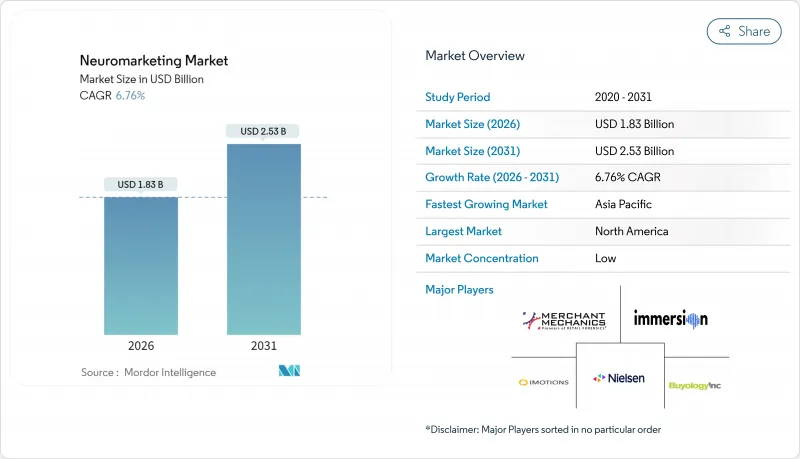
세계의 뉴로마케팅 시장 규모는 2026년 18억 3,000만 달러로 추정되며, 2025년 17억 1,000만 달러에서 성장해 2031년에는 25억 3,000만 달러에 이를 것으로 예측됩니다. 2026년부터 2031년까지는 CAGR 6.76%로 확대될 전망입니다.
이 확대는 뇌파 측정과 머신러닝 시스템이 구매 의도를 87.1%의 정확도로 예측할 수 있는 입증된 능력, 몰입형 증강현실 테스트 환경의 대두, 프라이버시 규제와 기존 소비자 인사이트 도구 간의 확대 격차에 의해 추진되고 있습니다. 세계 브랜드는 뉴로마케팅 플랫폼을 캠페인 사전 테스트, 잠재고객 세분화, 사용자 경험 최적화를 위한 기반으로 삼고 있는 반면, 투자자들은 하드웨어 소형화와 클라우드 분석을 다루는 신규 사업을 지원하고 있습니다. 캘리포니아주 SB 1223과 유럽연합의 GDPR(EU 개인정보보호규정)과 같은 엄격한 데이터 보호법을 통해 공급업체는 컴플라이언스 비용을 증가시키고 지속적인 경쟁 우위를 창출하는 프라이버시 보호 설계 원칙을 통합하고 있습니다. 대기업 기술 기업이 전문 기업을 인수하고, 보다 광범위한 마케팅 기술 스택 전체에 신경 측정 기능을 통합하는 움직임이 진행되고 업계 재편이 진행 중입니다.
브랜드 마케터는 참여의 지표로 클릭률과 전환율을 약화시키는 단편화된 디지털 여정에 직면해 있습니다. 머신러닝과 통합된 EEG 기반 시스템은 인지 부하, 감정적 각성, 구매 의욕 등 판매 향상과 직접 상관되는 인지 지표를 실시간으로 제공합니다. 획기적인 연구에서 구매 예측 정확도는 설문 조사의 64%에 대해 87.1%를 달성했으며 신경생물학적 측정으로의 전환이 입증되었습니다. 이러한 도구를 도입한 소비재 기업은 광고 소재의 신속한 반복, 미디어 낭비 감소, 광고비 대 효과 향상을 실현하고 있습니다. 붐비는 온라인 마켓플레이스에서 경쟁이 치열해짐에 따라 보다 깊은 행동 통찰력에 대한 수요가 더욱 커지고 있습니다.
뉴로마케팅 공급업체는 캠페인을 시작하기 전에 주의 패턴을 예측하기 위해 합성곱 신경망과 그라디언트 부스팅 모델을 통합합니다. 대규모 멀티모달 데이터세트를 이용한 교육을 통해 인구통계적 코호트 간의 미묘한 감정적 징후를 구별하는 교차 문화 세분화가 가능합니다. 기능적 근적외선 분광법(fNIRS) 연구는 이문화 혼합 광고에서 성별 특이적인 전두전야의 활성화를 밝혀내고, 브랜드는 신경 생물학적 적합성에 기초한 메시징 최적화를 가능하게 합니다. 예측 범위는 단일 크리에이티브를 넘어 장기적인 브랜드 가치의 궤적까지, 예산 배분 및 포트폴리오 전략의 지침이 됩니다. 이러한 예측 엔진을 미디어 계획 워크플로우에 통합한 기업은 인사이트 사이클을 몇 주에서 몇 시간으로 단축했습니다.
fMRI 장비 세트의 도입 비용은 300만 달러를 초과할 수 있으며 연간 유지비는 20만 달러에 달할 전망입니다. 이러한 지출은 주요 제약 기업에게는 가능하지만 대부분의 광고 대행사나 스타트업 기업에는 손이 닿지 않는 수준입니다. 이 자본적 장애물은 자원이 풍부한 조직이 고해상도 데이터에 액세스할 수 있는 반면, 다른 조직은 저비용의 EEG(뇌파)와 시선 추적 기술에 의존하는 양극화 구조를 정착하고 있습니다. 휴대형 fNIRS(근적외선 분광법) 장치는 fMRI의 약 75%의 정확도를 10%의 비용으로 실현하지만, 현재는 전뇌 매핑을 완전히 재현할 수 없습니다. 이 제약이 대규모 도입을 막아 조사 방법의 혁신을 늦추고 있습니다.
소매 및 소비재 브랜드는 소비재 분야에서 대규모 캠페인 테스트를 배경으로 2025년 뉴로마케팅 시장의 37.12%를 차지했습니다. 그러나, 의료 및 제약 분야의 응용은 7.12%의 연평균 복합 성장률(CAGR)로 진전하고 있으며, 최종 사용자 중에서 가장 빠른 페이스입니다. 의료 커뮤니케이션에서의 뉴로마케팅 시장 규모는 환자의 복약 준수율과 임상시험 참여 의욕을 향상시키는 신경과학에 근거한 컨텐츠의 혜택을 누릴 것입니다. 제약 회사의 마케터는 디지털 바이오 마커를 활용하여 인지 기능에 대한 부작용을 실시간으로 모니터링합니다. 한편, 병원 네트워크에서는 텔레헬스 포털의 사용자 경험 흐름을 테스트하여 이용상의 마찰이나 예약의 무단 취소를 줄이기 위한 노력이 진행되고 있습니다.
은행과 보험 회사는 신경 피드백을 신규 고객 획득 프로세스에 통합하여 서류 기입 시간을 단축하고 이탈률을 줄이기 위해 노력하고 있습니다. 시장 연구기관은 예측적 타당성을 높이기 위해 기존의 조사 인프라에 생체인증 패널을 내장하고 있습니다. 학술기관은 관민 공동 보조금으로 뇌 컴퓨터 인터페이스 연구소를 확대하고 있으며, 특히 정부가 번역 신경과학을 자금 지원하는 아시아태평양에서 두드러집니다. 자동차 및 엔터테인먼트 기업은 차재 감정 모니터링이나 스토리보드 최적화를 모색하고 있어 수요의 회복력을 강화하는 다양한 최종사용자 환경을 형성하고 있습니다.
뇌파 측정(EEG)은 확립된 조사 프로토콜과 센서 비용 절감으로 2025년에 40.28%의 수익 점유율을 유지했습니다. 기능적 근적외선 분광법(fNIRS)은 연간 7.35%의 성장률을 나타내며, 물리적 통로와 가상 점포를 열람하는 유저의 전두 전야의 혈중 산소화를 매핑하는 휴대형 및 파이버리스 캡 제공에 의해 차이를 줄이고 있습니다. 헤드셋 제조업체가 혼합 현실 디바이스 내에 광다이오드를 통합함에 따라 fNIRS 솔루션의 뉴로마케팅 시장 규모는 확대될 전망입니다. 시선 추적 모듈은 운전 중 주의 산만과 소매점의 선반에 대한 시선을 평가하는 스마트 글라스에 통합함으로써 혜택을 누리고 있습니다.
고해상도에 의한 잠재적인 브랜드 연상의 연구에 있어서는 예산 압박에 의해 경량인 수법이 선호되는 가운데, 기능적 자기 공명 이미징(fMRI)은 여전히 필수적입니다. 피부 전기 반응과 광전식 맥파계를 결합한 웨어러블 생체계측 기술을 통해 하루 종일 지속되는 소비자 행동 관찰(사파리)의 감정을 지속적으로 추적할 수 있습니다. 신흥 뇌 감지 이어폰과 뉴로모픽 센서는 최첨단에 위치해 있으며, 신뢰성 임계값이 충족되면 핸즈프리 수동 데이터 스트림을 실현하고 조사 기법의 규범을 재구성할 가능성을 갖고 있습니다.
북미는 2025년 시점에서 뉴로마케팅 시장의 41.20%를 차지했으며, 풍부한 벤처 캐피탈, 학술적인 뇌과학 클러스터, 명확한 프라이버시 지침을 반영하고 있습니다. 미국의 신경 기술에 대한 자금 조달은 같은 해 129건의 거래로 23억 달러에 달했고, 획기적인 센서 설계와 AI 파이프라인을 촉진했습니다. 캐나다에서는 국경을 넘은 컨소시엄을 촉진하는 공적 보조금이 보완적인 역할을 하고, 멕시코에서는 디지털 광고의 고도화에 따라 소비재 기업이 예산 친화적인 시선 추적 기술을 채용하고 있습니다. Apple의 Datakalab의 2,200만 달러 인수와 같은 인수 활동은 이 지역의 임베디드 신경 분석 기능에 대한 강한 수요를 뒷받침하고 있습니다.
아시아태평양은 2031년까지 연평균 복합 성장률(CAGR) 7.83%로 확대해 중국, 인도, 일본 및 한국이 옴니채널 소매, 게임, 자동차 체험에 뉴로마케팅을 통합함에 따라 지역 간 수익 격차는 축소될 전망입니다. 중국에서는 정부의 연구 보조금이 세계 브랜드와 제휴하는 뉴로 AI 스타트업을 지원하고 인도의 D2C 플랫폼은 사용성 실험실에서 EEG 헤드 밴드를 도입하고 있습니다. 집단조화를 중시하는 문화적 규범은 사회적 인지 지표의 영향력을 증폭시키고 현지 기관이 집단주의적 요소를 포착하는 연구 프로토콜의 커스터마이즈를 촉진하고 있습니다. 일본의 일렉트로닉스 대기업과 한국의 엔터테인먼트 그룹은 fNIRS와 촉각 피드백을 융합한 몰입형 XR 연구소를 개척해 제품 발매의 정확도 향상을 도모하고 있습니다.
유럽에서는 독일 자동차 산업의 전통, 프랑스 럭셔리 제품의 창의성, 영국 미디어 대행사의 혁신성으로 건전한 수요가 유지되고 있습니다. 엄격한 GDPR(EU 개인정보보호규정) 시행은 개인 데이터 전송을 제한하는 에지 분석 및 페더레이티드 학습 솔루션을 추진하고 유럽 벤더를 윤리적인 뉴로마케팅 세계의 벤치마크로 자리잡고 있습니다. 휴먼 브레인 프로젝트와 같은 학술 네트워크는 상용 제품으로 흐르는 계측 기술의 진보를 창출하고 있습니다. 프라이버시에 중점을 둔 평판은 소비자의 회의심 증가에 직면하는 다국적 브랜드를 끌어들여 컴플라이언스의 고도화를 수익의 촉매로 바꾸고 있습니다. 남미, 중동, 아프리카에서도 디지털 인프라 가속화와 다국적 소매업체의 옴니채널 전략의 현지화에 따라 장기적인 기회가 탄생하고 있습니다.
Neuromarketing market size in 2026 is estimated at USD 1.83 billion, growing from 2025 value of USD 1.71 billion with 2031 projections showing USD 2.53 billion, growing at 6.76% CAGR over 2026-2031.
Expansion is fueled by the proven ability of electroencephalography-machine learning systems to predict purchase intent with 87.1% accuracy, the rise of immersive extended-reality testing environments, and the widening gap between privacy regulations and traditional consumer-insight tools. Global brands view neuromarketing platforms as infrastructure for campaign pre-testing, audience segmentation, and user-experience optimization, while investors support new ventures that bridge hardware miniaturization with cloud analytics. Strict data-protection laws, notably California SB 1223 and the European Union's GDPR, compel vendors to embed privacy-preserving design principles that add compliance costs yet create durable competitive advantages. Consolidation is underway as larger technology companies acquire specialist firms to embed neural measurement across wider marketing-technology stacks.
Brand marketers face fragmented digital journeys that weaken click-through and conversion metrics as proxies for engagement. EEG-based systems integrated with machine learning provide real-time readouts of cognitive load, emotional arousal, and motivational intent that correlate directly with sales lift. A landmark study reported 87.1% purchase-prediction accuracy against 64% for surveys, validating the shift toward neurobiological measurement. Consumer goods firms that deploy these tools achieve faster creative iteration, reduced media wastage, and higher return on advertising spend. Heightened competition inside crowded online marketplaces further elevates demand for deeper behavioral insight.
Neuromarketing vendors embed convolutional neural networks and gradient-boosting models to forecast attention patterns before campaigns launch. Training on large multi-modal datasets enables cross-cultural segmentation that distinguishes subtle emotional cues among demographic cohorts. Functional near-infrared spectroscopy studies reveal gender-specific prefrontal activation during mixed-culture adverts, allowing brands to tailor messaging by neurobiological fit. Forecasting extends beyond single creatives to long-term brand-equity trajectories, guiding budget allocation and portfolio strategy. Companies that integrate these predictive engines into media-planning workflows compress insights cycles from weeks to hours.
Installing an fMRI suite can exceed USD 3 million, with recurrent maintenance topping USD 200,000 each year. Such spending is feasible for large pharmaceutical firms but unattainable for most agencies and start-ups. The capital hurdle entrenches a two-tier structure in which resource-rich organizations access high-resolution data while others rely on lower-cost EEG or eye-tracking alternatives. Portable fNIRS devices deliver roughly 75% of fMRI precision at 10% of its cost, but they cannot yet fully replicate whole-brain mapping. This constraint limits large-scale adoption and slows methodological innovation.
Other drivers and restraints analyzed in the detailed report include:
For complete list of drivers and restraints, kindly check the Table Of Contents.
Retail and consumer brands captured 37.12% neuromarketing market share during 2025, driven by high-volume campaign testing across fast-moving consumer goods. Healthcare and pharma applications, however, are advancing at a 7.12% CAGR, the fastest among end users. The neuromarketing market size for healthcare communications will benefit from neuroscience-based content that improves patient adherence and clinical-trial engagement. Pharmaceutical marketers employ digital biomarkers to monitor cognitive side effects in real time, while hospital networks test user-experience flows of telehealth portals to reduce friction and missed appointments.
Banks and insurers integrate neural feedback into onboarding journeys that shorten form-completion times and lower abandonment. Market-research agencies embed biometric panels within traditional survey infrastructures to boost predictive validity. Academic institutions expand brain-computer-interface labs through public-private grants, particularly in Asia Pacific where governments fund translational neuroscience. Automotive and entertainment firms explore in-vehicle emotion monitoring and storyboarding optimization, rounding out a diversified end-user landscape that strengthens demand resilience.
Electroencephalography held 40.28% revenue in 2025 thanks to well-established research protocols and shrinking sensor costs. Functional near-infrared spectroscopy is growing 7.35% annually, narrowing the gap by offering mobile, fiber-less caps that map prefrontal blood oxygenation while users browse physical aisles or virtual storefronts. The neuromarketing market size for fNIRS solutions will expand as headset manufacturers embed optical diodes inside mixed-reality devices. Eye-tracking modules benefit from integration into smart glasses that assess driver distraction and retail shelf gaze.
Functional magnetic resonance imaging remains indispensable for high-resolution studies of subconscious brand associations, even as budget pressures favor lighter modalities. Wearable biometrics that combine galvanic skin response with photoplethysmography enable continuous emotion tracking during day-long consumer safaris. Emerging brain-sensing earbuds and neuromorphic sensors sit at the frontier, promising hands-free passive data streams that could reshape methodological norms once reliability thresholds are met.
The Neuromarketing Market Report is Segmented by End Users (BFSI, Retail and Consumer Brands, Market Research Agencies, Scientific Institutions, and More), Technology (EEG, Eye Tracking, Biometrics, Facial Coding, FNIRS, and More), Offering (Hardware, Software, and Services), Application (Advertising and Media Testing, Product and Packaging Design, and More), and Geography. The Market Forecasts are Provided in Terms of Value (USD).
North America commanded 41.20% neuromarketing market share in 2025, reflecting deep venture-capital pools, academic brain-science clusters, and clear privacy guidance. United States funding for neurotechnology reached USD 2.3 billion across 129 deals that year, catalyzing breakthrough sensor designs and AI pipelines. Canada supplements with public grants that encourage cross-border consortia, while Mexico's consumer-goods companies adopt budget-friendly eye-tracking as digital advertising sophistication rises. Acquisition activity, such as Apple's USD 22 million purchase of Datakalab, underscores the region's appetite for embedded neural-analysis capability.
Asia Pacific is growing at a 7.83% CAGR through 2031 and will narrow the regional revenue gap as China, India, Japan, and South Korea integrate neuromarketing into omnichannel retail, gaming, and automotive experiences. Government research grants in China support neuro-AI startups that partner with global brands, while India's direct-to-consumer platforms deploy EEG headbands in usability labs. Cultural norms that emphasize group harmony amplify the impact of social-cognition metrics, motivating local agencies to customize study protocols that capture collectivist cues. Japan's electronics giants and South Korea's entertainment groups pioneer immersive XR laboratories that fuse fNIRS with haptic feedback to refine product launches.
Europe maintains healthy demand anchored by Germany's automotive heritage, France's luxury-goods creativity, and the United Kingdom's media-agency innovation. Stringent GDPR enforcement propels edge-analytics and federated-learning solutions that limit personal-data transfer, positioning European vendors as global benchmarks for ethical neuromarketing. Academic networks such as the Human Brain Project spin off instrumentation advances that flow into commercial offerings. Privacy-focused reputation attracts multinational brands facing rising consumer skepticism, turning compliance sophistication into a revenue catalyst. Long-run opportunities also emerge in South America, the Middle East, and Africa as digital infrastructure accelerates and multinational retailers localize omnichannel strategies.