



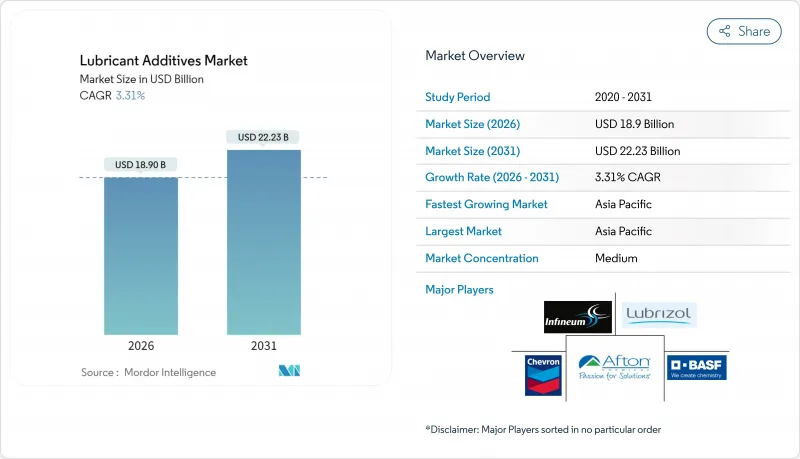
윤활유 첨가제 시장 규모는 2026년에는 189억 달러로 추정되며, 2025년 182억 9,000만 달러에서 성장한 수치입니다. 2031년에는 222억 3,000만 달러에 이르고, 2026년부터 2031년까지 연평균 복합 성장률(CAGR) 3.31%로 성장할 것으로 예상됩니다.
이 꾸준한 확대는 업계가 양도의 성장에서 가치 중심의 혁신으로 전환하고 있음을 반영하며 프리미엄 첨가제 화학 기술이 윤활유 수요의 둔화를 상쇄하고 있습니다. 2025년 3월에 도입된 ILSAC GF-7을 필두로 하는 규제 강화의 진전에 의해 보다 엄격한 배출 가스 규제와 저점도화에 대응하는 고도의 다기능 첨가제 패키지의 채택이 가속화되고 있습니다. 아시아태평양은 가장 규모가 큰 지역 점유율과 가장 높은 성장세를 결합합니다. 중국과 인도의 제조업 확대는 견고한 자동차 및 산업용 윤활유의 소비를 지원하기 때문입니다. 경쟁 환경에 있어서는 가격보다 기술적 차별화가 중시되고 있으며, 이는 2025년 2월에 루브리졸사가 발매한 차세대 저SAPs 엔진 오일용 제품 「Solsperse W60 Hyperdispersant」입니다. 오일 교환 간격의 연장과 전동화에 의해 첨가제의 절대량은 억제되는 한편, 나노스케일의 기술 혁신과 배출가스 규제의 강화로 고부가가치 솔루션에 대한 수요는 지속되고 있습니다.
ILSAC GF-7 규격은 2025년 3월에 발효하여 첨가제 공급자에게 보다 엄격한 인·황 함량 제한 하에서 저속 예연소를 억제하면서 타이밍 체인을 보호할 것을 의무화하고 있습니다. 유럽의 신규격 ACEA 2023 C7 카테고리는 SAE 0W-16 오일을 대상으로 하고 있으며, 기준 오일비로 적어도 0.3%의 연비 향상을 실현하는 마찰 조정제나 점도 지수 향상제 수요를 환기하고 있습니다. 자동차 제조업체가 0W-8그레이드로의 이행을 추진하는 중, 첨가제 배합은 연비 효율과 마모 방지 성능, 산화 안정성의 양립이 요구됩니다. 이 균형 조정은 고순도 세정제 화학과 고급 마모 부스터의 가치를 높입니다. 지역 간의 규제 수렴은 성능 기준의 세계 조화를 가속화하고 다국적 공급업체는 지역 특유의 혼합이 아닌 다목적 첨가제 플랫폼에 대한 투자를 촉진합니다. 신속한 인증 능력을 보여주는 공급업체는 블렌더와 OEM 모두와의 협상력을 강화합니다.
사우디아라비아의 '비전 2030'에 기반한 하류 부문의 다각화 프로그램은 풍부한 원료원에 가까운 지역에서 첨가제 생산을 목적으로 하는 합작사업을 창출하고 있습니다. 아람코와 카스트롤의 공동시설 계획과 리치풀 그룹과 파라비 석유화학의 제휴 등은 지역에서의 자립화의 움직임을 상징하고 있습니다. 통합 복합 단지는 수입 의존형 아프리카 제조업체의 물류 비용을 줄이고 홍해 회랑 전역의 고객에 대한 리드 타임을 단축합니다. 장기적으로, 이러한 투자는 아시아태평양 수요 급증에 대응하는 수출 기반을 구축하는 동시에 현지 믹서를 세계 운임 변동으로부터 보호합니다. 지역정부도 면세기간이나 우대지대 등 우대조치를 통해 특수화학제품 클러스터를 촉진하여 신규시설의 재무적 실현 가능성을 높이고 있습니다. 설비 용량이 증가함에 따라 첨가제 공급업체는 MEA 시장 특유의 기후적 극단 조건과 연료 품질에 맞는 배합을 조정할 수 있습니다.
미국의 승용차의 오일 교환 간격은 5,000마일에서 10,000마일로 두배로 늘어났으며, 풍력 터빈의 기어 박스에서는 윤활유의 수명 사이클을 36개월로 하는 목표가 설정되어 있습니다. 필터에 내장된 상태 모니터링 센서에 의해 오일의 산화나 입자 레벨이 경보를 발할 때까지 유지관리를 늦추는 데이터 구동형 보수가 가능하게 되었습니다. 각 오일 충전 시 첨가제 함량은 증가하고 있으며 연간 총 첨가제 사용량은 감소하는 경향이 있습니다. 이 때문에 블렌더 기업은 프리미엄인 장수명 브랜드에의 판매 시프트를 진행시키고 있어, 범용 화학제품에 주력하는 공급자를 압박하고 있습니다. 독립 정비 공장은 서비스 수익을 잃고 소비자의 연장 교환 간격 채택을 뒷받침하고 있습니다. 이를 보완하기 위해 첨가제 제조업체는 세척액 및 필터 컨디셔너 정제와 같은 보조 제품을 추진하고 있지만 보급은 제한적입니다.
분산제 및 유화제는 2025년 수익의 29.13%를 차지했고, 그을음과 산화 부산물을 현탁 상태로 유지하고 바니시 형성을 방지하는 중요한 역할을 반영하고 있습니다. OEM 제조업체가 고입자 부하의 가솔린 직분사 엔진으로 이행하는 가운데, 이 부문은 2031년까지 연평균 복합 성장률(CAGR)4.32%로 성장하여 윤활유 첨가제 시장 전체를 웃도는 전망입니다. 분산제로 인한 윤활유 첨가제 시장 규모는 황산회분 및 인에 대한 규제 상한이 강화됨으로써, 저처리율로 기능하는 고효율 폴리이소부틸렌숙시니미드 화학물질의 필요성이 높아지기 때문에 꾸준한 확대가 예상됩니다.
고분자계 점도 지수 향상제는 고온 작동 환경 하에서도 견고한 유막 강도를 필요로 하는 0W-8 등 저점도 등급으로 전환하여 2위 점유율을 차지하고 있습니다. 세정제와 부식방지제는 교환 간격의 연장에 의해 염기가 보존의 중요성이 증가함에 따라 안정적인 수요를 유지하고 있습니다. 마찰조정제는 1%의 연비 향상을 목표로 하는 승용차용 및 대형차용 오일에 있어서 중요성을 늘리고 있습니다. 한편, 극압 첨가제는 산업용 기어 오일과 금속 가공유의 핵심적인 역할을 유지하고 있습니다. 공급업체는 이러한 화학 물질을 다기능 패키지에 통합하여 엄격한 회분 예산 내에서 첨가량을 최적화합니다. 이 트렌드를 통해 벤더는 SKU가 적은 세계 엔진 테스트 매트릭스에 대응할 수 있습니다.
윤활유 첨가제 보고서는 기능 유형별(분산제 및 유화제, 점도 지수 향상제, 세정제, 부식 방지제 등), 윤활유 유형별(엔진 오일, 트랜스미션·유압 작동유, 금속 가공유 등), 최종사용자 산업(자동차 및 기타 수송 기기, 발전, 중기 등), 지역(아시아태평양, 북미, 유럽 등)마다 분석
아시아태평양은 2025년에 45.05%의 점유율로 세계 시장을 선도해 2031년까지 연평균 복합 성장률(CAGR)3.98%로 성장할 것으로 예측됩니다. 중국의 수직 통합형 석유화학 콤플렉스는 경쟁력 있는 가격의 그룹 II 및 그룹 III 기유를 생산하고 첨가제 블렌드 플랜트에 공급함으로써 국내 및 수출 수요를 지원합니다. 인도는 생산연동형 우대조치를 활용해 특수화학제품 분야에 대한 투자를 유치. 이에 따라 이 나라는 ASEAN 조립 제조업체를 위한 조달 거점으로 변모하고 있습니다. 일본과 한국은 독자적인 폴리머 개질제와 고순도 분산제를 제공하고, 태국과 베트남은 지역 OEM용 서비스 충전 프로그램용으로 비용 효율적인 블렌드 서비스를 제공합니다.
북미는 세계의 성능 사양 설정에서의 역할을 통해 여전히 큰 영향력을 유지하고 있습니다. 미국에 본부를 두고 있는 API와 ILSAC 위원회는 새로운 카테고리 도입을 주도하고, 수반되는 첨가제 시험 프로토콜의 세계 채택을 촉진하고 있습니다. 차량의 전동화와 오일 교환 간격의 연장이 수량 성장을 억제하는 한편, 이 지역의 플릿 소유자는 우수한 산화 안정성과 연비 성능을 요구하고 있어 첨가제의 단위당 높은 가치를 유지하고 있습니다. 멕시코의 자동차 조립 능력 확대는 무역 협정의 현지 조달률 규제에 대응하기 위해 공급망의 현지화를 추진하는 OEM 제조업체에 의해 지역 수요를 더욱 지원하고 있습니다.
유럽은 성숙한 자동차 보유 대수와 세계 최고 수준의 환경 규제를 겸비하고 있습니다. ACEA 2023 표준 및 유로 VII 제안에서는 미립자 물질 필터 대응과 초저점도 등급이 의무화되고, 배합 제조업체는 회분 제한과 터보차저의 청정성의 균형을 잡고 있습니다. 독일의 화학 대기업은 첨단 산화방지제와 마찰조정제를 공급하고 영국은 현저한 첨가제 연구개발 거점을 유지하고 있습니다. 러시아의 지정학적 상황은 기술 이전을 제한하고 있지만, 국내 블렌더는 산업용 오일용으로 기존의 첨가제 패키지를 계속 소비하고 있습니다.
남미에서는 브라질을 견인역으로 한 완만한 확대를 볼 수 있습니다. 이 나라에서는 농업 기계화가 진행되어 대형 디젤 윤활유의 소비가 증가하고 있습니다. 아르헨티나의 에너지 개혁은 셰일 개발을 촉진하고 드릴링 설비를 위한 기어 오일과 작동유 수요로 이어지고 있습니다. 사우디아라비아의 '비전 2030' 하류 프로젝트와 아랍에미리트(UAE)(UAE)의 지역 해사 서비스 거점화 추진은 선박용 및 산업용 윤활유 수요를 자극하고 있습니다.
Lubricant Additives Market size in 2026 is estimated at USD 18.9 billion, growing from 2025 value of USD 18.29 billion with 2031 projections showing USD 22.23 billion, growing at 3.31% CAGR over 2026-2031.
This measured expansion reflects the industry's shift from volume-driven growth toward value-focused innovation, where premium additive chemistries offset moderating lubricant demand. Rising regulatory stringency, led by the March 2025 introduction of ILSAC GF-7, has accelerated the uptake of sophisticated multi-functional packages that support tighter emission limits and lower viscosities. Asia-Pacific commands both the largest regional presence and the highest growth momentum because manufacturing expansion in China and India underpins robust automotive and industrial lubricant consumption. Competitive dynamics emphasize technology differentiation rather than price, exemplified by Lubrizol's launch of Solsperse W60 Hyperdispersant in February 2025, a product positioned for next-generation low-SAPs engine oils. Extended drain intervals and electrification temper absolute additive volumes, yet nano-scale innovations and stricter emission standards sustain demand for high-value solutions.
ILSAC GF-7 took effect in March 2025 and compels additive suppliers to mitigate low-speed pre-ignition while safeguarding timing chains under tighter phosphorus and sulfur caps. New ACEA 2023 C7 categories in Europe target SAE 0W-16 oils, spurring demand for friction modifiers and viscosity index improvers that deliver at least 0.3% fuel-economy gains versus reference oils. As OEMs push toward 0W-8 grades, additive formulations must reconcile fuel efficiency with wear protection and oxidative stability. This balancing act elevates the value of high-purity detergent chemistries and advanced antiwear boosters. Regulatory convergence across regions accelerates global harmonization of performance standards, incentivizing multinational suppliers to invest in versatile additive platforms rather than region-specific blends. Suppliers that demonstrate rapid certification capabilities secure stronger bargaining power with both blenders and OEMs.
Downstream diversification programs under Saudi Arabia's Vision 2030 have triggered joint ventures that localize additive production close to abundant feedstocks. Projects such as the prospective Aramco-Castrol facility and Richful Group's partnership with Farabi Petrochemicals illustrate regional momentum toward self-reliance. Integrated complexes lower logistics costs for import-dependent African manufacturers and shorten lead times for customers across the Red Sea corridor. Over the long term, these investments create an export platform serving Asia-Pacific demand spikes while insulating local blenders from global freight volatility. Regional governments also incentivize specialty chemical clusters through tax holidays and preferential land leases, amplifying the financial viability of greenfield facilities. As installed capacity rises, additive suppliers can tailor formulations to climatic extremes and fuel qualities characteristic of MEA markets.
Passenger-car oil-change intervals in the United States have doubled from 5,000 miles to 10,000 miles, while wind-turbine gearboxes now target 36-month lubricant life cycles. Condition-monitoring sensors embedded in filters enable data-driven maintenance that defers service until oil oxidation or particle levels trigger alarms. Although each oil fill contains a higher additive loading, the aggregate annual additive volume contracts. Blenders therefore shift marketing toward premium long-life brands, squeezing suppliers focused on commodity chemistries. Independent workshops lose service revenue, reinforcing consumer adoption of extended intervals. To compensate, additive manufacturers promote supplemental products such as flush fluids and filter-conditioner tablets, but uptake remains limited.
Other drivers and restraints analyzed in the detailed report include:
For complete list of drivers and restraints, kindly check the Table Of Contents.
Dispersants and emulsifiers accounted for 29.13% of 2025 revenues, reflecting their critical role in keeping soot and oxidation by-products suspended to prevent varnish formation. The segment is forecast to grow at a 4.32% CAGR through 2031, outpacing the lubricant additives market as OEMs migrate to gasoline direct-injection engines with elevated particulate loading. The lubricant additives market size attributed to dispersants is projected to expand steadily because regulatory caps on sulfated ash and phosphorus intensify the need for highly efficient polyisobutylene succinimide chemistries that operate at lower treat rates.
Polymeric viscosity index improvers hold the second-largest share, benefiting from the pivot toward low-viscosity grades such as 0W-8 that require robust film strength at high operating temperatures. Detergents and corrosion inhibitors enjoy stable demand as extended drain intervals magnify the importance of base-number retention. Friction modifiers gain relevance in passenger-car and heavy-duty oils targeting a 1% fuel-economy improvement, while extreme-pressure additives remain core to industrial gear oils and metalworking fluids. Suppliers consolidate these chemistries into multi-functional packages to optimize treat levels within stringent ash budgets, a trend that enables formulators to meet global engine-test matrices with fewer SKUs.
The Lubricant Additives Report is Segmented by Function Type (Dispersants and Emulsifiers, Viscosity Index Improvers, Detergents, Corrosion Inhibitors, and More), Lubricant Type (Engine Oil, Transmission and Hydraulic Fluid, Metalworking Fluid, and More), End-User Industry (Automotive and Other Transportation, Power Generation, Heavy Equipment, and More), and Geography (Asia-Pacific, North America, Europe, and More).
Asia-Pacific dominated the global landscape with 45.05% share in 2025 and is anticipated to register a 3.98% CAGR through 2031. China's vertically integrated petrochemical complexes generate competitively priced Group II and Group III base oils that feed additive blend plants, supporting local and export demand. India leverages production-linked incentives to attract investment in specialty chemicals, transforming the country into a sourcing hub for ASEAN assemblers. Japan and South Korea contribute proprietary polymer modifiers and high-purity dispersants, while Thailand and Vietnam offer cost-efficient blending services for regional OEM service-fill programs.
North America retains significant influence through its role in setting global performance specifications. API and ILSAC committees headquartered in the United States drive new category introductions, compelling worldwide adoption of accompanying additive test protocols. While vehicle electrification and extended drain intervals temper volume growth, fleet owners in the region demand superior oxidative stability and fuel-efficiency credentials, sustaining high per-unit additive value. Mexico's expanding automotive assembly capacity further underpins regional demand as OEMs localize supply chains to meet trade-agreement content rules.
Europe combines a mature car parc with some of the world's strictest environmental regulations. ACEA 2023 standards and Euro VII proposals mandate particulate filter compatibility and ultra-low-viscosity grades, forcing formulators to balance ash limits against turbocharger cleanliness. German chemical majors supply advanced antioxidants and friction modifiers, while the United Kingdom maintains notable additive research and development hubs. Russia's geopolitical situation restricts technology transfer, yet domestic blenders continue to consume traditional additive packages for industrial oils.
South America experiences moderate expansion led by Brazil, where agricultural mechanization boosts heavy-duty diesel lubricant consumption. Energy reforms in Argentina encourage shale development, translating into gear-oil and hydraulic-fluid demand for drilling equipment. Saudi Arabia's Vision 2030 downstream projects and United Arab Emirates' push to become a regional maritime services center stimulate demand for marine and industrial lubricants.