



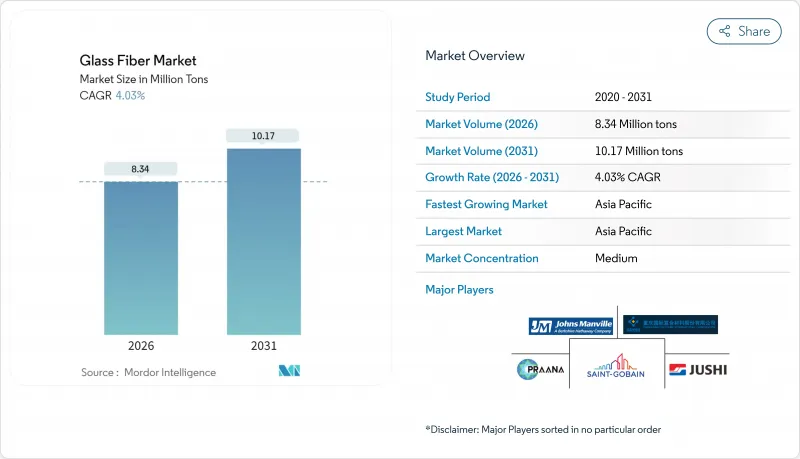
유리섬유 시장은 2025년 802만 톤으로 평가되었으며, 2026년 834만 톤에서 2031년까지 1,017만 톤에 이를 것으로 예상됩니다.
예측 기간(2026-2031년)의 CAGR은 4.03%를 나타낼 전망입니다.
수요의 회복력은 인장강도, 내식성, 비용효율성을 겸비한 본 재료의 특성을 반영하고 있으며, 인프라, 이동성, 에너지 시스템에서 금속 및 기타 기존 재료를 대체하는 움직임이 계속되고 있습니다. 건설용 단열재의 수주는 팬데믹 관련 감속 후 신속하게 회복되었습니다. 전기자동차(EV) 프로그램은 자동차 플랫폼에서 복합재료의 채택을 가속화하고 풍력에너지에 대한 노력은 기록적인 블레이드 생산을 견인했습니다. 이 세 가지 수요의 기둥 외에도 저탄소 제조 라인과 폐쇄 루프 재활용과 같은 제품 혁신은 생산자가 원재료 비용 상승과 무역 불확실성을 견디는 데 도움이되었습니다. 생산 능력의 합리화나 지역의 자급자족 프로그램도, 공급자가 최종 사용자의 성장 거점에 가까운 위치에 스스로를 배치하는 가운데, 경쟁 전략을 재구축하고 있습니다.
아시아태평양의 건설 지출은 2024년에 강력히 회복되었습니다. 각국 정부가 데이터센터 캠퍼스, 반도체 공장, 대량 수송 네트워크를 포함한 경기 자극책을 추진했기 때문입니다. 이러한 프로젝트에서는 운용시 탄소 배출 억제를 위해 고성능 단열재가 지정되어 유리섬유 시장에서 단열 성능(R값)이 낮은 대체품보다 글라스울이 입찰 리스트에 우선적으로 게재되고 있습니다. 인도에서는 그린 빌딩 인증이 지자체의 승인 워크플로우에 통합되어 개발자가 재활용 가능하고 난연성 단열재를 선택하도록 촉구하고 있습니다. 지하 교통 회랑에서는 수몰 환경에서 강철보다 부식 속도가 낮기 때문에 유리섬유 강화 폴리머(GFRP) 철근이 주목받고 있습니다. 주요 제조업체는 기존 공장의 로의 병목 해소나 재생 가능 전력으로 가동하는 새로운 저탄소 용해로의 도입으로 대응해 대도시권의 건설 클러스터에의 리드 타임 단축을 도모하고 있습니다(1). 추가 생산 능력의 증강에 의해 공급 핍박은 완화되고 있습니다만, 지역적인 수요의 기세로부터, 가동률은 2026년까지 85% 이상을 유지할 것으로 전망되고 있습니다.
배터리형 전기자동차(BEV) 프로그램은 경량화에 의한 Kg당 항속거리 향상을 명확히 평가하기 위해 플랫폼 엔지니어는 구조용 브래킷, 시트 프레임, 보닛 하부 부품에서 촙드 스트랜드 폴리프로필렌과 장섬유 열가소성 플라스틱을 복합재료로 대체하고 있습니다. Tier 1 공급업체는 피로 수명을 유지하면서 비현가 중량을 30% 삭감하는 복합재제 리프 스프링을 상품화하여 유리섬유 시장 수요 동향을 뒷받침하고 있습니다. 스케이트보드형 섀시를 넘어, 고전압 배터리 케이스에서는 구조용 발포재 위에 난연성 유리섬유/에폭시 수지 외장을 지정하는 케이스가 증가하고 있어, 열 차폐와 전자 양립성을 양립시키고 있습니다. 자동차 조달팀은 또한 하중이 집중되는 영역에만 탄소섬유 보강재를 배치하는 하이브리드 적층 구조를 평가하고 있으며, 2차층에 유리섬유를 사용하여 후자의 고비용을 상쇄하고 있습니다. 이 재료 믹스는 클래스 A 표면 마감을 위해 설계된 촙드 스트랜드, 로빙 및 멀티 엔드 로빙의 장기 수요 전망을 강화합니다.
중국, 미국, 중동의 확장 프로젝트로 인해 2023년부터 2027년까지 세계의 탄소섬유 명목생산 능력이 두배가 될 전망입니다. 규모의 경제, 저비용화가 진행되는 폴리아크릴로니트릴 전구체, 자동화에 의해 평균 가격은 2022년 수준에서 이미 15% 이상 하락했습니다. 비용 곡선이 낮아짐에 따라 자동차 및 항공우주 엔지니어는 선택적 구조 부품의 재료 선택을 검토하여 유리섬유 시장 내 경쟁 압력을 강화하고 있습니다. 강성과 내충격성의 균형을 맞추기 위해 탄소섬유와 유리섬유를 교대로 배치한 하이브리드 패브릭은 성능 피라미드의 정점에서 유리섬유 수요를 더욱 빼앗고 있습니다. 유리섬유 제조업체는 고탄성률 S 유리나 내식성 E-CR 배합의 개발로 대항하고 있지만, 이러한 개량은 탄소섬유와의 가격차를 해소하는 것이 아니라, 축소시키는 것에 머물러 있습니다. 탄소 가격이나 재활용 크레딧이 유리섬유에 유리하게 작동하지 않는 한, 차기 제품 사이클에서는 프리미엄 용도의 점유율이 탄소섬유를 풍부하게 포함하는 적층재로 이행할 가능성이 있습니다.
로빙은 2025년 수요의 33.41%를 차지하며, 가장 급속히 확대되는 제품 형태로 계속되었습니다. 선형 섬유 구조는 100m 이상의 터빈 스킨에 필수적인 단방향 강도를 제공하며, 이 이용 사례만으로 세계 로빙 출하량의 1/3을 차지하고 있습니다. 로빙으로 인한 유리섬유 시장 규모는 해상 설비 증가와 자동차용 오버몰드 복합재(리프 스프링, 시트백, 배터리 프레임)의 규모 확대에 따라 연률 4.39%의 성장이 예상됩니다. 인라인 케이크 커팅이나 고도의 사이징 배합과 같은 프로세스 개량에 의해 습윤성이 향상되어 보이드 함유량이 감소합니다. 이것에 의해 인발 성형이나 필라멘트 와인딩에 있어서 생산성 향상이 가능해집니다.
제조업체 각사는 또한 와인더 스테이션에 가상 센서를 도입하는 시험을 진행하고 있습니다. 클라우드 기반의 품질 관리 모듈에 데이터를 전송함으로써 폐기물의 삭감과 탄소 실적의 기록을 실현하여 유리섬유 시장 전체에서 디지털화의 중요성이 높아지고 있습니다. 매트는 제2위의 점유율을 차지하고, 방향성 강도보다 추종성이 중시되는 스프레이 업식 선체나 지붕 방수 시트에 즐겨 채용되고 있습니다. 스트랜드와 얀은 PCB 적층판, 여과재, 5G 레이더 돔용 패브릭 등 직경 공차가 엄격하고 샷 함량을 최소화할 필요가 있는 틈새 시장에 대응하고 있습니다.
본 유리섬유 보고서는 제품 형태(로빙, 매트, 스트랜드 등), 섬유 유형(E 유리, S 유리, E-CR 유리 등), 최종 사용자 산업(건축 및 건설, 자동차, 풍력에너지, 항공우주 및 방위, 선박, 스포츠 및 레저, 기타 최종 사용자 산업), 지역(아시아태평양, 북미, 유럽 등)별로 분할되어 있습니다. 시장 예측은 수량(톤) 단위로 제공됩니다.
아시아태평양은 2025년 출하량의 49.78%를 차지했으며 2031년까지 연평균 복합 성장률(CAGR) 4.51%로 선두를 유지할 것으로 예측됩니다. 각국의 산업 정책에 따라 터빈 블레이드, EV 부품, 고속 철도 부품의 국내 조달이 진행되고 있으며, 유리섬유 시장 전체에서 현지 공급자의 확보가 효과적으로 도모되고 있습니다. 중국은 자사 소유의 풍력발전소에 의한 탄소중립적인 용해로에 대한 투자를 추진하고 있어 이 대처에 의해 임베디드 배출량이 삭감되어 수출 제품이 저탄소 제품 카테고리에 해당하게 됩니다.
북미 시장은 건축물 에너지 기준의 강화와 EV 플랫폼의 투입에 의해 석유 및 가스용 복합 파이프 수요의 감속을 상쇄해 성장하고 있습니다. 태양광·풍력발전을 위한 세제우대조치의 확충이 터빈블레이드의 교환사이클을 가속시켜, 이 동향은 대륙중부지역의 로빙공장에 이익을 가져옵니다. 미국 일부 주에서의 재생재 사용 의무화는 유리 쓰레기의 이용을 촉진하고, 스크랩 시장을 지원하는 동시에 수입 소다재에의 의존도를 저감시킵니다. 유럽 전망은 북해와 발트해에서 해양 풍력 발전의 확대에 달려 있지만, 조사중인 무역 방위 조치로 아시아 로빙에 대한 관세 강화가 공급망 재편을 초래할 수 있습니다. 유리섬유 강화 압력 용기는 걸프 지역과 유럽을 연결하는 그린 수소 회랑에서 조기 도입이 예상됩니다. 라틴아메리카는 브라질 풍력발전소와 멕시코 자동차 조립 공장을 기반으로 하는 겸손한 기반을 가지고 있으며, 모두 유통 후에 증산 중입니다. 지역 생산자는 원료 수입 비용에 어려움을 겪을 수 있지만 자유 무역 협정과 니어 쇼어링 구상으로 태평양 횡단 수송 단축을 목적으로 한 투자가 모여 있습니다.
The Glass Fiber Market was valued at 8.02 Million tons in 2025 and estimated to grow from 8.34 Million tons in 2026 to reach 10.17 Million tons by 2031, at a CAGR of 4.03% during the forecast period (2026-2031).
Demand resilience reflects the material's combination of tensile strength, corrosion resistance, and cost efficiency, characteristics that continue to displace metals and other legacy materials in infrastructure, mobility, and energy systems. Construction insulation orders recovered quickly after pandemic-related slowdowns, electric-vehicle (EV) programs accelerated composite uptake in automotive platforms, and wind-energy commitments triggered record blade production. These three demand pillars, together with product innovations such as low-carbon manufacturing lines and closed-loop recycling, are helping producers withstand raw-material cost inflation and trade uncertainties. Capacity rationalization and regional self-sufficiency programs are also reshaping competitive strategies as suppliers position themselves close to end-user growth hubs.
Asia-Pacific construction spending rebounded strongly in 2024 as governments advanced stimulus pipelines encompassing data-center campuses, semiconductor fabs, and mass-transit networks. These projects specify high-performance insulation to curb operational carbon, placing glass wool on tender lists ahead of lower-R-value substitutes within the glass fiber market. In India, green-building certification is embedded in municipal approval workflows, encouraging developers to select recyclable, flame-resistant insulation. Underground transit corridors highlight glass fiber reinforced polymer (GFRP) rebar because corrosion rates are lower than steel in water-logged environments. Major producers responded with brownfield furnace debottlenecking and new low-carbon melters powered by renewable electricity, actions that shorten lead times to metropolitan construction clusters[1]. Supply tightness has begun to ease as additional capacity ramps up, yet regional demand momentum suggests utilization will remain above 85% through 2026.
Battery-electric vehicle programs reward every kilogram saved with measurable range extension, so platform engineers substitute chopped-strand polypropylene and long-fiber thermoplastics in structural brackets, seat frames, and under-hood components. Tier-1 suppliers have commercialized composite leaf springs that cut unsprung mass by 30% while retaining fatigue life, reinforcing demand trends in the glass fiber market. Beyond the skateboard chassis, high-voltage battery enclosures now specify flame-retardant glass fiber/epoxy skins over structural foams, combining thermal shielding with electromagnetic compatibility. Automotive procurement teams also evaluate hybrid lay-ups that place carbon reinforcement only in load-critical zones, offsetting the latter's higher cost with glass fiber in secondary layers. The resulting material mix strengthens long-term demand visibility for chopped strands, rovings, and multi-end rovings designed for class-A surface finishes.
Expansion projects in China, the United States, and the Middle East are doubling global carbon-fiber nameplate capacity between 2023 and 2027. Economies of scale, lower-cost polyacrylonitrile precursors, and automation have already trimmed average prices by more than 15% compared with 2022 levels. As cost curves fall, automotive and aerospace engineers revisit material selection for selective structural parts, intensifying competitive pressures within the glass fiber market. Hybrid fabrics that alternate carbon and glass to balance stiffness and impact resistance further cannibalize glass volumes at the top of the performance pyramid. Glass fiber producers counteract by developing higher-modulus S-glass and corrosion-resistant E-CR formulations, though these upgrades narrow, rather than eliminate, the price gap to carbon. Unless carbon pricing or recycling credits favor glass, the premium application share may drift toward carbon-rich laminates over the next product cycle.
Other drivers and restraints analyzed in the detailed report include:
For complete list of drivers and restraints, kindly check the Table Of Contents.
Rovings anchored 33.41% of 2025 demand and remain the fastest-expanding product form. Their linear-strand architecture delivers the unidirectional strength essential for 100-meter-plus turbine skins, a use case that alone accounts for a third of global roving shipments. The glass fiber market size attributed to roving is forecast to grow 4.39% annually as offshore installations escalate and as automotive over-molded composites gain scale in leaf springs, seat backs, and battery frames. Process upgrades such as inline cake cutting and advanced sizing formulations improve wet-out and reduce void content, enabling higher throughput in pultrusion and filament winding.
Producers are also trialing virtual sensors on winder stations, transmitting data to cloud-based quality modules that cut waste and document carbon footprints-digital upgrades increasingly relevant across the glass fiber market. Mats occupy the second-largest slot, favored for spray-up boat hulls and roofing membranes where conformability outweighs directional strength. Strands and yarns cater to PCB laminates, filtration, and 5G radome fabrics, niches that demand tight diameter tolerance and minimal shot content.
The Glass Fiber Report is Segmented by Product Form (Roving, Mats, Strands, and More), Fiber Type (E-Glass, S-Glass, E-CR Glass, and More), End-User Industry (Building and Construction, Automotive, Wind Energy, Aerospace and Defense, Marine, Sports and Leisure, and Other End-User Industries), and Geography (Asia-Pacific, North America, Europe, and More). The Market Forecasts are Provided in Terms of Volume (Tons)
Asia-Pacific dominated with 49.78% of 2025 shipments and is projected to retain leadership through 2031 at a 4.51% CAGR. National industrial policies encourage domestic sourcing of turbine blades, EV parts, and high-speed rail components, effectively locking in local suppliers across the glass fiber market. China invests in carbon-neutral furnaces powered by captive wind farms, an initiative that lowers embedded emissions and qualifies exports for low-carbon product categories.
North America's market is growing wth building-energy codes and EV platform launches offsetting slower oil-and-gas composite pipe demand. Expanded solar and wind tax credits amplify the replacement cycle for turbine blades, a trend that benefits mid-continent roving plants. Recycled content mandates in select U.S. states encourage the use of cullet, supporting scrap markets and reducing dependence on imported soda ash. Europe's outlook hinges on offshore wind build-outs in the North Sea and Baltic, but trade defense measures under investigation may reshape supply chains should tariffs on Asian rovings intensify. Glass fiber reinforced pressure vessels could see early adoption in green-hydrogen corridors linking the Gulf to Europe. Latin America's modest baseline is anchored by Brazilian wind parks and Mexico's automotive assembly plants, both of which are ramping post-pandemic. Regional producers may struggle with feedstock import costs; nonetheless, free-trade agreements and nearshoring initiatives draw investment aimed at shortening trans-Pacific freight legs.