


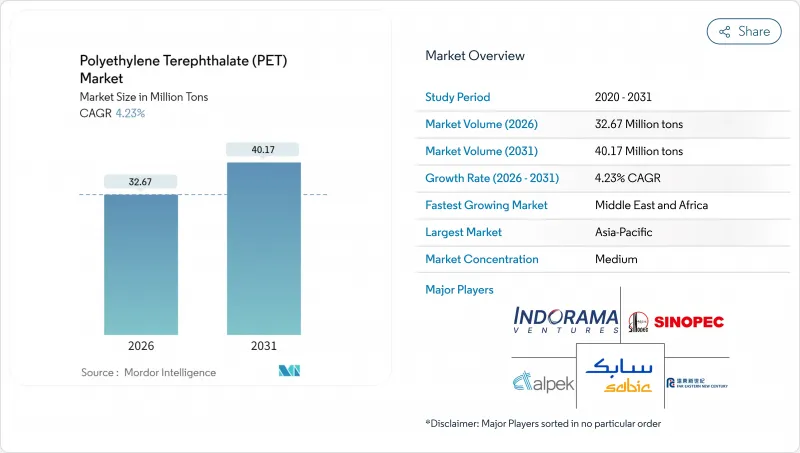
폴리에틸렌 테레프탈레이트(PET) 시장 규모는 2026년에는 3,267만 톤에 달할 것으로 예측되고 있습니다.
이는 2025년 3,134만 톤에서 성장한 수치이며, 2031년에는 4,017만 톤에 이를 것으로 전망되고 있습니다. 2026년부터 2031년까지 연평균 복합 성장률(CAGR)은 4.23%를 나타낼 것으로 전망됩니다.
성장은 장벽 성능, 비용 경쟁력 및 재활용 가능성의 균형에 힘입어 전자기기 및 테크니컬 텍스타일의 응용 범위가 넓어지는 가운데 음료 포장의 역할을 강화하고 있습니다. 아시아태평양에서의 견조한 수요, 재생재 사용에 관한 규제 요건의 확대, 화학적 재활용 기술의 진보가 수량 확대의 기반이 되고 있습니다. 브랜드 소유자의 지속가능성에 대한 노력은 재생 폴리에틸렌 테레프탈레이트(rPET)의 안정적인 수요 창출로 이어지는 반면, 신흥 시장에서의 비용 중심의 조달 자세는 버진 수지 수요를 지속시키고 있습니다. 폴리에틸렌 테레프탈레이트(PET) 시장은 원료 가격의 변동과 PEF(폴리에틸렌 프라노에이트)와 알루미늄에 의한 대체품의 위협이 역풍이 되는 것, 클로즈드 루프 시스템이나 특수 그레이드에 대한 투자에 의해 다양한 성장의 기반을 마련하고 있습니다.
2024년 유럽에서 폴리에틸렌 테레프탈레이트(PET) 음료병의 회수율은 75%에 이르렀고, 신규병에 대한 재생재 함량은 24%로 상승했습니다. 2025년 말 발효된 25% 의무화 기준에 가까워졌습니다. 트레이 용도에서 전용된 고품질 플레이크가 지역 공급을 저하시키고 유럽의 재생 폴리에틸렌 테레프탈레이트(rPET) 프리미엄은 버진 수지비로 톤당 750-800달러 전후의 고가를 유지하고 있습니다. 기계적 재활용의 한계가 촉매 분해·열분해 기술에 대한 투자를 촉진하는 한편, 스케일 업 비용과 원료 변동성이 즉각적인 효과를 억제하고 있습니다. 다국적 기업은 원료 확보를 위해 인프라에 대한 공동 출자를 계속하고 폴리에틸렌 테레프탈레이트(PET) 시장에서 장기 조달 전략을 재정의하고 있습니다.
동남아시아와 라틴아메리카의 신흥 시장에서는 콜드체인 부족이 계속되는 가운데 히트 세트 병의 도입이 가속화되고 있습니다. 폴리에틸렌 테레프탈레이트(PET)의 내열성은 주스와 우유 음료의 상온 보존이 가능해 전력 공급이 불안정한 지역에서의 부패를 감소시키고 있습니다. 히트 세트 등급의 고가격화는 전용 설비가 있는 기존 제조업체에 유리하게 작동합니다. 한편, 규제 당국은 무균 포장을 식품 안전 정책의 기둥으로 자리매김하는 경향을 강화하고 있습니다. 이 동향에 의해 폴리에틸렌 테레프탈레이트(PET) 시장의 적용 범위는 탄산음료를 넘어 확대해, 지역 마다의 수지 컨버터가 스트레치 블로우 성형 설비의 업그레이드 투자를 추진하는 추진되고 있습니다.
파라크실렌(PX)과 모노에틸렌글리콜(MEG)은 PET 변동비의 약 85%를 차지하고, 마진은 원유가격 변동과 연동합니다. 아시아의 통합 복합 시설은 물류 측면에서 우위를 가지고 있지만, 유럽 및 북미 제조업체는 운임과 에너지 비용의 프리미엄을 흡수하고 있습니다. 지정학적 혼란과 운송 제약으로 인해 지역 간의 가격 차이가 확대되고 단독 플랜트의 수출 경쟁력이 떨어지고 있습니다. 헤지 수단은 부분적인 완화책이지만, 계약의 복잡화를 초래해, 특히 재무 기반이 취약한 소규모 컨버터에 있어서는 부담이 됩니다.
2025년 세계 출하량 중 비용효율과 균일한 품질로부터 버진 수지가 76.10%(약 2,385만톤)를 차지했습니다. 재생 PET는 750만 톤 미만이면서 규제 의무나 브랜드 목표에 따른 수요 증가로 8.02%라는 가장 높은 CAGR이 전망되고 있습니다. 유럽은 도입을 주도했으며 2024년에는 현지 생산 재생 PET의 39%가 병에 재이용되었습니다. 그러나 원료 부족과 분별 수집의 과제에 의해 북미에서는 버진 수지비로 톤당 150-200달러, EU(유럽 연합)에서는 최대 800미국의 가격 프리미엄이 지속하고 있습니다.
기계적 재활용의 착색과 오염물질의 제한이 화학적 탈중합에 대한 관심을 가속화하고 있지만, 자본 집약성으로 인해 2028년 이전의 광범위한 전개는 어렵습니다. 식품 급료 펠렛화 라인에 대한 투자로 이용 가능한 재생 PET 비율이 확대되고 비용 차이가 줄어들고 있습니다. 버진 공급업체는 자사 리사이클 시설에서 헤지를 실시하여 베일 원료의 확보를 도모하고 있으며, 진화하는 폴리에틸렌 테레프탈레이트(PET) 시장에서 버진과 재생재의 연속체에 있어서경쟁 구도가 재구축되고 있습니다.
폴리에틸렌 테레프탈레이트(PET) 시장 보고서는 원료 유형별(버진 PET 및 재생 PET), 최종 사용자 산업별(자동차, 건축 및 건설, 전기 및 전자, 산업 및 기계, 기타 최종 사용자 산업), 지역별(북미, 남미, 유럽, 아시아태평양, 중동 및 아프리카)으로 분류되어 있습니다. 시장 예측은 수량(톤) 및 금액(달러)으로 제공됩니다.
아시아태평양은 2025년 생산량의 47.10%(약 1,480만 톤)를 차지하고 통합 원료 공급 능력과 급성장하는 소비자 수요로 시장을 견인하고 있습니다. 중국은 최대 생산 거점을 유지하면서 인도에서는 포장 식품 시장의 성장과 재활용 투자로 소비가 가속화되고 있습니다. 인도네시아와 태국 등의 동남아시아 국가들은 지역의 음료·섬유 산업 거점에 대응하기 위해 생산 능력을 확충하고 있습니다. Indorama Ventures는 Varun Beverages와의 합작 투자를 통해 현지에서의 사업 기반을 강화하고 규모 확대와 현지 시장에 대한 액세스를 양립시키는 전략을 제시했습니다.
유럽과 북미는 생산량이 적은 것, 재생 PET(rPET) 도입을 촉진하는 규제 프레임워크에서 주도적인 역할을 하고 있습니다. EU는 2024년 PET 병 재활용률 75%를 달성하여 국내 재생 PET 수요를 세계 수준을 웃도는 수준으로 밀어 올렸습니다. 높은 에너지·노동 비용이 현지 생산자를 압박하는 한편, 저탄소 포장을 요구하는 브랜드 오너와의 지리적 근접성이, 고부가가치의 특수 제품 생산을 지지하고 있습니다. 북미는 셰일 유래 원료의 경제성이 풍부하지만, 아시아로부터의 수입 압력에 의해 이익률의 성장은 억제되고, 폴리에틸렌 테레프탈레이트(PET) 시장에서의 경쟁력을 유지하기 위해, 생산자는 테크니컬 그레이드나 재생 그레이드로의 전환을 강요당하고 있습니다.
중동 및 아프리카는 5.05%라는 가장 빠른 CAGR이 전망되고 있습니다. 걸프 지역의 생산자들은 유리한 원료를 활용하고, 보루주와 같은 기업들은 2028년까지 연간 660만 톤 이상의 생산 능력을 계획하고 있으며 아시아와 아프리카로의 수출을 목표로 하고 있습니다. 도시화와 인프라 투자에 따라 특히 병 식수와 우유음료에 대한 국내 수요가 증가하고 있습니다. 정치적 불안정과 물 부족과 같은 과제는 존재하는 것, 원료 비용면에서의 우위성과 유럽과 아시아 간의 지리적 위치는 전략적인 수송 루트를 제공합니다.
Polyethylene Terephthalate Market size in 2026 is estimated at 32.67 Million tons, growing from 2025 value of 31.34 Million tons with 2031 projections showing 40.17 Million tons, growing at 4.23% CAGR over 2026-2031.
Growth rests on the material's balance of barrier performance, cost-competitiveness, and recyclability, reinforcing its role in beverage packaging even as electronics and technical textiles widen the application base. Robust demand in Asia-Pacific, expanding regulatory mandates for recycled content, and technology advances in chemical recycling underpin volume expansion. Brand-owner sustainability pledges create predictable offtake for rPET (Recycled Polyethylene Terephthalate), while cost-focused procurement in emerging markets sustains virgin resin demand. Feedstock volatility and substitution threats from PEF (polyethylene furanoate) or aluminum introduce headwinds; nonetheless, investment in closed-loop systems and specialty grades positions the PET (Polyethylene Terephthalate) market for diversified growth.
Collection rates of 75% for Polyethylene Terephthalate (PET) beverage bottles in Europe during 2024 pushed recycled content in new bottles to 24%, edging toward the 25% mandate effective end-2025. High-quality flakes diverted from tray applications tightened regional supply and kept European rPET (Recycled Polyethylene Terephthalate) premiums near USD 750-800 per ton above virgin resin. Mechanical recycling limits spur investment in catalytic glycolysis and pyrolysis, yet scale-up costs and feedstock variability restrain immediate impact. Multinationals continue to co-finance infrastructure to secure feedstock, redefining long-term procurement strategies within the Polyethylene Terephthalate (PET) market.
Emerging markets in Southeast Asia and Latin America accelerate the adoption of heat-set bottles as cold-chain gaps persist. Polyethylene Terephthalate (PET)'s thermal resistance enables ambient shelf life for juices and dairy drinks, reducing spoilage in areas with unreliable electricity. Premium pricing for heat-set grades favors incumbents with specialized equipment, while regulators increasingly cite aseptic packaging as a pillar of food-security policy. The trend widens the Polyethylene Terephthalate (PET) market beyond carbonated beverages and supports regional resin converters investing in stretch-blow molding upgrades.
Paraxylene (PX) and Mono Ethylene Glycol (MEG) account for roughly 85% of PET variable cost, tying margins to crude oil swings. Integrated Asian complexes enjoy logistic advantages, whereas European and North American makers absorb freight and energy premiums. Geopolitical disruptions and shipping constraints recently widened inter-regional price gaps, eroding export competitiveness for standalone plants. Hedging tools offer partial relief but increase contract complexity, particularly for small converters lacking balance-sheet strength.
Other drivers and restraints analyzed in the detailed report include:
For complete list of drivers and restraints, kindly check the Table Of Contents.
Virgin resin accounted for 76.10% of global shipments in 2025-roughly 23.85 million tons-owing to cost efficiency and uniform quality. Recycled PET, at just under 7.5 million tons, posted the steepest 8.02% CAGR projection as mandates and brand targets raise demand. Europe led adoption, with 39% of locally produced rPET re-entering bottles in 2024, yet tight feedstock and separate-collection gaps sustained price premiums of USD 150-200 per ton over virgin in North America and up to USD 800 per ton in the EU (European Union).
Mechanical recycling limitations in color and contamination have accelerated interest in chemical depolymerization, though capital intensity impedes widespread roll-out before 2028. Investment in food-grade pelletizing lines expands usable rPET fraction, narrowing the cost differential. Virgin suppliers hedge with captive recycling units to secure bale access, reframing competition along the virgin-recycled continuum in the evolving PET market.
The Polyethylene Terephthalate (PET) Market Report is Segmented by Source Type (Virgin PET and Recycled PET), End User Industry (Automotive, Building and Construction, Electrical and Electronics, Industrial and Machinery, and Other End-User Industries), and Geography (North America, South America, Europe, Asia-Pacific, and Middle East and Africa). The Market Forecasts are Provided in Terms of Volume (Tons) and Value (USD).
Asia-Pacific dominated with 47.10% of the 2025 volume, nearly 14.8 million tons, due to integrated feedstock capacity and burgeoning consumer demand. China retains the largest production base, while India's consumption accelerates through packaged food growth and recycling investments. Southeast Asian nations such as Indonesia and Thailand add capacity to serve regional beverage and textile hubs. Indorama Ventures strengthened its local footprint via a joint venture with Varun Beverages, illustrating the strategy of coupling scale with local market access.
Europe and North America contribute smaller shares but lead in regulatory frameworks that stimulate rPET uptake. The EU recorded a PET bottle recycling rate of 75% in 2024, driving domestic rPET demand above global norms. High energy and labor costs pressure local producers, but proximity to brand owners seeking low-carbon packaging supports high-value specialty production. North America benefits from shale-based feedstock economics; however, import pressure from Asia tempers margin gains, pushing producers toward technical and recycled grades to remain competitive in the PET market.
The Middle East and Africa region exhibited the fastest 5.05% CAGR outlook. Gulf producers exploit advantaged feedstocks, and companies such as Borouge plan capacity beyond 6.6 million tons per year by 2028, targeting exports to Asia and Africa. Domestic demand rises with urbanization and infrastructure spending, particularly for bottled water and dairy beverages. Political instability and water scarcity pose challenges, yet feedstock economics and geographic location between Europe and Asia provide strategic shipping routes.