


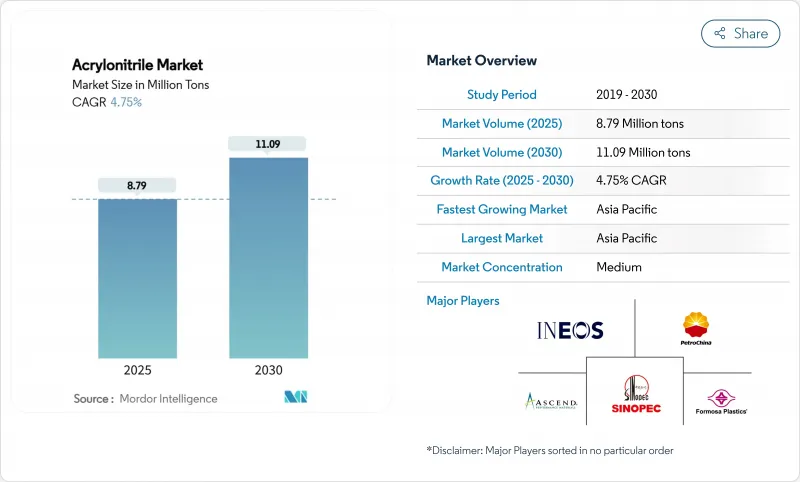
아크릴로니트릴 시장 규모는 2025년에 879만 톤으로 추계되고, 예측 기간(2025-2030년) CAGR 4.75%로 성장할 전망이며, 2030년에는 1,109만 톤에 달할 것으로 예측됩니다.

특히 ABS/SAN 수지, 아크릴 섬유, 폴리아크릴아미드 등의 강하 용도의 확대가 계속해서 수량 견인역이 되고 있습니다. 동시에 미국 환경보호청이 2024년에 아크릴로니트릴을 고우선 물질로 리스트업하기로 결정함으로써 제조업체 각사는 선진적인 배출 규제를 채택하고 바이오 기반의 루트를 시험적으로 도입하게 되었습니다. 아크릴로니트릴 시장에 대한 수요는 전기차 생산 증가, 수처리 인프라 성장, 아시아 전역의 인프라 지출 지속 등에 의해 더욱 지원되고 있습니다. 그러나 동남아시아의 증기 크래커 정지로 프로파일렌 원료의 취약성이 나타났기 때문에 공급망은 불안정성 증가에 직면하고 있습니다.
자동차 제조업체가 내충격성을 유지하면서 경량화를 추구하는 가운데, ABS 수요는 증가의 일도를 따르고 있으며, 아크릴로니트릴을 풍부하게 포함한 수지는 배터리 하우징 및 내장 트림에 최적입니다. Trinseo가 2024년에 전개하는 재생재를 사용한 MAGNUM ECO ABS는 탄소 실적을 18% 삭감하고 지속가능성이 얼마나 프리미엄인 부문인지를 보여줍니다. ABS 파이프 피팅과 메이크업 패널이 대규모 건설에 채택되어 중기적으로 지속적인 아크릴로 니트릴의 보급이 예상됩니다.
아시아태평양의 중간 소득층 확대가 퍼포먼스 어패럴이나 아웃도어용 패브릭에 있어서 내구성이 높고 탈색하기 어려운 아크릴 섬유 수요를 촉진하고 있는 것이, ACN 시장의 견인 요인이 되고 있습니다. 아크릴로니트릴 유래의 섬유는 자외선 열화나 화학약품에 강하고, 기존 면의 2배의 페이스로 성장하고 있는 스포츠웨어나 홈 텍스타일 시장에 적합합니다. 물 사용량을 40% 줄이는 프로세스 혁신은 환경 감시에 대응하면서 경쟁력을 강화합니다.
2024년 미국 환경보호청(EPA)에 의한 우선순위가 높은 리스트에 게재하는 것은 특정 용도를 제한하고 허용 노출 수준을 낮출 수 있는 다년간의 위험 평가를 시작하는 것입니다. 영국은 이미 직장 노출 상한을 2ppm으로 설정했지만 EPA는 연간 1억 6,900만 달러의 규정 준수 비용을 예상하고 있습니다. 소규모 생산자는 엄격한 직업 및 환경 기준을 충족하기 위해 스크러버를 개조하고 모니터링을 강화하기 위해 마진 압력에 직면하고 있습니다.
암목시데이션과 관련된 아크릴로니트릴 시장 규모는 2024년에 697만 톤에 이르렀으며, 점유율 83%에 해당합니다. 견고한 촉매 노하우와 플랜트의 디보틀 넥킹에 의해 현금 비용이 낮게 억제되어, 2030년까지 CAGR 5.1%로 견조한 성장을 지원합니다. NREL의 바이오매스에서 아크릴로니트릴에 대한 경로는 시안화수소 부산물을 피하고 탄소 집약도를 낮추는 등 98%의 실험실 규모 수율을 달성했습니다. 국립재생에너지연구소, '아크릴로니트릴로 가는 재생 가능 경로', nrel.gov.ISPA에 따른 플라즈마 화학 개념은 fossil 투입이 전혀 없는 것으로 나타났습니다. 상업적 점유율은 여전히 낮지만, 파일럿 데이터에 따르면 재생 가능한 프로필렌 프리미엄이 약화되면 경제성이 있는 것으로 나타나 2030년 이후 기술 믹스가 재편될 것으로 예상됩니다.
아시아태평양이 70%의 점유율을 차지했으며, CAGR 예측은 5.59%였습니다. 중국의 프로파일렌에서 ABS로 일관된 밸류체인이 투자를 지원하는 한편, 전자 제조의 규모가 안정적인 수지 인수를 견인하고 있습니다. Rongsheng Petrochemical 사우디 알람코와의 제휴와 같은 새로운 탄소섬유 생산 능력에 대한 정부 인센티브는 장기적인 포착 수요를 보장합니다.
북미에서는 탄소섬유 및 특수화학 용도에 대응하는 Ascend의 텍사스 공장의 고순도 아크릴로니트릴에 지지되어 성숙하면서도 견고한 수요가 있습니다. EPA(환경보호국)의 감독 강화는 순 증가를 억제할 수 있지만 진입 장벽을 높이는 기술의 업그레이드를 촉진합니다.
유럽은 과도적인 길을 걷고 있습니다. 바이오의 파일럿 라인은 호라이즌 유럽의 보조금과 각국의 탄소 가격 신호를 활용합니다. 조기 진출기업은 범위 3 감소를 목표로 하는 자동차 제조업체 공급망에 대한 프리미엄 액세스를 획득합니다. 라틴아메리카와 중동 및 아프리카는 섬유 및 수처리 투자를 통해 세계 무역 흐름을 다양화하고 그 양을 증가시킵니다.
The Acrylonitrile Market size is estimated at 8.79 Million tons in 2025, and is expected to reach 11.09 Million tons by 2030, at a CAGR of 4.75% during the forecast period (2025-2030).
Expansion in downstream uses, most notably ABS/SAN resins, acrylic fibers, and polyacrylamide, remains the chief volume driver. Simultaneously, the U.S. Environmental Protection Agency's 2024 decision to list acrylonitrile as a High-Priority Substance has propelled manufacturers to adopt advanced emission controls and pilot bio-based routes. Demand within the Acrylonitrile Market is further supported by rising electric-vehicle production, growth in water-treatment infrastructure, and sustained infrastructure spending across Asia. Yet supply chains face heightened volatility after steam-cracker outages in Southeast Asia exposed propylene feedstock fragility.
ABS demand continues to climb as automakers pursue lighter vehicle components that preserve impact resistance, making acrylonitrile-rich resins ideal for battery housings and interior trim. Trinseo's 2024 rollout of recycled-content MAGNUM ECO+ ABS, showing an 18% carbon-footprint cut, illustrates how sustainability now commands a premium segment trinseo.com. Post-pandemic infrastructure programs in Asia are equally important; ABS pipe fittings and decorative panels gain traction in large-scale construction, locking in sustained acrylonitrile uptake over the medium term.
Middle-class expansion across Asia-Pacific fuels demand for durable, color-fast acrylic fibers in performance apparel and outdoor fabrics are the driving factors of ACN market. Acrylonitrile-derived fibers resist UV degradation and chemicals, which positions them for sportswear and home-textile markets growing at twice the pace of conventional cotton. Process innovations that trim water usage by 40% bolster competitiveness while addressing environmental scrutiny.
The 2024 U.S. EPA High-Priority listing initiates a multi-year risk evaluation that could limit certain uses and ratchet permissible exposure levels. The UK already caps workplace exposure at 2 ppm, while the EPA estimates USD 169 million in annual compliance costs. Smaller producers face margin pressure as they retrofit scrubbers and bolster monitoring to meet stricter occupational and environmental thresholds.
Other drivers and restraints analyzed in the detailed report include:
For complete list of drivers and restraints, kindly check the Table Of Contents.
The acrylonitrile market size tied to ammoxidation reached 6.97 million tons in 2024, equal to 83% share. Robust catalyst know-how and plant debottlenecking keep cash costs low, supporting a healthy 5.1% CAGR outlook to 2030. NREL's biomass-to-acrylonitrile pathway achieved a 98% lab-scale yield, sidestepping hydrogen cyanide by-products and shrinking carbon intensity National Renewable Energy Laboratory, "Renewable Routes to Acrylonitrile," nrel.gov. Plasma-chemistry concepts under ISPA show promise for zero-fossil inputs. While commercial uptake remains modest, pilot data suggest viable economics once renewable-propylene premiums erode, foreshadowing a reshaped technology mix beyond 2030.
The Acrylonitrile Market Report Segments the Industry by Process Technology (Ammoxidation Process and Other Production Technologies), Application (Acrylic Fiber, Acrylamide, Nitrile-Butadiene Rubber, and More), End -User Industry (Automotive and Transportation, Construction and Infrastructure, Electrical and Electronics, and More) and Geography (Asia-Pacific, North America, Europe, South America, and Middle East and Africa).
Asia-Pacific dominated with a 70% acrylonitrile market share and a 5.59% CAGR projection. China's integrated propylene-to-ABS value chains anchor investment, while electronics manufacturing scales drive steady resin offtake. Government incentives for new carbon-fiber capacity, such as Rongsheng Petrochemical's tie-up with Saudi Aramco, ensure long-term captive demand rongsheng.com.
North America holds mature yet resilient demand, buoyed by high-purity acrylonitrile from Ascend's upgraded Texas unit that caters to carbon-fiber and specialty-chemical uses ascendmaterials.com. Stricter EPA oversight may cap net growth but encourages technology upgrades that raise cost barriers to entry.
Europe charts a transitional path. Bio-based pilot lines leverage Horizon Europe grants and national carbon-pricing signals. Early movers gain premium access to automaker supply chains targeting Scope 3 reductions. Latin America and the Middle East and Africa contribute incremental volumes through textile and water-treatment investments, diversifying global trade flows.