



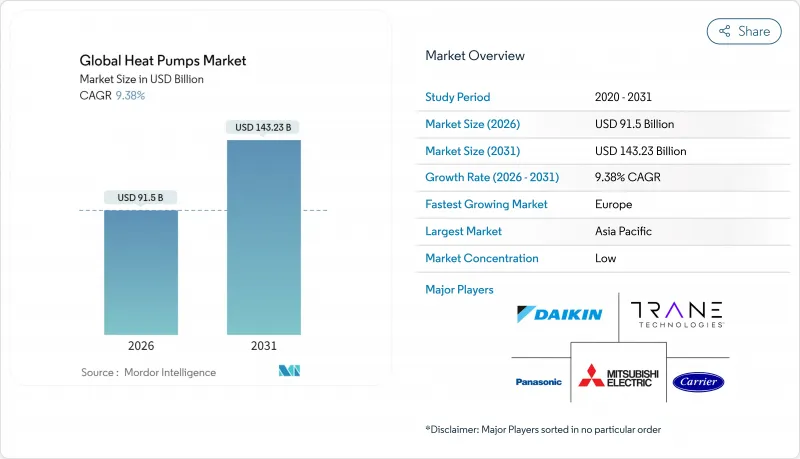
세계의 히트펌프 시장은 2025년 836억 6,000만 달러로 평가되었으며, 2026년 915억 달러에서 2031년까지 1,432억 3,000만 달러에 이를 것으로 예측됩니다. 예측 기간 중(2026-2031년) CAGR은 9.38%로 예상됩니다.
유럽 및 북미에서의 탈탄소화 의무화, 대규모 연방 및 주 수준의 인센티브 전략, 점점 대규모화하는 유틸리티 규모의 프로젝트를 통해 히트펌프 시장은 화석 연료 기반의 공간 및 온수 솔루션을 대체하는 주요 대안으로서의 지위를 확립했습니다. 중국의 통합 제조 거점이 비용 억제에 기여하고, 인버터 구동 컴프레서의 진보에 의해 빙점하 환경에서의 성능 격차가 축소됨으로써, 한랭 지역에서 급속한 보급의 기반이 갖추어졌습니다. 미국과 폴란드에서 공급망의 현지화 노력이 관세와 운송 위험을 줄이고 확대하는 'Heat-as-a-Service(서비스형 열 공급)' 금융 모델은 기존 건물의 도입을 지연시킨 고액의 초기 설치 비용 문제를 해결했습니다.
적극적인 정책 틀은 건축 기준과 보조금 수준을 재생 가능 열의 성과에 직접 연동시켜 히트펌프에 대한 구속력 있는 수요를 창출했습니다. 미국의 인플레이션 억제법은 연방세액공제와 주 보조금제도를 조합하여 가구당 최대 1만 4,000달러를 제공합니다. 한편 독일에서는 2024년 이후의 신규 난방 시스템에 대해 재생가능열 65% 이상의 사용을 의무화하는 규제를 실시했습니다. 캐나다의 '석유에서 히트펌프로 전환 지원 프로그램'에서는 저소득 가구에 최대 15,000캐나다 달러(1만 1,100달러)를, 영국의 '보일러 갱신 제도'에서는 최대 7,500파운드(9,400달러)의 보조금을 지급했습니다. 이러한 조치는 인위적인 수요의 하한을 설정하고, 제조 업체를 거시 경제의 감속으로부터 보호하고 시장 침투를 가속화했습니다.
대도시의 지역 온실가스 배출량 상한 규제에 의해 기존에 15-20년 걸리던 HVAC의 교환 사이클이 단축되어, 노후화한 보일러를 고효율 히트펌프로 치환하는 개수가 가속했습니다. 뉴욕시의 지방법 97호는 345 허드슨 스트리트의 개수 프로젝트 등을 일으켜, 히트펌프와 폐열 회수를 조합함으로써 2030년까지 70%의 배출량 감축 목표를 달성하고 있습니다. Massachusetts Utilities는 2024년 135명의 고객을 연결하는 미국 최초의 지열 네트워크를 프레이밍햄에 출시하여 지역 수준의 전기화 가능성을 나타냈습니다.
총 설치 비용은 지역에 따라 크게 달랐습니다. 독일의 전형적인 연동 주택 개보수 비용은 3만유로(3만 2,400달러)를 넘어 높은 인건비와 엄격한 허가 규제로 보조금을 공제한 후 비용이 프랑스의 2배가 되었습니다. 뉴욕의 다가구 사례 연구에서는 전기 패널 업그레이드만으로 프로젝트 비용의 40%를 차지했으며, 인센티브에서는 완전히 상쇄할 수 없는 인프라 장벽이 부각되었습니다.
2025년 시점의 히트펌프 시장 점유율은 설치 비용이 낮고 제품 인지도가 높아 공기 열원 유닛이 73.12%를 차지했습니다. 그러나 지중열 및 지열 카테고리는 2024년에 135가구를 연결한 1,400만 달러 규모의 프레이밍햄 프로젝트 등 유틸리티 기업이 네트워크화된 루프를 시험 도입하고 있기 때문에 12.35%의 연평균 복합 성장률(CAGR)을 기록해, 이 분야에서 가장 높은 성장률이 전망되고 있습니다. 직접 팽창식 볼링 기술과 공유 지중 루프의 진보로 COP 안정성이 4.0 이상으로 개선되어 고밀도 도시 지역의 재개발 지역에 대한 수요가 증가하고 있습니다.
공기 열원 공급업체는 저온 환경 알고리즘의 개선을 계속하여 -20°F(약 -29°C)에서 성능 저하를 억제하여 북부 지역에서 성장을 가능하게 했습니다. 한편 전력회사와 대규모 개발업체는 지열 시스템을 전력망의 피크 제약에 대한 헤지 수단으로 자리매김했습니다. 이는 출력이 고온 저하의 영향을 받지 않는 특성 때문입니다. 이러한 동향은 시장 구성의 점진적인 재균형을 시사하고 있지만, 예측 기간 중 히트펌프 시장에서는 공기 열원 유닛이 판매 대수를 계속 주도할 전망입니다.
10kW 이하의 주택용 시스템은 2025년 출하량의 45.92%를 차지해, 소비자용 보조금 제도에 지지된 단독주택 보급 폭을 반영하고 있습니다. 그러나 30kW 슈퍼 클래스는 지역 냉난방 및 산업 공정 프로젝트가 증가함에 따라 12.18%의 연평균 복합 성장률(CAGR)로 다른 부문을 능가할 것으로 예측됩니다. 덴마크의 에스비아르 해수 플랜트(70MW)와 함부르크 폐수 이용 프로젝트(60MW)는 집중형 대규모 자산에 대한 기세를 보여줍니다.
표준화된 설비와 간소화된 허가 절차를 통해 소용량의 보급은 여전히 높은 수준을 유지합니다. 대용량 기세는 창고, 식품 가공, 탄소 중립 열 공급을 목표로 하는 지자체 네트워크 등 적용 범위의 확대를 뒷받침하고 있습니다.
히트펌프 시장은 열원 유형(공기 열원, 수원, 지중 및 지열원), 정격 용량(10kW 이하, 10-20kW, 20kW 이상), 시스템 설계(스플릿 시스템, 모노블록, 하이브리드 히트펌프), 최종 사용자(주택, 상업시설, 기타), 용도(공간 냉난방, 온수 등), 지역별로 분류됩니다. 시장 예측은 금액 기준(달러)으로 제공됩니다.
아시아태평양은 2025년 히트펌프 시장에서 38.05%라는 압도적인 점유율을 유지했습니다. 이는 중국에서 13%의 국내 판매 성장과 세계 생산 능력의 40%를 차지하는 이 국가의 존재감에 뒷받침되고 있으며 공장 자동화의 진전에 의해 단위 비용이 12% 저하된 것으로 기여하고 있습니다. 일본의 신중한 1% 수량 증가와 한국 압축기 기술의 리더십이 지역 출하량을 안정시켰지만, 인도는 열대 환경이 기존 설계의 효율 우위성을 제한했기 때문에 여전히 개발 도상 단계에 있습니다.
유럽은 회복 기조에 있으며, 2024년 초에 독일의 난방법 논의가 소비자 심리를 식히고 판매가 50% 감소한 후 CAGR 10.92%가 전망되고 있습니다. 프랑스는 국내 연 생산 100만대를 공약했고, 덴마크는 2030년까지 화석 연료 제로 목표의 일환으로 에스비아르 해수 플랜트를 포함한 지역 규모의 플래그십 프로젝트를 선보였습니다. 영국에서는 7,500파운드라는 고액의 보조금에도 불구하고 설치 목표에 지연이 보였고, 순수한 경제성 이상으로 인프라와 기능면의 장벽이 중요하다는 것을 부각했습니다.
북미는 당초 성장 고민을 거쳐 정책지원에 의한 성장주기에 들어갔습니다. 미국에서는 인플레이션 억제법에 의한 우대조치를 받아 2024년 11월까지 전년 대비 15%의 매출 증가를 달성했습니다. 캐나다에서는 대서양 연안 주들를 중심으로 1만 3,000건 이상의 보조금 신청이 처리되었습니다. Mitsubishi Electric의 컴프레서 공장과 Daikin-Copeland의 합작사업 등 공급망의 국내 회귀 노력은 중요 부품의 현지화에 의해 예측되는 2억 5,000만-2억 7,500만 달러의 관세 부담을 상쇄하는 것을 목표로 하고 있습니다.
The heat pump market was valued at USD 83.66 billion in 2025 and estimated to grow from USD 91.5 billion in 2026 to reach USD 143.23 billion by 2031, at a CAGR of 9.38% during the forecast period (2026-2031).
Decarbonization mandates in Europe and North America, large federal and provincial incentive packages, and ever-larger utility-scale projects positioned the heat pump market as the leading replacement pathway for fossil-fuel-based space and water heating solutions. China's integrated manufacturing base held costs down while inverter-driven compressor advances narrowed performance gaps in sub-zero environments, setting the stage for rapid uptake in colder regions. Supply-chain localization efforts in the United States and Poland mitigated tariff and freight risks while growing "Heat-as-a-Service" finance models addressed steep upfront installation costs that had slowed adoption in existing buildings.
Aggressive policy frameworks created binding demand for heat pumps by tying building codes and subsidy levels directly to renewable heat outcomes. The US Inflation Reduction Act offered combined federal tax credits and state rebates as high as USD 14,000 per household, while Germany enforced its 65% renewable-heat requirement for all new heating systems starting in 2024. Canada's Oil to Heat Pump Affordability Program provided up to CAD 15,000 (USD 11,100) to lower-income homes, and the UK's Boiler Upgrade Scheme paid grants of up to GBP 7,500 (USD 9,400). These measures set artificial demand floors that shielded manufacturers from macroeconomic slowdowns and accelerated market penetration.
Local greenhouse gas caps in large cities condensed typical 15-20 year HVAC replacement intervals into fast-tracked retrofits that replace failing boilers with high-efficiency heat pumps. New York City's Local Law 97 triggered projects such as the retrofit of 345 Hudson Street, combining heat pumps and waste-heat recovery to hit a 70% emissions-cut target by 2030. Massachusetts Utilities launched the first US geothermal network in Framingham, connecting 135 customers in 2024 and demonstrating district-level electrification potential.
Total installed pricing diverged sharply by geography. Typical German row-house retrofits exceeded EUR 30,000 (USD 32,400), double France's post-subsidy cost because of higher labor expenses and stricter permitting rules. A New York multifamily case study showed that electrical panel upgrades alone amounted to 40% of the project cost, highlighting infrastructure hurdles that incentives cannot fully offset.
Other drivers and restraints analyzed in the detailed report include:
For complete list of drivers and restraints, kindly check the Table Of Contents.
Air-source units held 73.12% heat pump market share in 2025 because of lower installation costs and product familiarity. However, the ground/geothermal category is forecast to post a 12.35% CAGR, the fastest within the spectrum, as utilities pilot networked loops such as the USD 14 million Framingham project that connected 135 customers in 2024. Advances in direct-expansion boreholes and shared ground loops improved COP stability above 4.0, increasing appeal in dense urban infill.
Air-source manufacturers continued to refine low-ambient algorithms, cutting performance drop-off at -20°F and unlocking northern growth. Meanwhile, utilities and large developers viewed geothermal systems as a hedge against grid-peak constraints because output is decoupled from outdoor temperature swings. These dynamics suggest gradual rebalancing, yet the heat pump market will still see air-source units dominate unit volumes through the forecast horizon.
Residential-scale systems up to 10 kW contributed 45.92% of 2025 shipments, reflecting the breadth of single-family adoption supported by consumer rebates. The above-30 kW class, however, is projected to outpace all others at a 12.18% CAGR as district heating and industrial process projects proliferate. Denmark's 70 MW Esbjerg seawater plant and Hamburg's 60 MW wastewater initiative highlight the momentum toward centralized mega-scale assets.
Small-capacity uptake will remain elevated because of standardized equipment and simplified permitting. Large-capacity momentum underscores the widening application perimeter that includes warehouses, food processing, and municipal networks aiming for carbon-neutral heat.
Heat Pump Market is Segmented by Source Type (Air-Source, Water-Source, and Ground/Geothermal Source), Rated Capacity (Up To 10 KW, 10-20 KW, and More), System Design (Split System, Monobloc, and Hybrid Heat Pump), End-User (Residential, Commercial, and More), Application (Space Heating and Cooling, Water Heating, and More), and Geography. The Market Forecasts are Provided in Terms of Value (USD).
Asia-Pacific retained a commanding 38.05% portion of the heat pump market in 2025, underpinned by China's 13% domestic sales growth and its 40% share of global production capacity, which yielded 12% unit-cost declines from factory automation gains. Japan's cautious 1% volume uptick and South Korea's compressor technology leadership stabilized regional shipments, while India remained nascent because tropical ambient conditions limited efficiency advantages for traditional designs.
Europe is on a rebound path, with an 10.92% CAGR projected after a 50% sales dip in early 2024 when Germany's heating-law debate dampened consumer confidence. France committed to producing 1 million units per year domestically, and Denmark showcased flagship district-scale projects, including the Esbjerg seawater plant, as part of its fossil-free-by-2030 pledge. The United Kingdom trailed installation targets despite rich GBP 7,500 grants, underscoring the role of infrastructure and skills barriers over pure economics.
North America entered a policy-assisted growth cycle after initial softness: US year-over-year sales climbed 15% by November 2024 following the Inflation Reduction Act incentives, while Canada processed more than 13,000 subsidy applications concentrated in Atlantic provinces. Supply-chain reshoring efforts, including Mitsubishi Electric's compressor factory and the Daikin-Copeland joint venture, aim to offset projected USD 250-275 million tariff exposure by localizing critical components.