


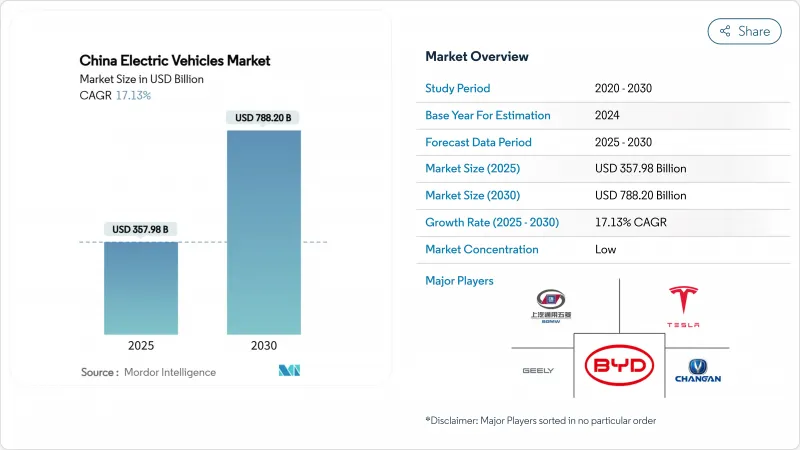
중국의 전기자동차 시장 규모는 2025년에 3,579억 8,000만 달러, 2030년에는 7,882억 달러에 이르며, 예측 기간(2025-2030년)의 CAGR은 17.13%를 나타낼 전망입니다.
전지 비용의 평준화, 전국적인 충전과 전지 교환의 보급, Tier2/3 도시의 PHEV 기세가 대수 확대를 뒷받침합니다. 자동차 제조업체는 또한 가격 경쟁에서 하락하는 마진을 보장하기 위해 수직 통합과 배터리 화학 혁신을 가속화하고 있습니다. 인프라 투자와 비용 경쟁력 있는 LFP 배터리는 중국의 전기자동차 시장이 가격에 민감한 농촌 부문으로의 추가 침투를 향한 위치를 차지합니다.
1대당 1,390-4,175달러에 해당하는 면세조치가 보조금 후의 이행을 완화해, 엔트리 레벨의 가격 경쟁력을 유지. Tier2/3 고객은 이 절약에 강하게 반응했고, 2024년 NEV 판매의 3분의 1은 면세 조치와 인수 인센티브를 활용했습니다. 정책이 예측 가능하기 때문에 자동차 제조업체는 특히 중국의 전기자동차 판매량을 견인하는 중형 크로스오버 차량에 대해 생산 능력 향상과 사이클 중반의 새로 고침을 계획 할 수 있습니다.
CATL과 시노펙은 2분간 교체가 가능한 배터리 교환 스테이션을 500개 설치하고 있습니다. 고속도로의 커버율은 현재 서비스 지역의 60%에 이르고 있지만, 충전기의 57%는 15개 도시에 집중되어 있으며 서부 지역에서는 여전히 여유가 있음을 보여줍니다. 이 투트랙의 인프라 전략은 통근·통학자의 요구와 차량의 업타임 수요에 대응하는 것으로, 중국의 전기자동차 시장에 대한 신뢰감을 지지하고 있습니다.
2022년 12월의 보조금 중단으로 구매 장려금이 1,670-2,780 위안화 삭감되어 중급 세단의 가격감응도가 높아졌습니다. 자동차 제조업체는 리베이트나 지역별 거래제도로 대항했지만, 그래도 교체 간격은 길어졌습니다. 배터리 투입 비용이 낮아짐에 따라 직접 보조금에 대한 의존도가 희미해지고 중국의 전기자동차 시장에서 자연적인 교체 리듬이 회복될 것으로 예측됩니다.
배터리식 전기자동차가 2024년 출하 대수의 58.36%를 차지해 같은 해 중국의 전기자동차 시장 규모를 견인했습니다. 그러나 플러그인 하이브리드차는 2030년까지 연평균 복합 성장률(CAGR)이 21.47%가 될 것으로 예측되며 인프라가 내륙부에 보급됨에 따라 차이가 줄어듭니다. 듀얼 연료의 유연성으로 인해 PHEV는 충전기가 드문드문 드라이버에 선호되는 교량 기술이 되었습니다.
BEV의 지속적인 비용 절감으로 완전 전기 모델은 서브 컴팩트 자동차와 택시 플릿에서 매력적이지만, 패밀리 SUV와 루럴 세단에서 PHEV가 성장하여 파워트레인 믹스가 다양화합니다. 따라서 제조업체는 아키텍처의 울타리를 넘어 헤지를 할 수 있지만 솔리드 스테이트 프로그램은 2030년 이후의 프리미엄 BEV 파도를 목표로 합니다.
승용차는 2024년에는 중국 전기자동차 시장 점유율의 88.25%를 차지했지만, 소형 상용밴은 CAGR 18.71%를 나타낼 전망입니다. 지자체의 제로 배출 할당, 허브 및 스포크 물류 및 배터리 교체의 경제성으로 인해 전기 LCV는 신뢰할 수 있는 차량 자산이 되었습니다.
SUV는 소비자가 차내 공간을 요구하여 구매하기 때문에 CAGR이 15.21%가 되고, 버스 사업자는 지역의 저배출 가스 의무화 하에서 디젤 차량을 리프레시합니다. 상업적 채용은 배터리 수요 곡선을 강화하고 중국의 전기자동차 시장 규모를 자가용 이동성 이외에도 확대합니다.
The China Electric Vehicles Market size is estimated at USD 357.98 billion in 2025, and is expected to reach USD 788.20 billion by 2030, at a CAGR of 17.13% during the forecast period (2025-2030).
Battery cost parity, a nationwide charging and battery-swap build-out, and tier-2/3 city PHEV momentum reinforce volume expansion. Automakers are also accelerating vertical integration and battery chemistry innovation to secure falling margins amid price wars. Infrastructure investment and cost-competitive LFP batteries position the Chinese electric vehicle market for further penetration into price-sensitive rural segments.
Tax-free status worth USD 1,390-4,175 per vehicle cushions the post-subsidy transition and keeps entry-level pricing competitive. Tier-2/3 customers react strongly to this saving, and one-third of 2024 NEV sales leveraged the exemption plus trade-in incentives. Predictable policy horizons let automakers schedule capacity ramps and mid-cycle refreshes, particularly for mid-market crossovers driving the volume of China's electric vehicles.
Public charging points rose drastically over the past few years, while CATL and Sinopec are placing 500 battery-swap stations capable of two-minute exchanges. Highway coverage now spans 60% of service areas, and 57% of chargers remain clustered within 15 cities, signalling headroom in western provinces. The twin-track infrastructure strategy addresses commuter top-up needs and fleet uptime demands, underpinning confidence in the Chinese electric vehicle market.
The December 2022 subsidy sunset trimmed purchase incentives by RMB 1,670-2,780, elevating price sensitivity in mid-market sedans. Automakers countered with rebates and regional trade-in schemes, yet replacement intervals lengthened. As battery input costs drop, reliance on direct subsidies is expected to fade, restoring natural replacement rhythms within the Chinese electric vehicle market.
Other drivers and restraints analyzed in the detailed report include:
For complete list of drivers and restraints, kindly check the Table Of Contents.
Battery electric vehicles led 2024 deliveries with a 58.36% share, anchoring the China electric vehicle market size for that year. Plug-in hybrids, however, are forecast to post a 21.47% CAGR to 2030, narrowing the gap as infrastructure diffuses inland. Dual-fuel flexibility makes PHEVs the preferred bridge tech for drivers facing sparse chargers.
Continued BEV cost erosion keeps fully electric models appealing in subcompacts and taxi fleets, yet PHEV growth in family SUVs and rural sedans diversifies the powertrain mix. Manufacturers, therefore, hedge across architectures, while solid-state programs target the post-2030 premium BEV wave.
Passenger cars captured 88.25% of China's electric vehicle market share in 2024, but light commercial vans are rising on an 18.71% CAGR trajectory. Municipal zero-emission quotas, hub-and-spoke logistics, and battery-swap economics make electric LCVs a reliable fleet asset.
SUVs show 15.21% CAGR as consumers trade up for cabin space, and bus operators refresh diesel fleets under local low-emission mandates. Commercial adoption reinforces battery demand curves and broadens China's electric vehicle market size beyond private mobility.
The China Electric Vehicle Market Report is Segmented by Drivetrain Type (Battery Electric Vehicles, Plug-In Hybrid Electric Vehicles, and More), Vehicle Type (Passenger Cars [Hatchback and More] and Commercial Vehicles [Light Commercial Vehicles and More]), Battery Chemistry (LFP, NCM/NMC, and More), and Price Band (Less Than USD 10, 000 and More). The Market Forecasts are Provided in Terms of Value (USD) and Volume (Units).