



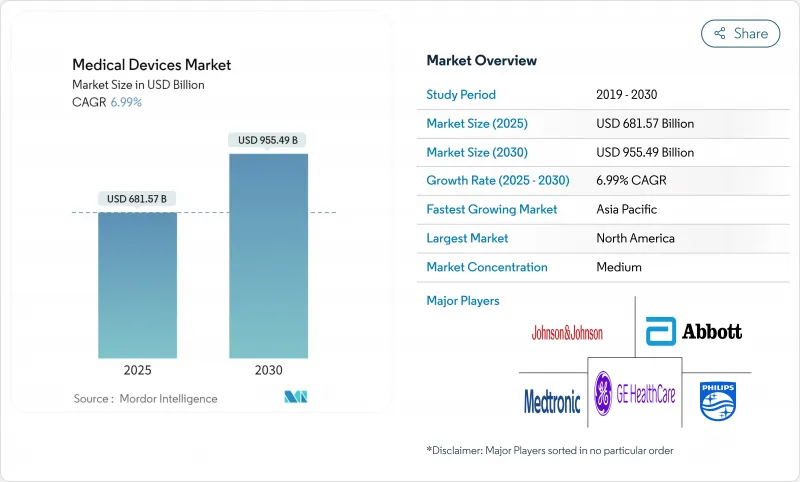
의료기기 시장은 현재 2025년에 6,815억 7,000만 달러, 2030년에는 9,554억 9,000만 달러에 달할 것으로 예상되며, CAGR은 6.99%를 나타낼 전망입니다.
견고한 수요의 배경에는 만성 질환의 확산, 진단 및 치료제에 대한 인공지능의 급속한 도입, 안전 기준을 높이면서 세계 제품 승인을 단순화하는 규제 개혁 등이 있습니다. 제조업체는 중요한 조치 대기 시간을 단축하는 5G 인프라를 지원하고 실시간 의사 결정 지원을 향상시키는 연결된 소프트웨어 중심 솔루션을 선호합니다. 2025년 식품의약국(FDA)이 도입하는 사이버 보안 의무는 보안 바이 디자인 아키텍처에 대한 투자를 가속화하고 2026년에 시행되는 품질 시스템의 정합화를 통해 다국간 상시에 걸리는 중복 비용을 삭감합니다. 신경학, 원격 모니터링, 증강현실(AR) 트레이닝 툴, 외래 의료 기술에 대한 자금 유입이 계속되고 있으며, 병원 중심의 의료 제공 모델에서 분산형 데이터 풍부한 에코시스템으로의 업계 변화를 반영하고 있습니다.
2030년까지 65세 이상의 노인이 세계 인구의 22%를 차지하고 85%가 적어도 하나의 만성 질환을 앓게 되므로 진단, 모니터링, 치료 장비에 대한 지속적인 수요가 예상됩니다. 2030년까지 세계의 만성질환 관련 경제적 부담은 47조 달러에 달할 것으로 예상되며, 지불자는 예방과 원격 감시를 선호하게 되었습니다. 파킨슨병의 이환율이 2040년까지 두배가 될 수 있으며, 적응성이 있는 심부뇌 자극과 브레인 컴퓨터 인터페이스에 대한 투자가 촉진되기 때문에 신경학이 혜택을 받습니다. 낙하 감지 및 복약 준수를 위한 웨어러블은 새로운 고용량 카테고리를 개척하고, 가치 기반 상환 모델은 결과 개선을 입증하는 장비에 보상합니다.
2024년 FDA가 승인한 AI 대응 기기는 69종으로 전년대비 40% 증가, 화상처리, 수술로봇, 의사결정 지원에 이르렀습니다. 머신러닝 알고리즘은 현재 치료 파라미터를 실시간으로 조정합니다. 예를 들어, 심장 절제 시스템은 조직 임피던스 데이터를 사용하여 에너지 전달을 동적으로 조정하고 치료 시간을 30% 단축합니다. 5G 커넥티비티는 원격 개입에 밀리초 이하의 대기 시간을 허용하며, 디지털 치료제는 소프트웨어와 하드웨어를 융합하여 만성기 치료 요법을 개별화합니다. 이러한 기능은 기존의 폼 팩터에 인텔리전스를 통합하여 대응 가능한 의료기기 시장을 확대하고 있습니다.
반도체 부족으로 인해 2024년 OEM의 78%에서 의료 부품의 리드 타임이 52주로 연장되는 PTFE와 희토류 금속의 지역 집중 공급업체에 대한 의존은 제조업체를 지정학적 충격에 노출시켰습니다. 메드트로닉은 벤더 베이스를 40% 줄이고 물류 허브를 통합하여 내성을 강화했지만, 니어 쇼어링과 듀얼 소싱은 비용을 15-20% 밀어 올리고 다년간의 롤아웃을 필요로 합니다. 소아용 기관 절개 튜브를 포함한 FDA공급 부족 목록은 환자 케어에 직결될 위험을 부각하고 있으며, 예상치 못한 상황에 대비한 재설계와 전략적 안전 재고 프로그램을 강요하고 있습니다.
기존의 전기기계식 일회용 제품은 2024년 매출의 56.47%를 차지하며 입증된 신뢰성, 확립된 워크플로우, 비용 효율성으로 치명타 케어에서의 역할을 확고하게 했습니다. 기본 주사기부터 ICU 인공호흡기까지 폭이 넓고 신흥 및 고소득 시스템 모두에 필수적입니다. 그러나 외과의사가 복잡한 절차에 몰입형 시각화 도구를 채택함에 따라 증강현실(AR) 및 가상현실(VR) 장비는 CAGR 7.78%를 나타낼 전망입니다. AR 가이드 내비게이션 시스템의 FDA 허가는 수술 시간의 단축과 합병증의 감소를 보여주는 임상 증거입니다.
원격 모니터링용 웨어러블은 현재 미국에서 5,000만 명의 사용자를 지원하고 있으며 2021년 이후 프로그램 등록자 수의 3배 증가를 반영하고 있습니다. 존슨 엔드 존슨의 Velys Spine과 같은 로봇 수술 플랫폼은 AI를 활용하여 궤도 계획을 정밀화하고, 3D 프린팅 임플란트는 2024년 레이저 프린팅에 의한 첫 무릎 관절 전치환에 이어 프로토타입에서 영구적인 근골격계 용도으로 이동했습니다. 원격 의료 주변 장치는 클라우드 대시보드와 원활하게 통합되어 임상의가 원격지에서 여러 바이탈을 모니터링할 수 있게 하며, m Health 플랫폼이 진단 알고리즘을 포함함에 따라 그 능력이 확대됩니다. 나노기술은 아직 초기 단계에 있지만, 표적 약물 전달 및 고해상도 생체 내 센서의 연구 개발 자금을 모으고 있습니다.
북미는 고도의 상환, 통합된 연구 캠퍼스, 규제 당국에의 근접성에 의해 2024년 매출의 40.23%를 유지했습니다. 강력한 벤처 자금과 임상의의 찬성이 퍼스트 인 클래스의 릴리스를 가속화하여 로봇 공학, AI 화상 처리, 리드리스 심장 기기의 조기 채용을 확실히 하고 있습니다. 하지만 아시아태평양은 CAGR 9.23%로 확대를 이끌고 있으며, 이는 중국이 국내 혁신 장려책과 디지털 병원 조종사를 통해 2025년까지 2,100억 달러 규모에 달할 것으로 예상하고 있다고 박차를 가하고 있습니다. 인구동태의 고령화는 만성질환의 부담을 증가시키고, 이 지역은 2030년까지 세계 65세 이상 인구의 60%를 보유하게 되어 장기적인 수량 성장을 유지합니다.
유럽의 통일 의료기기 규제는 국경을 넘어서는 하모나이제이션을 촉진하고 결과 검증 솔루션에 대한 수요를 유지합니다. 독일과 영국은 로봇 수술과 영상 진단의 보급으로 선도하고 있으며 프랑스와 이탈리아는 회복 자금을 원격 감시 인프라에 할당하고 있습니다. 영국의 EU 이탈 후의 길은 시장의 연속성을 유지했지만 대륙의 제품에는 이중 표시가 필요하며, 사내에 규제 팀을 가진 대기업에게는 관리 가능한 부담입니다.
남미와 중동 및 아프리카는 관민 모델이 새로운 병원과 전문센터에 자금을 제공함으로써 새로운 비즈니스 기회를 제공합니다. 브라질의 국민 모두 보험제도는 충분한 서비스가 꽉 차지 않은 지역에도 화상 진단 기능을 확대해, 견고한 CT나 초음파 검사에의 인계를 낳고 있습니다. 걸프 협력 회의 국가는 석유 수입을 의료 관광에 돌려 놓고 고사양 방사선 치료 및 심장 병학 제품군을 구입합니다. 외환변동과 수입관세가 여전히 장벽이 되고 있기 때문에 다국적 기업은 현지에서의 조립을 확립하거나 지역의 유통업체와 제휴하여 접근 및 가격 변동을 완화할 필요가 있습니다.
The medical devices market currently values at USD 681.57 billion in 2025 and is forecast to reach USD 955.49 billion by 2030, advancing at a 6.99% CAGR.
Steady demand stems from growing chronic disease prevalence, rapid adoption of artificial intelligence in diagnostics and therapeutics, and regulatory reforms that simplify global product approvals while elevating safety standards. Manufacturers are prioritizing connected, software-driven solutions that improve real-time decision support, supported by 5G infrastructure that reduces latency for critical procedures. Cybersecurity obligations introduced by the Food and Drug Administration (FDA) in 2025 are accelerating investment in secure-by-design architectures, and quality system harmonization effective 2026 is lowering duplication costs for multinational launches. Capital continues to flow toward neurology, remote monitoring, augmented reality training tools and ambulatory care technologies, reflecting an industry shift away from hospital-centric delivery models toward decentralized, data-rich ecosystems.
Adults aged 65 or older will form 22% of the world's population by 2030, with 85% experiencing at least one chronic condition, ensuring sustained demand for diagnostics, monitoring and therapeutic devices. Global chronic-disease-related economic burden is projected at USD 47 trillion through 2030, prompting payers to favor prevention and remote monitoring. Neurology benefits as Parkinson's disease incidence may double by 2040, catalyzing investment in adaptive deep-brain stimulation and brain-computer interfaces. Wearables for fall detection and medication adherence open new high-volume categories, while value-based reimbursement models reward devices that demonstrate outcome improvement.
The FDA cleared 69 AI-enabled devices in 2024, a 40% year-over-year increase, spanning imaging, surgical robotics and decision support. Machine-learning algorithms now tune therapy parameters in real time; for example, cardiac ablation systems dynamically adjust energy delivery using tissue impedance data and shorten procedure times by 30%. 5G connectivity enables sub-millisecond latency for remote interventions, while digital therapeutics merge software with hardware to personalize chronic-care regimens. These capabilities are enlarging the addressable medical devices market by embedding intelligence into legacy form factor
Semiconductor scarcity extended medical component lead times to 52 weeks for 78% of OEMs in 2024 mddionline.com. Reliance on regionally concentrated suppliers of PTFE and rare-earth metals exposes manufacturers to geopolitical shocks. Medtronic cut its vendor base 40% and consolidated distribution hubs to reinforce resilience, yet near-shoring and dual-sourcing inflate costs 15-20% and require multi-year rollouts. FDA shortage lists that include pediatric tracheostomy tubes underscore direct patient-care risks, forcing contingency redesigns and strategic safety-stock programs.
Other drivers and restraints analyzed in the detailed report include:
For complete list of drivers and restraints, kindly check the Table Of Contents.
Conventional electro-mechanical and disposable products delivered 56.47% of 2024 revenue, cementing their role in critical care due to proven reliability, established workflows and cost efficiency. Their breadth, from basic syringes to ICU ventilators, makes them indispensable to both emerging and high-income systems. However, augmented and virtual reality devices are accelerating at a 7.78% CAGR as surgeons adopt immersive visualization tools for complex procedures. FDA authorizations for AR-guided navigation systems provide clinical evidence of shorter operating times and fewer complications.
Remote-monitoring wearables now support 50 million U.S. users, reflecting a tripling in program enrollments since 2021. Robotic surgery platforms such as Johnson & Johnson's Velys Spine leverage AI to refine trajectory planning, while 3D-printed implants move from prototypes to permanent musculoskeletal applications following the first laser-printed total knee clearance in 2024. Telehealth peripherals integrate seamlessly with cloud dashboards, enabling clinicians to oversee multiple vitals remotely, a capability magnified as mHealth platforms embed diagnostic algorithms. Nanotechnology remains early-stage but draws R&D funding for targeted drug delivery and high-resolution in-vivo sensors.
The Medical Devices Market Report is Segmented by Technology Platform (Conventional Electro-Mechanical & Disposable Devices, Wearable & Remote Monitoring, and More), Therapeutic Application (Cardiology, Orthopedics, Neurology, and More), End User (Hospitals, Clinics, Ambulatory Surgical Centers, and More), and Geography (North America, Europe, and More). The Market Forecasts are Provided in Terms of Value (USD).
North America retains 40.23% of 2024 revenue due to advanced reimbursement, integrated research campuses and proximity to regulators. Strong venture funding and clinician buy-in accelerate first-in-class releases, ensuring early adoption of robotics, AI imaging and leadless cardiac devices. Nevertheless, Asia-Pacific drives expansion at a 9.23% CAGR, spurred by China's projection to reach a USD 210 billion medical devices market size by 2025 through domestic innovation incentives and digital hospital pilots. Aging demographics amplify chronic-disease burdens; the region will host 60% of the global 65-plus population by 2030, sustaining long-term volume growth.
Europe's unified Medical Device Regulation promotes cross-border harmonization, sustaining demand for outcome-validated solutions. Germany and the United Kingdom lead in robotic surgery and imaging penetration, while France and Italy allocate recovery funds to tele-monitoring infrastructure. The United Kingdom's post-Brexit pathway maintained market continuity but necessitates dual labeling for continental products, a manageable burden for large corporations with in-house regulatory teams.
South America and the Middle East & Africa present emerging opportunities as public-private models finance new hospitals and specialty centers. Brazil's universal system extends imaging capability to underserved regions, creating pull for rugged CT and ultrasound. Gulf Cooperation Council states channel oil revenue into medical tourism, purchasing high-spec radiotherapy and cardiology suites. Currency fluctuations and import tariffs remain barriers, pushing multinationals to establish local assembly or partner with regional distributors to ease access and price volatility.