



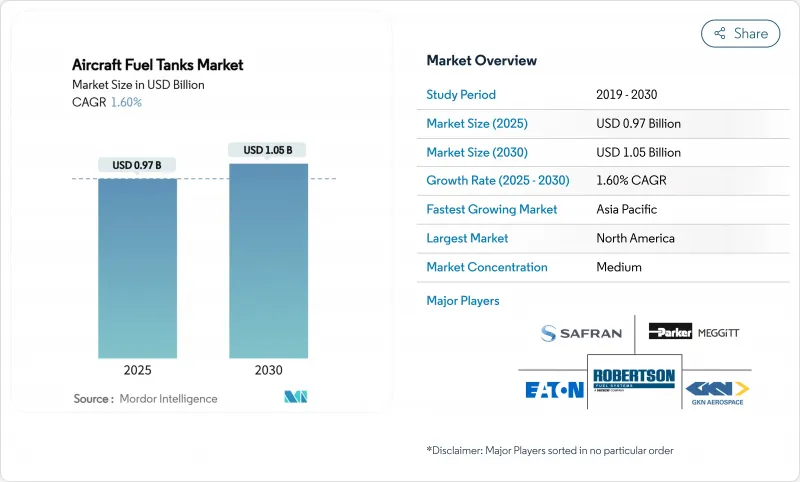
항공기 연료 탱크 시장은 2025년 9억 7,000만 달러에 이르고, 2030년에는 10억 5,000만 달러 규모에 도달할 것으로 예상되며, CAGR은 1.6%를 나타낼 전망입니다.
이 겸손한 최상위 라인은 OEM이 등유 기반 시스템의 점진적 업그레이드와 수소 저장을 위한 대규모 R&D 비용의 균형을 유지하면서 잠재적인 혼란을 가리고 있습니다. 2043년까지 4만 4,000기 가까운 신규 납품을 전망하는 보잉사의 예측에 뒷받침된 견조한 교체 수요는 2030년대 중반의 취항을 향해 극저온 컨셉이 성숙해도, 베이스 라인 생산량을 지지합니다. 미국의 KC-Y 브리지 유조선과 차세대 공중 급유 시스템 등 병행하는 국방 재자본화 구상은 지금까지 상용 프로그램이 주도해 온 시장에 프리미엄 수익원을 주입합니다. 복합재료의 보급은 이득을 매력적인 것으로 유지합니다. 탄소섬유 솔루션은 2024년 소재 매출의 41.34%를 차지하며 경량화에 대한 OEM의 지속적인 집중을 반영했습니다.
항공사는 구식 협폭동체에서 가동률이 높은 단통로 제트기로 교체를 진행하고 있으며, 거시경제가 불안정한 시기라도 기준선의 연료 탱크 수요는 유지되고 있습니다. 에어버스 A321XLR의 1만 2,900리터 후방 중앙 탱크는 항속 거리를 4,700km까지 늘려 창조적인 연료 저장이 새로운 얇은 경로를 가능하게 한다는 것을 증명합니다. 기록적인 백로그의 시각화(수시로 10년을 넘는)에 의해 탱크 공급자는 용량을 앞당겨 계획할 수 있게 되었습니다. OEM은 현재 캐빈에서 윙으로의 개조 사이클을 초기 프로그램의 120일에서 90일로 단축하는 것을 목표로 하고 있으며 LINE-FIT 처리량을 확대하고 있습니다. 항공사가 고밀도 좌석을 표준화함에 따라 단일 통로의 혼합 이동이 지속되고 무게 중심 관리를 용이하게 하는 기술이 선호되고 있습니다. 공급망의 취약성이 목표 생산량을 억제하는 것, 이 드라이버의 순 플러스 효과는 중기적으로 여전히 큽니다.
미국에서는 KC-46A의 납품을 2029년까지 완료시키고 KC-Y를 140-160기 조달하고 스텔스 NGAS 플랫폼을 2040년경에 배치한다는 3단계 탱커 재조합을 계획하고 있습니다. KC-46A만으로 세계적인 작전으로 2억 파운드 이상의 연료를 수송하고 있으며, 고급 탱크 기술의 미션 크리티컬한 역할을 강조하고 있습니다. 세계 무기 수입의 42%를 차지하는 아시아태평양 지출은 대응 가능한 군용 기체 기반을 넓히고 있습니다. 유럽의 8기 다국적 MRTT 함대는 비용 효율적인 공중 급유 능력에 대해 다른 지역이 모방할 수 있는 협력 모델을 제공합니다. 스텔스 대응 탱크의 프리미엄 가격은 국방 프로그램에 전형적인 좁은 단위 수량을 상쇄하여 장기간에 걸쳐 견조한 수익 공헌을 보장합니다.
스폰지 티타늄의 조달은 여전히 불안정하며 미국은 90% 이상을 지정학적으로 민감한 공급업체로부터 수입하고 있습니다. 러시아와 우크라이나의 분쟁과 중국의 생산 능력 증강은 가격의 안정을 저해해 2027년까지 세계 티타늄의 CAGR을 6.8%로 밀어 올립니다. 위조 합금 사건은 에어 버스 및 보잉 라인에서 수락 검사 프로토콜의 강화를 촉진하고 비용과 일정의 압력을 높입니다. 오더 잔량은 현재 단조품과 주조품의 긴 리드 타임을 내장하고 OEM은 중요한 탱크 부품의 이중 조달을 강요하고 있습니다. 다각화 캠페인과 니어 쇼어링 이니셔티브는 다년간의 자본 헌신을 필요로 하며, 일류 공급업체의 마진업을 희박화시키고 있습니다.
군이 드롭 탱크, 컨포멀 시스템, 버디 포드 연료 보급 장치를 우선하고 있기 때문에 외부 탱크는 가장 빠른 CAGR 4.11%를 나타낼 전망입니다. 내부 시스템은 여전히 2024년 매출의 59.77%를 지배했으며, 상업 서비스에서 공간 효율성과 무게 중심의 이점을 강조했습니다. 이튼의 1,360 갤 제티소너블 유닛은 JP-4, JP-5, JP-8에 적합을 나타내는 동시에 초음속 수송을 위한 구조적 규정을 제공합니다. Conformable 모양의 출현은 전통적인 날개 상자가없는 혼합 날개 몸의 증명기를 지원합니다. 셀프 실링 기술의 진보는 소이탄을 방지하고 통합 연료량 측정은 디지털 프로브에 의해 0.25% 이하의 정확도를 달성합니다.
스텔스성과 페리의 항속 거리를 요구하는 새로운 하이브리드 전투기 미션이 성장의 축이 되어, 설계자는 내부 베이와 저시인성의 외부 포드의 융합을 강요받고 있습니다. 블러더 기반 보조 키트는 애프터마켓의 기세를 강화하고, 항공사는 구조적인 재인증 없이 항속거리 연장 패키지를 실전 투입할 수 있게 됩니다. 액티브 헬스 모니터링 센서는 누설이 전파되기 전에 유지보수 윈도우를 스케줄링하는 예측 알고리즘에 공급됩니다. 이와 같이 항공기 연료 탱크 시장 규모가 축소되고 있음에도 불구하고, 내부시스템과 외부탱크의 기술 혁신이 증수의 불균형한 비율을 차지하고 있습니다.
탄소섬유 복합재는 2024년 매출액의 41.34%를 차지하며, 이는 단거리 수송기 1기당 15-35kg의 경량화가 원동력이 되어 수백만 달러의 평생 연료 소비량 삭감으로 이어졌습니다. 하이브리드 극저온 구조는 수소 로드맵이 2030년대 중반 취항을 목표로 결정화함에 따라 CAGR 5.6%를 나타낼 전망입니다. 라이너리스 유형 V 탱크는 40% 중량 감소를 약속하지만, 높은 사이클 압력 부하 하에서 미세균열 전파 문제에 직면합니다. 알루미늄 - 리튬과 같은 금속 합금은 특히 넓은 바디용 날개 일체형 탱크와 같이 입증 된 파괴 인성이 가장 중요한 경우 관련성을 유지합니다. 고분자 기반 블래더는 설치 속도와 자본 요구사항이 낮기 때문에 지속적인 수요에 대응하고 있습니다.
자동 섬유 배치는 극저온 LH2의 필수 조건인 액밀 심을 형성하기 위해 초음파 용접을 결합합니다. 티타늄 라이너와 탄소 오버랩의 하이브리드 구성은 라이너리스 컨셉의 성숙을 가능하게 합니다. 통합 광섬유 센서는 실시간으로 스트레인과 온도를 추적하여 예측 유지보수의 비즈니스 모델을 가능하게 합니다. 그 결과, 현재 복합재료가 가치를 독점하고 있지만, 항공기 연료 탱크 시장 점유율은 하이브리드 및 스마트 재료 솔루션으로 계속 상승할 것으로 보입니다.
북미는 보잉의 대량 생산 라인인 B737과 B787에 더해 미국 공군의 유조선 재자본화 로드맵을 배경으로 2024년 매출의 35.34%를 차지해 선두가 되었습니다. KC-46A 프로그램은 일정 지연에도 불구하고 분당 1,200갤런의 오프로드 속도가 가능한 고급 삽입 및 붐 급유 탱크를 검증합니다. 워싱턴 정책은 티타늄과 알루미늄의 밸류체인 재구성에 중점을 두고 러시아와 중국에서 지정 학적 위험을 줄이기 위해 노력하고 있습니다. 바이덴 정부의 2025년 인플레이션 감소법은 수소 항공기의 시연자를 평가하고 초기 LH2 탱크 R&D 자금을 촉진합니다.
중국이 2043년까지 상용항공기를 두배로 늘리고 8,000기 이상의 단통로기(탄소섬유탱크 일체형기)를 요구하고 있기 때문에 아시아태평양의 CAGR은 가장 높은 5.28%를 나타낼 전망입니다. COMAC C919공급기는 2024년 말까지 10대에 이르며 국산 서브시스템의 생태계를 자극했습니다. 인도의 연간 여객수 8.3% 증가는 높은 좌석 수의 내로우 바디기의 수주를 지지하고 있으며, 메이크 인 인도 계획은 LEAP 엔진 부품을 위한 사프란-HAL과 같은 연료 시스템의 합작 사업을 유치하고 있습니다. 세계 수입의 42%를 차지하는 국방비는 멀티롤 유조선과 혁신된 전투기대의 컨포멀 솔루션을 요구하고 있습니다.
유럽 점유율은 에어버스의 안정적인 생산량과 네덜란드에서 납품한 8대의 MRTT 플릿과 같은 공동 방어 프로젝트를 통해 전진하고 있습니다. EASA의 RefuelEU 지침은 2025년에 2%의 SAF 혼합을 의무화하고 2050년까지 70%로 확대하는 것으로, 연료 특성의 편차에 대응한 탱크 업그레이드의 길을 강제하는 것입니다. 스웨덴과 프랑스 지역 R&D 클러스터는 극저온 실증 실험에 많은 투자를 하고 있으며, GKN이 트롤하탄에 AFP 셀과 디지털 트윈을 통합한 5,000㎡의 확장 공사를 한 것이 그 예입니다. 브렉시트(영국 EU 이탈)로 인한 관세 마찰은 영국 공급업체의 경쟁력을 저하시키지만, Spirit AeroSystems(Spirit AeroSystems)의 목표 투자는 중요한 구조물의 생산 능력을 강화합니다. 전반적으로 지리적 수요 변화로 인해 아시아태평양은 양적 성장의 리더이지만, 북미는 기술적인 리더가 되고 있습니다.
The aircraft fuel tanks market stands at USD 0.97 billion in 2025 and is forecasted to reach a market size of USD 1.05 billion by 2030, translating into a restrained 1.6% CAGR.
The modest topline masks latent disruption as OEMs balance incremental upgrades to kerosene-based systems with sizeable R&D outlays for hydrogen storage. Robust replacement demand-underpinned by Boeing's projection for nearly 44,000 new deliveries through 2043-anchors baseline production volumes, even as cryogenic concepts mature for mid-2030s entry-into-service. Parallel defense recapitalization initiatives, such as the US KC-Y bridge tanker and the Next Generation Air-refueling System, inject premium revenue streams into a market historically led by commercial programs. Composite material penetration keeps margins attractive; carbon-fiber solutions account for 41.34% of 2024 material revenues, reflecting the unrelenting OEM focus on weight reduction.
Airlines are replacing older narrow-bodies with high-utilization single-aisle jets, sustaining baseline fuel-tank demand even during macroeconomic uncertainty. The Airbus A321XLR's 12,900-liter rear-center tank extends range to 4,700 nm, proving that creative fuel storage unlocks new, thinner routes. Record backlog visibility-often exceeding 10 years-allows tank suppliers to forward-plan capacity. OEMs now target 90-day cabin-to-wing modification cycles, down from 120 days on early programs, broadening line-fit throughput. Sustained single-aisle mix shifts favor technologies that ease center-of-gravity management as airlines standardize high-density seating. While supply-chain fragility tempers near-term output, the driver's net positive effect remains sizable over the medium term.
Three-phase tanker recapitalization in the United States involves completing KC-46A deliveries by 2029, procuring 140-160 KC-Y units, and fielding the stealth NGAS platform around 2040. The KC-46A alone has transferred over 200 million lb of fuel in global operations, highlighting the mission-critical role of advanced tank technology. Asia-Pacific outlays, accounting for 42% of global arms imports, widen the addressable military fleet base. Europe's eight-unit Multinational MRTT Fleet provides a cooperative model that other regions may replicate for cost-effective aerial refueling capacity. Premium pricing of stealth-compatible tanks offsets the narrower unit volumes typical of defense programs, ensuring a robust revenue contribution through the long term.
Titanium sponge sourcing remains exposed, with the United States importing over 90% from geopolitically sensitive suppliers. Russia's conflict with Ukraine and China's capacity build-up undermine price stability, driving a 6.8% global titanium CAGR through 2027. Counterfeit alloy incidents have prompted intensified incoming inspection protocols at Airbus and Boeing lines, heightening cost and schedule pressure. Backlogs now embed longer lead times for forgings and castings, forcing OEMs to dual-source critical tank components. Diversification campaigns and near-shoring initiatives require multi-year capital commitments, diluting margin upside for first-tier suppliers.
Other drivers and restraints analyzed in the detailed report include:
For complete list of drivers and restraints, kindly check the Table Of Contents.
External tanks record the fastest 4.11% CAGR as militaries prioritize drop-tanks, conformal systems, and buddy-pod refuelers that can be jettisoned or detached when tactical needs shift. Internal systems still dominate 59.77% of 2024 revenue, underscoring their space-efficiency and center-of-gravity advantages in commercial service. Eaton's 1,360-gal jettisonable units showcase compliance with JP-4, JP-5, and JP-8 while offering structural provisions for supersonic carriage. The emergence of conformable shapes supports blended-wing-body demonstrators that lack traditional wing boxes. Advancements in self-sealing technology protect against incendiary rounds, while integrated fuel-quantity gauging achieves sub-0.25% accuracy through digital probes.
Growth pivots to emerging hybrid fighter missions demanding stealth and ferry range, compelling designers to blend internal bays with low-observable external pods. Bladder-based auxiliary kits reinforce aftermarket momentum, letting airlines field range-extension packages without structural re-certification. Active-health-monitoring sensors feed prognostic algorithms that schedule maintenance windows before leaks propagate. Thus, even as the aircraft fuel tank market size remains, internal systems and external tank innovation deliver a disproportionate share of incremental revenue.
Carbon-fiber composites captured 41.34% of 2024 revenue, driven by weight savings of 15-35 kg per short-haul aircraft, translating into multi-million-dollar lifetime fuel burn reductions. Hybrid cryogenic structures clock a 5.6% CAGR as hydrogen roadmaps crystallize around mid-2030s entry-into-service. Linerless Type V tanks promise 40% additional weight savings but face micro-crack propagation issues under high-cycle pressure loads. Metallic alloys such as aluminum-lithium retain relevance where proven fracture toughness is paramount, especially in wing integral tanks for wide-bodies. Polymer-based bladders continue to service retrofit demand thanks to installation speed and lower capital requirements.
Automated Fiber Placement couples ultrasonic welding to create liquid-tight seams, a prerequisite for cryogenic LH2. Hybrid configurations mesh titanium liners with carbon overwraps, allowing linerless concepts to mature. Embedded fiber-optic sensors track strain and temperature in real time, enabling predictive maintenance business models. Consequently, while composites dominate value today, the aircraft fuel tanks market share of hybrid and smart-material solutions will continue to climb.
The Aircraft Fuel Tanks Market Report is Segmented by Type (Internal and External), Material (Metallic Alloys, Carbon-Fiber Composites, Polymer/Elastomer Bladders, and More), Platform (Commercial Aircraft, Military Aircraft, and More), End Use (OEM, Aftermarket/Retrofit), and Geography (North America, Europe, Asia-Pacific, and More). The Market Forecasts are Provided in Terms of Value (USD).
North America led with 35.34% of 2024 revenue on the back of Boeing's high-volume B737 and B787 lines, plus the US Air Force's tanker recapitalization roadmap. The KC-46A program, despite schedule slips, validates advanced inert-ing and boom-refueling tanks capable of 1,200 gallons-per-minute offload rates. Washington's policy focuses on reshoring titanium and aluminum value chains and aims to defuse geopolitical risk from Russia and China. The Biden administration's 2025 Inflation Reduction Act credits hydrogen-aircraft demonstrators, catalyzing early LH2 tank R&D funding
Asia-Pacific posts the highest 5.28% CAGR as China seeks to double its commercial fleet by 2043, demanding more than 8,000 single-aisle aircraft that will ship with integral carbon-fiber tanks. COMAC C919 deliveries reached 10 aircraft by end-2024, stimulating home-grown subsystem ecosystems. India's 8.3% annual passenger growth underpins high-seat-count narrow-body orders, while its Make-in-India scheme lures fuel-system joint ventures such as Safran-HAL for LEAP engine parts. Defense spending, accounting for 42% of global imports, demands multirole tankers and conformal solutions on revamped fighter fleets.
Europe's share edges forward on steady Airbus output and collaborative defense projects like the eight-unit MRTT fleet delivered out of the Netherlands. EASA's RefuelEU mandate requires 2% SAF blending in 2025, scaling to 70% by 2050, compelling tank upgrade paths for fuel-property variability. Regional R&D clusters in Sweden and France invest heavily in cryogenic demonstrators, exemplified by GKN's 5,000 m2 expansion in Trollhattan that integrates AFP cells and digital twins. Brexit-driven customs frictions dampen UK suppliers' competitiveness, yet targeted investments by Spirit AeroSystems shore up critical-structure capacity. Overall, geographical demand shifts make Asia-Pacific the volume growth leader while North America remains the technology bellwether.