



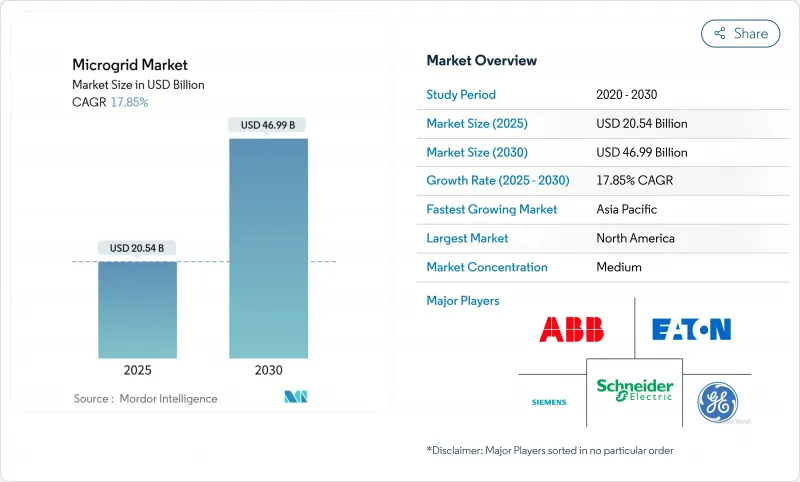
마이크로그리드 시장 규모는 2025년에 205억 4,000만 달러, 예측 기간(2025-2030년)의 CAGR은 17.85%를 나타내고, 2030년에는 469억 9,000만 달러에 달할 것으로 예측됩니다.

에지 분석, 디지털 트윈, 사이버 보안 레이어를 고급 컨트롤러에 통합하여 하드웨어 플릿 전체의 실시간 최적화를 가능하게 하는 IT/OT 컨버전스를 통해 성장을 가속합니다. 2030년까지 3억명의 아프리카인을 대상으로 하는 세계은행의 '미션 300'을 필두로 대규모 농촌 전기화가 오프 그리드 수요를 확대하고 있습니다. 상업 및 산업 분야에서는 무정전전력에 대한 요구와 국방자금에 의한 넷제로 베이스 프로그램에 대한 요구는 하이브리드 마이크로그리드 구성을 가속화합니다. 한편, 태양광 발전과 배터리 비용 저하로 새로운 가치 흐름이 생겨나지만, 리튬 이온의 가격 변동과 상호 접속 코드의 단편화에 의해 직면한 프로젝트 일정은 엄격해집니다.
양허 자금 조달, 하드웨어 가격 하락, 조달의 합리화가 진행되고, 2024년 농촌에서의 마이크로그리드 도입은 사상 최고치를 기록했습니다. 콩고 민주 공화국은 2024년 10월에 아프리카에서 가장 큰 태양 미니 그리드를 승인했습니다. 이는 다자간 투자보증기관의 지원을 받은 5,030만 달러의 프로젝트로 2만8,000가구와 중소기업에 서비스를 제공합니다. 세계의 미니 그리드 시장 현황 2024년 보고서에 따르면, 사하라 이남의 아프리카에서는 현재 2020년의 3배에 해당하는 5,000개 이상의 미니 그리드가 가동하고 있으며, 설치된 발전 용량의 59%를 태양광 발전이 차지하고 있습니다. 방글라데시는 2024년 사례 연구에서 독립된 마을을 위해 설계된 태양광, 풍력 및 배터리의 마이크로그리드에 대한 지역 송전망 확장 벤치마크보다 낮은 0.0688달러/kWh의 평준화 비용을 입증하여 자연 에너지 전용 설계의 경제적 실행 가능성을 보여주었습니다. 여러 정부가 고객 연결이 확인된 시점에서 보조금을 지급하는 성과 기반 대출 창구를 채택하여 민간 개발자의 우선 손실 위험을 줄이고 2025년에 예정된 도입 파이프라인을 가속화하고 있습니다. 이러한 개발로 단기 수요 풀이 확대되고 마이크로그리드 시장 예측 CAGR 상승을 지원하고 있습니다.
첨단 컨트롤러는 현재 SCADA 데이터, 클라우드 분석 및 AI 주도의 사이버 보안을 통합하여 변화하는 시장 신호 하에서 자산의 자체 최적화를 가능하게 합니다. Siemens와 Microsoft는 2025년 3월에 제휴를 확대하고 PLC 데이터와 Azure 기반 모델을 융합시켜 마이크로그리드 사업자의 예기치 않은 다운타임을 줄입니다. 디지털 트윈은 운전 상태의 실시간 시뮬레이션을 가능하게 하고, 고장 검출이나 발전의 결정을 가속화합니다. 백악관의 에너지 근대화 사이버 보안 계획은 분산 에너지 자원이 2024년 90GW에서 2025년 380GW로 증가할 것으로 예상되며, 안전한 OT 프로토콜의 필요성이 증가하고 있습니다. AI 비정상 감지 프레임워크는 96.5%의 정확성을 달성하여 사이버 위협에 대한 대응 시간을 크게 단축했습니다. 이러한 기능은 전력 회사와 군사 사용자의 신뢰를 높이고 마이크로그리드 시장의 성장 전망을 강화합니다.
미국의 독립 시스템 운영자 프로젝트 대기 기간이 5년을 초과했습니다. 샌프란시스코의 발렌시아 가든 축전지 프로젝트는 예기치 않은 상호 연결 비용으로 인해 포기되었지만 규제 위험을 나타냅니다. 에너지부는 병목 현상을 완화하기 위해 배전 유틸리티자에게 상향식 부하 모델을 구축하도록 촉구하고 있습니다. 유럽 개발자들은 또한 회원국 간의 표준이 다르고 엔지니어링의 오버헤드가 증가하고 있음을 밝혔습니다. 무결성의 부족은 투자자의 의욕을 극복하고, 전력 회사의 조달 주기를 늦추고, 중기적인 마이크로그리드 시장의 확대를 제한합니다.
계통 연계 프로젝트는 2024년에 마이크로그리드 시장 점유율의 62%를 차지하며, 세계의 마이크로그리드 시장 규모의 107억 달러에 해당합니다. 마이크로그리드의 매력은 요금의 재정 기회와 정전시의 섬 싱크 기능에 있습니다. 2030년까지 연평균 복합 성장률(CAGR)은 19%를 나타낼 전망입니다. 듀얼 모드 아키텍처는 현재 싱크로파더 데이터를 통합하고 있기 때문에 시스템은 200밀리초 이하로 전환하여 산불이나 폭풍우에도 전력 품질 기준을 유지할 수 있습니다. 총액은 작지만 오프 그리드 마이크로그리드는 아프리카와 남아시아의 농촌 전력화를 지원합니다. 세계은행이 지원하는 계획은 태양광 및 축전 하이브리드가 경쟁력 있는 요금으로 24시간 365일 수요를 충족시킬 수 있음을 증명하고, Off-grid EPC 계약의 판매 경로를 확대하고, 마이크로그리드 시장에 깊이를 더하고 있습니다.
오프 그리드의 배치는 기후 변화 기금으로부터 양허적 자금을 끌어들여, 더 긴 투자 회수와 보조금이 포함된 요금 플랜을 가능하게 합니다. 개발자는 표준화된 컨테이너 설계를 활용하여 현장에서의 건설 일수를 최소화하고 융통성을 향상시킬 수 있습니다. 커뮤니티 소유 모델도 수익 회수를 강화하고 지역 경제 발전을 뒷받침합니다. 통신 타워와 채굴 사업이 보다 깨끗한 전력을 요구하는 가운데, 자급 자족형 마이크로그리드는 순수한 전기 사업의 틀을 넘어 마이크로그리드 산업의 밑단을 펼칩니다. 예측 기간 동안 연결성 선택은 요금 체계, 정전 통계, 정책 인센티브에 따라 다르지만 혼합 포트폴리오는 투자자의 파이프라인을 지배할 것으로 예측됩니다.
2024년에는 하드웨어가 109억 달러를 창출해 마이크로그리드 시장 규모의 63%를 차지했습니다. 컨트롤러, 인버터 및 배터리 랙이 물리적 핵심을 형성합니다. 그리드 형성 인버터는 북유럽 조종사 사업에서 재생가능 에너지의 보급률이 90%를 초과하더라도 시스템의 안정성을 유지합니다. 벤더가 하이브리드 배터리 팩을 테스트하고 슈퍼커패시터를 통합하여 고속 부팅을 실현함으로써 스토리지 기술 혁신이 가속화되고 있습니다. 소프트웨어는 전통적인 예산의 15%를 차지할 뿐, 디지털 트윈과 시장 진입 알고리즘에 견인되어 CAGR 22%로 성장하고 있습니다. 이러한 플랫폼은 자산의 수명을 연장하고, 디스패치 오류를 줄이고, 언시러리 서비스의 수익을 끌어내고, 마이크로그리드 시장의 총 수익을 증가시킵니다.
서비스 제공업체는 사이트 평가, 허가, EPC 및 운영을 다룹니다. 특히 멀티벤더 환경에서는 복잡성이 증가하고 있으며 시스템 수준의 사이버 보안과 서비스 수준 계약을 보장하는 전문 통합업체에 대한 수요가 증가하고 있습니다. 컨설턴트 업무는 열화율을 예측하는 머신러닝 모델을 활용하여 성능 보증으로 확대하고 있습니다. 고객은 성과 기반 계약을 선호하기 때문에 마이크로그리드 애즈어 서비스는 하드웨어, 소프트웨어 및 운영을 단일 구독 요금으로 번들하여 소규모 상업 고객의 진입 장벽을 낮추고 있습니다.
마이크로그리드 시장 보고서는 연결성(계통 연계와 오프 그리드), 제공(하드웨어, 소프트웨어, 서비스), 전원(태양광 발전, 열전 병급, 연료전지, 기타), 유형(AC 마이크로그리드, DC 마이크로그리드, 기타), 전력 정격(1MW 미만, 1-5MW, 기타), 최종 사용자(유틸리티, 상업 및 산업, 주택)기준으로 세분화됩니다.
북미는 2024년 매출의 38%를 차지했으며, 에너지부(Department of Energy)의 Grid Resilience and Innovation Partnerships의 105억 달러의 자금 지원을 받았습니다. 국방부는 기지의 에너지 공급 능력 강화를 위해 5억 4,800만 달러를 할당하고, 하이브리드형 마이크로그리드의 조달에 중점을 두고 있습니다. 사이버 보안은 이 지역의 초점이었고, 인공지능 기반의 계층화된 프레임워크는 위협 감지 정확도 96.5%를 기록했으며, 중요한 시설의 배치에 대한 신뢰가 강화되었습니다. 이러한 프로그램을 종합하면 마이크로그리드 시장에서 북미의 리더십이 확고합니다.
아시아태평양은 농촌 지역의 전기화와 도시 혼잡 완화로 인해 2030년까지 연평균 복합 성장률(CAGR) 24%로 확대될 것으로 예측됩니다. 인도의 PM-KUSUM 체계는 커뮤니티 마이크로그리드와 연동하는 농업용 태양 펌프를 맡는 것이지만, 보조금의 붕괴가 단기적인 리스크가 되고 있습니다. 태양광발전, 풍력발전, 배터리를 조합한 방글라데시의 파일럿 사업에서는 에너지 비용이 0.07 USD/kWh 미만으로 송전망이 확장되지 않아도 경제적으로 가능하다는 것이 입증되었습니다. 중국은 수소 저장을 통합한 산업단지 마이크로그리드의 규모를 확대하고 일본은 내진성을 위해 이웃 규모의 시스템을 개량하고 있습니다. 이러한 다양한 이니셔티브로 인해 지역 마이크로그리드 시장은 다른 지역보다 빠르게 확장되고 있습니다.
유럽은 재생에너지의 보급률과 그리드 형성 기술에 주력하고 있습니다. 플루언스가 공급한 핀란드의 35MW 배터리 시스템은 아일랜드 테스트에서 100% 재생에너지로 운전을 지원합니다. 유럽 감사원은 2050년까지 인터넷 제로를 달성하기 위해 1조 9,000억 유로에서 2조 3,000억 유로의 그리드 투자가 필요하며, 그 중 일부는 혼잡 완화와 공급 균형을 위한 마이크로그리드에 자금을 제공한다고 합니다. 남미와 중동, 아프리카는 현재 규모는 작지만, 28,000개의 접속에 대응하는 콩고 최대의 미니 그리드의 전개에 주목하여 활발해지고 있습니다. 이 프로젝트는 이전에 디젤 발전에 의존했던 지역으로의 마이크로그리드의 세계적인 보급을 강조하여 마이크로그리드 시장 전체의 전망을 풍부하게합니다.
The Microgrid Market size is estimated at USD 20.54 billion in 2025, and is expected to reach USD 46.99 billion by 2030, at a CAGR of 17.85% during the forecast period (2025-2030).
Growth is catalyzed by IT/OT convergence that embeds edge analytics, digital twins, and cybersecurity layers into advanced controllers, enabling real-time optimization across hardware fleets. Large-scale rural electrification, notably the World Bank's Mission 300 targeting 300 million Africans by 2030, is expanding off-grid demand. The commercial and industrial segment's need for uninterrupted power and defense-funded net-zero base programs accelerates hybrid microgrid configurations. Meanwhile, declining solar PV and battery costs open new value streams, although lithium-ion price volatility and fragmented interconnection codes temper near-term project timelines.
Rural microgrid rollouts hit a new high in 2024 as concessional finance, falling hardware prices, and streamlined procurement converged. The Democratic Republic of Congo approved Africa's largest solar mini-grid in October 2024: a USD 50.3 million project backed by the Multilateral Investment Guarantee Agency to serve 28,000 households and small businesses. The "State of the Global Mini-Grids Market 2024" report shows that sub-Saharan Africa now hosts more than 5,000 operational mini-grids, triple the fleet counted in 2020, with solar providing 59% of installed generation capacity. In Bangladesh, a 2024 case study on a solar-wind-battery microgrid designed for an isolated village demonstrated a levelized cost of USD 0.0688/kWh-less than regional grid extension benchmarks-illustrating the economic viability of renewables-only designs. Multiple governments have adopted results-based financing windows that disburse subsidies upon verified customer connections, cutting first-loss risk for private developers and accelerating deployment pipelines scheduled for 2025. These developments collectively enlarge the near-term demand pool and underpin the forecast CAGR uplift for the microgrid market.
Advanced controllers now integrate SCADA data, cloud analytics, and AI-driven cybersecurity, allowing assets to self-optimize under changing market signals. Siemens and Microsoft extended their partnership in March 2025, blending PLC data with Azure-based models to shrink unplanned downtime for microgrid operators. Digital twins enable real-time simulation of operating states, accelerating fault detection and dispatch decisions. The White House Energy Modernization Cybersecurity plan anticipates distributed energy resources climbing from 90 GW in 2024 to 380 GW by 2025, heightening the need for secure OT protocols. An AI anomaly-detection framework has reached 96.5% accuracy, sharply reducing response time to cyber threats. These capabilities elevate confidence among utilities and military users, reinforcing the microgrid market growth outlook.
Project queues in several U.S. Independent System Operators have exceeded five years. The Valencia Gardens storage project in San Francisco was abandoned after unforeseen interconnection costs, illustrating regulatory risk. The Department of Energy urges distribution utilities to build bottom-up load models to ease bottlenecks. European developers also cite divergent standards between member states, increasing engineering overheads. Lack of harmonization discourages investors and slows utility procurement cycles, constraining the microgrid market expansion over the medium term.
Other drivers and restraints analyzed in the detailed report include:
For complete list of drivers and restraints, kindly check the Table Of Contents.
Grid-connected projects held 62% of the microgrid market share in 2024, equating to USD 10.7 billion of the global microgrid market size. Their appeal stems from tariff arbitrage opportunities and the ability to island during outages. Utility resilience mandates and community programs support a projected 19% CAGR through 2030. Dual-mode architectures now integrate synchrophasor data so systems switch in sub-200 ms, maintaining power-quality standards during wildfires or storms. Though smaller in aggregate value, off-grid microgrids underpin the rural electrification push across Africa and South Asia. World Bank-backed schemes prove that solar-storage hybrids can meet 24/7 demand at competitive rates, expanding the funnel for off-grid EPC contracts and adding depth to the microgrid market.
Off-grid deployments attract concessionary finance from climate funds, allowing longer paybacks and subsidized tariffs. Developers leverage standardized container designs to minimize on-site construction days and improve bankability. Community ownership models also enhance revenue recovery and boost local economic development. As telecom towers and mining operations seek cleaner power, self-sufficient microgrids broaden the microgrid industry footprint beyond pure electrification plays. Over the forecast horizon, connectivity choice will depend on tariff structures, outage statistics, and policy incentives, but mixed portfolios are expected to dominate investor pipelines.
In 2024, hardware generated USD 10.9 billion, representing 63% of the microgrid market size. Controllers, inverters, and battery racks form the physical core. Grid-forming inverters keep systems stable even when renewable penetration exceeds 90% in Nordic pilots. Storage innovation is accelerating as vendors test hybrid battery packs and integrate supercapacitors for fast ramping. Software, although accounting for just 15% of traditional budgets, is growing at 22% CAGR, driven by digital twins and market-participation algorithms. These platforms extend asset life, cut dispatch errors, and unlock ancillary-service revenues, amplifying total microgrid market returns.
Service providers cover site assessment, permitting, EPC, and operations. Growing complexity, particularly in multi-vendor environments, raises demand for specialized integrators who guarantee system-level cybersecurity and service-level agreements. Consultancy practices are expanding into performance assurance, leveraging machine-learning models that predict degradation rates. As customers prioritize outcome-based contracts, microgrid-as-a-service offerings bundle hardware, software, and operations into a single subscription fee, lowering the entry barriers for small commercial clients.
The Microgrid Market Report is Segmented by Connectivity (Grid-Connected and Off-Grid), Offering (Hardware, Software, and Services), Power Sources (Solar Photovoltaic, Combined Heat and Power, Fuel Cell, and More), Type (AC Microgrids, DC Microgrids, and Others), Power Rating (Below 1 MW, 1 To 5 MW, and Others), End-User (Utilities, Commercial and Industrial, and Residential) and Geography (North America, Asia-Pacific, and Others).
North America generated 38% of 2024 revenue, supported by USD 10.5 billion in Department of Energy Grid Resilience and Innovation Partnerships funding that targets extreme-weather mitigation.The Department of Defense allocated USD 548 million for energy-resilience upgrades at bases, channeling procurement toward hybrid microgrids. Cybersecurity remains a regional focus; a layered AI-based framework recorded 96.5% threat-detection accuracy, reinforcing trust in critical-facility deployments. Collectively, these programs solidify North America's leadership in the microgrid market.
Asia-Pacific is forecast to expand at a 24% CAGR to 2030, propelled by rural electrification and urban congestion relief. India's PM-KUSUM scheme underwrites agricultural solar pumps that interface with community microgrids, although subsidy claw-backs pose short-term risk. A Bangladeshi pilot combining PV, wind, and batteries achieved an energy cost below USD 0.07/kWh, demonstrating economic viability even without grid extension. China is scaling industrial park microgrids that integrate hydrogen storage, while Japan refines neighborhood-scale systems for seismic resilience. These diverse initiatives enlarge the regional microgrid market faster than any other geography.
Europe concentrates on high-renewables penetration and grid-forming technology. A Finnish 35 MW battery system supplied by Fluence supports 100% renewable operation during islanding trials. The European Court of Auditors states that reaching net-zero will demand EUR 1.9-2.3 trillion in grid investments by 2050, part of which will fund microgrids to relieve congestion and balance supply. South America and the Middle East & Africa are smaller today but show escalating activity, highlighted by the Congo's largest mini-grid rollout that will serve 28,000 connections. These projects underscore the global diffusion of microgrids into regions previously reliant on diesel generation, enriching the overall microgrid market landscape.