


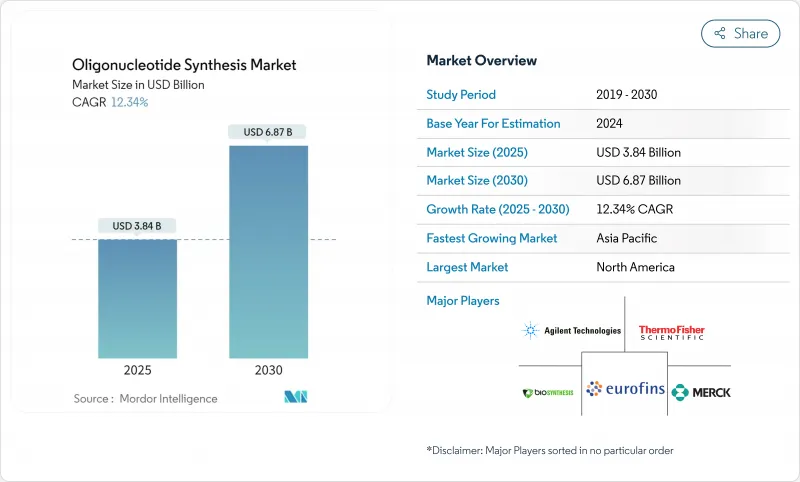
올리고뉴클레오티드 합성 시장은 2025년에 38억 4,000만 달러로 추정되고, 2030년에는 68억 7,000만 달러에 이를 것으로 예측됩니다.
위험한 시약을 사용하지 않고 길고 깨끗한 사슬을 만드는 효소 플랫폼은 40년에 걸쳐 포스포르아미다이트의 이점에 도전하여 올리고뉴클레오티드 합성 시장을 재형성하고 있습니다. NIH의 1,540만 달러의 RNA 프로그램으로 대표되는 정부 보조금은 새로운 제조 방법의 촉매가 되는 한편, 위탁 제조업체는 의약품의 아웃소싱 요구의 고조에 대응하기 위해 생산 능력을 확대하고 있습니다. 2023년 후반까지 22개의 핵산 의약품이 규제 당국의 승인을 받았고, 2024년에는 추가로 4개의 핵산 의약품이 승인되었으며, 올리고뉴클레오티드 합성 시장은 연구용 시약을 넘어 산업 규모의 생물 제제로 성장했습니다. PFAS와 관련된 시약의 환경 모니터링은 레거시 프로세스를 압박하고 진화하는 규제를 준수하면서 폐기물을 줄이는 효소 대체품에 대한 관심을 높입니다.
연방 정부의 투자는 올리고뉴클레오티드를 팬데믹 대책 및 정밀의료를 위한 중요한 인프라로 밀어 올렸습니다. NIH는 마이크로플루이딕스 장쇄 합성과 나노포어 시퀀싱을 개선하는 RNA 연구에 1,540만 달러를 기록했으며, 기술 개발 조정 센터는 2029년까지 매년 150만 달러를 확보하여 핵산 생산 시스템을 개량하고 있습니다. 유럽의 보조금과 병행하여 공급망의 현지화, 바이오 보안 강화, 치료 허가를 지원하는 올리고뉴클레오티드 표준의 가속화를 대서양을 넘어 추진하고 있습니다.
2024년에 발행된 새로운 FDA 지침은 품질 요건을 명확히 하고, 진단 분석의 전개를 가속화하며, 올리고뉴클레오티드 합성 시장을 뒷받침합니다. GalNAc 결합 안티센스 올리고가 처음으로 승인되었으며, 고충실도 합성에 의존하는 정확한 전달 화학이 확인되었습니다. 개인화된 'N-of-1' 치료는 현재 신속한 마이크로 배치 생산을 요구하고 있으며 서비스 제공 업체는 희귀질환 환자의 치료 방법을 변경하는 디자인-클리닉 워크 플로우의 통합을 촉진하고 있습니다.
치료 등급 정제는 고속 액체 크로마토그래피가 절단 사슬 및 반응성 불순물을 제거하기 위한 표준이기 때문에 제조 예산의 60-70%를 소비할 수 있습니다. 30mer의 배열이 98%의 커플링 효율로 55%로 저하하는 것으로 나타난 수율의 저하는 시약의 사용량과 폐기물 처리량을 증가시키는 과잉 생산을 강요시키고, 규모의 경제성이 부족한 중소기업에 스트레스를 주고 있습니다.
보고서에서 분석된 기타 촉진요인 및 억제요인
제약 스폰서가 개발 기간을 단축하는 턴키 솔루션을 선호했기 때문에 서비스는 2024년 매출 전체의 41.25%를 차지했습니다. 이러한 이점은 올리고뉴클레오티드 합성 시장이 합성, 정제, 약사 지원을 단일 벤더 계약에 번들한 외부 능력을 선호한다는 것을 뒷받침합니다. 이 모델은 각 로트가 엄격한 GMP 감사를 통과해야 하는 고가치 임상 배치에 적합합니다. 시약 소비는 병렬로 확대되고 벤치탑 효소 플랫폼이 등장하더라도 소모품 공급자는 안정적인 연금 수입을 제공합니다.
앞으로는 컴플라이언스의 복잡성이 계속 증가함에 따라 서비스 수익이 제품 판매를 초과할 것으로 예측됩니다. CDMO는 분석 비용을 수십 명의 고객에게 분산시키지만, 개별 생명 공학 기업은 수백만 달러의 클린룸 투자를 정당화하는 경우가 드뭅니다. 장비 공급업체는 올리고당 비용을 절감하는 384-웰 신디사이저와 같은 더 높은 처리량의 장비를 지원하지만 대부분의 장비는 의약품 제조업체의 실험실이 아닌 서비스 시설 내에 설치될 것입니다. 따라서 올리고뉴클레오티드 합성 시장 규모 확대는 CDMO의 증설을 추종하는 한편, 특수한 벤치탑형 시스템은 연구 코어 내의 틈새 시장에서 신속한 요구에 대응합니다.
DNA는 120 염기까지의 사슬에서 99% 이상의 커플링 효율을 실현하는 성숙한 포스포르아미다이트 프로토콜에 의해 2024년 올리고뉴클레오티드 합성 시장에서 43.45%의 점유율을 유지했습니다. RNA의 13.78% 점유율은 mRNA 백신, CRISPR 가이드, siRNA 약물이 임상에서 보급됨에 따라 상승합니다. 효소 합성이 RNA에 유리한 이유는 수성 효소가 2'-하이드록실기를 분해하는 산성 탈보호 단계를 회피하고 캡핑제 없이 실현 가능한 길이를 200 염기 이상으로 늘릴 수 있기 때문입니다.
포스포로티오에이트 및 2'-O-메틸리보스와 같은 변형된 백본은 이미 안티센스 및 RNAi 치료제의 주류가 되었으며, 염기당 가격은 DNA의 몇 배나 많습니다. 틈새 화학물질(LNA, PNA, 모르폴리노)은 작은 조각을 차지하지만 안정성이 중요한 적응증에 필수적인 도구를 제공합니다. 치료 수요가 증가함에 따라 생산은 GMP를 준수하는 효소와 더 친환경적인 용매로 이동하고 올리고뉴클레오티드 합성 시장 점유율은 RNA로 상승하는 반면, DNA는 유전자 어셈블리 및 PCR의 프라이머 양의 기초가 되고 있습니다.
북미는 2024년 42.81%의 점유율을 획득했습니다. FDA 지침에 의한 개발 리스크의 경감과, NIH에 의한 플랫폼 혁신에 대한 보조금이 뒷받침하고 있습니다. 미국에 본사를 둔 기업은 벤처 캐피탈, 탁월한 학술 및 제조 노하우에 걸쳐 통합 에코시스템을 활용하고 있습니다. 캐나다는 근접성으로부터 혜택을 받으며 신흥 GMP 스위트가 국경을 넘어선 프로젝트를 유치하고 있습니다. 멕시코의 저비용 기지가 시약 포장 및 QC 기능을 유치하기 시작했지만 합성은 여전히 북쪽에 집중되어 있습니다.
아시아태평양은 14.71%로 가장 높은 성장률을 보였습니다. 중국 스폰서는 2024년 중 소규모 핵산 벤처에 40억 달러 이상을 투입했으며 지방 정부는 공급을 현지화하기 위해 공장 허가를 신속하게 진행했습니다. 한국은 밀리포어 시그마로부터 이중구조 생물제제 캠퍼스를 위해 3억 유로를 확보했고, 싱가포르는 규제가 확실하기 때문에 우크시 STA와 젠스크립트로부터 복수 라인의 확장을 유치했습니다. 인도의 'Make in India'의 추진은 CoDx-CoSara의 새로운 구자라트 시설을 탄생시키고 밸류체인을 상승시키려는 지역의 의지를 보여주었습니다.
유럽은 여전히 혁신 강국이지만, PFAS 관련 화학물질 규정은 레거시 포스포르아미다이트의 워크스트림을 복잡하게 하고 있습니다. 독일의 BioSpring은 생산 능력을 3배로 향상시키고 1,500명의 고용을 늘리며, 불소가 없는 시약의 개척에 의해 공급면에서 두통의 씨앗을 상쇄했습니다. 영국의 투석 센터는 공공 보조금과 생명 공학 스핀 아웃을 결합하고 프랑스는 효소 시스템의 신흥 기업을 육성하고 있습니다. 그 밖에 브라질과 아르헨티나가 중남미에서 유전자 치료의 보급을 이끌고 걸프 국가들은 수입 올리고뉴클레오티드를 축으로 한 정밀의료 허브를 구축하여 향후 10년간의 현지 생산을 예감시킵니다.
The oligonucleotide synthesis market reached USD 3.84 billion in 2025 and is forecast to climb to USD 6.87 billion by 2030, advancing at a 12.34% CAGR as therapeutic breakthroughs accelerate demand.
Enzymatic platforms that create longer, cleaner strands without hazardous reagents are reshaping the oligonucleotide synthesis market by challenging four decades of phosphoramidite dominance. Government grants, notably the NIH's RNA-focused USD 15.4 million program, catalyze new production methods while contract manufacturers scale capacity to meet rising pharmaceutical outsourcing needs. Clinical approvals underscore momentum: 22 nucleic-acid drugs cleared regulators by late 2023, and four more won clearance in 2024, pulling the oligonucleotide synthesis market beyond its research-reagent roots into industrial-scale biologics. Environmental scrutiny of PFAS-linked reagents pressures legacy processes, amplifying interest in enzymatic alternatives that reduce waste while complying with evolving regulations.
Federal investment elevated oligonucleotides to critical-infrastructure status for pandemic preparedness and precision medicine. The NIH earmarked USD 15.4 million for RNA research that improves microfluidic long-strand synthesis and nanopore sequencing, while its Technology Development Coordinating Center secures USD 1.5 million annually through 2029 to refine nucleic-acid production systems . Parallel European grants create a trans-Atlantic push to localize supply chains, reinforce biosecurity, and accelerate oligonucleotide standards that underpin therapeutic approvals.
Fresh FDA guidance issued in 2024 clarifies quality requirements, accelerating diagnostic assay rollouts and boosting the oligonucleotide synthesis market . GalNAc-conjugated antisense oligos received their first approval, confirming precise delivery chemistries that rely on high-fidelity synthesis. Personalized "N-of-1" treatments now demand rapid micro-batch production, prompting service providers to integrate design-to-clinic workflows that transform how rare-disease patients are treated.
Therapeutic-grade purification can consume 60-70% of manufacturing budgets as high-performance liquid chromatography remains the standard for removing truncated strands and reactive impurities. Yield erosion, demonstrated by 30-mer sequences falling to 55% at 98% coupling efficiency, forces over-production that inflates reagent use and waste disposal, stressing smaller players that lack economies of scale.
Other drivers and restraints analyzed in the detailed report include:
For complete list of drivers and restraints, kindly check the Table Of Contents.
Services generated 41.25% of overall 2024 revenue as pharmaceutical sponsors prioritized turnkey solutions that compress development timelines. This dominance confirms the oligonucleotide synthesis market preference for external capacity that bundles synthesis, purification, and regulatory support into single-vendor contracts. The model suits high-value clinical batches where each lot must pass stringent GMP audits. Reagent consumption scales in parallel, offering steady annuity streams for consumables providers even as benchtop enzymatic platforms appear.
Looking ahead, service revenue is expected to outpace product sales because compliance complexity continues to rise. CDMOs spread analytical costs across dozens of clients, whereas individual biotechs seldom justify multi-million-dollar cleanroom investments. Equipment suppliers respond with higher-throughput instruments such as 384-well synthesizers that cut per-oligo costs, yet most machines will still land inside service facilities rather than drug-maker labs. The oligonucleotide synthesis market size expansion therefore tracks CDMO build-outs, while specialized benchtop systems address niche rapid-turnaround needs within research cores.
DNA retained 43.45% command of the oligonucleotide synthesis market in 2024 thanks to mature phosphoramidite protocols that deliver >99% coupling efficiency for strands up to 120 bases. RNA's 13.78% share is set to climb as mRNA vaccines, CRISPR guides, and siRNA drugs gain clinical traction. Enzymatic synthesis favors RNA because aqueous enzymology avoids the acidic deprotection steps that degrade 2'-hydroxyl groups, extending feasible lengths beyond 200 bases without capping agents.
Modified backbones such as phosphorothioates and 2'-O-methyl riboses already dominate antisense and RNAi therapeutics, commanding multiples of DNA's price per base. Niche chemistries (LNA, PNA, Morpholino) occupy small slices yet supply indispensable tools for stability-critical indications. As therapeutic demand intensifies, production shifts toward GMP-compliant enzymes and greener solvents, lifting the oligonucleotide synthesis market share of RNA while DNA remains foundational for gene-assembly and PCR primer volumes.
The Oligonucleotide Synthesis Market Report Segments the Industry Into by Product Type (Synthesized Oligonucleotide Products, and More), by Chemistry (DNA, RNA, and More), by Application (Research, Diagnostics, Therapeutics), by End-User (Academic Research Institutes, Pharmaceutical and Biotechnology Companies, and More), and by Geography. The Market Sizes and Forecasts are Provided in Terms of Value (USD).
North America captured 42.81% share in 2024, propelled by FDA guidance that de-risks development and by NIH funding that subsidizes platform innovation. United States-based firms leverage integrated ecosystems spanning venture capital, academic excellence, and manufacturing know-how. Canada benefits from proximity, with emerging GMP suites attracting cross-border projects. Mexico's low-cost sites are beginning to draw reagent packaging and QC functions, though synthesis remains concentrated further north.
Asia-Pacific held 14.71% yet registers the highest growth trajectory. Chinese sponsors poured more than USD 4 billion into small-nucleic-acid ventures during 2024, while provincial governments fast-tracked plant permits to localize supply. South Korea secured EUR 300 million from MilliporeSigma for a duplex biologics campus, and Singapore's regulatory certainty lured multi-line expansions from WuXi STA and GenScript. India's "Make in India" drive birthed CoDx-CoSara's new Gujarat facility, signaling regional intent to rise up the value chain.
Europe remains an innovation powerhouse but encounters PFAS-related chemical restrictions that complicate legacy phosphoramidite workstreams. Germany's BioSpring tripled capacity and added 1,500 jobs, offsetting supply headaches by pioneering fluorine-free reagents. The United Kingdom's Catapult centers pair public grants with biotech spin-outs, while France cultivates enzymatic start-ups. Elsewhere, Brazil and Argentina lead Latin American uptake of genetic therapies, and Gulf states build precision-medicine hubs anchored by imported oligonucleotides, foreshadowing localized production over the next decade.