


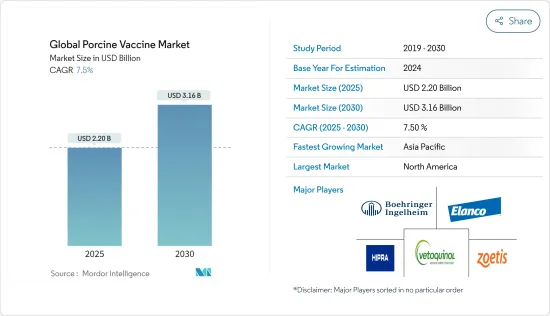
세계 돼지 백신 시장 규모는 2025년 22억 달러에서 2030년에는 31억 6,000만 달러에 이를 것으로 예측되며, 예측 기간(2025-2030년) 동안 CAGR는 7.5%로 추정됩니다.

COVID-19의 갑작스러운 발생은 모든 시장에 큰 영향을 미쳤습니다. 주로 COVID-19 대책에 중점이 옮겨졌기 때문에 다른 연구 개발은 모두 보류되고 있습니다. 2020년 7월, 질병 관리 예방 센터(CDC)는 COVID-19 발생 시 동물처리에 관한 구체적인 지침을 수의 전문가에게 제공했습니다. 많은 정부 기관도 진료소나 병원에게 긴급 진찰을 우선시하도록 권고하고 있습니다. 또한 OIE(세계동물보건기구)에 따르면 세계의 의료시설과 COVID-19 검사기관의 부족을 극복하기 위해 대부분의 동물검사기관은 인간의 COVID-19 검사에 적극적으로 임하고 있습니다. 그러나 일부 병원 및 클리닉에서는 이 유행 상황에서 바이러스 확산을 피하기 위한 명확한 조치를 취하고 있습니다. 예를 들어, 프레스티지 동물 병원은 동물을 치료할 때 예방 조치를 취합니다. 또한 주인이 진단과 치료를 위해 반려동물을 맡길 수있는 "드롭 오프 검사"프로그램을 시작했습니다. 치료 결과와 계획은 전화와 이메일을 통해 상의합니다. 그 결과, 반려동물 백신 시장은 COVID-19 기간 동안 동물 병원 진찰의 감소로 인해 단기적으로 약간의 부정적인 영향을 받고 있습니다. 따라서 COVID-19는 돼지 백신 시장에 약간의 영향을 미칠 것으로 예상됩니다.
또한, 질병을 치료하기 위한 신규 돼지 백신을 발견하기 위한 주요 기업에 의한 R&D 활동의 활성화와 제품 허가 증가가 예측 기간 동안의 조사 시장의 플러스 성장에 기여할 것으로 예상됩니다. 예를 들어, 2021년 5월에는 돼지열병(CSF) 백신이 Indian Immunologicals Limited(IIL) 브랜드 이름으로 Raksha Class로 출시되었습니다. 이와 같은 제품 출시 증가는 예측 기간 동안 시장 성장으로 이어질 것으로 예상하고 있습니다.
2021년 4월 의회 예산국의 보고에 따르면 제약 산업은 R&D에 830억 달러를 지출했습니다. 이러한 비용은 신약 발견 및 시험, 제품 확장과 같은 단계적 혁신 개발, 안전 모니터링 및 마케팅 목적으로 임상시험을 수행하는 등 다양한 활동을 위해 지급되었습니다. 이와 같이 연구 개발비 증가는 예측 기간 동안 시장을 밀어 올립니다.
PRRS(Porcine Reproductive and Respiratory Syndrome : 돼지 생식기 호흡기 증후군)는 현재도 양돈장에서 흔히 발견되는 질병으로, 번식, 성장, 임상 질환에 악영향을 끼치면서 경제적 손실을 일으키고 있습니다. 따라서 고객 수요를 충족시키기 위한 시장 혁신이 계속되고 있습니다. 예를 들어, 2021년 4월, 아흐메다바드를 거점으로 하는 Hester Bioscience사는 인도에서 돼지열병 백신과 양두 백신을 상업 생산할 권리를 얻었습니다. 과학자들은 인도 농업 연구위원회(ICAR) 산하 이자트나가르(Izatnagar)에 있는 인도 수의사 연구소(IVRI)에서 이 두 가지 백신을 개발하고 있습니다. 또한 2021년 4월 아르헨티나 연구소 Vetanco는 Pharmgate Animal Health과 제휴하여 아르헨티나 및 라틴아메리카에서 Circo/MycoGard 백신을 판매했습니다. 이 백신은 PCV-2와 폐렴 마이코플라스마 모두로부터 돼지를 보호합니다.
따라서 위의 요인으로 인해 시장은 예측 기간 동안 성장을 나타낼 것으로 예상됩니다. 그러나 보관 조건의 유지와 취급에 드는 높은 비용 및 백신에 의한 역반응의 가능성이 시장의 성장을 크게 저해하고 있습니다.
PCV(돼지 써코바이러스)는 최소 크기의 비외피형 단일 가닥 DNA 바이러스로, 유전체 증폭에 숙주 중합효소를 사용하여 진핵 세포 내에서 자율 복제합니다. PCV는 감염된 돼지와 직접 접촉하여 전파됩니다. PCV2는 단일 가닥 DNA(ssDNA) 바이러스 중에서 가장 돌연변이율과 재조합률이 높은 바이러스입니다. PCV는 세계 돼지 생산성에 영향을 미치는 가장 중요한 감염 인자 중 하나입니다.
게다가 2021년 1월에 MDPI Viruses에 게재된 Henna의 논문에 따르면 PCV의 세계 유행과 상황에 따라 돼지의 혈청 양성률은 20-80%, 발병률은 60%로 매우 높으며, 심각한 피해를 입은 양돈장에서의 도태율은 40%를 나타낼 전망입니다.
시판되는 PCVAD 백신에는 많은 유형이 있으며 주로 복용량, 포장 크기, 사용하는 돼지의 연령, 바이러스 유형에 따라 다릅니다. 세계적으로 PCVAD용 돼지 백신을 제조 및 판매하고 있는 주요 브랜드로는 Boehringer Ingelheim, Merck, Zoetis 등이 있습니다. 단일 주사로 PCV2를 예방하는 최초의 FLEX 가족 돼지 백신은 Boehringer Ingelheim의 Ingelvac CircoFLEX였습니다. 따라서 이 백신은 시장에서 획기적인 PCV2 백신 중 하나입니다.
이와 같이, 이 분야는 상기 요인으로 인해 예측 기간 동안 크게 성장할 것으로 예측되고 있습니다.
돼지고기 소비량 증가, 다양한 돼지병의 유행, 1인당 동물 의료 지출 증가는 미국이 큰 시장 점유율을 유지할 것으로 예상되는 요인입니다.
미국에서는 백신 개발의 진보로 생 벡터 백신, 비복제 재조합 항원 백신, 핵산 매개 백신, 생유전자 제거 백신 등이 개발되고 있습니다. 또한, 백신 분야에서의 기술 진보와 확립된 헬스케어 인프라도 이 지역 시장의 성장을 크게 뒷받침하고 있습니다. 예를 들어, 2022년 3월, Boehringer Ingelheim은 돼지 파보바이러스 백신 ReproCyc ParvoFLEX를 출시했습니다. 이 백신은 돼지 파보바이러스로 인한 번식 부전에 대해 6개월 이상 건강한 어머니와 암컷 돼지에게 안전하고 효과적인 보호를 제공합니다.
게다가 Agricultural Economic Insights(AEI)의 보고서에 따르면 미국에서 육류 소비량을 1970년부터 2020년까지 조사한 결과 2020년에는 증가하는 추세를 보였습니다. 닭고기, 쇠고기, 돼지고기의 소비 패턴은 크게 다르지만 소비량 증가로 돼지 관련 질병의 위험이 높아집니다.
따라서 위의 요인으로 인해 시장은 예측 기간 동안 크게 성장할 것으로 예상됩니다.
돼지 백신 시장은 상당히 경쟁이 치열하며 Hipra, Zoetis, Elanco Inc, Boehringer Ingelheim, Vetoquinol 등 여러 선도기업들이 참여하고 있습니다. 이러한 대기업의 대부분은 세계적인 존재감을 보여주며, 신흥국에서의 격렬한 경쟁에 직면하고 있습니다. 신흥국은 식품 안전성에 대한 우려가 높아지고 가축뿐만 아니라 반려동물의 사육 증가로 시장 규모가 급속히 확대되고 있기 때문에 큰 경쟁 지역으로 자리잡고 있습니다.
The Global Porcine Vaccine Market size is estimated at USD 2.20 billion in 2025, and is expected to reach USD 3.16 billion by 2030, at a CAGR of 7.5% during the forecast period (2025-2030).
The sudden outbreak of COVID-19 majorly impacted all the markets. With the focus primarily shifted to combat COVID-19, all other research and development are on hold. In July 2020, the Center for Disease Control and Prevention (CDC) provided specific guidelines to veterinary professionals for treating animals during COVID-19. Many government agencies have also recommended prioritizing urgent and emergency visits to clinics and hospitals. Furthermore, most veterinary laboratories are actively involved in testing COVID-19 in humans to overcome the global shortage of healthcare facilities and COVID-19 testing laboratories, according to the OIE (World Organization for Animal Health). However, some hospitals and clinics are taking definite measures to avoid the transmission of the virus during this pandemic situation. Prestige Animal Hospitals, for example, has taken precautionary measures when treating animals. It also launched the 'Drop Off Exams' program, which allows owners to drop off their pets for diagnosis or treatment. The results and treatment plans are then discussed through a phone call/e-mail. As a result, the companion animal vaccine market is experiencing a slight short-term negative impact, owing to lower veterinary visits during COVID-19. Thus, COVID-19 is expected to impact the porcine vaccine market slightly.
Additionally, the growing R&D activities by the key players for discovering novel porcine vaccines to treat diseases and rising product approvals are expected to aid in the positive growth of the studied market over the forecast period. For instance, in May 2021, the Classical Swine Fever (CSF) vaccine was launched under the Raksha Class by Indian Immunologicals Limited (IIL) brand name. Thus, rising product launches anticipated market growth over the forecast period.
According to the Congress Budget Office report in April 2021, the pharmaceutical industry spent USD 83 billion on research and development. These costs were paid for various activities, including discovering and testing new drugs, developing incremental innovations like product extensions, and conducting clinical trials for safety monitoring or marketing purposes. Thus rising in R&D spending boosts the market over the forecast period.
PRRS (Porcine Reproductive and Respiratory Syndrome) is still a common disease in pig farms, causing financial losses due to its adverse effects on reproduction, growth, and clinical illness. As a result, market innovation to meet customer demand has been ongoing. For example, in April 2021, Ahmedabad-based company Hester Bioscience got the right to commercially produce classical swine fever and sheep pox vaccines in India. Scientists develop these two vaccines from the Indian Veterinary Research Institute (IVRI), Izatnagar, under the Indian Council of Agricultural Research (ICAR). Also, in April 2021, the Argentine laboratory Vetanco partnered with Pharmgate Animal Health to distribute the Circo/MycoGard vaccine in Argentina and Latin America. The vaccine protects pigs against both PCV-2 and Mycoplasma hyopneumoniae.
Thus, owing to the abovementioned factors, the market is expected to show growth over the forecast period. However, high expenses of maintaining and handling storage conditions and chance of reverse reaction from vaccines significantly hinder the market's growth.
PCV (Porcine Circovirus) is the smallest non-enveloped, single-stranded DNA virus, which replicates autonomously in eukaryotic cells, using the host polymerase for genome amplification. PCV can be spread through direct contact with an infected pig. PCV2 is the single-stranded DNA (ssDNA) virus with the highest mutation and recombination rate of all single-stranded DNA (ssDNA) viruses. PCV is one of the most important infectious agents affecting pig productivity worldwide.
Furthermore, according to Henna's article published in MDPI Viruses in January 2021, the global prevalence and status of PCV have resulted in a seropositivity rate of 20-80% in pigs, as well as a very high incidence rate of 60%, with a culling rate of 40% in severely affected pig farms.
Commercially available PCVAD vaccines can be of many types, mainly based upon the dosage, packaging size, age of the pig it is used on, and virus type. Some of the major brands manufacturing and selling porcine vaccines for PCVAD, globally, are Boehringer Ingelheim, Merck, and Zoetis, among others. The first FLEX Family swine vaccine for PCV2 protection in a single injection was Ingelvac CircoFLEX, by Boehringer Ingelheim. Hence, it is one of the revolutionary PCV2 vaccines on the market.
Thus, the segment is anticipated to witness significant growth over the forecast period due to the abovementioned factors.
Increasing pork consumption, the growing prevalence of various swine diseases, and rising per capita animal healthcare expenditure are the factors the United States is expected to retain its large market share.
In the United States, advancements in vaccine development include the development of live vector vaccines, non-replicating recombinant antigen vaccines, nucleic acid-mediated vaccines, and live-gene-deleted vaccines. Moreover, technological advances in the vaccine field and well-established healthcare infrastructure are also considerably fueling the regional market's growth. For instance, in March 2022, Boehringer Ingelheim launched the porcine parvovirus vaccine ReproCyc ParvoFLEX which provides safe, efficacious protection for healthy sows and gilts six months of age or older against reproductive failure caused by porcine parvovirus.
Furthermore, according to the Agricultural Economic Insights (AEI) report, meat consumption in the United States increased in 2020 when studied from 1970 to 2020. Although poultry, beef, and pork consumption pattern broadly vary, it increases the risk of swine diseases.
Thus, the market is expected to witness significant growth during the forecast period due to the abovementioned factors.
The porcine vaccines market is fairly competitive and consists of several major players including Hipra, Zoetis, Elanco Inc, Boehringer Ingelheim, and Vetoquinol. Most of these major players enjoy a global presence and are facing intense competition in emerging economies. The emerging countries are becoming hotspots for significant competition, due to a rapidly expanding market size, fueled by rising concerns over food safety and the increasing adoption of companion as well as farm animals.