US LED Lighting - Market Share Analysis, Industry Trends & Statistics, Growth Forecasts (2025 - 2030)
상품코드:1685714
리서치사:Mordor Intelligence
발행일:2025년 03월
페이지 정보:영문
라이선스 & 가격 (부가세 별도)
ㅁ Add-on 가능: 고객의 요청에 따라 일정한 범위 내에서 Customization이 가능합니다. 자세한 사항은 문의해 주시기 바랍니다.
ㅁ 보고서에 따라 최신 정보로 업데이트하여 보내드립니다. 배송기일은 문의해 주시기 바랍니다.
한글목차
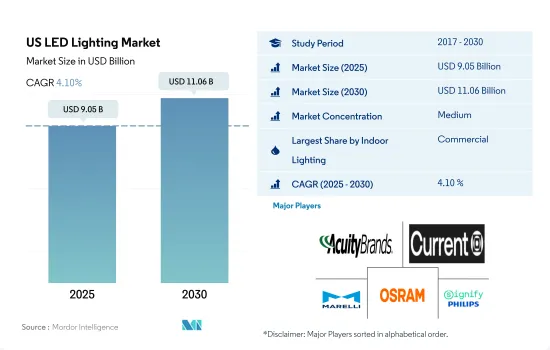
미국의 LED 조명 시장 규모는 2025년 90억 5,000만 달러, 2030년 110억 6,000만 달러에 이를 것으로 예측되며, 예측 기간 중(2025-2030년) CAGR 4.10%로 확대될 것으로 예상됩니다.
가처분 소득 증가, 정부 투자, 이 지역의 상업 건축물 증가 등이 LED 조명 시장의 성장을 이끌고 있습니다.
2023년 금액 점유율에서는 상업시설이 점유율의 대부분을 차지했고 산업 및 창고, 주택이 뒤를 이었습니다.
2023년 수량 점유율에서는 상업 부문이 대부분을 차지했고, 주택 부문, 산업 및 창고 부문이 뒤를 이었습니다. 지금까지 이상의 성장 기회를 볼 수도 있습니다.
건설 업계는 모든 분야에서 성장산업입니다. 민간 및 상업섹터의 건설업자, 계약자, 토목기사 등이 포함됩니다.
2022년 미국의 중소기업은 3,320만 곳이었습니다. 급성장하고 있는 신흥기업 5사의 본사는 샌프란시스코에 있습니다. 리더십을 취하고 있습니다. 2022년에는 65% 이상의 중소기업이 이익을 계상했습니다.
미국 LED 조명 시장 동향
가구수 증가가 LED 시장 성장을 견인
2021년 미국 전체의 인구는 3억 3,218만 명이었습니다. 미국 전체의 출생률은 2021년 여성 1명당 1.66명이 될 것으로 예상되었습니다. 2021년 출생 시 평균 수명은 76.33세였습니다.
2022년 미국의 가구 수는 1억 3,120만 가구였습니다. 2020년 소유주가 거주하는 가구의 비율은 65.9%였습니다.
전기자동차(EV) 시장은 급속히 확대되고 있어 향후 10년간은 확대가 계속될 것으로 예상됩니다. 2011-2021년까지 10년간, EV 주행 대수는 약 2만 2,000대에서 200만대 이상으로 대폭 증가했습니다.
민간 주택 증가와 정부 규제가 LED 시장을 견인
2021년 미국의 가구수는 약 1억 2,400만 가구였습니다. 2020년에는 3억 3,140만 명, 2022년에는 3억 3,320만명으로 증가해, 0.6%의 성장을 나타냈습니다. 이러한 사례로부터, 미국의 조명 LED 보급이 진행될 것으로 예상됩니다. 미국의 1인당 소득은 2020년 12월 3만 3,740.8달러에 비해 2021년 12월에는 3만 6,430달러에 달할 달했습니다. 다른 개발도상국에 비해 미국은 보다 많은 소득을 얻고 있습니다.
5월의 개인 주택 착공 건수는 연간 기준으로 163만 1,000건이었습니다. 이는 2022년 5월 154만 3000호를 5.7%, 2023년 4월 개정치인 134만 호를 21.7% 상회한 수치입니다. 에너지정책법(EPAct) 제179D조에 따라 2023년 신규 제도에서 최대 세액 공제액은 업그레이드된 공간 1평방피트당 5달러로 늘어났습니다. 2022년에는 1평방피트당 1.88달러가 공제됐습니다.
미국 LED 조명 산업 개요
미국의 LED 조명 시장은 적당히 통합되어 있으며 상위 5개사에서 64.62%를 차지하고 있습니다. 시장의 주요 기업에는 ACUITY BRANDS, INC., Current Lighting Solutions, LLC., Marelli Holdings Co., Ltd., OSRAM GmbH. and Signify (Philips)가 있습니다(알파벳순 정렬).
기타 혜택
엑셀 형식 시장 예측(ME) 시트
3개월의 애널리스트 서포트
목차
제1장 주요 요약과 주요 조사 결과
제2장 보고서 제안
제3장 소개
조사의 전제조건과 시장 정의
조사 범위
조사 방법
제4장 주요 산업 동향
자동차 생산 대수
인구
1인당 소득
자동차 대출 금리
충전소 수
자동차 보유 대수
LED 총 수입량
조명 소비 전력
가구 수
도로망
LED 보급률
경기장 수
원예 면적
규제 프레임워크
실내 조명
미국
옥외 조명
미국
자동차용 조명
미국
밸류체인과 유통채널 분석
제5장 시장 세분화
실내 조명
농업용 조명
상업용 조명
사무실
소매
기타
산업 및 창고
주택 조명
옥외 조명
공공시설
도로
기타
자동차용 유틸리티 조명
주간 주행등(DRL)
방향 지시기
헤드라이트
후진등
정지등
테일 라이트
기타
자동차용 조명
이륜차
상용차
승용차
제6장 경쟁 구도
주요 전략 동향
시장 점유율 분석
기업 상황
기업 프로파일
ACUITY BRANDS, INC.
Current Lighting Solutions, LLC.
Dialight
GRUPO ANTOLIN IRAUSA, SA
KOITO MANUFACTURING CO., LTD.
Marelli Holdings Co., Ltd.
NVC INTERNATIONAL HOLDINGS LIMITED
OSRAM GmbH.
Signify(Philips)
Stanley Electric Co., Ltd.
제7장 CEO에 대한 주요 전략적 질문
제8장 부록
세계 개요
개요
Porter's Five Forces 분석 프레임워크
세계의 밸류체인 분석
시장 역학(DROs)
정보원과 참고문헌
도표 일람
주요 인사이트
데이터 팩
용어집
JHS
영문 목차
영문목차
The US LED Lighting Market size is estimated at 9.05 billion USD in 2025, and is expected to reach 11.06 billion USD by 2030, growing at a CAGR of 4.10% during the forecast period (2025-2030).
The increasing disposable income, government investments, and rising commercial construction in the region drive the growth of led lighting market
In terms of value share, in 2023, commercial accounted for the majority of the share, followed by industrial and warehouse, and residential. The main factors contributing to the growth of the industrial sector's resilience are changes in labor force levels in China, less regulatory burden for US production than European counterparts, and greater vitality of manufacturing income relative to the United States Gross Domestic Product.
In terms of volume share, in 2023, commercial accounted for the majority of the share, followed by the residential sector and industrial and warehouse sector. America's need for storage space is advancing toward a brighter future. With the acceleration of e-commerce, the warehousing industry may see more growth opportunities than ever. The US retail e-commerce sales in Q3 2020 are estimated at USD 209.5 billion. This is a 36.7% increase over Q3 2019.
The construction industry is a growth industry in all areas. These include builders, contractors, and civil engineers in the private and commercial sectors. Employment in the construction and mining sector is expected to increase by 4% from 2019 to 2029, about the same rate as the average for all jobs. Part of the driver of this growth is the increasing demand for new buildings, roads, and other structures due to population growth.
In 2022, there were 33.2 million small businesses in the United States. The five fast-growing startups are headquartered in San Francisco. 40% of US startups have at least one woman in leadership. Over 65% of small businesses reported profits in 2022. The above instances are expected to create more demand for Indoor LEDs in the coming years.
US LED Lighting Market Trends
Increase in the number of households to drive the growth of the LED market
In 2021, there were 332.18 million people living in the US as a whole. The overall fertility rate in the US was expected to be 1.66 children per woman in 2021. When compared to the prior year, it went up 0.01. In rough terms, there were 11 live births per 1,000 people in the US. This rose from the previous year by 0.1. In the US, the average life expectancy at birth was 76.33 years in 2021. According to the data, more children are being born and more people in the world, which means that more space will need to be inhabited by people, which will help the market expand. Thus, the sale of new LEDs will rise as a result of the building of the new home.
The United States had 131.2 million households in 2022. There are now more households in the United States than there were in 2020 (128.45 million). In 2022, there were 3.13 people in the typical American family. The proportion of owner-occupied households in 2022 was 65.9%. In 2020, six or more rooms were present in 19.3% of all occupied dwelling units. The expansion of LEDs will be fueled by an increase in families and the need to accommodate this increase in the typical number of rooms.
The market for electric cars (EVs) has expanded quickly and is anticipated to do so throughout the next ten years. From just 0.2% of all car sales in 2011 to 4.6% in 2021, electric car sales in the US grew. Over the decade of 2011-21, the number of EVs on the road increased significantly, from around 22,000 to over 2 million. As a result, the need for semiconductor chips used in various EV applications rose along with the popularity of EVs, raising the need for LED illumination.
Increase in the number of private-owned dwellings and government regulations to drive the market for LEDs
As of 2021, there were around 124 million households in the United States. Person per household between 2017 and 2021 was 2.6 persons, and the total housing units registered were 143.7 million by 2022. Furthermore, the population in 2020 was 331.4 million, which increased to 333.2 million by 2022, representing 0.6% growth. The owner-occupied housing unit rate was 64.6%, which is higher. Considering the above instances, it suggested that the household size is smaller and requires new housing units, and the population is growing, which also represents the same. Such instances are expected to create more LED penetration for the need for illumination in the country. In the United States, disposable income is growing, resulting in the rising spending power of individuals who can spend more on new residential spaces. The United States per Capita income reached USD 36,430 in December 2021, compared with USD 33,740.8 in December 2020. Compared to other developing nations, the US is getting more. For instance, Mexico had a per capita income of USD 2,639.7 as of 2020, and Canada had USD 29,330, which is lower.
The number of privately owned home starts in May was 1,631,000 on an annual basis. This is 5.7% above the May 2022 rate of 1,543,000 and is 21.7% higher than the revised April 2023 estimate of 1,340,000. As per the Energy Policy Act (EPAct) section 179D, the maximum tax deduction jumped to USD 5 per sq. ft. of upgraded space in 2023 under the new regulations. Which had USD 1.88 per sq. ft. deductions in 2022 (but is set to rise to USD 2.00 per sq. ft.). Eligible projects include those related to interior lighting, HVAC, and building envelopes. Such instances are further expected to surge the demand for LED lighting in the country.
US LED Lighting Industry Overview
The US LED Lighting Market is moderately consolidated, with the top five companies occupying 64.62%. The major players in this market are ACUITY BRANDS, INC., Current Lighting Solutions, LLC., Marelli Holdings Co., Ltd., OSRAM GmbH. and Signify (Philips) (sorted alphabetically).
Additional Benefits:
The market estimate (ME) sheet in Excel format
3 months of analyst support
TABLE OF CONTENTS
1 EXECUTIVE SUMMARY & KEY FINDINGS
2 REPORT OFFERS
3 INTRODUCTION
3.1 Study Assumptions & Market Definition
3.2 Scope of the Study
3.3 Research Methodology
4 KEY INDUSTRY TRENDS
4.1 Automotive Production
4.2 Population
4.3 Per Capita Income
4.4 Interest Rate For Auto Loans
4.5 Number Of Charging Stations
4.6 Number Of Automobile On-road
4.7 Total Import Of Leds
4.8 Lighting Electricity Consumption
4.9 # Of Households
4.10 Road Networks
4.11 Led Penetration
4.12 # Of Stadiums
4.13 Horticulture Area
4.14 Regulatory Framework
4.14.1 Indoor Lighting
4.14.1.1 United States
4.14.2 Outdoor Lighting
4.14.2.1 United States
4.14.3 Automotive Lighting
4.14.3.1 United States
4.15 Value Chain & Distribution Channel Analysis
5 MARKET SEGMENTATION (includes market size in Value in USD and Volume, Forecasts up to 2030 and analysis of growth prospects)
5.1 Indoor Lighting
5.1.1 Agricultural Lighting
5.1.2 Commercial
5.1.2.1 Office
5.1.2.2 Retail
5.1.2.3 Others
5.1.3 Industrial and Warehouse
5.1.4 Residential
5.2 Outdoor Lighting
5.2.1 Public Places
5.2.2 Streets and Roadways
5.2.3 Others
5.3 Automotive Utility Lighting
5.3.1 Daytime Running Lights (DRL)
5.3.2 Directional Signal Lights
5.3.3 Headlights
5.3.4 Reverse Light
5.3.5 Stop Light
5.3.6 Tail Light
5.3.7 Others
5.4 Automotive Vehicle Lighting
5.4.1 2 Wheelers
5.4.2 Commercial Vehicles
5.4.3 Passenger Cars
6 COMPETITIVE LANDSCAPE
6.1 Key Strategic Moves
6.2 Market Share Analysis
6.3 Company Landscape
6.4 Company Profiles (includes Global level Overview, Market level overview, Core Business Segments, Financials, Headcount, Key Information, Market Rank, Market Share, Products and Services, and analysis of Recent Developments)