



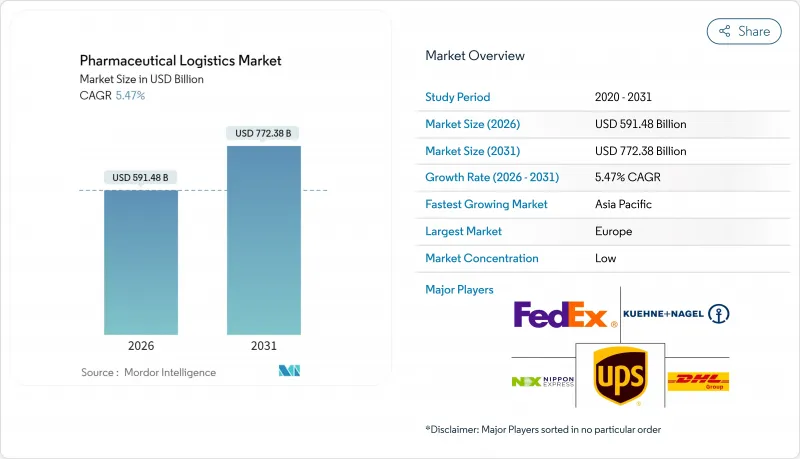
세계의 의약품 물류 시장은 2025년 5,608억 1,000만 달러로 평가되었으며, 2026년 5,914억 8,000만 달러에서 2031년까지 7,723억 8,000만 달러에 이를 것으로 예측됩니다. 예측 기간 중(2026-2031년) CAGR은 5.47%로 예상됩니다.
견고한 성장은 생물학적 제형의 보급, 엄격한 직렬화 의무 및 정밀한 유통 능력을 필요로 하는 환자 직접 배송 모델로의 전환에 기인합니다. 세계 통합사업자들의 강력한 설비투자, 지속적인 전자 약국의 도입, 온도관리 인프라의 확대는 경쟁을 격화시키고 있는 한편, 엔드 투 엔드에서 컴플라이언스를 준수하는 공급망 솔루션에 대한 잠재적인 수요를 확대하고 있습니다. 기술 도입, 특히 IoT 센서, 블록체인에 의한 추적성, AI 구동 네트워크 최적화는 이해관계자가 온도 편차와 위조 위험을 방지하기 위해 가속화되고 있습니다. 동시에 배출량 저감을 위한 지속가능성에 대한 노력은 운송수단을 복합수송과 해상수송으로 전환시켜 전문 서비스 제공업체에게 새로운 틈새 시장을 개척하고 있습니다. 콜드체인의 에너지 비용과 여러 관할 구역에 걸친 컴플라이언스와 관련된 가격 압력은 여전히 역풍이지만, 저탄소 포장, 지역별 재고 관리, 대체 연료에 대한 투자를 촉진하고 결국 의약품 물류 시장의 확대로 이어지고 있습니다.
현재 소비자의 거의 절반이 의약품의 온라인 주문을 선호하고 있으며, 운송업자에게는 온도 관리가 중요한 제품을 위해 2-8℃의 환경을 보장하는 문앞 배송 네트워크의 구축이 요구되고 있습니다. 아시아태평양 공급자는 디지털 결제와 원격 의료 플랫폼을 활용하여 상온 및 냉장 소포 서비스의 확대를 도모하고 있습니다. 반면 미국의 통합 사업자는 IoT 지원 포장 솔루션을 통해 라스트 마일 가시성을 높이고 있습니다. 규제 당국은 이에 대응해, 직렬화와 추적 관리를 단품 레벨까지 확대하빈다. 컴플라이언스 장애물은 높아지는 반면 실시간 온도 및 위치 데이터를 제공하는 사업자의 차별화도 진행되고 있습니다. 전자 약국의 취급량이 증가하는 가운데, 마이크로풀필먼트 허브를 향한 네트워크 재설계에 의해 리드 타임이 단축되어, 복약 준수율이 향상되고 의약품 물류 시장 전체에서 수요 증가를 추진하고 있습니다.
OTC 의약품은 처방약에 비해 취급 규칙이 덜 엄격하기 때문에 통합형 유통업체의 보관 비용 절감으로 이어지는 혼합 수송 루트가 가능해집니다. 그러나 당뇨병과 심혈관 질환의 유병률 상승으로 지속적인 보충 사이클이 요구되고 시간 엄수 재고의 처리 능력 요건이 강화되고 있습니다. 물류 파트너는 로봇에 의한 피킹 및 패킹이나 스마트 블리스터 포장 등의 자동화 기술을 활용해 OTC 의약품과 만성 질환 치료제을 통합 플로우로 조합함으로써 체류 시간을 삭감하고 있습니다. 하이브리드 모델은 의약품 물류 시장에서 자산 활용률을 높이고 수익성을 유지하는 동시에 약국과 클리닉에 대한 서비스 품질을 향상시킵니다.
콜드체인 장애는 의약품 제조업체에 연간 350억 달러의 손실을 초래합니다. 이것은 폐기 처리, 재포장, 벌칙 첨부 배송 등을 반영한 금액입니다. 상변화물질를 이용한 패시브 포장은 보호 시간을 96시간까지 연장 가능하지만, 소포당의 비용을 크게 증가시키는 경우가 많아, 자금이 한정되는 신흥 시장용 프로그램에 부담을 가하고 있습니다. 중복 감시 장비와 자격을 갖춘 직원의 필요성은 간접비를 증가시키고 의약품 물류 시장에서 중소 운송업체의 이익률을 제한합니다. 저탄소 냉매와 재사용 가능한 토트백의 혁신은 운송 비용 절감을 목표로 하지만 초기 투자액이 장벽이 되고 광범위한 도입은 여전히 제약을 받고 있습니다.
운송 부문은 2025년 수익의 51.40%를 차지했으며 물리적 이동이 의약품 물류 시장의 핵심임을 보여줍니다. 도로화물 운송은 지역 간 유통, 특히 유럽과 북미를 연결하는 흐름을 담당하고, 항공화물 운송은 익일 배송 보증에 의한 장거리 바이오 의약품 보충을 지원합니다. 해운 루트는 배출량 감축을 위해 GDP에 준거한 냉장 컨테이너를 활용하는 화주가 지속 가능한 선택을 추구하는 중 중요성을 늘리고 있습니다.
부가가치 서비스는 CAGR 4.42%로 확대되고 있으며, 라벨 부착, 2차 포장, 주문 키트화, 직렬화 컨설팅 등이 포함되어 제조업체의 비중핵 업무 부담을 경감합니다. 수요가 가장 빠르게 성장하고 있는 것은 아시아태평양이며, 계약 제조 업체는 다국어 규제 인쇄를 처리할 수 있는 단일 소스 파트너를 찾고 있습니다. 데이터 무결성에 대한 규제가 강화됨에 따라 인증된 재라벨 부착 및 변조 방지 포장은 옵션 추가 서비스에서 조달 전제조건으로 변화하여 의약품 물류 시장 전반에 걸친 이익률 향상을 촉진하고 있습니다.
유럽은 2025년에도 31.70%의 수익 점유율을 유지했습니다. 이것은 조화로운 GDP 시행, 조밀한 도로망, 독일, 스위스, 아일랜드의 대규모 제조 클러스터에 의해 지원되었습니다. 국경을 넘은 철도 및 항공 회랑에 대한 투자는 리드 타임을 손상시키지 않고 배출량을 삭감하는 모달 시프트를 지원하고 있습니다. 유럽의 의약품 물류 시장 규모는 Cold Chain Technologies의 네덜란드 신허브 등 지속적인 용량 증강의 혜택을 받고 있으며, 이로써 지역의 PCM 생산이 강화되어 운송 리스크가 저감됩니다.
북미는 DSCSA(의약품안전공급법)에 근거한 시리얼화 시스템의 성숙도와 팬데믹 대책에 지속적인 공적 자금 투입에 의해 계속해서 주요 시장으로서의 지위를 유지하고 있습니다. DHL은 20억 유로(20억 8,000만 달러) 계획의 50%를 미국/캐나다 시설에 배분하고 서비스 수준을 유지하면서 배출량을 억제하는 태양광 발전 창고와 LNG 트럭을 도입했습니다. FedEx의 4억 4,000만 달러 규모 의료 유통 센터 확장과 함께 이 지역은 데이터 가시성과 지속가능성에 대한 모범 사례를 재정의하고 있습니다.
아시아태평양은 중국과 인도의 생산 증가, 보험 적용 범위 확대, 전자 약국의 보급에 힘입어 2026년부터 2031년까지 5.02%의 연평균 복합 성장률(CAGR)로 가장 빠른 성장이 전망되고 있습니다. 인도는 2025년 GDP 준수 창고 시설에 세금 환급을 하는 등 각국 정부는 콜드체인 업그레이드를 장려하고 있습니다. 지역 운송업체는 중국과 유럽을 연결하는 회랑을 따라 철도, 트럭, 해상 및 항공의 복합 운송 솔루션을 도입하여 비용 절감과 운송 중 배출 가스를 줄이기 위해 노력하고 있습니다. 중동 및 아프리카는 인프라 정비가 늦었지만 걸프 협력 회의(GCC)의 현지화 프로그램이 창고 투자를 자극하고 미래의 의약품 물류 시장 확대를 확보하고 있습니다.
The Pharmaceutical Logistics Market was valued at USD 560.81 billion in 2025 and estimated to grow from USD 591.48 billion in 2026 to reach USD 772.38 billion by 2031, at a CAGR of 5.47% during the forecast period (2026-2031).
Robust growth stems from biologics proliferation, rigorous serialization mandates, and the pivot toward direct-to-patient delivery models that require precision distribution capacities. Strong capital spending by global integrators, sustained e-pharmacy adoption, and expanding temperature-controlled infrastructure continue to intensify competition while enlarging addressable demand for end-to-end, compliant supply-chain solutions. Technology deployment-particularly IoT sensors, blockchain traceability, and AI-driven network optimization-has accelerated as stakeholders guard against temperature excursions and counterfeit risk. At the same time, sustainability commitments are redirecting capacity toward intermodal and ocean transportation to curb emissions, opening new service niches for specialty providers. Price pressures linked to cold-chain energy costs and multi-jurisdictional compliance remain headwinds, yet they also spur investment in low-carbon packaging, regionalized inventories, and alternative fuels that ultimately expand the pharmaceutical logistics market.
Nearly half of consumers now prefer ordering medicines online, compelling carriers to engineer door-step delivery networks that secure 2 °C-8 °C conditions for sensitive products. Providers in Asia-Pacific leverage digital payments and telehealth platforms to scale ambient and refrigerated parcel services, while U.S. integrators enhance last-mile visibility through IoT-enabled pack-out solutions. Regulators have responded by extending serialization and track-and-trace to the single-unit level, raising compliance hurdles but also differentiating operators that offer real-time temperature and location data. As e-pharmacy volumes climb, network redesign toward micro-fulfillment hubs tightens lead-times, improving medication adherence and fueling incremental demand across the pharmaceutical logistics market.
OTC formulations carry less-stringent handling rules than prescription drugs, enabling blended transport lanes that cut storage costs for integrated distributors. However, the rising prevalence of diabetes and cardiovascular disease forces continual replenishment cycles that intensify throughput requirements for time-critical inventory. Logistics partners exploit automation, such as robotic pick-and-pack and smart blister packaging, to combine OTC and chronic-care medications within unified flows that reduce dwell time. Hybrid models improve asset utilization and sustain profitability within the pharmaceutical logistics market while enhancing service quality for pharmacies and clinics.
Cold-chain failures cost drug makers an estimated USD 35 billion each year, reflecting write-offs, repackaging, and penalty shipments. Passive packaging with phase-change materials can extend protection to 96 hours but often doubles per-parcel expenses, placing strain on emerging-market programs where funding is scarce. The need for redundant monitoring equipment and qualified staff compounds overhead, limiting profit margins for smaller carriers within the pharmaceutical logistics market. Innovation in low-carbon refrigerants and reusable totes aims to reduce cost per shipment, yet wide deployment remains constrained by initial capital outlay.
Other drivers and restraints analyzed in the detailed report include:
For complete list of drivers and restraints, kindly check the Table Of Contents.
Transportation generated 51.40% of 2025 revenue, illustrating that physical movement remains the backbone of the pharmaceutical logistics market. Road freight captures regional flows, particularly across Europe and North America, while air freight underpins long-haul biologics replenishment with next-day service guarantees. Ocean lanes gain relevance as shippers pursue sustainable options, leveraging GDP-compliant reefer containers to curb emissions.
Value-added services, growing at a 4.42% CAGR, include labeling, secondary packaging, order kitting, and serialization consulting that relieve manufacturers of non-core tasks. Demand rises fastest in Asia-Pacific, where contract manufacturers seek single-source partners to handle regulatory printing in multiple languages. As data integrity rules tighten, certified relabeling and tamper-evident pack-outs transform from optional extras into procurement prerequisites, driving incremental margin across the pharmaceutical logistics market.
The Pharmaceutical Logistics Market Report is Segmented by Service Type (Transportation, Warehousing & Storage, and Value-Added Services & Others), Mode of Operation (Cold-Chain Logistics and Non-Cold-Chain Logistics), Product Type (Prescription Drugs, OTC Drugs, Biologics & Biosimilars, and More), Geography (North America, South America, Europe, Asia-Pacific, and, More). The Market Forecasts are Provided in Terms of Value (USD).
Europe maintained a 31.70% revenue share in 2025, underpinned by harmonized GDP enforcement, dense road networks, and large-scale manufacturing clusters in Germany, Switzerland, and Ireland. Investment in cross-border rail-air corridors supports modal shifts that lower emissions without compromising lead times. The pharmaceutical logistics market size in Europe benefits from continual capacity additions such as Cold Chain Technologies' new Netherlands hub, which augments regional PCM production and reduces transit risk.
North America remains a powerhouse thanks to DSCSA-driven serialization maturity and sustained public-sector funding for pandemic preparedness. DHL allocated 50% of its EUR 2 billion (USD 2.08 billion) plan to U.S. and Canadian facilities, integrating solar-powered warehouses and LNG trucks that curb emissions while preserving service standards. Combined with FedEx's USD 440 million expansion of healthcare distribution centers, the region continues to redefine best practices around data visibility and sustainability.
Asia-Pacific is expected to post the fastest growth at 5.02% CAGR from 2026 to 2031, buoyed by increased production out of China and India, widening insurance coverage, and e-pharmacy proliferation. Governments incentivize cold-chain upgrades, as evidenced by India's 2025 tax rebates on GDP-compliant warehousing equipment. Regional carriers deploy rail-truck sea-air solutions along the China-Europe corridor, trimming cost and cutting transit emissions. Middle East & Africa trail in infrastructure, yet Gulf Cooperation Council localization programs spur warehouse investment, securing future pharmaceutical logistics market expansion.