은행 업무용 빅데이터 분석 : 시장 점유율 분석, 업계 동향, 성장 예측(2025-2030년)
Big Data Analytics In Banking - Market Share Analysis, Industry Trends & Statistics, Growth Forecasts (2025 - 2030)
상품코드:1640506
리서치사:Mordor Intelligence
발행일:2025년 01월
페이지 정보:영문
라이선스 & 가격 (부가세 별도)
ㅁ Add-on 가능: 고객의 요청에 따라 일정한 범위 내에서 Customization이 가능합니다. 자세한 사항은 문의해 주시기 바랍니다.
ㅁ 보고서에 따라 최신 정보로 업데이트하여 보내드립니다. 배송기일은 문의해 주시기 바랍니다.
한글목차
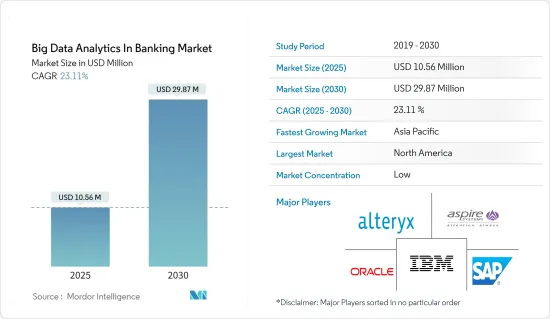
은행 업무용 빅데이터 분석 시장 규모는 2025년에 1,056만 달러로 추정되며, 예측 기간(2025-2030년)의 CAGR은 23.11%로, 2030년에는 2,987만 달러에 달할 것으로 예측됩니다.
투자 패턴, 쇼핑 동향, 투자 동기, 개인적 또는 경제적 배경 등 수많은 인사이트에서 얻은 정보를 바탕으로 빅데이터 분석은 은행이 고객의 행동을 이해하는 데 도움을 줍니다.
주요 하이라이트
증가하는 데이터 생성량과 정부의 요구 사항은 은행 부문에서 빅데이터 분석을 채택하는 주요 원동력이 되었습니다. 기술 개발로 소비자가 거래용으로 사용하는 장치(스마트폰 등)가 늘어나 거래량에 영향을 미치고 있습니다. 현재의 데이터 증가율을 감안할 때 더 나은 데이터 수집, 정리, 통합 및 분석 능력이 필요합니다.
정부 규제와 상당한 규모의 데이터 수집량이 은행 업계에 영향을 미치고 있습니다. 기술이 개발됨에 따라 더 많은 소비자가 더 많은 기기(스마트폰 등)를 사용하여 거래를 할 수 있게 되어 거래량이 증가하고 있습니다. 이것이 빅데이터 분석의 동기부여가 되었으며 데이터 애널리스트는 모든 데이터 포인트를 한 곳에서 확인해, 신속하게 찾아낼 수가 있습니다. 이러한 통합 솔루션 덕분에 팀 구성원은 은행 업계를 강화할 수 있는 인사이트를 교환할 수 있습니다.
빅데이터 분석 솔루션은 새로운 비즈니스 인사이트를 발굴하는 데 필요한 처리 능력, 지속성 및 분석 능력을 제공하는 동시에 기업이 모든 데이터를 유연하고 저렴한 환경에 저장할 수 있도록 합니다. 빅데이터 분석 툴은 구조화된 데이터와 비정형화된 데이터를 수집하고 추적하며 다양한 소스에서 엄청난 양의 다양한 데이터를 정리하는 기술을 제공합니다.
레거시 시스템의 대부분은 증가하는 부하를 수용할 수 없으며 오래된 인프라를 활용하여 필요한 양의 데이터를 수집, 저장 및 분석하면 전체 시스템의 안정성이 저하될 수 있습니다. 조직은 이 문제를 해결하기 위해 처리 능력을 향상시키거나 시스템을 완전히 재설계해야 합니다.
은행 업무용 빅데이터 분석 시장 동향
은행 전체의 리스크 관리와 내부 통제가 성장을 견인
최첨단 기술을 활용함으로써 은행은 신용 위험을 줄이고 다양한 위험 기준에 따라 보다 적절한 의사 결정을 내릴 수 있습니다. 빅데이터 및 분석 플랫폼 덕분에 은행은 신용 위험을 통제하고 채무 불이행 상황을 피할 수 있습니다.
게다가, 소매 은행은 신용 리스크 관리에 빅데이터 분석을 빠르게 도입하고 있습니다. 지급 거래에서 행동 패턴을 기반으로 하는 신용 위험 지표를 적용하면 초과 인출 계좌 및 미납 등을 바탕으로 기존 지표보다 훨씬 빨리 신용 사건을 발견할 수 있음이 입증되었습니다.
데이터 및 분석 도구를 사용한 실시간 사기 감지는 채무자의 면밀한 모니터링과 채무 불이행을 예측할 수 있는 능력을 제공하여 신용 및 유동성 위험을 줄이는 데 도움이 됩니다.
Bank of America가 입증한 바와 같이, 빅데이터는 위험한 계좌를 식별하는 데 사용할 수 있습니다. 950만 건의 주택 대출에 대해 Corporate Investment Group은 부채 불이행 가능성을 계산할 책임이 있으며, Bank of America는 대출 부채 불이행으로 인한 손실을 예측하는 데 도움이 되었으며 채무 불이행 계산에 필요한 시간을 96시간에서 4시간으로 단축함으로써 효율을 높일 수 있었습니다.
큰 성장이 기대되는 유럽
금융기관이 고객의 개인 정보를 교환하고 보호하는 방법을 규정하는 가장 유명한 규정은 EU의 일반 데이터 보호 규정입니다.
게다가 유럽연합(EU)에 의한 결제 서비스 지침 2(PSD2)의 결과, 공개 애플리케이션 프로그래밍 인터페이스(API)를 통해 데이터 교환이 가능하게 되었습니다. 데이터를 자유롭게 공유할 수 있는 환경이 갖추어지면서 데이터를 수집, 취급, 분석하는 능력의 중요성이 증가하고 있습니다.
또한 고객 수와 규제 개정 모두 증가할 것으로 예상되며 그 결과 고객 분석과 인텔리전스 기술에 대한 수요가 높아질 것입니다.
영국에 기반을 둔 Lloyds Banking Group은 다양한 고객 카테고리의 요구를 충족하는 동시에 목표 부문의 성장을 최적화하기 위해 데이터 분석을 채택했습니다.
유럽의 소매 은행은 전통적인 금융 기관이 수십년동안 직면해 온 문제를 해결하는 '오픈 뱅킹' 동향을 통해 빅데이터 분석 솔루션을 활용합니다.
은행 업무용 빅데이터 분석
은행 업계의 빅데이터 분석 시장은 부정 감지 및 관리, 고객 분석, 소셜 미디어 분석 등 다양한 용도의 은행용 빅데이터 분석 솔루션을 제공하는 수많은 세계 기업이 존재하기 때문에 상당히 세분화되어 있습니다. Oracle Corporation, IBM Corporation, SAP SE 등이 주요 시장 진출기업입니다.
2023년 2월 - Alteryx는 Alteryx Inc의 클라우드 기반 분석 도구에 신규 셀프 서비스 및 엔터프라이즈급 기능을 추가하여 정보를 기반으로 의사 결정을 보다 신속하게 지원할 것이라고 발표했습니다. Designer Cloud에 대한 전체 액세스가 포함된 이 플랫폼은 데이터 거버넌스 및 보안 표준을 손상시키지 않고 모든 기술 수준의 직원이 친숙하고 사용하기 쉬운 드래그 앤 드롭 인터페이스를 활용할 수 있도록 개선되었습니다.
2022년 8월 - Aspira Systems는 구현을 가속화하는 전반적인 접근법을 발표했습니다. 이번 혁신은 AI를 탑재하여 구현 속도를 향상시킵니다. 새로 개발된 자율 애플리케이션 구현 기술을 통해 Aspira Systems는 기업이 Oracle Cloud ERP 애플리케이션 구현에서 최대한의 가치를 얻을 수 있도록 지원합니다.
기타 혜택
엑셀 형식 시장 예측(ME) 시트
3개월간 애널리스트 지원
목차
제1장 서론
조사의 전제조건과 시장 정의
조사 범위
제2장 조사 방법
제3장 주요 요약
제4장 시장 인사이트
시장 개요
업계의 매력도 - Porter's Five Forces 분석
신규 진입업자의 위협
구매자/소비자의 협상력
공급기업의 협상력
대체품의 위협
경쟁 기업간 경쟁 관계
업계 밸류체인 분석
시장에 대한 COVID-19의 영향
제5장 시장 역학
촉진요인
정부의 이니셔티브
은행 전체의 리스크 관리와 내부 통제가 성장을 견인
은행이 생성하는 데이터량 증가
시장의 과제
데이터 프라이버시와 보안 부족
제6장 관련 사례와 이용 사례
제7장 시장 세분화
솔루션 유형별
데이터 디스커버리 및 시각화(DDV)
고급분석기법(AA)
지역별
북미
유럽
아시아
호주 및 뉴질랜드
라틴아메리카
중동 및 아프리카
제8장 경쟁 구도
기업 프로파일
IBM Corporation
SAP SE
Oracle Corporation
Aspire Systems Inc.
Adobe Systems Incorporated
Alteryx Inc.
Microstrategy Inc.
Mayato GmbH
Mastercard Inc.
ThetaRay Ltd
제9장 투자 분석
제10장 시장의 미래
CSM
영문 목차
영문목차
The Big Data Analytics In Banking Market size is estimated at USD 10.56 million in 2025, and is expected to reach USD 29.87 million by 2030, at a CAGR of 23.11% during the forecast period (2025-2030).
Based on the inputs obtained from numerous insights, such as investment patterns, shopping trends, investment motivation, and personal or financial background, big data analytics can help banks understand client behavior.
Key Highlights
The considerable increase in the volume of data generated and governmental requirements are the main forces behind adopting Big Data analytics in the banking sector. With the development of technology, consumers are using more and more devices to start transactions (such as smartphones), which impacts the volume of transactions. Given the current data growth rate, better data collection, organization, integration, and analysis are necessary.
Government rules and considerable data gathering are affecting the banking industry. As technology develops, more consumers are using more devices to start transactions (such as smartphones), which boosts the volume of transactions. This motivates big data analytics, which gives data analysts a single location to see and quickly locate all data points. Thanks to this consolidated picture, team members can exchange insights that could enhance the banking industry.
A Big Data Analytics solution offers the processing, persistence, and analytic capabilities necessary to unearth fresh business insights while enabling a company to store all its data in a flexible, affordable environment. An analytics tool for big data gathers and keeps track of structured and unstructured data and techniques for arranging enormous amounts of wildly different data from various sources.
The majority of legacy systems are unable to handle the rising burden. The entire system's stability may be compromised if the necessary amounts of data are gathered, stored, and analyzed utilizing an obsolete infrastructure. Organizations must either improve their processing capacity or entirely redesign their systems to tackle the issue.
Big Data Analytics in Banking Market Trends
Risk Management and Internal Controls Across the Bank to Witness the Growth
With the use of cutting-edge technologies, banks can reduce credit risk and make better decisions based on a variety of risk criteria. Banks can control credit risk and avert default circumstances thanks to the big data and analytics platform.
Additionally, a blatant indicator is the retail bank's use of Big Data analytics for credit risk management. It has been demonstrated that applying credit risk indicators based on behavioral patterns in payment transactions allows for the detection of credit events much sooner than conventional indicators based on overdrawn accounts and late payments.
Real-time fraud detection using data and analytics tools helps reduce credit and liquidity risk by enabling close monitoring of debtors and the ability to foresee loan default.
Big data can be used to identify high-risk accounts, as demonstrated by The Bank of America. For 9.5 million mortgages, the Corporate Investment Group is responsible for calculating the likelihood of default, which helped Bank of America forecast losses from loan defaults. By cutting the time needed to calculate loan defaults from 96 to 4 hours, the bank was able to increase its efficiency.
Europe to Expected to Witness Significant Growth
The most well-known rule governing how financial organizations exchange and safeguard customers' private information continues to be the General Data Protection Rule of the European Union.
Moreover, data exchange was made possible through open application programming interfaces (APIs) as a result of the Payment Services Directive (PSD2) by the European Union. Due to an environment where data can be shared freely, the capacity to collect, handle, and analyze data has grown in importance.
Additionally, it is anticipated that both the number of customers and regulatory revisions will rise shortly. The demand for customer analytics and intelligence technologies should consequently increase.
The UK-based Lloyds Banking Group employed data analytics to meet the needs of diverse client categories while optimizing growth in targeted segments.
European retail banks are using Big Data analytics solutions due to the "open banking" trend, which addresses problems that traditional financial institutions have faced for decades.
Big Data Analytics in Banking Industry Overview
Big Data Analytics In Banking Market is quite fragmented due to the existence of numerous global firms that provide a range of big data analytics solutions for banks for diverse applications, such as fraud detection and management, customer analytics, social media analytics, etc. Oracle Corporation, IBM Corporation, and SAP SE are some of the major market participants.
February 2023 - Alteryx announced new self-service and enterprise-grade capabilities to its Alteryx Inc cloud-based analytics tool to support clients in making quicker and more informed decisions. With full access to Designer Cloud now included, the platform has been improved to provide employees of all skill levels with an approachable, simple-to-use drag-and-drop interface without compromising data governance or security standards.
August 2022 - Aspire Systems launches the holistic approach to accelerate implementation. This innovation is powered by AI and drives implementation speeds. With this new autonomous application implementation methodology, Aspire Systems is geared to help businesses derive maximum value out of their Oracle Cloud ERP Application implementation.
Additional Benefits:
The market estimate (ME) sheet in Excel format
3 months of analyst support
TABLE OF CONTENTS
1 INTRODUCTION
1.1 Study Assumptions & Market Definition
1.2 Scope of the Study
2 RESEARCH METHODOLOGY
3 EXECUTIVE SUMMARY
4 MARKET INSIGHTS
4.1 Market Overview
4.2 Industry Attractiveness - Porter's Five Force Analysis
4.2.1 Threat of New Entrants
4.2.2 Bargaining Power of Buyers/Consumers
4.2.3 Bargaining Power of Suppliers
4.2.4 Threat of Substitute Products
4.2.5 Intensity of Competitive Rivalry
4.3 Industry Value Chain Analysis
4.4 Impact of COVID-19 on the Market
5 MARKET DYNAMICS
5.1 Market Drivers
5.1.1 Enforcement of Government Initiatives
5.1.2 Risk Management and Internal Controls Across the Bank to Witness the Growth
5.1.3 Increasing Volume of Data Generated by Banks