비상용 발전기 시장 : 점유율 분석, 산업 동향 및 통계, 성장 예측(2025-2030년)
Emergency Power Generators - Market Share Analysis, Industry Trends & Statistics, Growth Forecasts (2025 - 2030)
상품코드:1636497
리서치사:Mordor Intelligence
발행일:2025년 01월
페이지 정보:영문
라이선스 & 가격 (부가세 별도)
ㅁ Add-on 가능: 고객의 요청에 따라 일정한 범위 내에서 Customization이 가능합니다. 자세한 사항은 문의해 주시기 바랍니다.
ㅁ 보고서에 따라 최신 정보로 업데이트하여 보내드립니다. 배송기일은 문의해 주시기 바랍니다.
한글목차
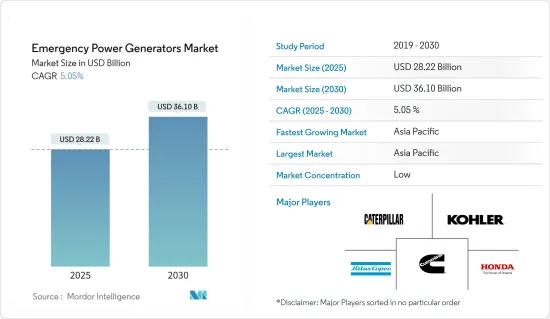
비상용 발전기 시장 규모는 2025년 282억 2,000만 달러, 2030년 361억 달러로 추정되며, 예측기간(2025-2030년)중 CAGR은 5.05%에 달할 것으로 예측됩니다.
주요 하이라이트
중기적으로는 헬스케어와 건설 부문 수요 증가가 향후 시장을 견인할 것으로 보입니다.
그러나 분산형 신재생에너지 발전기술에 대한 투자 증가는 시장 조사에 부정적인 영향을 미칠 것으로 예상됩니다.
최근 발전기 기술의 발전은 소음 감소, 배출 가스 제어, 출력 및 효율 향상에 중점을 둡니다. 또한 천연가스와 디젤 모두에서 운전할 수 있는 듀얼 연료 발전기에 대한 관심도 높아지고 있습니다. 발전기의 이러한 기술적 진보는 향후 수년간 시장 성장을 뒷받침할 것으로 예상됩니다.
아시아태평양은 중국과 인도와 같은 국가에서 수요가 급증함에 힘입어 예측 기간 동안 시장을 선도하게 됩니다.
비상용 발전기 시장 동향
75kVA 미만이 큰 성장을 이룰 가능성이 높다
75kVA 미만의 비상 발전기는 주택, 소규모 상업시설, 경공업 용도에 안정적인 백업 전력을 제공하도록 설계된 컴팩트하고 다재다능한 기계입니다. 이러한 발전기는 전력 수요가 적당한 소규모 업무에 이상적이며 정전 시 중요한 시스템을 가동하기 위한 효율적인 솔루션을 제공합니다.
전력 인프라의 노후화, 이상 기후, 전력 수요의 증대에 의해 선진 지역에서도 개발 도상 지역에서도 정전이 빈발하고 있습니다. 그 결과 주택 사용자와 중소기업 모두 75kVA 미만의 발전기에 의존하는 경우가 많아지고 있습니다. 이 시프트는 정전 중에도 전력을 유지하고 냉장, 난방, 조명, 통신 등 필수적인 서비스를 지킬 수 있습니다.
세계 인구가 증가함에 따라 전력 수요도 증가하고 있습니다. 2021년에서 2023년 사이에 세계 전력 소비는 28,169 TWh에서 29,470 TWh로 증가합니다. 아시아태평양, 아프리카, 라틴아메리카 등 급속한 도시화와 전기화가 진행되는 지역에서는 백업 전원 솔루션에 대한 수요가 높아지고 있습니다. 이 지역의 많은 도시와 농촌 지역에서는 신뢰할 수 없는 송전망에 접근하기가 어려우며 가정과 중소기업의 안정적인 전력을 확보하기 위한 컴팩트하고 비용 효율적인 발전기에 대한 요구가 증가하고 있습니다.
2023년 12월 남동부의 중요한 산업 기지인 울산은 현저한 정전에 휩쓸렸습니다. 변전소의 고장으로 인해 약 15만 5,000가구가 약 2시간에 걸쳐 정전의 영향 아래에 남아 있었습니다. 이 사고는 서울광역권에서 약 20만 가구가 정전의 영향을 받은 2017년 이후 한국에서 가장 큰 정전으로 두드러지고 있습니다. 이러한 사건은 비상 백업 발전기의 필요성이 증가하고 있음을 강조합니다.
전 세계적으로 주택 프로젝트가 크게 증가하고 있습니다. 이 동향은 가까운 미래에 백업 발전기 수요를 견인하게 될 것으로 보입니다. 예를 들어, 터키 건설 회사 Karmod는 2024년 7월 콩고, 감비아, 탄자니아에서 새로운 주택 프로젝트를 시작할 예정입니다. 이러한 주택 프로젝트의 가속화로 향후 몇 년동안 건설 기계에 전력을 공급하는 비상 백업 발전기 수요가 높아질 것으로 예상됩니다.
요약하면 정전으로 이어지는 전력 수요 증가는 주택 건설 프로젝트 증가와 함께 향후 몇 년동안 발전기 부문에 이익을 줄 것으로 예상됩니다.
아시아태평양이 시장을 독점
중국의 급속한 산업화와 도시의 성장은 송전망을 피폐시키고 정전의 빈발로 이어지고 있습니다. 이러한 정전은 큰 불편과 경제적 영향을 초래합니다. 이에 따라 백업 발전기 수요가 급증하고 있습니다.
중국의 백업 발전기 시장을 형성하는 것은 다양한 요인입니다. 세계의 제조업의 허브로서 중국의 산업 부문은 주요 소비자로서 두드러집니다. 백업 발전기는 상업용 건물, 공장, 통신 타워 및 데이터센터에 안정적인 전원 공급을 유지하는 데 필수적입니다.
중국의 백업 발전기 시장에서 정부 정책은 매우 중요한 역할을 합니다. 중국의 급속한 도시화와 산업 확대가 전력 수요를 끌어올리고 있습니다. 이에 대응하기 위해 정부는 인프라, 특히 송전망에 많은 투자를 해왔습니다. 그러나 이러한 송전망은 특히 농촌지역이나 피크시에는 고전을 겪고 있으며 백업 발전기에 대한 지속적인 수요를 확보하고 있습니다.
반면 인도의 호경기와 인프라 성장은 발전 능력을 능가하고 있습니다. 이 불균형으로 인해 특히 농촌과 교외에서 정전이 빈발합니다.
인도의 백업용 발전기 시장은 여러 요인들에 힘입어 성장하고 있습니다. 주요 요인은 수요가 공급을 초과하여 정전이 증가하는 것입니다. 2024년 6월에는 과부하로 인해 북부와 동부의 송전망이 붕괴되어 6억 2,000만 명이 13시간에 걸쳐 정전을 겪었습니다.
2023년 5월 설문 조사에서 인도의 전력 과제가 부각되었습니다. 전국적으로 기온이 상승함에 따라 정전이 심화될 위험이 더욱 두드러지고 있습니다. 그 결과 개인과 기업 모두 이러한 잠재적인 혼란으로부터 자신을 보호하기 위해 백업 발전기에 대한 의존도를 높이고 있습니다.
종합하면 양국의 다양한 부문에서 전력 수요가 급증하는 가운데 비상발전기 수요는 향후 수년간 증가할 전망입니다.
비상용 발전기 산업 개요
비상용 발전기 시장은 세분화되어 있습니다. 이 시장에서 사업을 전개하는 주요 기업(순부동)은 Caterpillar Inc, Atlas Copco AB, Cumins Inc, Kohler Company, American Honda Motor Co. Inc. 등이 있습니다.
기타 혜택:
엑셀 형식 시장 예측(ME) 시트
3개월간의 애널리스트 서포트
목차
제1장 서론
조사 범위
시장의 정의
조사의 전제
제2장 주요 요약
제3장 조사 방법
제4장 시장 개요
소개
2029년까지 시장 규모 및 수요 예측(단위: 달러)
최근 동향과 개발
정부의 규제와 정책
시장 역학
성장 촉진요인
헬스케어와 건설 섹터로부터 수요 증가
정전 문제 증가
억제요인
분산형 재생 가능 에너지 발전에 대한 투자 증가
공급망 분석
Porter's Five Forces 분석
공급기업의 협상력
소비자의 협상력
신규 진입업자의 위협
대체품의 위협
경쟁 기업간 경쟁 관계
투자 분석
제5장 시장 세분화
용량별
75KVA 미만
75-350KVA
350KVA 이상
최종 사용자별
주택
상업
산업
연료 유형별
가스
디젤
기타 연료
지역별
북미
미국
캐나다
기타 북미
유럽
독일
영국
프랑스
스페인
러시아
북유럽 국가
이탈리아
터키
기타 유럽
아시아태평양
중국
인도
일본
한국
태국
베트남
말레이시아
인도네시아
기타 아시아태평양
남미
브라질
아르헨티나
콜롬비아
기타 남미
중동 및 아프리카
아랍에미리트(UAE)
사우디아라비아
남아프리카
이집트
카타르
나이지리아
기타 중동 및 아프리카
제6장 경쟁 구도
M&A, 합작사업, 제휴, 협정
주요 기업의 전략
기업 프로파일
Atlas Copco AB
Briggs & Stratton Corporation
Caterpillar Inc.
Wartsila Oyj Abp
Cummins Inc.
Doosan Corporation
Generac Holdings Inc.
American Honda Motor Co., Inc.
Kohler Company
Mitsubishi Heavy Industries Ltd
기타 주요 기업 목록
시장 랭킹/공유(%) 분석
제7장 시장 기회와 앞으로의 동향
휴대용 발전기의 기술 진보
JHS
영문 목차
영문목차
The Emergency Power Generators Market size is estimated at USD 28.22 billion in 2025, and is expected to reach USD 36.10 billion by 2030, at a CAGR of 5.05% during the forecast period (2025-2030).
Key Highlights
In the medium term, increasing demand from the healthcare and construction sectors is likely to drive the market in the upcoming years.
However, increasing investment in distributed renewable energy generation technology is expected to negatively impact the market study.
Recent advancements in generator technology have focused on reducing noise, controlling emissions, and boosting power output and efficiency. Furthermore, there's an increasing focus on dual-fuel gensets that can operate on both natural gas and diesel. These technological strides in generators are anticipated to bolster market growth in the coming years.
Asia-Pacific is set to lead the market during the forecast period, fueled by surging demand in nations like China and India.
Emergency Power Generators Market Trends
Below 75 kVA is Likely to Witness Significant Growth
Emergency power generators with a capacity below 75 kVA are compact, versatile machines designed to provide reliable backup power for residential, small commercial, and light industrial applications. These generators are ideal for smaller-scale operations where the power demand is moderate, offering an efficient solution for keeping essential systems running during power outages.
Aging power infrastructure, extreme weather events, and escalating electricity demand are causing more frequent outages in both developed and developing regions. Consequently, both residential users and small businesses are increasingly relying on generators under 75 kVA. This shift ensures they can maintain power during disruptions, safeguarding essential services like refrigeration, heating, lighting, and communication.
As the global population grows, so does the demand for electricity. Between 2021 and 2023, global electricity consumption rose from 28,169 TWh to 29,470 TWh. Regions like Asia-Pacific, Africa, and Latin America, witnessing rapid urbanization and electrification, are seeing a heightened demand for backup power solutions. Many urban and rural areas in these regions grapple with unreliable grid access, amplifying the need for compact, cost-effective generators to ensure consistent power for homes and small businesses.
In December 2023, Ulsan, a key industrial hub in the southeast, suffered a notable power outage. Around 155,000 households were left in the dark for about two hours due to a malfunctioning substation. This incident stands out as South Korea's most significant power outage since 2017, when a blackout impacted roughly 200,000 households in the greater Seoul area. Such events underscore the growing need for emergency power backup generators.
Globally, there's been a significant uptick in residential projects. This trend is set to drive the demand for backup generators in the near future. For example, in July 2024, Turkish construction firm Karmod plans to launch new housing projects in Congo, Gambia, and Tanzania. The acceleration of these housing projects is anticipated to heighten the demand for emergency backup generators to power construction equipment in the coming years.
In summary, the increasing power demand leading to outages, coupled with a rise in residential construction projects, is poised to benefit the generator segment in the coming years.
Asia Pacific to Dominate the Market
China's rapid industrialization and urban growth have strained its power grid, leading to more frequent power outages. These outages have caused significant inconvenience and economic repercussions. In response, the demand for backup power generators has surged.
Various factors shape China's backup power generator market. As the world's manufacturing hub, China's industrial sector stands out as a primary consumer. Backup generators are essential for commercial buildings, factories, telecommunication towers, and data centers to maintain a consistent power supply.
Government policies play a pivotal role in China's backup power generator market. China's swift urbanization and industrial expansion have driven up electricity demands. In response, the government has heavily invested in infrastructure, especially power grids. Yet, these grids, particularly in rural regions and during peak times, often struggle, ensuring a continuous demand for backup generators.
Meanwhile, India's booming economy and infrastructure growth are outpacing its power generation capacity. This imbalance has led to frequent power outages, especially in rural and suburban regions.
India's backup power generator market is witnessing growth, fueled by several factors. A primary driver is the increase in power cuts, stemming from demand outstripping supply. A significant incident occurred in June 2024, when an overload caused both the northern and eastern grids to collapse, leaving 620 million people in darkness for 13 hours.
A survey from May 2023 highlighted the power challenges in India: 57% of households experienced daily outages of up to two hours, and 37% faced interruptions lasting two to four hours. With rising temperatures across the nation, the risk of intensified power outages becomes more pronounced. As a result, both individuals and businesses are increasingly relying on backup power generators to shield against these potential disruptions.
In summary, as power demand surges across various sectors in both countries, the demand for emergency power generators is poised to rise in the coming years.
Emergency Power Generators Industry Overview
The emergency power generators market is fragmented. Some of the major players operating in the market (in no particular order) include Caterpillar Inc, Atlas Copco AB, Cummins Inc, Kohler Company, and American Honda Motor Co., Inc., among others.
Additional Benefits:
The market estimate (ME) sheet in Excel format
3 months of analyst support
TABLE OF CONTENTS
1 INTRODUCTION
1.1 Scope of the Study
1.2 Market Definition
1.3 Study Assumptions
2 EXECUTIVE SUMMARY
3 RESEARCH METHODOLOGY
4 MARKET OVERVIEW
4.1 Introduction
4.2 Market Size and Demand Forecast in USD, till 2029
4.3 Recent Trends and Developments
4.4 Government Policies and Regulations
4.5 Market Dynamics
4.5.1 Drivers
4.5.1.1 Increasing Demand from the Healthcare and Construction Sectors
4.5.1.2 Increasing Power Cuts Issues
4.5.2 Restraints
4.5.2.1 Increased Investment In Distributed Renewable Energy Generation
4.6 Supply Chain Analysis
4.7 Porter's Five Forces Analysis
4.7.1 Bargaining Power of Suppliers
4.7.2 Bargaining Power of Consumers
4.7.3 Threat of New Entrants
4.7.4 Threat of Substitutes Products and Services
4.7.5 Intensity of Competitive Rivalry
4.8 Investment Analysis
5 MARKET SEGMENTATION
5.1 Capacity
5.1.1 Below 75 KVA
5.1.2 75-350 KVA
5.1.3 Above 350 KVA
5.2 End-user
5.2.1 Residential
5.2.2 Commercial
5.2.3 Industrial
5.3 Fuel Type
5.3.1 Gas
5.3.2 Diesel
5.3.3 Other Fuel Types
5.4 Geography
5.4.1 North America
5.4.1.1 United States
5.4.1.2 Canada
5.4.1.3 Rest of North America
5.4.2 Europe
5.4.2.1 Germany
5.4.2.2 United Kingdom
5.4.2.3 France
5.4.2.4 Spain
5.4.2.5 Russia
5.4.2.6 NORDIC Countries
5.4.2.7 Italy
5.4.2.8 Turkey
5.4.2.9 Rest of Europe
5.4.3 Asia-Pacific
5.4.3.1 China
5.4.3.2 India
5.4.3.3 Japan
5.4.3.4 South Korea
5.4.3.5 Thailand
5.4.3.6 Vietnam
5.4.3.7 Malaysia
5.4.3.8 Indonesia
5.4.3.9 Rest of Asia-Pacific
5.4.4 South America
5.4.4.1 Brazil
5.4.4.2 Argentina
5.4.4.3 Colombia
5.4.4.4 Rest of South America
5.4.5 Middle East and Africa
5.4.5.1 United Arab Emirates
5.4.5.2 Saudi Arabia
5.4.5.3 South Africa
5.4.5.4 Egypt
5.4.5.5 Qatar
5.4.5.6 Nigeria
5.4.5.7 Rest of Middle East and Africa
6 COMPETITIVE LANDSCAPE
6.1 Mergers and Acquisitions, Joint Ventures, Collaborations, and Agreements
6.2 Strategies Adopted by Leading Players
6.3 Company Profiles
6.3.1 Atlas Copco AB
6.3.2 Briggs & Stratton Corporation
6.3.3 Caterpillar Inc.
6.3.4 Wartsila Oyj Abp
6.3.5 Cummins Inc.
6.3.6 Doosan Corporation
6.3.7 Generac Holdings Inc.
6.3.8 American Honda Motor Co., Inc.
6.3.9 Kohler Company
6.3.10 Mitsubishi Heavy Industries Ltd
6.4 List of Other Prominent Companies
6.5 Market Ranking/Share (%) Analysis
7 MARKET OPPORTUNITIES AND FUTURE TRENDS
7.1 Technological Advancement in Portable Generators