유한요소해석 소프트웨어 : 시장 점유율 분석, 산업 동향 및 통계, 성장 예측(2024-2029년)
Finite Element Analysis Software - Market Share Analysis, Industry Trends & Statistics, Growth Forecasts (2024 - 2029)
상품코드:1549890
리서치사:Mordor Intelligence
발행일:2024년 09월
페이지 정보:영문
라이선스 & 가격 (부가세 별도)
ㅁ Add-on 가능: 고객의 요청에 따라 일정한 범위 내에서 Customization이 가능합니다. 자세한 사항은 문의해 주시기 바랍니다.
ㅁ 보고서에 따라 최신 정보로 업데이트하여 보내드립니다. 배송기일은 문의해 주시기 바랍니다.
한글목차
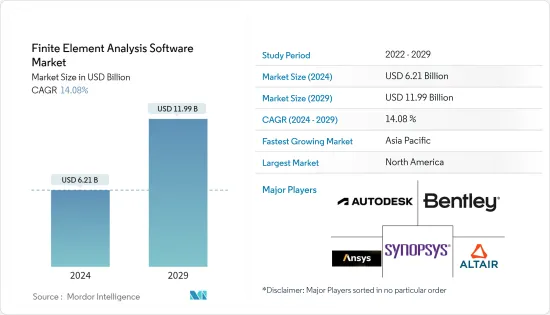
유한요소해석(FEA) 소프트웨어 시장 규모는 2024년 62억 1,000만 달러로 추정되며, 2029년에는 119억 9,000만 달러에 달할 것으로 예상되며, 예측 기간(2024-2029년) 동안 14.08%의 CAGR로 성장할 것으로 예상됩니다.
주요 하이라이트
유한요소해석 소프트웨어 세계 시장 성장은 가상 프로토타이핑의 채택 증가, 최신 자동차의 안전과 편안함에 대한 수요 증가, 그리고 재료와 시간 낭비를 최소화하고 설계 주기를 단축하여 더 높은 품질의 제품을 만들어야 한다는 요구의 증가가 주도하고 있습니다. 이러한 추세는 가볍고 에너지 효율적인 설계에 대한 수요 증가와 제품 설계의 복잡성 증가로 인해 더욱 가속화되고 있습니다.
세계 각국 정부가 규제 기준을 강화하는 가운데, 안전과 신뢰성을 보장하기 위한 시뮬레이션 기술에 대한 수요가 눈에 띄게 증가하고 있어 시장 전망이 밝다는 것을 알 수 있습니다.
클라우드 기반 솔루션으로의 전환과 같은 FEA 소프트웨어 환경의 기술적 발전은 전 세계 산업에서 FEA 소프트웨어의 채택을 더욱 촉진하고 있습니다. 다양한 분야의 기업들이 제품 개발 및 기술 혁신에 대한 접근 방식을 크게 바꾸고 있으며, 이는 시장 성장을 더욱 촉진하고 있습니다. 이러한 채택 증가는 FEA 소프트웨어가 정확도를 높이고 물리적 프로토타입과 관련된 시간과 비용을 절감하는 데 있어 FEA 소프트웨어가 매우 중요한 역할을 하고 있다는 것을 입증합니다.
연료 생산 및 소비 증가와 함께 전기 및 하이브리드 자동차에 대한 수요와 생산이 증가함에 따라 세계 유한요소해석 소프트웨어 시장의 성장을 촉진하고 있습니다. 전기 및 하이브리드 자동차(EHV)는 환경적 이점과 연료 효율성으로 인해 찬사를 받고 있습니다.
그러나 전기 모터, 배터리, 파워트레인에서 발생하는 진동과 소음과 같은 차량 설계 및 성능 관련 문제도 있습니다. 이러한 외란은 차량의 편안함, 안전성, 부품의 수명을 저해할 수 있습니다. 이에 따라 차량과 부품의 동적 거동을 시뮬레이션하고 개선하기 위한 FEA 소프트웨어에 대한 수요가 증가하고 있으며, 이는 시장 성장을 견인하고 있습니다.
FEA 소프트웨어의 복잡한 특성으로 인해 고급 분석을 수행할 수 있는 고도로 숙련된 전문가를 고용해야 합니다. 이러한 전문가를 확보하기 위해서는 상당한 시간과 재정적 자원이 필요하기 때문에 기업들이 FEA 솔루션 도입에 대한 의욕을 떨어뜨릴 수 있습니다. 이 문제는 예산이 한정된 중소기업이나 FEA 교육을 받은 엔지니어가 부족한 국가에서 더욱 두드러지게 나타납니다.
선거, 분극화, 국가 내 및 국가 간 분쟁으로 인한 지정학적 리스크는 세계 경제와 국가 경제에 큰 영향을 미칩니다. 특히 러시아-우크라이나 전쟁, 중동 위기 등 전 세계적인 지정학적 우려가 지속되고 있으며, 이는 세계 유한요소해석 소프트웨어 시장에 지속적인 영향을 미치고 있습니다.
유한요소해석 소프트웨어 시장 동향
자동차 애플리케이션 부문이 큰 시장 점유율을 차지
자동차 부문의 급격한 성장은 조사 대상 시장의 성장을 촉진할 가능성이 높습니다. 예를 들어, 중국 승용차 협회에 따르면 중국의 신에너지 승용차 연간 판매량은 2021년 369만 대에서 2028년 780만 대까지 증가할 것으로 예상됩니다. 독일자동차공업협회(VDA)는 독일이 세계 최대 규모의 자동차 산업을 보유하고 있으며, 2022년 독일 승용차 판매량은 약 265만 대에 달해 2021년 262만 대에서 완만하게 증가할 것으로 예상했습니다. 이러한 판매량 증가는 미세 요소 분석 소프트웨어의 채택을 촉진하고 있습니다.
안전은 자동차 공학에서 최우선 순위로 남아 있으며, 전 세계 규제 기관은 엄격한 규제를 부과하고 있으며, WHO가 2023년 12월에 발표한 보고서에 따르면 매년 약 119만 명이 교통 사고로 인해 사망하고 있습니다. 교통 사고는 대부분의 국가에서 국내 총생산의 3%를 희생시키고 있습니다.
따라서 이러한 교통 사고를 방지하기 위해 자동차 회사는 FEA 소프트웨어를 사용하고 있으며, FEA 소프트웨어는 자동차가 이러한 안전 표준을 충족하는 데 중요한 역할을 합니다. FEA는 충돌 테스트, 충격력 및 기타 안전 관련 시나리오를 시뮬레이션함으로써 엔지니어가 차량 부품의 구조적 무결성을 평가하고 강화할 수 있습니다. 이 가상 테스트는 잠재적인 약점을 식별하고 충돌 안전과 승객 보호를 개선하기 위해 설계를 최적화하는 데 도움이 됩니다.
지속가능한 모빌리티를 위한 여러 정부의 노력과 e-모빌리티 스타트업에 대한 투자 증가는 전기자동차의 수요와 생산을 촉진하고 예측 기간 동안 세계 유한요소해석 소프트웨어 시장의 성장을 뒷받침할 것입니다. 예를 들어, 국제에너지기구(IEA)는 2023년 플러그인 전기자동차(PEV) 판매량을 약 1,370만 대에 달할 것으로 예상하고 있습니다.
결론적으로, 자동차 분야에서 유한요소해석 소프트웨어에 대한 수요 증가는 최신 차량 설계 및 개발 과제를 해결하는 데 있어 유한요소해석 소프트웨어가 점점 더 중요해지고 있음을 반영하며, FEA 소프트웨어는 안전성을 높이고, 성능을 최적화하며, 비용을 절감하는 동시에 제품 개발을 가속화할 수 있는 귀중한 인사이트를 제공합니다. 자동차 산업이 계속 진화하고 새로운 기술을 도입함에 따라, FEA의 혁신과 효율을 촉진하는 역할은 더욱 중요해질 것입니다.
북미가 큰 시장 점유율을 차지할 것으로 예상
미국의 유한요소해석(FEA) 소프트웨어 시장은 기술 발전과 다양한 산업 분야의 수요 증가에 힘입어 강력한 성장세를 보이고 있으며, FEA 소프트웨어는 복잡한 엔지니어링 문제를 시뮬레이션하고 분석하는 데 중요한 역할을 수행하여 설계 및 공정 최적화를 촉진합니다. 설계 및 공정 최적화를 촉진합니다.
확장성, 유연성, 비용 효율성을 제공하는 클라우드 기반 FEA 솔루션의 채택이 증가하고 있습니다. 클라우드 FEA 소프트웨어를 통해 사용자는 비용이 많이 드는 온프레미스 하드웨어에 투자하지 않고도 고부하 시뮬레이션을 실행할 수 있어 중소기업(SME)을 포함한 다양한 기업에서 활용할 수 있습니다.
예를 들어, 2023년 11월 Ansys는 TSMC 및 Microsoft와 협력하여 멀티 다이 3D-IC 시스템의 기계적 응력 분석을 위한 솔루션을 검증했습니다. 이러한 시스템은 3DFabric로 알려진 TSMC의 첨단 패키징 기술을 사용하여 제조됩니다. 이 공동 솔루션은 멀티피직스의 새로운 과제를 해결하는 고객의 신뢰성을 높이고, TSMC의 3DFabric 제품군을 활용한 설계의 기능적 신뢰성을 강화할 수 있습니다. 유한요소해석 소프트웨어의 최고봉인 Ansys Mechanical은 3D-IC의 기계적 응력, 특히 열 구배에 의해 유발되는 응력을 능숙하게 시뮬레이션할 수 있습니다. 또한, 이 솔루션은 Microsoft Azure에서 그 효율성을 입증하여 복잡한 2.5D/3D-IC 시스템의 빠른 처리 시간을 보장합니다.
인공지능(AI)과 머신러닝(ML)을 유한요소해석(FEA) 소프트웨어에 통합하면 복잡한 시뮬레이션을 보다 효율적으로 관리할 수 있습니다. 이러한 발전은 자동화된 메쉬 생성, 최적화 및 예측 분석을 가능하게 하고, FEA 소프트웨어를 강력하고 사용하기 쉽게 만들어줍니다.
캐나다의 유한요소해석(FEA) 소프트웨어 시장은 다양한 분야에서 정교한 엔지니어링 솔루션의 채택이 증가함에 따라 꾸준히 성장하고 있으며, FEA 소프트웨어는 제품 및 시스템의 설계, 시뮬레이션, 분석에 있어 매우 중요한 역할을 하고 있습니다. 엔지니어에게 성능 향상, 비용 절감, 안전성 강화 등의 이점을 제공합니다.
석유 및 가스, 재생에너지 등 캐나다의 에너지 분야에서는 파이프라인, 풍력 터빈, 해상 플랫폼 등 복잡한 구조물의 설계 및 해석에 FEA 소프트웨어가 활용되고 있습니다. 효율적이고 안전한 에너지 생산 및 공급 시스템을 추진하면서 FEA 솔루션의 채택이 확대되고 있습니다. 캐나다는 석유 및 가스 인프라에 많은 투자를 하고 있습니다. 대표적으로 2030년 가동을 목표로 240억 캐나다 달러(약 177억 8,000만 달러)를 투자해 현재 발표 단계에 있는 '캐나다 프로스펄리티 프로젝트'가 있습니다. 이 프로젝트는 총 길이 4,500km에 달하는 캐나다 프로스펄리티 파이프라인의 운영을 감독하게 됩니다.
유한요소해석 소프트웨어 산업 개요
유한요소 해석 소프트웨어 시장은 Ansys Inc, Autodesk Inc, Bentley Systems Inc, Altair Engineering Inc, Synopsys, Inc 등 주요 업체들이 존재하며, 다소 세분화되어 있습니다. 시장 기업들은 제품 라인업을 강화하고 지속가능한 경쟁 우위를 확보하기 위해 파트너십, 인수 등의 전략을 채택하고 있습니다.
2024년 3월 - Dassault Systemes와 Embraer가 이브 에어 모빌리티(Eve Air Mobility)의 전기 수직이착륙기(eVTOL)의 가상 시뮬레이션, 분석 및 테스트에 Dassault Systemes의 시뮬레이션 기술이 중요한 역할을 수행했다고 발표했습니다. 중요한 역할을 수행했다고 발표했습니다.
기타 혜택:
엑셀 형식의 시장 예측(ME) 시트
3개월간의 애널리스트 지원
목차
제1장 소개
조사 가정과 시장 정의
조사 범위
제2장 조사 방법
제3장 주요 요약
제4장 시장 인사이트
시장 개요
기술 현황
산업 밸류체인 분석
업계의 매력 - Porter's Five Forces 분석
공급 기업의 교섭력
구매자의 교섭력
대체품의 위협
경쟁 정도
신규 참여업체의 위협
제5장 시장 역학
시장 성장 촉진요인
전기자동차와 하이브리드 자동차 수요와 생산 증가
연료 생산과 소비 증가
시장 성장 억제요인
복잡하고 시간이 걸리는 프로세스
제6장 시장 세분화
전개별
온프레미스
클라우드
조직 규모별
중소기업(SMEs)
대기업
용도별
건설
전기·전자 제조
항공우주 및 방위
석유 및 가스·에너지
아키텍처와 플래닝
테크놀러지·하드웨어 및 소프트웨어
자동차 산업
기타 용도
지역별
북미
미국
캐나다
유럽
북유럽
독일
영국
프랑스
기타 유럽
아시아
호주 및 뉴질랜드
라틴아메리카
중동 및 아프리카
제7장 경쟁 상황
기업 개요
Ansys Inc.
Autodesk Inc.
Bentley Systems Inc.
Altair Engineering Inc.
Synopsys, Inc.
Siemens AG
PTC Inc.
Dassault Systemes
ESI Group(Keysight Technologies Inc.)
Dlubal Software GmbH
제8장 투자 분석
제9장 시장 기회와 향후 동향
ksm
영문 목차
영문목차
The Finite Element Analysis Software Market size is estimated at USD 6.21 billion in 2024, and is expected to reach USD 11.99 billion by 2029, growing at a CAGR of 14.08% during the forecast period (2024-2029).
Key Highlights
The global finite element analysis software market growth is governed by the increasing adoption of virtual prototyping, the rising demand for safety and comfort in modern automobiles, coupled with the growing need to create higher-quality products in a reduced design cycle, minimizing material and time waste. This trend is further fueled by a rising demand for lightweight, energy-efficient designs and the escalating complexity of product designs.
As governments worldwide tighten regulatory standards, the demand for simulation techniques to ensure safety and reliability has seen a notable uptick, indicating a positive market outlook.
Technological advancements in the FEA software landscape, such as the shift toward cloud-based solutions, are further augmenting the adoption of FEA software across industries worldwide. Businesses across diverse sectors are increasingly making substantial shifts in their approach to product development and innovation, further propelling market growth. This heightened adoption underscores the pivotal role of FEA software in boosting precision and simultaneously reducing the time and costs associated with physical prototypes.
The rising demand and production of electric and hybrid vehicles, coupled with an increase in fuel production and consumption, drives the growth of the global finite element analysis software market. Electric and hybrid vehicles (EHVs) are lauded for their environmental benefits and fuel efficiency.
However, they also introduce vehicle design and performance challenges, such as the vibration and noise generated by the electric motor, battery, and powertrain. Such disturbances can compromise the vehicle's comfort, safety, and the longevity of its components. In response, the demand for FEA software to simulate and refine the dynamic behavior of both the vehicle and its parts is growing, driving the growth of the market.
The intricate nature of FEA software necessitates recruiting highly skilled professionals capable of conducting advanced analyses. Such recruitment demands a considerable investment of time and financial resources, potentially dissuading companies from embracing FEA solutions. This challenge is pronounced for smaller firms with limited budgets and countries lacking a robust pool of FEA-trained engineers.
Geopolitical risks from elections, polarization, and conflicts within and between states significantly impact both global and national economies. The ongoing geopolitical concerns worldwide, notably the Russia-Ukraine War and Middle-East crisis, have a lasting impact on the global finite element analysis software market.
The surge in the automotive sector is likely to boost the growth of the market studied. For instance, according to the China Passenger Car Association, annual sales of new energy passenger vehicles in China are projected to rise from 3.69 million units in 2021 to 7.8 million units by 2028. The German Association of the Automotive Industry (VDA) highlights that Germany boasts one of the world's largest automobile industries. In 2022, Germany's passenger car sales reached approximately 2.65 million units, marking a modest increase from 2.62 million units in 2021. Such growth in sales drives the adoption of fine element analysis software.
Safety remains a top priority in automotive engineering, with stringent regulations imposed by regulatory bodies worldwide. According to the report published by WHO in December 2023, approximately 1.19 million people die each year because of road traffic crashes. Road traffic crashes cost most countries 3% of their gross domestic product.
Hence, to prevent such road accidents, automotive companies use FEA software, which plays a crucial role in ensuring that vehicles meet these safety standards. By simulating crash tests, impact forces, and other safety-related scenarios, FEA enables engineers to evaluate and enhance the structural integrity of vehicle components. This virtual testing helps identify potential weaknesses and optimize designs to improve crashworthiness and passenger protection.
Several government initiatives towards sustainable mobility coupled with growing investments in e-mobility startups will drive the demand and production of electric vehicles, supporting the growth of the global finite element analysis software market over the forecast period. For instance, the International Energy Association (IEA) estimated that 2023 saw plug-in electric light vehicle (PEV) sales of around 13.7 million units.
In conclusion, the rising demand for finite element analysis software in the automotive sector reflects its growing importance in addressing the challenges of modern vehicle design and development. FEA software provides valuable insights that enhance safety, optimize performance, and accelerate product development while reducing costs. As the automotive industry continues to evolve and embrace new technologies, the role of FEA in driving innovation and efficiency will become even more crucial.
North America is Expected to Hold Significant Market Share
The US finite element analysis (FEA) software market is witnessing robust growth fueled by technological advancements and heightened demand across diverse industries. FEA software plays a crucial role in simulating and analyzing intricate engineering challenges, facilitating the optimization of designs and processes.
There is a growing trend toward the adoption of cloud-based FEA solutions, which provide scalability, flexibility, and cost-effectiveness. With cloud FEA software, users can conduct high-computation simulations without investing in costly on-premises hardware, broadening accessibility to a wider array of companies, including small and medium-sized enterprises (SMEs).
For instance, in November 2023, Ansys, in partnership with TSMC and Microsoft, validated a solution aimed at analyzing mechanical stresses in multi-die 3D-IC systems. These systems are produced using TSMC's advanced packaging technologies, known as 3DFabric. This joint solution enhances customer confidence in tackling new multiphysics challenges, thereby bolstering the functional reliability of designs leveraging TSMC's 3DFabric suite. Ansys Mechanical, the premier finite element analysis software, adeptly simulates mechanical stresses in 3D-ICs, particularly those induced by thermal gradients. Furthermore, this solution has demonstrated its efficiency on Microsoft Azure, ensuring swift turn-around times for intricate 2.5D/3D-IC systems.
Integrating artificial intelligence (AI) and machine learning (ML) with finite element analysis (FEA) software significantly boosts its efficiency in managing intricate simulations. These advancements enable automated mesh generation, optimization, and predictive analytics, rendering FEA software both robust and user-friendly.
In Canada, the market for finite element analysis (FEA) software is witnessing consistent growth, fueled by the rising embrace of sophisticated engineering solutions across diverse sectors. FEA software is pivotal in product and system design, simulation, and analysis, empowering engineers to enhance performance, cut costs, and bolster safety.
Canada's energy sector, encompassing both oil and gas and renewable energy, utilizes FEA software to design and analyze intricate structures, including pipelines, wind turbines, and offshore platforms. The push for efficient and safe energy production and distribution systems drives the growing adoption of FEA solutions. Canada is making significant investments in its oil and gas infrastructure. A prime example is The Canadian Prosperity Project, currently in the announced stage, which is set to commence operations in 2030, with an estimated cost of CAD 24 billion (approximately USD 17.78 billion). This project will oversee the operation of the 4,500 km-long Canadian Prosperity Pipeline.
Finite Element Analysis Software Industry Overview
The Finite Element Analysis Software Market is semi-fragmented with the presence of major players like Ansys Inc., Autodesk Inc., Bentley Systems Inc., Altair Engineering Inc., and Synopsys, Inc. Market players are adopting strategies, including partnerships and acquisitions, to enhance their product offerings and gain sustainable competitive advantage.
March 2024 - Dassault Systemes and Embraer declared that Dassault Systemes' simulation technology played a pivotal role in virtually simulating, analyzing, and testing Eve Air Mobility's electric vertical take-off and landing (eVTOL) aircraft.
Additional Benefits:
The market estimate (ME) sheet in Excel format
3 months of analyst support
TABLE OF CONTENTS
1 INTRODUCTION
1.1 Study Assumptions and Market Definition
1.2 Scope of the Study
2 RESEARCH METHODOLOGY
3 EXECUTIVE SUMMARY
4 MARKET INSIGHTS
4.1 Market Overview
4.2 Technology Snapshot
4.3 Industry Value Chain Analysis
4.4 Industry Attractiveness - Porter's Five Forces Analysis
4.4.1 Bargaining Power of Suppliers
4.4.2 Bargaining Power of Buyers
4.4.3 Threat of Substitute Products and Services
4.4.4 Degree of Competition
4.4.5 Threat of New Entrants
5 MARKET DYNAMICS
5.1 Market Drivers
5.1.1 Rising Demand and Production of Electric and Hybrid Vehicles