


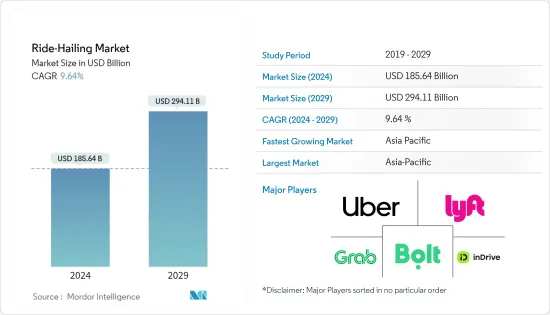
라이드 헤일링 시장 규모는 2024년에 1,856억 4,000만 달러로 추정되고, 2029년에는 2,941억 1,000만 달러에 이를 것으로 예측되며, 예측 기간 중(2024-2029년)의 CAGR은 9.64%로 성장할 것으로 예측됩니다.

장기적으로는 세계의 도시화율 상승, 관광산업의 성장, 도시 지역의 교통체증 증가가 라이드 헤일링 시장의 성장을 가속하는 큰 요인이 될 것으로 보입니다.
도시화가 진행됨에 따라 도시 지역에서 더 나은 직업 기회를 찾는 사람들이 늘어나고 라이드 헤일링 서비스에 대한 수요가 증가하고 있습니다. 이러한 소비자는 자동차를 소유하는 것보다 저렴한 통근 수단을 선호합니다. 또한 교통 정체가 심각해지는 동안 장거리를 매일 이동해야 하는 사람들은 육체적으로 피곤할 수 있으므로 스스로 운전하는 것을 피하고 싶습니다.
최근의 동향에서는 미국, 유럽 등의 선진 지역뿐만 아니라 인도, 중국, 베트남 등의 신흥 국가에서도 라이드 헤일링 서비스를 선호하는 경향이 강해지고 있습니다. 이러한 동향을 통해 각 회사는 모바일 애플리케이션을 통해 서비스를 개선하고 사업을 확대함으로써 시장에서의 효율적인 경쟁을 촉진하고 있습니다.
라이드 헤일링 기업은 테일 파이프 배출을 없애는 것을 목표로 가솔린 자동차를 전기자동차로 전환하여 전 세계적으로 차량의 이산화탄소 배출량을 줄이기 위해 노력하고 있습니다. 차량 전환은 직접적인 환경상의 이점과 다른 시장에 대한 간접적인 이점을 제공합니다. 라이드 헤일링 플릿에서 전기자동차의 통합은 시장의 상당한 성장을 가속할 것으로 예상됩니다.
개인 이동의 편의에 대한 요구 증가와 세계 관광객 수 증가로 여행 목적으로 자가용 교통을 이용하는 소비자의 기호가 높아지고 있다는 것이 자동차 부문 수요 증가의 주요 결정 요인이 되었습니다.
관광객은 그 편의성에서 라이드 헤일링 서비스를 이용하게 되어 있습니다. 이러한 서비스를 사용하면 하루 종일 또는 특정 기간 동안 차량을 예약할 필요가 없으며 필요할 때 필요한만큼 교통을 이용할 수 있습니다.
친환경 교통 수단이 요구되는 가운데 세계 정책 입안자들은 자동차에 의한 환경 오염과 싸우고 기후 변화 문제를 해결하기 위해 교통 솔루션의 진보를 우선하고 있습니다.
세계 각국의 정부는 이산화탄소 배출을 최소화하기 위해 차량의 전기화를 제창하고 있습니다. 이 시장의 신규 진출기업은 라이드 헤일링 서비스에 전 전기자동차를 도입하기 위해 다액의 투자를 실시했습니다. 브랜드의 존재감을 높이기 위해 적극적으로 파트너십을 맺고 있습니다.
또한, 이 시장에서는 여러 기업이 고객의 안전성을 높이기 위해 '긴급 버튼' 등의 선진 기능을 승용차에 적극적으로 통합하고 있습니다. 그 결과, 이 부문 수요가 확대될 것으로 예상됩니다. 또한 관광산업의 성장과 라이드 헤일링 플랫폼의 발전으로 이 시장의 승용차 부문은 예측 기간 동안 큰 성장을 이룰 것으로 예상됩니다.
아시아태평양에서의 라이드 헤일링 서비스 시장의 성장은 교통 정체 증가나 다른 교통 수단에 비해 저 운임이 원동력이 되고 있습니다. 또한 인도와 중국과 같은 도시 인구 증가는 고속 운송 솔루션에 대한 수요 증가로 이어지고 있으며 아시아태평양의 라이드 헤일링 시장에 긍정적인 영향을 미칩니다.
최근 아시아태평양의 라이드 헤일링 시장에서는 인도의 BluSmart와 베트남의 GSM과 같은 새로운 기업이 등장하고 있습니다. 인도와 중국은 세계에서 가장 인구가 많은 국가이며, 이들 국가에서 라이드 헤일링 서비스에 대한 수요가 증가하는 경향이 있습니다.
에코시스템에서 사업을 전개하는 다양한 기업들이 이 경쟁이 치열한 시장에서 브랜드의 존재감을 높이기 위해 제휴와 파트너십을 맺고, 차량을 확대하고, 새로운 이니셔티브의 전략을 반영하고 있습니다. 예를 들어,
도시 인구 증가, 신규 진출기업 시장 통합 증가, 개인 이동의 편리성을 선호하는 소비자 증가로 아시아태평양 시장에서의 라이드 헤일링 서비스 수요는 향후 수년간 급증할 것으로 예상됩니다.
라이드 헤일링 시장은 Didi Chuxing Technology Co., Uber Technologies Inc., Lyft Inc., Grab Holdings Inc., Cabify, Bolt, inDrive, Gett, Ani Technologies Pvt. Ltd.(OLA)와 같은 여러 주요 기업에 의해 지배됩니다. 이러한 기업은 고객의 편의성을 높이기 위해 라이드 헤일링 플랫폼의 M&A, 지리적 확장, 고급 기능의 도입에 적극적으로 노력하고 있습니다. 예를 들어,
The Ride-Hailing Market size is estimated at USD 185.64 billion in 2024, and is expected to reach USD 294.11 billion by 2029, growing at a CAGR of 9.64% during the forecast period (2024-2029).
Over the long term, the increasing urbanization rate worldwide, the growing tourism industry, and the rising traffic congestion in urban cities will be major factors driving the growth of the ride-hailing market.
The increasing urbanization has led to a higher demand for ride-hailing services as more people seek better job opportunities in cities. These consumers prefer affordable commuting options over owning a vehicle. In addition, with growing traffic congestion, people who need to travel long distances daily prefer to avoid having to drive themselves, as it can be physically exhausting.
In recent years, there has been a growing preference for ride-hailing services in developing countries like India, China, and Vietnam, as well as in developed regions such as the United States and Europe. This trend has prompted companies to improve their services and expand their operations through mobile applications to compete effectively in the market.
Ride-hailing companies are working to reduce vehicle carbon emissions globally by converting gasoline vehicles to electric, aiming to eliminate tailpipe emissions. Fleet conversion offers direct environmental benefits and indirect advantages for other markets. The integration of electric vehicles in ride-hailing fleets is expected to drive substantial market growth.
The increasing preference of consumers toward using private transportation for traveling purposes, owing to the rising need for convenience in personal mobility and the growing number of tourists worldwide, serve as major determinants of the rising demand for the cars segment.
Tourists are increasingly turning to ride-hailing services due to their convenience. These services allow them to access transportation as and when they need it, without the need to book a car for an entire day or a specific period.
In the age of environmentally friendly transportation, policymakers across the world are prioritizing advancements in transportation solutions to combat environmental pollution from vehicles and address climate change issues.
Governments globally are advocating for the electrification of vehicle fleets to minimize carbon emissions. New players in the market are investing substantial amounts in introducing an all-electric vehicle fleet for their ride-hailing services. They are actively forming partnerships to strengthen their brand presence.
Additionally, several companies in the market are actively incorporating advanced features, such as the "emergency button," into their passenger car fleet to improve customer safety. This, in turn, is expected to drive demand for this segment. Furthermore, with the growing tourism industry and the advancement of ride-hailing platforms, the cars segment of the market is anticipated to experience significant growth during the forecast period.
The growth of the ride-hailing service market in Asia-Pacific is driven by increasing traffic congestion and low fares compared to other modes of transportation. In addition, the rising urban population in countries like India and China is leading to a higher demand for fast transportation solutions, which is positively impacting the ride-hailing market in Asia-Pacific.
In recent years, the ride-hailing market in Asia-Pacific has seen the emergence of new players such as BluSmart in India and GSM in Vietnam. With India and China being the world's most populous countries, the demand for ride-hailing services in these nations is on the rise.
Various companies operating in the ecosystem are forming collaborations and partnerships, expanding their fleets, and strategizing for new initiatives to enhance their brand's presence in this competitive market. For instance,
With the growing urban population, rising integration of new entrants in the market, and the consumers' increasing preference for convenience in personal mobility, the demand for ride-hailing services in the Asia-Pacific market is anticipated to surge rapidly over the coming years.
The ride-hailing market is dominated by several key players, such as Didi Chuxing Technology Co., Uber Technologies Inc., Lyft Inc., Grab Holdings Inc., Cabify, Bolt, inDrive, Gett, and Ani Technologies Pvt. Ltd (OLA). These players are actively engaging in mergers and acquisitions, geographical expansions, and introducing advanced features in their ride-hailing platforms to enhance customers' convenience. For instance,