


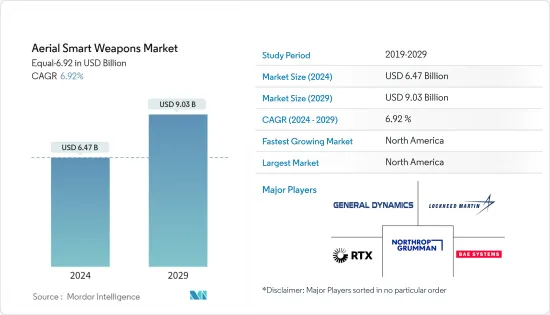
세계 항공 스마트 무기 시장 규모는 2024년 64억 7,000만 달러에 이를 것으로 추정됩니다. 2029년에는 90억 3,000만 달러에 달할 것으로 예측되며, 예측 기간(2024-2029년) 동안 CAGR 6.92%를 나타낼 것으로 예상됩니다.
항공용 스마트 무기 시장은 다양한 최종 사용자 및 지역 수요 증가로 인해 향후 몇 년동안 상당한 성장이 예상됩니다. 항공전 성격의 변화와 군용 항공기용 첨단 무기 시스템 개발 및 조달을 위한 국방 지출 증가는 예측 기간 동안 항공 스마트 무기 시장을 견인할 것으로 예상됩니다.
기업들이 첨단적이고 비용 효율적인 스마트 무기 시스템을 제공하기 위해 경쟁하면서 시장에서는 다양한 혁신과 발전이 이루어질 것으로 예상됩니다. 전자, 재료 기술, 추진 시스템, 유도 시스템의 소형화와 관련된 기술 발전은 예측 기간 동안 항공 스마트 무기 시스템 시장의 성장을 가속할 것으로 예상됩니다.
조사 대상 시장은 정부 규제, 수출 규제, 윤리적 문제 등 시장 성장을 제한할 수 있는 몇 가지 과제에 직면할 것으로 예상됩니다. 그러나 시장 기회는 시장 과제를 능가하며, 항공 스마트 무기 시장은 예측 기간 동안 긍정적인 성장을 보일 것으로 예상됩니다.
국방군의 첨단 유도 미사일에 대한 수요가 증가함에 따라 미사일 부문은 예측 기간 동안 가장 큰 시장 점유율을 차지할 것으로 예상됩니다. 미사일 분야의 성장을 가속하는 주요 요인은 선진국과 개발도상국 모두에서 국방 예산의 대폭적인 증가, 첨단 무기 사용률 증가, 전 세계 공중전의 변화입니다. 예를 들어, 2022년 세계 군사비 지출은 2조 2,400억 달러에 달하고, 2021년 대비 6% 증가할 것으로 예상됩니다.
네트워크 지원 무기, 극초음속 미사일, 인공지능 기반 무기의 개발은 군사 작전을 변화시킬 것으로 예상되는 미사일 부문의 최신 동향 중 일부입니다. 여러 국가가 항공 무기 시스템 제조업체와 제휴하여 미래의 위협에 대응하기 위해 첨단 스마트 미사일을 개발하고 있습니다. 예를 들어, 2023년 11월 MBDA는 아랍에미리트와 제휴하여 스마트 무기를 공동 개발하기로 했으며, 초기 생산 시점을 2030년으로 잡았다고 발표했습니다. 이 제휴는 AI를 통합한 기능을 갖춘 미래 전투에 특화된 스마트 글라이더 및 순양함 공대지 미사일을 개발하기 위해 설립되었습니다.
또 다른 국가들은 진화하는 위협에 대응하고 변화하는 전쟁의 성격에 대응하기 위한 현대화 노력의 일환으로 스마트 무기 시스템을 탑재한 첨단 군용 드론을 조달하고 있습니다. 예를 들어, 2023년 5월 네덜란드는 1억 7천만-2억 6,800만 달러의 개조 및 무기 조달을 통해 정찰용 드론 MQ-9 리퍼에 레이저 유도 GBU 폭탄과 공대지 헬파이어 미사일을 장착하기 시작한다고 발표했습니다. 무장 드론의 초기 배치는 2025년까지 예정되어 있으며, 완전 배치는 3년 후로 예정되어 있습니다. 전반적으로 이러한 첨단 무기 시스템 개발 및 조달 주문은 예측 기간 동안 이 부문의 성장을 가속화할 것으로 예상됩니다.
미국의 대규모 시장 개발로 북미는 항공 스마트 무기 시장에서 가장 큰 시장 점유율을 차지할 것으로 예상됩니다. 예를 들어, 2022년 미국의 군사 방위비 지출은 8,770억 달러로 2021년 대비 9% 증가할 것으로 예상됩니다. 기술적으로 진보된 무기에 대한 투자 증가는 전장에서 중국과 러시아의 능력 향상으로 미국에 대한 위협이 증가했기 때문입니다. 미국은 스마트 총알부터 핵 탑재가 가능한 극초음속 유도 무기까지 첨단 스마트 무기 시스템의 개발 및 도입을 위해 막대한 자금을 투자하고 있습니다. 이 나라는 향후 몇 년동안 조사 대상 시장을 주도할 것으로 예상되는 여러 항공용 스마트 무기 조달 프로그램에 참여하고 있습니다.
예를 들어, 2023년 1월 미 해군은 RTX Corporation과 미 해군 제트 전투기 및 기타 전투기용 AIM-9X 고정밀 단거리 적외선 유도 공대공 미사일 408발을 개발하기 위해 3억 1,700만 달러 규모의 계약을 체결했습니다. 마찬가지로 2023년 3월 미 공군은 RTX Corporation과 미화 3억 2,000만 달러 규모의 StormBreaker 스마트 무기 1,500대를 생산 및 납품하는 계약을 체결했습니다. 이 무기는 공대지 네트워크 지원 무기로, 멀티 이펙트 탄두와 트라이 모드 시커를 사용하여 모든 기상 조건에서 이동식 표적을 공격할 수 있습니다. 스톰브레이커는 F-15E 스트라이크 이글에 탑재되어 있으며, F-35B와 F/A-18에서 테스트가 진행 중입니다. 이러한 발전은 예측 기간 동안 이 지역 시장 전망을 강화할 것으로 예상됩니다.
항공용 스마트 무기 시장은 반쯤 통합되어 있으며, 국내외 기업들이 다양한 유형의 미사일, 탄약, 유도 로켓탄, 유도 발사체를 전 세계 항공 부대에 공급하고 있습니다. 국제적인 기업 외에도 몇몇 국영 기업들은 수출 기회도 염두에 두고 각 국가를 위해 스마트 무기를 개발 및 제조하고 있습니다.
시장에서 유명한 기업으로는 BAE Systems PLC, RTX Corporation, Lockheed Martin Corporation, General Dynamics Corporation, Northrop Grumman Corporation 등이 있습니다. 등이 있습니다. 항공전의 성격이 변화함에 따라 여러 국가들이 자국 군를 위해 차세대 항공 스마트 무기를 개발, 도입할 계획입니다. 국산 스마트 무기 개발에 대한 관심이 높아짐에 따라 국내 제조업체들은 R&D 투자 증가를 통해 시장 점유율을 확대할 수 있는 기회를 포착할 수 있으며, 이는 예측 기간 동안 성장으로 이어질 것으로 보입니다. 또한, 기업들은 다른 기업들과 합작 투자 및 파트너십을 맺어 기술 이전을 할 수 있으며, 이는 혁신을 촉진하고 예측 기간 동안 고도로 정교한 항공 스마트 무기 개발을 촉진할 것입니다.
The Aerial Smart Weapons Market size is estimated at USD 6.47 billion in 2024, and is expected to reach USD 9.03 billion by 2029, growing at a CAGR of 6.92% during the forecast period (2024-2029).
The aerial smart weapons market is expected to witness significant growth in the coming years, owing to the rising demand from diverse end users and regions. The changing nature of aerial warfare and the growth in defense spending toward developing and procuring advanced weapon systems for military aircraft are expected to drive the aerial smart weapons market during the forecast period.
The market is expected to undergo various innovations and developments as the players compete to offer advanced and cost-effective smart weapon systems. Technological advancements, in terms of miniaturization of electronics, material technologies, propulsion, and guidance systems, are expected to aid the growth of the aerial smart weapon systems market during the forecast period.
The market studied is also expected to face some challenges, such as government regulations, export controls, and ethical issues, which may limit the market growth. However, the market opportunities outweigh the market challenges, and the aerial smart weapons market is projected to grow positively during the forecast period.
The missile segment is anticipated to occupy the largest market share over the forecast period due to the increasing demand for advanced guided missiles from the defense forces. The key factors driving the growth of the missile segment are significant increases in defense budgets by both developed and developing nations, an increased use rate of advanced weapons, and changing aerial warfare worldwide. For instance, in 2022, the global military expenditure reached USD 2,240 billion, a growth of 6% from 2021.
The development of network-enabled weapons, hypersonic missiles, and artificial intelligence-based weapons are some of the latest trends in the missile segment that are expected to transform armed force operations. Various countries are partnering with aerial weapon system manufacturers to develop advanced smart missiles to counter future threats. For instance, in November 2023, MBDA announced that it partnered with the United Arab Emirates to co-develop smart weapons with an initial production date of 2030. The partnership was established to develop the Smart Glider and Cruiser air-to-ground missiles dedicated to future combat with AI-embedded capabilities.
Various countries are also procuring advanced military drones equipped with smart weapon systems to counter evolving threats and as a modernization effort to the changing nature of warfare. For instance, in May 2023, the Netherlands announced that it would begin arming its reconnaissance MQ-9 Reaper drones with laser-guided GBU bombs and air-to-surface Hellfire missiles under a modification and weapons procurement of USD 107-268 million. The initial deployment of the armed drones is expected by 2025, and the full deployment will be three years later. Overall, such developments and procurement orders of advanced weapons systems are expected to accelerate the growth of this segment during the forecast period.
North America is expected to occupy the largest market share in the aerial smart weapons market due to large-scale developments in the market by the United States. For instance, in 2022, the US military defense expenditure rose to USD 877 billion, a growth of 9% compared to 2021. The increased investments toward technologically advanced weaponry are due to the growing threat to the country from the enhanced capabilities of China and Russia on the battlefield. The country is divesting huge amounts for the development and induction of advanced smart weapon systems ranging from smart bullets to nuclear-capable hypersonic-guided weapons. The country has been involved in several aerial smart weapon procurement programs that are expected to drive the market studied in the years to come.
For instance, in January 2023, the US Navy awarded RTX Corporation a USD 317 million contract to develop 408 AIM-9X precision short-range infrared-guided air-to-air missiles for the navy's jet fighters and other combat aircraft. Similarly, in March 2023, the US Air Force awarded RTX Corporation a USD 320 million contract to produce and deliver 1500 StormBreaker smart weapons, which are air-to-surface, network-enabled weapons that can engage moving targets in all weather conditions using its multi-effects warhead and tri-mode seeker. The StormBreaker is fielded on the F-15E Strike Eagle, with testing underway on the F-35B and F/A-18. Such developments are expected to bolster the market prospects in the region during the forecast period.
The aerial smart weapons market is semi-consolidated, with local as well as international players providing various types of missiles, munitions, guided rockets, and guided projectiles for aerial forces across the world. Other than international players, several state-owned companies have been developing and manufacturing smart weapons for their respective countries while also looking at export opportunities.
Some of the prominent players in the market are BAE Systems PLC, RTX Corporation, Lockheed Martin Corporation, General Dynamics Corporation, and Northrop Grumman Corporation. Due to the changing nature of aerial warfare, several nations are planning to develop and induct next-generation aerial smart weapons for their militaries. As the focus is increasing on developing indigenous smart weapons, local manufacturers can grab the opportunity to increase their market share through higher R&D investments, which will help their growth during the forecast period. Players can also establish joint ventures and partnerships with other players to enable technology transfer, which will facilitate innovations and aid the development of highly sophisticated aerial smart weapons during the forecast period.