가스 센서 시장 : 제품별, 출력 유형별, 접속 방식별, 기술별, 유형별, 최종 용도별, 지역별 - 세계 예측(-2033년)
Gas Sensor Market By Gas Type (Oxygen, Carbon Monoxide, Carbon Dioxide, Volatile Organic Compounds, Hydrocarbons), Technology (Electrochemical, Infrared, Solid-State/Metal-Oxide-Semiconductors), Output Type, Connectivity- Global Forecast to 2033
상품코드:1936012
리서치사:MarketsandMarkets
발행일:2025년 12월
페이지 정보:영문 310 Pages
라이선스 & 가격 (부가세 별도)
ㅁ Add-on 가능: 고객의 요청에 따라 일정한 범위 내에서 Customization이 가능합니다. 자세한 사항은 문의해 주시기 바랍니다.
한글목차
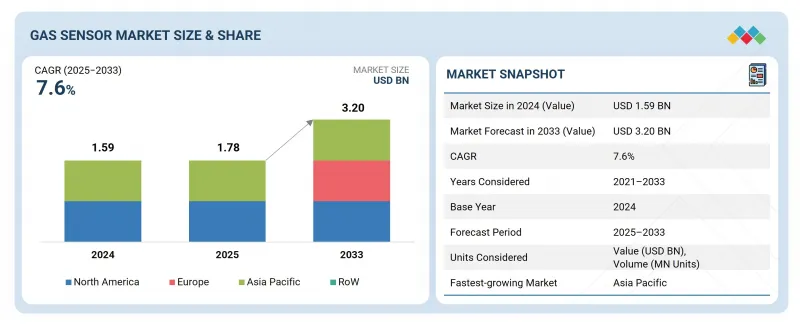
세계의 가스 센서 시장 규모는 2025년 17억 8,000만 달러에서 2033년까지 32억 달러로 성장하여 2025년부터 2033년까지 연평균 성장률(CAGR)은 7.6%로 예측됩니다.
이러한 성장은 석유 및 가스, 화학, 광업, 전력 등 주요 산업의 수요 증가에 의해 주도되고 있습니다. 또한, 사물인터넷(IoT), 빌딩 자동화 및 현대적 제어 시스템의 발전으로 소형화된 무선 가스 센서에 대한 수요가 증가하고 있습니다. 이 센서는 저전력, 고성능, 소형 사이즈로 평가받고 있습니다.
조사 범위
조사 대상 기간
2020-2033년
기준 연도
2024년
예측 기간
2025-2033년
대상 단위
금액(10억 달러)
부문
제품별, 출력 유형별, 접속 방식별, 기술별, 유형별, 최종 용도별, 지역별
대상 지역
북미, 유럽, 아시아태평양, 기타 지역
또한, 스마트폰과 웨어러블 기기에 가스 센서를 통합하여 환경과 대기 중 공기질을 지속적으로 모니터링할 수 있게 됨에 따라 향후 몇 년 동안 수요가 증가할 것으로 예상됩니다.
"출력 유형별로는 디지털 부문이 예측 기간 동안 가장 높은 CAGR로 성장할 것으로 예상됩니다."
가스 센서 시장의 디지털 부문은 보다 진보되고 지능적이며 연결된 가스 감지 솔루션에 대한 수요 증가로 인해 더 높은 CAGR을 기록할 것으로 예상됩니다. 디지털 가스 센서는 아날로그 방식에 비해 정확도 향상, 스마트 시스템과의 연결 방식, 고급 신호 처리 기능 등 여러 가지 장점을 제공합니다. 산업 분야의 디지털화와 사물인터넷(IoT) 기술 채택이 증가함에 따라 디지털 네트워크 연결, 원격 데이터 전송, 자동화 시스템에 통합할 수 있는 가스 센서에 대한 수요가 증가하고 있습니다.
유선 부문은 이미 구축된 인프라와 산업용 애플리케이션의 신뢰성으로 인해 전체 시장에서 더 큰 점유율을 차지하고 있습니다. 유선 가스 센서는 안정적이고 지속적인 데이터 전송이 필수적이며, 전원 공급과 연결 방식이 확보된 환경에서 일반적으로 사용됩니다. 제조업, 석유화학, 자동차, 의료 등의 산업에서는 내구성과 제어 시스템에 직접 연결되는 방식 때문에 유선 센서가 선호되며, 정확하고 끊김 없는 데이터 모니터링이 보장됩니다. 유선 가스 센서는 무선 기술에 영향을 미칠 수 있는 간섭이나 신호 손실 문제에 영향을 덜 받기 때문에 특정 응용 분야에서 더 안전하고 안정적인 것으로 간주되는 경우가 많습니다.
예측 기간 동안 중국은 아시아태평양의 가스 센서 시장에서 우위를 유지할 것으로 예상됩니다. 중국에서는 공정 산업(특히 화학제품 제조 및 석유 정제) 및 전력 발전과 같은 유틸리티 사업이 가스 센서의 주요 수요처로 남을 것입니다. 석유 및 가스, 인프라, 상하수도 처리 등의 분야가 가스 센서 시장의 성장을 견인할 것으로 예상됩니다. 또한, 대기오염이 건강에 미치는 영향에 대한 대중의 인식이 높아지면서 가스 센서가 장착된 스마트 공기질 모니터, 스마트 밴드, 공기청정기, 공기청정기, 공기청정장치에 대한 수요도 증가하고 있습니다.
Honeywell International Inc.(미국), MSA Safety Incorporated(미국), Amphenol Corporation(미국), Figaro Engineering Inc. Sensirion AG(스위스), Process Sensing Technologies(영국), ams-OSRAM AG(오스트리아), MEMBRAPOR(스위스), Senseair AB(미국) 등이 가스 센서 시장의 주요 기업입니다.
가스 센서 시장의 주요 기업들에 대해 조사했으며, 상세한 경쟁 분석과 함께 기업 프로파일, 최근 동향, 주요 시장 전략 등의 정보를 전해드립니다.
조사 범위:
본 조사 보고서는 가스 센서 시장을 출력 유형별, 연결 방식별, 제품 유형별, 기술별, 유형별, 최종 용도별, 지역별로 분석하고 있습니다. 이 보고서는 가스 센서 시장의 주요 시장 촉진요인, 저해요인, 도전과제, 기회를 개괄하고 2033년까지의 예측을 제공합니다. 또한, 가스 센서 생태계 내 모든 기업에 대한 리더십 매핑 및 분석도 포함되어 있습니다.
본 보고서 구매의 주요 이점
이 보고서는 전체 가스 센서 시장과 그 하위 부문의 예상 수익 규모를 제공함으로써 시장 리더와 신규 진입자에게 도움이 될 것입니다. 이해관계자들이 경쟁 상황을 이해하고, 비즈니스를 더 잘 포지셔닝하고, 효과적인 시장 진입 전략을 수립할 수 있는 인사이트를 얻을 수 있도록 돕습니다. 또한, 주요 촉진요인, 억제요인, 도전과제, 기회 등 시장 동향에 대한 정보를 제공합니다.
이 보고서는 다음 사항에 대한 인사이트를 제공합니다:
주요 촉진요인(석유 및 가스, 화학, 광업, 전력 부문 수요 증가, 건강 및 안전 규제 시행, HVAC 시스템 및 대기질 모니터에 가스 센서 통합, 자율주행차 수요 급증) 기회(사물인터넷, 클라우드 컴퓨팅, 빅데이터 기술 통합, 소비자 전자기기 채택 확대, 소형 무선 가스 센서 수요 증가), 도전 과제(복잡한 제조 공정) 기기에서의 채택 확대, 소형 무선 가스 센서 수요 증가), 도전과제(복잡한 제조 공정)가 가스 센서 시장 성장에 미치는 영향에 대해
제품 개발/혁신 : 가스 센서 시장의 향후 기술 동향, 연구개발 활동, 최신 제품 및 서비스 출시에 대한 상세 분석
시장 개발 : 수익성 높은 시장에 대한 종합적인 정보 - 이 보고서는 다양한 지역의 가스 센서 시장을 분석합니다.
시장 다각화 : 신제품 및 서비스, 미개척 지역, 최근 동향, 가스 센서 시장 투자에 관한 종합적인 정보
경쟁사 평가 : 주요 기업 - Honeywell International Inc. ), Sensirion AG(스위스), Process Sensing Technologies(영국), ams-Osram AG(오스트리아), MEMBRAPOR(스위스), Senseair AB(미국) 등 가스 센서 시장 주요 기업의 시장 점유율, 성장 전략, 서비스 제공 서비스 제공 내용에 대한 상세 분석
목차
제1장 소개
제2장 주요 요약
제3장 주요 인사이트
제4장 시장 개요
제5장 업계 동향
제6장 기술의 진보, AI에 의한 영향, 특허, 혁신, 그리고 향후 응용
제7장 규제 상황
제8장 고객 상황과 구매 행동
제9장 가스 센서 시장(제품별)
제10장 가스 센서 시장(출력 유형별)
제11장 가스 센서 시장(접속 방식별)
제12장 가스 센서 시장(기술별)
제13장 가스 센서 시장(유형별)
제14장 가스 센서 시장(최종 용도별)
제15장 가스 센서 시장(지역별)
제16장 경쟁 구도
제17장 기업 개요
제18장 조사 방법
제19장 부록
KSM
영문 목차
영문목차
The global gas sensor market is expected to grow from USD 1.78 billion in 2025 to USD 3.20 billion by 2033, with a compound annual growth rate (CAGR) of 7.6% from 2025 to 2033. This growth is driven by increasing demand in key industries such as oil & gas, chemicals, mining, and power. Additionally, the demand for miniaturized wireless gas sensors is rising due to advancements in IoT, building automation, and modern control systems. These sensors are valued for their low power consumption, high performance, and small size.
Scope of the Report
Years Considered for the Study
2020-2033
Base Year
2024
Forecast Period
2025-2033
Units Considered
Value (USD Billion)
Segments
By Gas Type, Technology, Connectivity and region
Regions covered
North America, Europe, APAC, RoW
Furthermore, the integration of gas sensors into smartphones and wearable devices for continuous environmental or atmospheric air quality monitoring is expected to boost demand in the coming years.
"By output type, digital segment to grow at highest CAGR during forecast period"
The digital segment of the gas sensor market is expected to register a higher CAGR due to rising demand for more advanced, intelligent, and connected gas sensing solutions. Digital gas sensors provide several benefits over their analog equivalents, including better accuracy, the ability to connect with smart systems, and advanced signal processing features. As industries adopt digitalization and Internet of Things (IoT) technologies, the need for gas sensors that can connect to digital networks, send data remotely, and integrate into automated systems is increasing.
"Wired segment to capture largest share of gas sensor market in 2025"
The wired segment holds a larger share of the overall market due to its established infrastructure and reliability in industrial applications. Wired gas sensors are commonly used in environments where stable and continuous data transmission is essential and where power supply and connectivity are reliable. Industries such as manufacturing, petrochemical, automotive, and healthcare prefer wired sensors for their durability and direct connection to control systems, ensuring precise and uninterrupted data monitoring. Wired gas sensors are often considered more secure and stable for certain applications because they are less susceptible to interference and signal loss issues that can affect wireless technologies.
"China to be largest market for gas sensors in Asia Pacific."
China is expected to maintain its dominance in the gas sensor market across Asia Pacific during the forecast period. Process industries, especially chemical production and petroleum refining, along with public utilities like electric power generation, will remain the primary consumers of gas sensors in the country. Sectors such as oil & gas, infrastructure, and water & wastewater treatment, among others, are projected to drive the growth of the gas sensor market. Additionally, increasing public awareness about the health impacts of air pollution is also boosting demand for smart air quality monitors, smart bands, air purifiers, and air cleaners that are equipped with gas sensors.
Extensive primary interviews were conducted with key industry experts in the gas sensor market to determine and verify the market size for various segments and subsegments. The breakdown of primary participants for the report is shown below: The study includes insights from a range of industry experts, from component suppliers to Tier 1 companies and OEMs. The breakdown of the primary respondents is as follows:
By Company Type: Tier 1 - 20%, Tier 2 - 45%, and Tier 3 - 35%
By Designation: C-level Executives - 35%, Directors - 340%, and Others - 20%
By Region: North America - 25%, Europe - 20%, Asia Pacific - 45%, and RoW - 10%
Note: Three tiers of companies are defined based on their total revenue as of 2024; tier 1: revenue more than or equal to USD 500 million, tier 2: revenue between USD 100 million and USD 500 million, and tier 3: revenue less than or equal to USD 100 million. Other designations include sales and marketing executives, researchers, and members of various gas sensor organizations.
Honeywell International Inc. (US), MSA Safety Incorporated (US), Amphenol Corporation (US), Figaro Engineering Inc. (Japan), Alphasense (UK), Sensirion AG (Switzerland), Process Sensing Technologies (UK), ams-OSRAM AG (Austria), MEMBRAPOR (Switzerland), and Senseair AB (US), among others, are the key players in the gas sensor market.
The study includes an in-depth competitive analysis of these key players in the gas sensor market, as well as their company profiles, recent developments, and key market strategies.
Research Coverage:
This research report categorizes the gas sensor market by output type (analog and digital), connectivity (wired and wireless), product (gas analyzers & monitors, gas detectors, air quality monitors, air purifiers/air cleaners, HVAC systems, medical equipment, and consumer devices), technology (electrochemical, photoionization detection (PID), solid-state/metal-oxide-semiconductors (MOS), catalytic, infrared, laser, zirconia, holographic, and others), gas type (oxygen (O2), carbon monoxide (CO), carbon dioxide (CO2), ammonia (NH3), chlorine (Cl), hydrogen sulfide (H2S), nitrogen oxides (NOx), volatile organic compounds, methane (CH4), hydrocarbons, and hydrogen), end use (automotive & transportation, smart cities & building automation, oil & gas industry, water & wastewater treatment, food & beverage industry, power stations, medical industry, metal & chemical industry, mining, consumer electronics, and government & regulatory bodies), and region (North America, Europe, Asia Pacific, and RoW). The report outlines the key drivers, restraints, challenges, and opportunities in the gas sensor market and provides forecasts until 2033. It also includes leadership mapping and analysis of all companies within the gas sensor ecosystem.
Key Benefits of Buying the Report
The report will assist market leaders and new entrants by providing estimated revenue figures for the overall gas sensor market and its subsegments. It will help stakeholders understand the competitive landscape and gain insights to better position their businesses and develop effective go-to-market strategies. Additionally, the report offers information on the market pulse, including key drivers, restraints, challenges, and opportunities.
The report provides insights on the following pointers:
Analysis of key drivers (rising demand in oil & gas, chemicals, mining, and power sectors, implementation of health and safety regulations, integration of gas sensors into HVAC systems and air quality monitors, surge in demand for autonomous vehicles) restraints (intense pricing pressure resulting in declining average selling prices), opportunities (incorporation of Internet of Things, cloud computing, and big data technologies, growing adoption in consumer electronics, increasing demand for miniaturized wireless gas sensors) and challenges (complex manufacturing process) influencing the growth of the gas sensor market
Product Development/Innovation: Detailed insights into upcoming technologies, research and development activities, and the latest product and service launches in the gas sensor market
Market Development: Comprehensive information about lucrative markets - the report analyzes the gas sensor market across varied regions
Market Diversification: Exhaustive information about new products and services, untapped geographies, recent developments, and investments in the gas sensor market
Competitive Assessment: In-depth assessment of market share, growth strategies, and service offerings of leading players, such as Honeywell International Inc. (US), MSA Safety Incorporated (US), Amphenol Corporation (US), Figaro Engineering Inc. (Japan), Alphasense (UK), Sensirion AG (Switzerland), Process Sensing Technologies (UK), ams-OSRAM AG (Austria), MEMBRAPOR (Switzerland), and Senseair AB (US) in the gas sensor market
TABLE OF CONTENTS
1 INTRODUCTION
1.1 STUDY OBJECTIVES
1.2 MARKET DEFINITION AND SCOPE
1.3 STUDY SCOPE
1.3.1 MARKETS COVERED
1.3.2 INCLUSIONS AND EXCLUSIONS
1.3.3 YEARS CONSIDERED
1.4 CURRENCY CONSIDERED
1.5 UNIT CONSIDERED
1.6 LIMITATIONS
1.7 STAKEHOLDERS
1.8 SUMMARY OF CHANGES
2 EXECUTIVE SUMMARY
2.1 MARKET HIGHLIGHTS AND KEY INSIGHTS
2.2 KEY MARKET PARTICIPANTS: MAPPING OF STRATEGIC DEVELOPMENTS
2.3 DISRUPTIVE TRENDS IN GAS SENSOR MARKET
2.4 HIGH-GROWTH SEGMENTS
2.5 REGIONAL SNAPSHOT: MARKET SIZE, GROWTH RATE, AND FORECAST
3 PREMIUM INSIGHTS
3.1 ATTRACTIVE OPPORTUNITIES FOR PLAYERS IN GAS SENSOR MARKET
3.2 GAS SENSOR MARKET, BY PRODUCT
3.3 GAS SENSOR MARKET, BY TECHNOLOGY
3.4 GAS SENSOR MARKET, BY TYPE
3.5 GAS SENSOR MARKET, BY END USE
3.6 GAS SENSOR MARKET, BY CONNECTIVITY AND OUTPUT TYPE
3.7 GAS SENSOR MARKET, BY COUNTRY
4 MARKET OVERVIEW
4.1 INTRODUCTION
4.2 MARKET DYNAMICS
4.2.1 DRIVERS
4.2.1.1 Rising demand in oil & gas, chemicals, mining, and power sectors
4.2.1.2 Implementation of health and safety regulations
4.2.1.3 Integration of gas sensors into HVAC systems and air quality monitors
4.2.1.4 Surge in demand for autonomous vehicles
4.2.2 RESTRAINTS
4.2.2.1 Intense pricing pressure resulting in declining average selling prices
4.2.3 OPPORTUNITIES
4.2.3.1 Incorporation of Internet of Things, cloud computing, and big data technologies
4.2.3.2 Growing adoption in consumer electronics
4.2.3.3 Increasing demand for miniaturized wireless gas sensors
4.2.4 CHALLENGES
4.2.4.1 Complex manufacturing process
4.3 UNMET NEEDS AND WHITE SPACES
4.3.1 UNMET NEEDS IN GAS SENSORS MARKET
4.3.2 WHITE SPACE OPPORTUNITIES
4.4 INTERCONNECTED MARKETS AND CROSS-SECTOR OPPORTUNITIES
4.4.1 INTERCONNECTED MARKETS
4.4.2 CROSS-SECTOR OPPORTUNITIES
4.5 STRATEGIC MOVES BY TIER 1/2/3 PLAYERS
4.5.1 MARKET DYNAMICS
5 INDUSTRY TRENDS
5.1 INTRODUCTION
5.2 PORTER'S FIVE FORCES ANALYSIS
5.2.1 THREAT OF NEW ENTRANTS
5.2.2 THREAT OF SUBSTITUTES
5.2.3 BARGAINING POWER OF SUPPLIERS
5.2.4 BARGAINING POWER OF BUYERS
5.2.5 INTENSITY OF COMPETITIVE RIVALRY
5.3 MACROECONOMIC INDICATORS
5.3.1 INTRODUCTION
5.3.2 GDP TRENDS AND FORECAST
5.3.3 TRENDS IN GLOBAL AUTOMOTIVE AND TRANSPORTATION INDUSTRY
5.3.4 TRENDS IN GLOBAL SMART CITIES AND BUILDING-AUTOMATION INDUSTRY