Workforce Management Market By Solution - Global Forecast to 2030
상품코드:1927587
리서치사:MarketsandMarkets
발행일:2025년 12월
페이지 정보:영문 308 Pages
라이선스 & 가격 (부가세 별도)
ㅁ Add-on 가능: 고객의 요청에 따라 일정한 범위 내에서 Customization이 가능합니다. 자세한 사항은 문의해 주시기 바랍니다.
한글목차
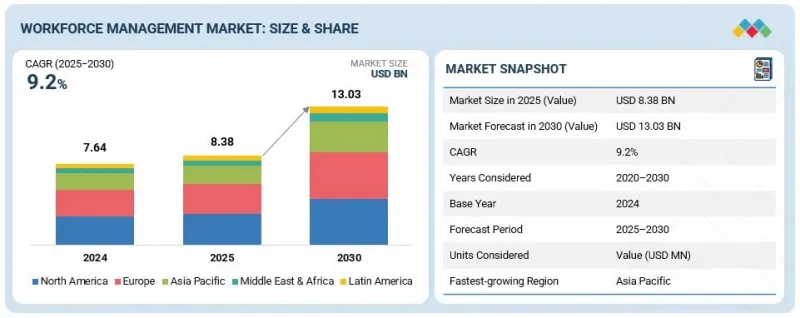
세계의 인력 관리 시장 규모는 급속히 확대하고 있어 2025년 약 83억 8,000만 달러에서 2030년까지 130억 3,000만 달러에 이를 것으로 예측되어 CAGR로 9.2%의 성장이 전망되고 있습니다.
세계 시장과 지역 시장에서의 노동 규제의 복잡성 증가가 인력관리 수요를 촉진할 것으로 예측됩니다. 현대의 조직은 초과 근무 규정, 휴식 요건, 휴가권, 노조 협약, 안전 규정, 산업별 규정 준수 의무 등 자주 변경되는 노동법이 적용되는 환경에서 운영되고 있습니다.
조사 범위
조사 대상 기간
2020년-2030년
기준 연도
2024년
예측 기간
2025년-2030년
단위
100만 달러
부문
제공, 솔루션 유형, 전개 유형, 업계
대상 지역
북미, 유럽, 아시아태평양, 중동 및 아프리카, 라틴아메리카
대규모 또는 분산된 인력을 관리하는 기업들은 이러한 규정을 수작업으로 준수하는 것이 점점 더 어려워지고 있으며, 규정 위반으로 인한 처벌, 부정확한 급여 계산, 업무 효율성 저하의 위험이 증가하고 있습니다. 인력관리 솔루션은 규제 자동 적용, 특정 국가별 컴플라이언스 템플릿 유지, 규제 변경 사항의 실시간 업데이트를 통해 이러한 문제를 해결합니다. 이를 통해 정확한 시간 관리, 적절한 급여 계산, 문서화 개선, 전 지점에서의 일관된 정책 적용을 보장합니다. 기업이 지리적으로 확장하고 하이브리드 또는 유연한 근무 형태를 채택함에 따라 중앙 집중식 자동화된 컴플라이언스 관리의 필요성이 더욱 중요해지고 있습니다. 이러한 규제 압력으로 인해 기업들은 리스크를 줄이고 원활한 합법적 경영을 지원하는 선진화된 인력 관리 시스템으로 전환해야 하는 상황에 직면해 있습니다.
"구축 방식별로는 클라우드가 예측 기간 동안 가장 높은 성장률을 보일 것으로 예상됩니다"
제조, 소매, 의료, 서비스 등 다양한 분야의 조직이 사업을 확장하는 가운데, 클라우드 기반 WFM 플랫폼은 On-Premise 인프라를 관리할 필요 없이 멀티사이트 통합, 실시간 데이터 액세스, 원활한 업데이트가 가능합니다. 모바일 워커와 데스크리스 워커 증가는 클라우드 시스템 도입을 더욱 가속화하고 있습니다. 클라우드 시스템은 스케줄링, 시간 추적, 셀프 서비스 도구에 대한 원격 액세스를 가능하게 하기 때문입니다.
또한, 클라우드 구축은 신속한 도입, 자동화된 컴플라이언스 업데이트, 강화된 보안 프레임워크를 지원하기 때문에 민첩성과 IT 비용 절감을 원하는 기업에게 최적의 선택이 될 수 있습니다. 각 벤더들은 AI, 예측 분석, 자동화 기능을 클라우드 플랫폼에 직접 통합하여 인력 계획 최적화, 수요 예측, 인력 생산성 향상을 지원하고 있습니다. 기업들이 비용 효율성, 업무 유연성, 디지털 전환을 우선시하는 가운데, 클라우드 구축 모델은 On-Premise 시스템을 지속적으로 능가하며 WFM 시장의 중요한 촉진요인으로 부상할 것으로 보입니다.
"제품별로는 솔루션 부문이 예측 기간 동안 가장 큰 시장 점유율을 차지할 것으로 예측됩니다."
근태 관리, 스케줄링, 결근관리, 인력 최적화 등 핵심 기능의 자동화를 우선시하는 조직이 늘어나면서 인력관리 솔루션이 꾸준히 가장 큰 시장 점유율을 차지하고 있습니다. 이러한 솔루션은 제조, 소매, 물류, 의료 등의 산업이 직면한 업무상의 문제에 직접적으로 대응할 수 있습니다. 이러한 부서에서는 비용 관리와 생산성 향상을 위해 실시간 인력 가시성과 정확한 인력 추적이 필수적입니다. 노동법규가 복잡해지고 현장 인력이 확대됨에 따라 기업들은 컴플라이언스 확보, 수작업으로 인한 실수 감소, 일상적인 인력 운영의 효율화를 위해 첨단 WFM 플랫폼 도입에 박차를 가하고 있습니다.
WFM 솔루션에 AI와 애널리틱스를 통합하여 예측적 스케줄링, 수요 예측, 자동화된 의사결정을 지원할 수 있게 됨에 따라 그 수요는 더욱 가속화되고 있습니다. 모바일 우선 기능, 셀프 서비스 포털, HR, 급여, ERP 시스템과의 원활한 통합도 인력 디지털화 전략의 핵심입니다. 클라우드 기반 구축이 증가하고 기업이 통합 인력 생태계로 전환하는 가운데, 솔루션 제공은 예측 기간 동안 최고의 가치와 가장 폭넓은 채택을 지속하며 인력 관리 시장의 선도적 요소로서의 입지를 강화하고 있습니다.
세계의 인력 관리(Workforce Management) 시장에 대해 조사 분석했으며, 주요 촉진요인 및 저해요인, 제품 개발 및 혁신, 경쟁 구도에 대해 조사 분석하여 전해드립니다.
목차
제1장 서론
제2장 주요 요약
제3장 중요 지견
인력 관리 시장 기업에 있어서 매력적인 기회
인력 관리 시장 : 제공 별
인력 관리 시장 : 솔루션 유형별
인력 관리 시장 : 비즈니스 기능별
인력 관리 시장 : 딜리버리 방식별
인력 관리 시장 : 조직 규모별
인력 관리 시장 : 업계별
인력 관리 시장 : 지역별
제4장 시장 개요
시장 역학
성장 촉진요인
성장 억제요인
기회
과제
미충족 요구와 화이트 스페이스
인력 관리 시장 미충족 요구
화이트 스페이스 기회
연결된 시장과 부문간 기회
연결된 시장
부문간 기회
새로운 비즈니스 모델과 에코시스템 변화
새로운 비즈니스 모델
에코시스템 변화
Tier 1/2/3 기업의 전략적 움직임
제5장 업계 동향
Porter의 Five Forces 분석
거시경제 전망
GDP 동향과 예측
세계의 인력 관리 업계 동향
세계의 코어 HR소프트웨어 업계 동향
공급망 분석
기술·데이터 인프라 프로바이더
인력 관리 소프트웨어 벤더
시스템 통합사업자·채널 파트너
업계
생태계 분석
가격 결정 분석
솔루션 평균 판매 가격 : 주요 기업별(2025년)
제품 참고 가격 분석 : 벤더별(2025년)
주요 컨퍼런스 및 이벤트(2026년)
고객의 비즈니스에 영향을 미치는 동향/혼란
투자 및 자금조달 시나리오
사례 연구 분석
2025년 미국 관세의 영향 - 인력 관리 시장
주요 관세율
가격 영향 분석
국가/지역에 대한 영향
업계에 대한 영향
제6장 기술 진보, AI에 의한 영향, 특허, 혁신, 향후 용도
기술 분석
주요 신기술
보완 기술
인접 기술
기술/제품 로드맵
단기 : 플랫폼 통합·컴플라이언스 설계(2026년-2028년)
중기 : 실시간 노동자 오케스트레이션·업무 통합(2028년-2031년)
장기 : 자율적인 노동력 운영·신뢰성 비싼 에코시스템(2031년-2036년 이후)
특허 분석
향후 용도
실시간 자율적 워크포스 오케스트레이션
스킬에 근거한 동적인 노동력 배분
컴플라이언스를 짜넣은 공평한 스케줄링 에코시스템
경험 중심 최전선 워크포스 플랫폼
경영 주도 노동력 관제탑
인력 관리 시장에 대한 AI/생성형 AI의 영향
주요 이용 사례와 시장 장래성
인력 관리 베스트 프랙티스
인력 관리 시장 AI도입 사례 연구
상호 접속된 인접 에코시스템과 시장 기업에 대한 영향
인력 관리 생성형 AI 채택에 대한 클라이언트 준비 상황
성공 사례와 실세계에의 응용
ATOSS 소프트웨어 : AI 인력 관리 플랫폼
PAYCOR : AI 워크포스 인사이트
제7장 규제 상황
규제와 컴플라이언스
규제기관, 정부기관, 기타 조직
업계표준 : 지역별
제8장 고객 상황과 구매 행동
의사결정 프로세스
구매 프로세스에 관여하는 구매측 이해관계자와 그 평가 기준
구매 프로세스 주요 이해관계자
구입 기준
채택 장벽과 내부 과제
다양한 최종 이용 산업 미충족 요구
시장 수익성
잠재적인 매출
비용 역학
주요 용도 마진 기회
제9장 인력 관리 시장 : 제공별
솔루션
서비스
제10장 인력 관리 시장 : 솔루션 유형별
코어 WFM
워크포스 최적화(WFO)·애널리틱스
워크포스 인텔리전스·전략
제11장 인력 관리 시장 : 딜리버리 방식별
On-Premise
클라우드
제12장 인력 관리 시장 : 조직 규모별
대기업
중소기업
제13장 인력 관리 시장 : 비즈니스 기능별
인사 기능
경영/최전선 리더
재무·급여계산
IT/보안
제14장 인력 관리 시장 : 업계별
BFSI
소매 및 E-Commerce
의료 및 생명과학
통신
IT·ITeS
미디어 및 엔터테인먼트
제조
정부 및 방위
운송 및 물류
기타 업계
제15장 인력 관리 시장 : 지역별
북미
미국
캐나다
유럽
영국
독일
프랑스
이탈리아
기타 유럽
아시아태평양
중국
인도
일본
기타 아시아태평양
중동 및 아프리카
GCC 국가
남아프리카공화국
기타 중동 및 아프리카
라틴아메리카
브라질
멕시코
기타 라틴아메리카
제16장 경쟁 구도
주요 시장 진출기업의 전략/강점(2023년-2025년)
매출 분석(2020년-2024년)
시장 점유율 분석(2024년)
제품 비교
WORKDAY
UKG
ORACLE
SAP
ADP
기업 평가 매트릭스 : 주요 기업(2025년)
기업 평가 매트릭스 : 스타트업/중소기업(2025년)
기업 평가와 재무 지표
주요 벤더 기업 평가
주요 벤더 재무 지표
경쟁 시나리오
제17장 기업 개요
주요 기업
WORKDAY
UKG
ORACLE
SAP
ATOSS SOFTWARE
DAYFORCE
INFOR
ADP
VERINT
IBM
기타 기업
RAMCO SYSTEMS
ACTIVEOPS PLC
SISQUAL WFM
NICE
PAYCHEX
PAYLOCITY
QUINYX
ZEBRA
DELTEK
LEGION TECHNOLOGIES, INC.
ASSEMBLED
SKEDULO
CONNECTEAM
PUSH OPERATIONS
RIPPLING
PERSONIO
제18장 조사 방법
제19장 부록
LSH
영문 목차
영문목차
The workforce management market is expanding rapidly, with a projected market size anticipated to rise from about USD 8.38 billion in 2025 to USD 13.03 billion by 2030, featuring a CAGR of 9.2%. Growing complexity of labor regulations across global and regional markets is expected to drive the workforce management. Organizations today operate in environments where labor laws change frequently, covering overtime policies, breaking requirements, leave entitlements, union agreements, safety rules, and industry-specific compliance mandates.
Scope of the Report
Years Considered for the Study
2020-2030
Base Year
2024
Forecast Period
2025-2030
Units Considered
Value (USD Million)
Segments
By Offering, By Solution Type, By Deployment Type, By Vertical
Regions covered
North America, Europe, Asia Pacific, Middle East & Africa, and Latin America
For companies managing large or distributed workforces, ensuring adherence to these regulations manually has become increasingly difficult, leading to higher risks of non-compliance penalties, payroll inaccuracies, and operational inefficiencies. Workforce management solutions address this challenge by automating rule enforcement, maintaining country-specific compliance templates, and updating regulatory changes in real time. This ensures accurate time tracking, correct pay calculations, improved documentation, and consistent policy application across sites. As businesses expand geographically and adopt hybrid or flexible working models, the need for centralized, automated compliance management becomes even more critical. This growing regulatory pressure continues to push enterprises toward advanced workforce management systems that reduce risk and support smooth, lawful operations.
"In deployment mode, Cloud is expected to account for the fastest growth rate during the forecast period"
As organizations across manufacturing, retail, healthcare, and services expand their operations, cloud-based WFM platforms offer easier multi-site integration, real-time data access, and seamless updates without the burden of managing on-premise infrastructure. The rise of mobile and deskless workers is further accelerating cloud adoption, as cloud systems enable remote access to scheduling, time tracking, and self-service tools.
Additionally, cloud deployment supports faster implementation, automated compliance updates, and stronger security frameworks, making it a preferred choice for companies seeking agility and reduced IT overheads. Vendors are also embedding AI, predictive analytics, and automation capabilities directly into cloud platforms, helping organizations optimize labor planning, forecast demand, and enhance workforce productivity. As enterprises prioritize cost efficiency, operational flexibility, and digital transformation, the cloud deployment model will continue to outpace on-premise systems and emerge as the dominant growth driver in the WFM market.
"By offering, solutions segment is expected to hold the largest market share during the forecast period"
Workforce management solutions are steadily capturing the largest share of the market as organizations prioritize automation of core functions such as time and attendance, scheduling, absence management, and labor optimization. These solutions directly address the operational pressures faced by sectors like manufacturing, retail, logistics, and healthcare, where real-time workforce visibility and accurate labor tracking are essential for cost control and productivity. As labor laws become more complex and frontline workforces expand, companies are increasingly adopting advanced WFM platforms to ensure compliance, reduce manual errors, and streamline day-to-day workforce operations.
The growing integration of AI and analytics within WFM solutions is further accelerating demand, enabling predictive scheduling, demand forecasting, and automated decision support. Mobile-first capabilities, self-service portals, and seamless integration with HR, payroll, and ERP systems also make these solutions central to workforce digitalization strategies. With cloud-based deployments rising and enterprises shifting toward unified workforce ecosystems, solution offerings continue to deliver the highest value and widest adoption, reinforcing their position as the dominant component in the workforce management market throughout the forecast period.
"North America leads the workforce management market with strong adoption of cloud-based solutions, while Asia Pacific is the fastest-growing region driven by rapid digital transformation"
North America is expected to hold the largest share of the workforce management market due to its advanced digital infrastructure, strong regulatory frameworks, and widespread adoption of automation across major industries. Organizations in the US and Canada face growing labor compliance requirements, including overtime rules, union agreements, and state-level labor policies, which drive reliance on sophisticated WFM tools for accuracy and transparency. The region's mature enterprise landscape spanning manufacturing, retail, healthcare, BFSI, and public sector has also accelerated investments in modern time and attendance systems, AI-powered scheduling, and analytics-driven labor optimization.
High adoption of cloud-based workforce management platforms further strengthens North America's lead, supported by robust vendor presence, including ADP, UKG, Workday, Ceridian, and Oracle. These companies continuously introduce innovations such as predictive workforce planning, mobile self-service, and AI-enabled compliance monitoring, which attract both large enterprises and mid-sized firms. Additionally, the region's shift toward hybrid and frontline workforce models has increased demand for unified platforms that offer real-time visibility, mobile access, and integrated HR-payroll workflows. With strong technology readiness, significant vendor investments, and ongoing workplace transformation, North America is expected to maintain its dominant position throughout the forecast period.
Breakdown of Primaries
In-depth interviews were conducted with Chief Executive Officers (CEOs), innovation and technology directors, system integrators, and executives from various key organizations operating in the workforce management market.
By Company: Tier I - 42%, Tier II - 38%, and Tier III - 20%
By Designation: C-Level Executives - 32%, D-Level Executives -36%, and Others - 32%
By Region: North America - 35%, Europe - 27%, Asia Pacific - 23%, and Rest of the world - 15%
The report includes a study of key players offering workforce management. It profiles major vendors in the workforce management market. The major market players include ADP (US), SAP (Germany), Workday (US), Ceridian (US), Oracle (US), Paycor (US), Paychecx (US), Infor (US), BambooHR (US), Atoss Software (Germany), Nice (Israel), IBM (US), Ramco System (India), Timeclock Plus (US), Sumtotal (US), Avature (UK), Sisqual Workforce Management (Portugal), Activeops (UK), Ultimate Software (US), Verint (US), Mark Information (US), Reflexis Systems (US), Authority Software (US), Paylocity (US).
Research Coverage
This research report categorizes the workforce management market based on based on Offering (Solutions and Services), Solution Type (Time & Attendance, Workforce Scheduling & Planning, Leave & Absence Management, Workforce Analytics, Others), Services (consulting, integration & implementation, training & support), Deployment Type (on-premises and cloud), Vertical (BFSI, Retail & E-commerce, Healthcare & Life Sciences, Telecommunication, IT & ITes, Media & Entertainment, Manufacturing, Government & Defense, Transport & Logistics, Others )and Region (North America, Europe, Asia Pacific, Middle East & Africa, and Latin America). The report's scope encompasses detailed information regarding the major factors, including drivers, restraints, challenges, and opportunities, that influence the growth of the workforce management market. A detailed analysis of key industry players was conducted to provide insights into their business overview, solutions, and services, as well as key strategies, contracts, partnerships, agreements, new product & service launches, mergers and acquisitions, and recent developments associated with the workforce management market. This report also includes a competitive analysis of emerging startups in the workforce management market ecosystem.
Reason to Buy this Report
The report would provide market leaders and new entrants with information on the closest approximations of the revenue numbers for the overall workforce management market and its subsegments. It would help stakeholders understand the competitive landscape and gain more insights to better position their businesses and plan suitable go-to-market strategies. It also helps stakeholders understand the market's pulse and provides them with information on key market drivers, restraints, challenges, and opportunities.
The report provides insights into the following points:
Analysis of key drivers (Widespread Shift to Cloud/SaaS Licensing, Regulatory Compliance Complexity, Integration with Payroll and HCM Platforms, Labor Volatility & Workforce Shortages), restraints (Implementation Complexity, Integration & Data Sync Complexity), opportunities (Vertical Specialization, Mobile-First Workforce Experience), and challenges (Regulatory Localization Burden, Talent Shortage in WFM Implementation)
Product Development/Innovation: Detailed insights into upcoming technologies, research & development activities, and new product & service launches in the workforce management market
Market Development: Comprehensive information about lucrative markets - the report analyses the workforce management market across varied regions
Market Diversification: Exhaustive information about new products & services, untapped geographies, recent developments, and investments in the workforce management market
Competitive Assessment: In-depth assessment of market shares, growth strategies and service offerings of leading players such as ADP (US), SAP (Germany), Workday (US), Ceridian (US), Oracle (US), Paycor (US), Paychecx (US), Infor (US), BambooHR (US), Atoss Software (Germany), Nice (Israel), IBM (US), Ramco System (India), Timeclock Plus (US), Sumtotal (US), Avature (UK), Sisqual Workforce Management (Portugal), Activeops (UK), Ultimate Software (US), Verint (US), Mark Information (US), Reflexis Systems (US), Authority Software (US), Paylocity (US). The report also helps stakeholders understand the workforce management market, providing information on key market drivers, restraints, challenges, and opportunities.
TABLE OF CONTENTS
1 INTRODUCTION
1.1 STUDY OBJECTIVES
1.2 MARKET DEFINITION
1.3 MARKET SCOPE
1.3.1 MARKET SEGMENTATION AND REGIONAL SCOPE
1.3.2 INCLUSIONS AND EXCLUSIONS
1.3.3 YEARS CONSIDERED
1.4 CURRENCY CONSIDERED
1.5 LIMITATIONS
1.6 STAKEHOLDERS
1.7 SUMMARY OF CHANGES
2 EXECUTIVE SUMMARY
2.1 MARKET HIGHLIGHTS AND KEY INSIGHTS
2.2 KEY MARKET PARTICIPANTS: MAPPING OF STRATEGIC DEVELOPMENTS
2.3 DISRUPTIVE TRENDS IN WORKFORCE MANAGEMENT MARKET
2.4 HIGH-GROWTH SEGMENTS
2.5 REGIONAL SNAPSHOT: MARKET SIZE, GROWTH RATE, AND FORECAST
3 PREMIUM INSIGHTS
3.1 ATTRACTIVE OPPORTUNITIES FOR PLAYERS IN WORKFORCE MANAGEMENT MARKET
3.2 WORKFORCE MANAGEMENT MARKET, BY OFFERING
3.3 WORKFORCE MANAGEMENT MARKET, BY SOLUTION TYPE
3.4 WORKFORCE MANAGEMENT MARKET, BY BUSINESS FUNCTION
3.5 WORKFORCE MANAGEMENT MARKET, BY DELIVERY MODE
3.6 WORKFORCE MANAGEMENT MARKET, BY ORGANIZATION SIZE
3.7 WORKFORCE MANAGEMENT MARKET, BY VERTICAL
3.8 WORKFORCE MANAGEMENT MARKET, BY REGION
4 MARKET OVERVIEW
4.1 INTRODUCTION
4.2 MARKET DYNAMICS
4.2.1 DRIVERS
4.2.1.1 Growth in hybrid work models
4.2.1.2 Rising wage inflation
4.2.1.3 Increasing workforce scale and complexity
4.2.1.4 Regulatory compliance mandates
4.2.2 RESTRAINTS
4.2.2.1 High implementation complexity
4.2.2.2 Integration challenges with legacy HR, payroll, and ERP systems
4.2.3 OPPORTUNITIES
4.2.3.1 Emergence of AI-driven scheduling
4.2.3.2 Mobile-first workforce tools
4.2.3.3 Cloud-native deployment models
4.2.3.4 Analytics-led workforce insights
4.2.3.5 Shift from rule-based to AI-native WFM platforms
4.2.4 CHALLENGES
4.2.4.1 Data accuracy issues
4.2.4.2 Employee resistance to automated workforce monitoring solutions
4.3 UNMET NEEDS AND WHITE SPACES
4.3.1 UNMET NEEDS IN WORKFORCE MANAGEMENT MARKET
4.3.2 WHITE SPACE OPPORTUNITIES
4.4 INTERCONNECTED MARKETS AND CROSS-SECTOR OPPORTUNITIES
4.4.1 INTERCONNECTED MARKETS
4.4.2 CROSS-SECTOR OPPORTUNITIES
4.5 EMERGING BUSINESS MODELS AND ECOSYSTEM SHIFTS
4.5.1 EMERGING BUSINESS MODELS
4.5.1.1 Workforce management business models
4.5.2 ECOSYSTEM SHIFTS
4.6 STRATEGIC MOVES BY TIER-1/2/3 PLAYERS
4.6.1 KEY MOVES AND STRATEGIC FOCUS
5 INDUSTRY TRENDS
5.1 PORTER'S FIVE FORCES ANALYSIS
5.1.1 THREAT OF NEW ENTRANTS
5.1.2 THREAT OF SUBSTITUTES
5.1.3 BARGAINING POWER OF BUYERS
5.1.4 BARGAINING POWER OF SUPPLIERS
5.1.5 INTENSITY OF COMPETITIVE RIVALRY
5.2 MACROECONOMIC OUTLOOK
5.2.1 INTRODUCTION
5.2.2 GDP TRENDS AND FORECASTS
5.2.3 TRENDS IN GLOBAL HUMAN CAPITAL MANAGEMENT INDUSTRY
5.2.4 TRENDS IN GLOBAL CORE HR SOFTWARE INDUSTRY
5.3 SUPPLY CHAIN ANALYSIS
5.3.1 TECHNOLOGY & DATA INFRASTRUCTURE PROVIDERS
5.3.2 WORKFORCE MANAGEMENT SOFTWARE VENDORS
5.3.3 SYSTEM INTEGRATORS & CHANNEL PARTNERS
5.3.4 VERTICALS
5.4 ECOSYSTEM ANALYSIS
5.5 PRICING ANALYSIS
5.5.1 AVERAGE SELLING PRICE OF SOLUTIONS, BY KEY PLAYER, 2025
5.5.2 INDICATIVE PRICING ANALYSIS OF PRODUCTS, BY VENDOR, 2025
5.6 KEY CONFERENCES AND EVENTS, 2026
5.7 TRENDS/DISRUPTIONS IMPACTING CUSTOMER BUSINESS