Disposable Endoscopes Market by Type (GI Endoscopes, Urology Endoscopes, Laryngoscopes), Clinical Usage (Diagnostic, Surgical), Application (Urology, Gastroenterology, ENT Endoscopy), End User (Hospitals, ASCs, Clinics), Region - Global Forecast to 2030
상품코드:1889163
리서치사:MarketsandMarkets
발행일:2025년 10월
페이지 정보:영문 245 Pages
라이선스 & 가격 (부가세 별도)
ㅁ Add-on 가능: 고객의 요청에 따라 일정한 범위 내에서 Customization이 가능합니다. 자세한 사항은 문의해 주시기 바랍니다.
한글목차
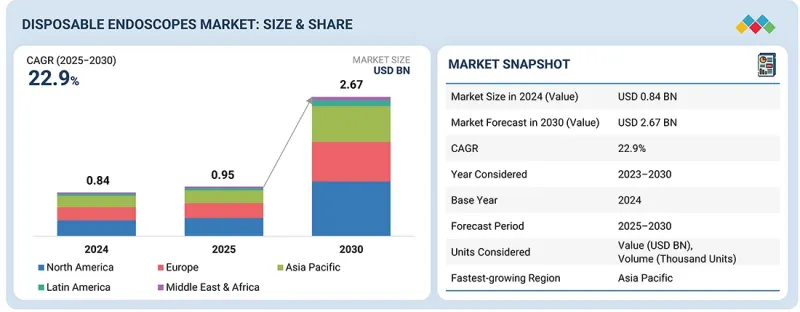
세계의 일회용 내시경 시장의 규모는 2025년 9억 5,000만 달러에서 2030년까지 26억 7,000만 달러에 이를 것으로 예측되며, 2025-2030년 CAGR로 22.9%의 성장이 예상됩니다.
조사 범위
조사 대상 기간
2024-2033년
기준연도
2024년
예측 기간
2025-2030년
단위
10억 달러
부문
유형, 임상 사용, 용도, 최종 사용자, 지역
대상 지역
북미, 유럽, 아시아태평양, 중남미, 중동, 아프리카
일회용 내시경 시장은 만성 질환의 유병률 증가, 저침습 수술에 대한 수요 증가, 이미징 및 광학 기술의 지속적인 발전으로 강한 성장을 보이고 있습니다. 신흥 시장에서는 의료 인프라 개선, 처치 건수 확대, 의료 관광의 성장으로 첨단 내시경 솔루션의 보급이 촉진되어 큰 기회가 탄생하고 있습니다. 그러나 감염 위험, 불충분한 멸균 및 재처리 관행, 높은 처치 비용 등의 과제가 시장 성장을 저해하고, 특히 비용이 중시되고 자원이 한정된 의료 환경에서는 보급이 제한될 가능성이 있습니다.
기관지경 부문은 2024년 일회용 내시경 시장에서 두 번째로 높은 성장률을 기록했습니다.
유형별로 일회용 내시경 시장은 비뇨기 내시경, 기관지경, 방광경, 후두경, 소화기 내시경, 관절경 및 기타 일회용 내시경으로 구분됩니다. 이 중 기관지경 부문은 특히 폐암을 중심으로 호흡기 질환의 세계적인 이환율 증가로 2024년에 두 번째로 높은 시장 점유율을 차지했습니다. American Cancer Society에 따르면 2025년 미국에서 약 22만 6,650건의 새로운 폐암 사례와 12만 4,730건의 관련 사망이 발생했습니다. 한편 World Cancer Research Fund는 2022년 세계적으로 248만 675건의 신규 사례를 보고했습니다. 이 증가하는 질병 부하로 인해 조기 진단과 치료에 사용되는 기관지경 검사에 대한 수요가 크게 높아지고 있습니다. 일회용 기관지경은 교차 오염의 방지, 재처리의 불필요화, 긴급 시나 집중 치료 환경에 있어서의 안정된 성능의 확보에 기여하기 때문에 선택되는 것이 증가하고 있습니다. 게다가 이미징 기술과 조작성의 진보, 병원이나 외래 진료소에서의 채용의 확대가 이 부문의 성장을 더욱 촉진하고 있어 기관지경은 일회용 내시경 시장에서 두 번째로 높은 촉진요인이 되고 있습니다.
수술 부문은 2024년 일회용 내시경 시장에서 가장 큰 점유율을 차지했습니다.
임상 사용 별로 일회용 내시경 시장은 진단과 수술로 나뉩니다. 수술 부문은 2024년에 가장 큰 시장 점유율을 차지했습니다. 이러한 성장은 소화기과, 비뇨기과, 호흡기과, 부인과 같은 다양한 전문 분야에서 저침습 수술의 채용 증가에 의해 촉진됩니다. 외과의사는 탁월한 멸균성, 신뢰할 수 있는 성능, 교차 오염 및 재처리 실수와 관련된 위험을 제거할 수 있다는 점에서 일회용 내시경을 선호합니다. 암, 신장 질환, 호흡기 질환 등 만성 질환의 유병률이 증가함에 따라 정밀한 시인성과 신뢰성이 높은 기구의 사용을 필요로 하는 수술이 증가하고 있습니다. 또한 고해상도 이미징과 인체공학적 디자인을 갖춘 고급 일회용 내시경의 보급으로 수술의 효율성과 안전성이 향상되었습니다. 병원과 외래수술센터(ASC)에서는 감염 관리를 강화하고 업무 효율화를 위한 일회용 기구로의 전환이 진행되고 있습니다. 이러한 요인으로 인해 임상 사용 별로 수술 부문이 일회용 내시경 시장의 주요 촉진요인이 되었습니다.
유럽은 예측 기간에 일회용 내시경 시장에서 두 번째로 큰 규모를 차지할 전망입니다.
세계의 일회용 내시경 시장은 북미, 유럽, 아시아태평양, 라틴아메리카, 중동 및 아프리카의 5개 지역으로 구분됩니다. 2024년 유럽이 시장에서 두 번째로 높은 점유율을 차지했습니다. 이것은 인구 역학 변화, 높은 이환율 및 고급 의료 시스템이라는 복합적 요인에 기인합니다. 이 지역에서는 현저한 고령화가 진행되고 있어 독일의 65세 이상의 인구는 2050년까지 41% 증가해 2,400만명에 달할 것으로 예측되고 있습니다. 게다가 영국에서는 2022년 시점에서 이미 인구의 19%가 65세 이상이며, 진단 검사나 저침습 수술 수요 증가로 이어지고 있습니다. 만성질환과 암 증가도 일회용 내시경 수요를 뒷받침하고 있으며(2024년) 독일 성인의 53.7%가 만성질환을 가진 것으로 보고되었고 암 관련 사망자 수는 영국에서 13만 8,579명(2022년), 독일에서 23만 292명(2023년)에 이르렀습니다. 이러한 요인에 더해 일류 병원, 선진 의료 기술의 채용, 지원적인 규제 프레임워크에 의해 강력한 시장 환경이 형성되어, 유럽은 세계의 일회용 내시경 시장에서 중요한 성장 지역이 되고 있습니다.
이 보고서는 세계의 일회용 내시경 시장에 대한 조사 분석을 통해 주요 촉진요인과 억제요인, 경쟁 구도, 미래 동향 등의 정보를 제공합니다.
목차
제1장 서론
제2장 주요 요약
제3장 중요한 인사이트
일회용 내시경 시장 개요
북미 일회용 내시경 시장 : 최종 사용자별
일회용 내시경 시장의 지리적 스냅샷(2024년)
지리적 구성 : 일회용 내시경 시장의 규모(2025-2030년)
일회용 내시경 시장 : 개발도상시장 vs 선진시장
제4장 시장 개요
시장 역학
성장 촉진요인
억제요인
기회
과제
미충족 요구와 새로운 사업 기회
일회용 내시경 시장에서의 미충족 요구
새로운 사업 기회
상호연결된 시장과 부문 간 기회
상호연결된 시장
부문 간 기회
Tier 1, 2, 3 기업의 전략적 움직임
제5장 업계 동향
Porter's Five Forces 분석
거시경제 전망
GDP의 동향과 예측
세계의 내시경 기기 업계 동향
세계의 연성 내시경 업계 동향
공급망 분석
밸류체인 분석
생태계 분석
가격 설정 분석
일회용 내시경의 평균 판매 가격 동향 : 주요 기업별(2022-2024년)
일회용 내시경의 평균 판매 가격 동향 : 유형별(2022-2024년)
일회용 내시경의 평균 판매 가격 동향 : 지역별(2022-2024년)
무역 분석
수입 시나리오(HS 코드 9018)
수출 데이터(HS 코드 9018)
주요 컨퍼런스 및 이벤트(2025-2027년)
고객사업에 영향을 주는 동향 및 혁신
투자 및 자금조달 시나리오
사례 연구 분석
일회용 내시경 시장에 대한 2025년 미국 관세의 영향
주요 관세율
가격의 영향 분석
국가 및 지역에 미치는 영향
최종 이용 산업에 대한 영향
제6장 기술의 진보, AI에 의한 영향, 특허, 혁신, 미래의 용도
주요 신기술
CMOS 및 CCD 이미징 센서
광섬유 조명 시스템
보완 기술
기술 및 제품 로드맵
단기 : 기반 구축과 조기 상업화(2025-2027년)
중기 : 확장과 표준화(2027-2030년)
장기 : 대규모 상업화와 파괴(2030-2035년 이후)
특허 분석
미래의 용도
AI를 활용한 가시화와 진단 지원
생분해성 친환경 내시경
센서를 내장한 스마트 내시경
일회용 내시경 시장에 대한 AI 및 생성형 AI의 영향
일회용 내시경 처리의 모범 사례
일회용 내시경 시장에서 AI 도입의 사례 연구
상호연결된 인접 생태계와 시장 기업에 미치는 영향
일회용 내시경 시장에서의 생성형 AI의 채용에 대한 고객의 준비 상황
제7장 지속가능성과 규제정세
지역 규제 및 규정 준수
규제기관, 정부기관, 기타 조직
업계 표준
지속가능성에 대한 노력
지속가능성에 미치는 영향과 규제 정책의 노력
인증, 라벨, 환경 기준
제8장 고객정세와 구매행동
의사결정 프로세스
구매자의 이해 관계와 구입 평가 기준
구매 프로세스의 주요 이해 관계자
주요 구매 기준
채용 장벽과 내부 과제
다양한 최종 이용 산업으로부터의 미충족 요구
시장의 수익성
잠재적인 수익
비용역학
주요 용도에 있어서의 마진 기회
제9장 일회용 내시경 시장 : 유형별
비뇨기내시경
기관지경
방광경
소화기내시경
후두경
관절경
기타 일회용 내시경
제10장 일회용 내시경 시장 : 임상 사용별
수술용
진단용
제11장 일회용 내시경 시장 : 용도별
비뇨기과
기관지경 검사
소화기내과
이비인후과
기타 용도
제12장 일회용 내시경 시장 : 최종 사용자별
병원
외래수술센터(ASC)
진료소
기타 최종 사용자
제13장 일회용 내시경 시장 : 지역별
북미
북미의 거시경제 전망
미국
캐나다
유럽
유럽의 거시 경제 전망
독일
영국
프랑스
이탈리아
스페인
기타 유럽
아시아태평양
아시아태평양의 거시 경제 전망
중국
일본
인도
호주
한국
기타 아시아태평양
라틴아메리카
라틴아메리카의 거시 경제 전망
브라질
멕시코
기타 라틴아메리카
중동 및 아프리카
중동 및 아프리카의 거시 경제 전망
GCC 국가
기타 중동 및 아프리카
제14장 경쟁 구도
주요 진입기업의 전략 및 강점
수익 분석(2020-2024년)
시장 점유율 분석(2024년)
기업 평가 매트릭스 : 주요 기업(2024년)
기업 평가 매트릭스 : 스타트업 및 중소기업(2024년)
기업 평가 및 재무 지표
브랜드 및 제품 비교
경쟁 시나리오
제15장 기업 프로파일
주요 기업
AMBU A/S
BOSTON SCIENTIFIC CORPORATION
OLYMPUS CORPORATION
HOYA CORPORATION
VERATHON INC.
KARL STORZ SE & CO. KG
HUNAN VATHIN MEDICAL INSTRUMENT CO., LTD.
INNOVEX MEDICAL CO., LTD.
SCIVITA MEDICAL
GUANGZHOU RED PINE MEDICAL INSTRUMENT CO., LTD.
기타 기업
THE COOPER COMPANIES, INC.
ZHUHAI PUSEN MEDICAL TECHNOLOGY CO., LTD.
UROVIU CORPORATION
OTU MEDICAL
GI VIEW LTD.
TSC LIFE
RICHARD WOLF GMBH
DAICHUAN MEDICA
NEOSCOPE INC.
INTEGRATED ENDOSCOPY
HUGER MEDICAL INSTRUMENT CO., LTD.
XENOCOR
MACROLUX MEDICAL TECHNOLOGY CO., LTD.
SHENZHEN HUGEMED MEDICAL TECHNICAL DEVELOPMENT CO., LTD.
ZHEJIANG GEYI MEDICAL DEVICES CO., LTD.
제16장 조사 방법
제17장 부록
CSM
영문 목차
영문목차
The global disposable endoscopes market is projected to reach USD 2.67 billion by 2030, growing from USD 0.95 billion in 2025, at a CAGR of 22.9% from 2025 to 2030.
Scope of the Report
Years Considered for the Study
2024-2033
Base Year
2024
Forecast Period
2025-2030
Units Considered
Value (USD billion)
Segments
Type, Clinical Usage, Application, End User, and Region
Regions covered
North America, Europe, APAC, LATAM, MEA
The disposable endoscopes market is experiencing strong growth driven by the rising prevalence of chronic diseases, increasing demand for minimally invasive procedures, and ongoing advancements in imaging and optical technologies. Emerging markets offer substantial opportunities due to improving healthcare infrastructure, expanding procedure volumes, and the growth of medical tourism, which facilitate the wider adoption of advanced endoscopic solutions. However, market growth faces challenges such as infection risks, insufficient sterilization and reprocessing practices, and high procedural costs, which may limit broader adoption-particularly in cost-sensitive and resource-limited healthcare settings.
The bronchoscopes segment accounted for the second-largest growth in the disposable endoscopes market in 2024.
By type, the disposable endoscopes market is divided into urology endoscopes, bronchoscopes, cystoscopes, laryngoscopes, GI endoscopes, arthroscopes, and other disposable endoscopes. Among these, the bronchoscopes segment held the second-largest market share in 2024, driven by the increasing global incidence of respiratory diseases, especially lung cancer. According to the American Cancer Society, in 2025, the US is expected to see about 226,650 new lung cancer cases and 124,730 related deaths, while the World Cancer Research Fund reported 2,480,675 new cases worldwide in 2022. This rising disease burden has significantly boosted the demand for bronchoscopy procedures for early diagnosis and treatment. Disposable bronchoscopes are increasingly chosen because they help prevent cross-contamination, eliminate the need for reprocessing, and ensure consistent performance in emergency and intensive care situations. Additionally, advancements in imaging technology and maneuverability, along with growing adoption by hospitals and outpatient clinics, are further driving the growth of this segment, making bronchoscopes the second largest contributor to the disposable endoscopes market.
The surgical segment accounted for the largest share of the disposable endoscopes market in 2024.
By clinical practice, the disposable endoscopes market is divided into diagnostic and surgical uses. In 2024, the surgical use segment held the largest market share. This growth is driven by the rising adoption of minimally invasive surgical procedures across various specialties, including gastroenterology, urology, pulmonology, and gynecology. Surgeons favor disposable endoscopes for their superior sterility, reliable performance, and ability to eliminate risks associated with cross-contamination and reprocessing errors. The increasing prevalence of chronic conditions such as cancer, kidney disorders, and respiratory diseases has led to a rise in surgical procedures that require precise visualization and dependable instrumentation. Additionally, the availability of advanced single-use endoscopes with high-definition imaging and ergonomic designs improves procedural efficiency and safety. Hospitals and outpatient surgical centers are increasingly shifting toward single-use devices to enhance infection control and streamline operations. Collectively, these factors establish the surgical usage segment as the leading contributor to the disposable endoscopes market by clinical application.
Europe accounted for the second-largest position in the disposable endoscopes market during the forecast period.
The global disposable endoscopes market is divided into five major regions: North America, Europe, the Asia Pacific, Latin America, and the Middle East & Africa. In 2024, Europe held the second-largest share in this market. This is due to a mix of demographic trends, high disease rates, and advanced healthcare systems. The region is experiencing notable population aging, with Germany's population aged 65 and older projected to increase by 41% to 24 million by 2050. Additionally, 19% of the UK population was already over 65 in 2022, leading to higher demand for diagnostic and minimally invasive procedures. The growing burden of chronic diseases and cancer also drives the need for disposable endoscopes, with 53.7% of adults in Germany reporting chronic conditions in 2024, and cancer-related deaths reaching 138,579 in England (2022) and 230,292 in Germany (2023). Coupled with well-established hospitals, the adoption of advanced medical technology, and supportive regulatory frameworks, these factors together create a strong market environment, making Europe a key growth region in the global disposable endoscopes market.
A breakdown of the primary participants referred to for this report is provided below:
By Company Type: Tier 1 -40%, Tier 2 -30%, and Tier 3 -30%
By Designation: C-level -50%, Director level -30%, and Others -20%
By Region: North America -30%, Europe - 25%, Asia Pacific -20%, Latin America -15%, and Middle East & Africa -10%
Notes:
Companies are classified into tiers based on their total revenue. The tiers are as follows: Tier 1 = > USD 10.0 billion, tier 2 = USD 1.0 billion to USD 10.0 billion, and tier 3 = < USD 1.0 billion
C-level primaries include CEOs, CFOs, COOs, and VPs.
Others include sales managers, marketing managers, business development managers, product managers, distributors, and suppliers.
The players operating in the disposable endoscopes market include Olympus Corporation (Japan), Boston Scientific Corporation (US), HOYA Corporation (Japan), Ambu A/s (Denmark), Karl Storz SE & Co. KG (Germany), Hunan Vathin Medical Instrument Co., Ltd. (China), Zhuhai Pusen Medical Technology Co., Ltd. (China), GI View Ltd (Isareal), Richard Wolf GmbH (Germany), Daichuan medica (China), Scivita Medical (China), Uroviu Corporation (US), Neoscope Inc. (US), Verathon Inc. A Ropper Technologies Company (US), Integrated Endoscopy (US), HUGER Medical Instrument Co., Ltd. (China), Guangzhou Red Pine Medical Instrument Co. Ltd. (China), Nanchang WOEK Medical Technology Co., Ltd (China), Innovex Medical Co., Ltd. (China), Xenocor (US), MacroLux Medical Technology Co., Ltd. (China), THE COOPER COMPANIES, INC. (US), Shenzhen HugeMed Medical Technical Development Co., Ltd. (China), and Xi'an Haiye Medical Equipment Co., Ltd. (China).
Research Coverage
This report examines the disposable endoscopes market based on type, application, clinical use, end user, and region. It also explores factors such as drivers, restraints, opportunities, and challenges influencing market growth, and provides an overview of the competitive landscape for market leaders. Additionally, the report analyzes micro markets concerning their individual growth trends and forecasts the revenue of market segments across five major regions and their respective countries.
Reasons to Buy the Report
The report will help both established and smaller firms understand the market, which, in turn, will assist them in increasing their market share. Firms purchasing the report can use one or a combination of the strategies mentioned below to strengthen their position in the market presence.
This report provides insights into the following pointers:
Analysis of key drivers (Increasing investments, funds, and grants by government and other organizations, growing focus of hospitals to expand endoscopic units, increasing preference for minimally invasive surgeries, rising need for endoscopy to diagnose & treat target diseases), restraints (High overhead costs of endoscopy procedures), opportunities (Rapidly developing healthcare sector in emerging countries), challenges (Environmental concerns related to medical waste disposal, limited reimbursement policies)
Market Penetration: Complete knowledge of the spectrum of products presented by the major companies in the disposable endoscopes market
Product Development/Innovation: Comprehensive understanding of the forthcoming trends, research and development initiatives, and product launches within the disposable endoscopes market
Market Development: Complete knowledge about profitable developing regions
Market Diversification: Exhaustive knowledge of new goods, expanding geographies, and current changes in the disposable endoscopes industry help to diversify the market
Competitive Assessment: In-depth assessment of market share, growth strategies and product offerings of leading players like Olympus Corporation (Japan), Boston Scientific Corporation (US), HOYA Corporation (Japan), Ambu A/s (Denmark), Karl Storz SE & Co. KG (Germany), Hunan Vathin Medical Instrument Co., Ltd. (China), Zhuhai Pusen Medical Technology Co., Ltd. (China), and among others.