항공기 열교환기 시장 : 판매 거점별, 플랫폼별, 디자인별, 매체별, 재질별, 구조별, 용도별, 지역별 예측(-2030년)
Aircraft Heat Exchanger Market by Design, Application, Medium, Platform, Material, Architecture, Point of Sale and Region - Global Forecast to 2030
상품코드:1883068
리서치사:MarketsandMarkets
발행일:2025년 11월
페이지 정보:영문 265 Pages
라이선스 & 가격 (부가세 별도)
ㅁ Add-on 가능: 고객의 요청에 따라 일정한 범위 내에서 Customization이 가능합니다. 자세한 사항은 문의해 주시기 바랍니다.
한글목차
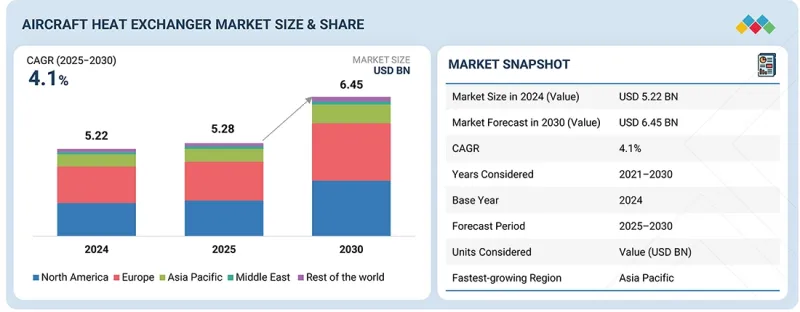
항공기 열교환기 시장 규모는 예측 기간 동안 CAGR 4.1%로 성장했으며 2025년 52억 8,000만 달러로 평가되었고 2030년에는 64억 5,000만 달러에 이를 것으로 전망됩니다. 시장 성장은 주로 현대적이고 연료 효율이 높은 항공기의 생산 증가, 정비·수리·개조(MRO) 활동 확대, 상업 및 군용 항공 부문 전반에 걸친 지속적인 기체 현대화 노력에 의해 주도되고 있습니다. 항공기 시스템이 더욱 통합되고 열적으로 복잡해짐에 따라, 제조사들은 운영 효율성 향상, 부품 신뢰성 확보, 엄격한 배출 기준 준수를 위해 소형 고성능 열교환기에 대한 투자를 확대하고 있습니다.
조사 범위
조사 기간
2021-2030년
기준 연도
2024년
예측 기간
2025-2030년
대상 단위
금액(10억 달러)
부문
판매 거점별, 플랫폼별, 디자인별, 매체별, 재질별, 구조별, 용도별, 지역별
대상 지역
북미, 유럽, 아시아태평양 및 기타 지역
또한 경량 재료, 적층 조형, 최적화된 핀 코어 형상의 진보에 의해 우수한 열전달 성능을 실현하면서, 시스템 전체의 중량을 삭감하는 것이 가능해지고 있습니다.
엔진 시스템 부문은 고온 환경에서 최적의 열 균형과 운영 효율성을 유지하는 데 필수적인 역할을 수행하기 때문에 예측 기간 동안 가장 높은 CAGR은 성장할 것으로 전망됩니다. 현대식 터보팬 및 터보프롭 엔진은 상당한 열 부하를 발생시키며, 이는 열 응력을 방지하고 연료 효율을 유지하기 위해 효과적으로 관리되어야 합니다. GE Aerospace, Rolls-Royce plc, Pratt & Whitney와 같은 주요 OEM 업체들이 더 높은 압력비와 더 엄격한 열 마진을 가진 차세대 추진 시스템을 개발함에 따라, 특히 판형 핀 및 마이크로채널 설계와 같은 첨단 열교환기의 채택이 계속 가속화되고 있습니다.
OEM 부문은 예측 기간 동안 에어버스, 보잉, 엠브라에르, COMAC 등 주요 제조사들의 강력한 항공기 생산 속도와 상당한 주문 잔고에 힘입어 애프터마켓 부문보다 높은 성장을 기록할 것으로 예상됩니다. 신규 생산되는 각 항공기는 엔진, 환경 제어, 항공전자 냉각 등 다양한 시스템에 걸쳐 다수의 열교환기를 통합하여 OEM 조립 라인으로부터 지속적인 수요를 창출합니다. 또한 첨단 추진 및 하이브리드-전기 구성을 갖춘 차세대 항공기 플랫폼의 지속적인 개발은 더욱 소형화되고 경량화되며 효율적인 열 관리 시스템에 대한 필요성을 가속화하고 있습니다. 성장을 주도하는 또 다른 중요한 요인은 항공기 조립 과정에서 적층 제조(3D 프린팅) 및 고성능 소재의 통합이 증가하면서 열 효율 개선, 시스템 중량 감소, 설계 유연성 향상이 가능해진 점입니다. OEM 업체들은 첨단 복합재 구조물 및 신형 추진 기술과 원활한 통합을 보장하는 열교환기를 우선적으로 채택하고 있습니다. 애프터마켓 교체 부품과 달리 OEM 업체들은 다년간 생산 계약 및 장기 공급 파트너십을 통해 혜택을 요구하며, 주요 공급업체들은 항공기 프로그램에 장기적으로 참여하여 수명 주기를 연장합니다.
아시아태평양 지역은 급속한 항공기 함대 확장, 강력한 경제 성장, 국내 항공우주 제조업에 대한 투자 증가에 힘입어 2030년까지 항공기 열교환기 시장에서 가장 높은 성장률을 보일 것으로 예상됩니다. 중국, 인도, 일본 등의 국가들은 대규모 상업용 항공기 도입 및 자체 항공기 개발 프로그램을 통해 지역 성장을 주도하고 있습니다. 증가하는 항공 여객 수송량과 지역 항공사들의 확대 역시 해당 지역의 성장을 촉진하고 있습니다.
방위 분야에서는 인도, 한국, 일본의 지역 현대화 프로그램이 고효율 열 관리 시스템을 장착한 첨단 전투기, 수송기, 무인항공기(UAV)의 조달을 촉진하고 있습니다. 또한 인도네시아, 말레이시아, 필리핀과 같은 신흥국들은 MRO(정비·수리·개조) 인프라를 확장함으로써 열교환기 교체 및 유지보수를 위한 애프터마켓 기회를 강화하고 있습니다. 이러한 요소들이 복합적으로 작용하여 아시아태평양 지역은 상업 및 군용 항공 부문 전반에 걸친 지속적인 OEM 생산량, 증가하는 방위 조달, 그리고 함대 효율성에 대한 관심 증대로 인해 가장 빠르게 성장하는 시장으로 자리매김하고 있습니다.
본 보고서에서는 세계의 항공기 열교환기 시장에 대해 조사했으며, 판매 거점별, 플랫폼별, 디자인별, 매체별, 재질별, 구조별, 용도별, 지역별 동향 및 시장 진출기업 프로파일 등을 정리했습니다.
목차
제1장 서론
제2장 조사 방법
제3장 주요 요약
제4장 중요 인사이트
제5장 시장 개요
소개
시장 역학
가격 분석
밸류체인 분석
생태계 분석
기술 로드맵
고객사업에 영향을 주는 동향과 혼란
관세 및 규제 상황
무역 데이터
이용 사례 분석
주요 이해관계자와 구매 기준
주요 회의 및 이벤트
투자 및 자금조달 시나리오
비즈니스 모델
거시경제 전망
AI 영향
특허 분석
기술 분석
메가 트렌드의 영향
제6장 항공기 열교환기 시장(판매 거점별)
소개
OEM
애프터마켓
제7장 항공기 열교환기 시장(플랫폼별)
소개
민간항공
비즈니스 및 일반 항공
군용 항공
첨단 항공 모빌리티
무인 항공기
제8장 항공기 열교환기 시장(디자인별)
소개
판형 핀
튜브 핀
제9장 항공기 열교환기 시장(매체별)
소개
공기-공기
공기-액체
액체-공기
액체-액체
제10장 항공기 열교환기 시장(재질별)
소개
알루미늄
스테인레스 스틸
니켈 합금
티타늄
제11장 항공기 열교환기 시장(구조별)
소개
전기
비전기
제12장 항공기 열교환기 시장(용도별)
소개
환경 냉각 시스템
엔진 시스템
블리드 에어 시스템
항공전자/전자 포드 냉각
유압 냉각
제13장 항공기 열교환기 시장(지역별)
소개
북미
PESTLE 분석
미국
캐나다
유럽
PESTLE 분석
영국
독일
프랑스
스페인
이탈리아
아시아태평양
PESTLE 분석
중국
인도
일본
호주
한국
중동
PESTLE 분석
GCC
이스라엘
튀르키예
라틴아메리카
PESTLE 분석
브라질
멕시코
아프리카
PESTLE 분석
남아프리카
나이지리아
제14장 경쟁 구도
소개
주요 참가 기업의 전략/강점(2021-2025년)
수익 분석(2021-2024년)
시장 점유율 분석(2024년)
기업평가 매트릭스 : 주요 진입기업(2024년)
기업평가 매트릭스 : 신흥기업/중소기업(2024년)
기업평가와 재무지표
브랜드/제품 비교
경쟁 시나리오
제15장 기업 프로파일
주요 진출기업
HONEYWELL INTERNATIONAL INC.
RTX
SAFRAN
LIEBHERR GROUP
PARKER HANNIFIN CORPORATION
AMETEK, INC.
BOYD CORPORATION
CONFLUX TECHNOLOGY
TAT TECHNOLOGIES LTD.
SUMITOMO PRECISION PRODUCTS CO., LTD.
JAMCO CORPORATION
UNISON INDUSTRIES, LLC
WALL COLMONOY CORPORATION
TRIUMPH GROUP
THERMOVAC AEROSPACE
RANGSONS AEROSPACE PRIVATE LIMITED
EATON
기타 기업
ADDUP SAS
SINTAVIA, LLC
INTERGALACTIC
MORPHEUS DESIGNS
PARFUSE CORPORATION
SIGNIA AEROSPACE
AIRMARK COMPONENTS
AKG GROUP
AVIATION TECHNICAL SERVICES
VITESSE SYSTEMS
제16장 부록
HBR
영문 목차
영문목차
The aircraft heat exchanger market is projected to reach USD 6.45 billion by 2030, growing from USD 5.28 billion in 2025, at a CAGR of 4.1% during the forecast period. Market growth is primarily driven by the increasing production of modern, fuel-efficient aircraft, rising MRO activities, and continuous fleet modernization initiatives across the commercial and military aviation sectors. As aircraft systems become more integrated and thermally complex, manufacturers are increasingly investing in compact, high-performance heat exchangers to enhance operational efficiency, ensure component reliability, and comply with stringent emission standards.
Scope of the Report
Years Considered for the Study
2021-2030
Base Year
2024
Forecast Period
2025-2030
Units Considered
Value (USD Billion)
Segments
By Design, Application, Medium, Platform, Material, Architecture and Region
Regions covered
North America, Europe, APAC, RoW
Moreover, advancements in lightweight materials, additive manufacturing, and optimized fin-core geometries are enabling superior heat transfer performance while reducing overall system weight.
"By application, the engine systems segment is projected to grow at the highest CAGR during the forecast period."
The engine systems segment is projected to grow at the highest CAGR during the forecast period due to the essential role of engine systems in maintaining optimal thermal balance and operational efficiency in high-temperature environments. Modern turbofan and turboprop engines generate substantial heat loads that must be effectively managed to prevent thermal stress and maintain fuel efficiency. As leading OEMs, such as GE Aerospace, Rolls-Royce plc, and Pratt & Whitney, develop next-generation propulsion systems with higher pressure ratios and tighter thermal margins, the adoption of advanced heat exchangers-particularly plate-fin and microchannel designs-continues to accelerate.
Additionally, the engine systems segment experiences consistent aftermarket demand, as oil, fuel, and bleed air cooling systems require regular maintenance and replacement during overhaul cycles. This recurring demand is reinforced by the global shift toward sustainable aviation, where minimizing heat-related inefficiencies directly supports reduced fuel consumption and lower emissions. Consequently, engine system heat exchangers remain central to improving aircraft performance, durability, and environmental compliance across all major aviation platforms.
"By point of sale, the OEM segment is projected to grow at a higher CAGR than the aftermarket segment during the forecast period."
The OEM segment is projected to record higher growth than the aftermarket segment during the forecast period, driven by strong aircraft production rates and substantial order backlogs from major manufacturers, including Airbus, Boeing, Embraer, and COMAC. Each newly produced aircraft integrates multiple heat exchangers across various systems, including engines, environmental control, and avionics cooling, resulting in consistent demand from OEM assembly lines. Additionally, the continuous development of next-generation aircraft platforms with advanced propulsion and hybrid-electric configurations is accelerating the need for more compact, lightweight, and efficient thermal management systems. Another significant factor driving growth is the increasing integration of additive manufacturing and high-performance materials during aircraft assembly, which enables improved thermal efficiency, reduced system weight, and enhanced design flexibility. OEMs are prioritizing heat exchangers that ensure seamless integration with advanced composite structures and new propulsion technologies. Unlike aftermarket replacements, OEMs demand benefits from multi-year production contracts and long-term supply partnerships, where key suppliers are embedded in aircraft programs for extended lifecycles.
"Asia Pacific is projected to grow at the highest rate during the forecast period."
Asia Pacific is projected to register the highest growth rate in the aircraft heat exchanger market through 2030, supported by rapid fleet expansion, strong economic growth, and increasing investments in domestic aerospace manufacturing. Countries such as China, India, and Japan are leading regional growth through large-scale commercial aircraft acquisitions and indigenous aircraft development programs. Rising air passenger traffic and the growing presence of regional airlines are also fueling the growth of the region.
On the defense side, regional modernization programs in India, South Korea, and Japan are boosting procurement of advanced fighter aircraft, transport planes, and UAVs equipped with high-efficiency thermal management systems. Furthermore, emerging nations such as Indonesia, Malaysia, and the Philippines are expanding their MRO infrastructure, thereby strengthening aftermarket opportunities for heat exchanger replacement and maintenance. Combined, these factors are positioning Asia Pacific as the fastest-growing market, driven by sustained OEM output, growing defense procurement, and increased focus on fleet efficiency across both commercial and military aviation sectors.
The breakdown of profiles for primary participants in the aircraft heat exchanger market is provided below:
By Company Type: Tier 1 - 35%, Tier 2 - 45%, and Tier 3 - 20%
By Designation: C Level - 35%, Director Level - 25%, and Others - 40%
By Region: North America - 25%, Europe - 15%, Asia Pacific - 45%, Middle East - 10% Rest of the World (RoW) - 5%
Research Coverage:
This market study covers the aircraft heat exchanger market across various segments and subsegments. It aims to estimate the size and growth potential of this market across different parts and regions. This study also includes an in-depth competitive analysis of the key players in the market, their company profiles, key observations related to their products and business offerings, recent developments, and key market strategies they adopted.
Reasons to buy this report:
The report will help the market leaders/new entrants with information on the closest approximations of the revenue numbers for the overall aircraft heat exchanger market. It will also help stakeholders understand the competitive landscape and gain more insights to position their businesses better and plan suitable go-to-market strategies. The report will also help stakeholders understand the market pulse and will provide information on key market drivers, restraints, challenges, and opportunities.
The report provides insights into the following pointers:
Market Drivers (Growing fleet sizes and aircraft renewals, tightening fuel efficiency and CO2 requirements, rising avionics and electrical power density), Restraints (Weight pressure drop trade-offs, supply chain constraints in specialty materials and furnace capacity), Opportunities (Expansion of additive manufacturing for exchanger cores, adoption of sensorized units and predictive maintenance), Challenges (Detection of internal effects, integration with tight high-load spaces)
Market Penetration: Comprehensive information on aircraft heat exchangers offered by the top players in the market
Product Development/Innovation: Detailed insights on upcoming technologies, research & development activities, and product launches in the aircraft heat exchanger market
Market Development: Comprehensive information about lucrative markets across varied regions
Market Diversification: Exhaustive information about new products, untapped geographies, recent developments, and investments in the aircraft heat exchanger market
Competitive Assessment: In-depth assessment of market share, growth strategies, products, and manufacturing capabilities of leading players in the aircraft h/at exchanger market
TABLE OF CONTENTS
1 INTRODUCTION
1.1 STUDY OBJECTIVES
1.2 MARKET DEFINITION
1.3 STUDY SCOPE
1.3.1 MARKETS COVERED AND REGIONAL SCOPE
1.3.2 INCLUSIONS AND EXCLUSIONS
1.3.3 YEARS CONSIDERED
1.4 CURRENCY CONSIDERED
1.5 STAKEHOLDERS
2 RESEARCH METHODOLOGY
2.1 RESEARCH DATA
2.1.1 SECONDARY DATA
2.1.1.1 Secondary sources
2.1.2 PRIMARY DATA
2.1.2.1 Primary sources
2.1.2.2 Breakdown of primary interviews
2.2 FACTOR ANALYSIS
2.2.1 DEMAND-SIDE INDICATORS
2.2.2 SUPPLY-SIDE INDICATORS
2.3 MARKET SIZE ESTIMATION
2.3.1 BOTTOM-UP APPROACH
2.3.1.1 Market size estimation methodology
2.3.2 TOP-DOWN APPROACH
2.4 DATA TRIANGULATION
2.5 RESEARCH ASSUMPTIONS
2.6 RESEARCH LIMITATIONS
2.7 RISK ASSESSMENT
3 EXECUTIVE SUMMARY
4 PREMIUM INSIGHTS
4.1 ATTRACTIVE OPPORTUNITIES FOR PLAYERS IN AIRCRAFT HEAT EXCHANGER MARKET
4.2 AIRCRAFT HEAT EXCHANGER MARKET, BY ARCHITECTURE
4.3 AIRCRAFT HEAT EXCHANGER MARKET, BY DESIGN
4.4 AIRCRAFT HEAT EXCHANGER MARKET, BY MATERIAL
4.5 AIRCRAFT HEAT EXCHANGER MARKET, BY PLATFORM
5 MARKET OVERVIEW
5.1 INTRODUCTION
5.2 MARKET DYNAMICS
5.2.1 DRIVERS
5.2.1.1 Expanding fleet sizes and ongoing aircraft renewals
5.2.1.2 Focus on reducing fuel consumption and emissions
5.2.1.3 Increasing complexity of modern aircraft systems
5.2.2 RESTRAINTS
5.2.2.1 Trade-off between weight reduction and pressure-drop performance
5.2.2.2 Supply chain constraints in specialty materials and furnace capacity
5.2.3 OPPORTUNITIES
5.2.3.1 Expansion of additive manufacturing for exchanger cores
5.2.3.2 Adoption of on-demand connectivity services
5.2.4 CHALLENGES
5.2.4.1 Detection of internal defects in complex cores
5.2.4.2 Integration within tight, high-load spaces
5.3 PRICING ANALYSIS
5.3.1 INDICATIVE PRICING ANALYSIS FOR OEMS, BY PLATFORM AND APPLICATION
5.3.2 INDICATIVE PRICING ANALYSIS FOR AFTERMARKET, BY PLATFORM AND APPLICATION
5.4 VALUE CHAIN ANALYSIS
5.5 ECOSYSTEM ANALYSIS
5.5.1 MANUFACTURERS
5.5.2 SERVICE PROVIDERS
5.5.3 END USERS
5.6 TECHNOLOGY ROADMAP
5.7 TRENDS AND DISRUPTIONS IMPACTING CUSTOMER BUSINESS
5.8 TARIFF AND REGULATORY LANDSCAPE
5.8.1 TARIFF DATA
5.8.2 REGULATORY BODIES, GOVERNMENT AGENCIES, AND OTHER ORGANIZATIONS
5.8.3 REGULATORY FRAMEWORK
5.9 TRADE DATA
5.9.1 IMPORT SCENARIO (HS CODE 841950)
5.9.2 EXPORT SCENARIO (HS CODE 841950)
5.10 USE CASE ANALYSIS
5.10.1 AKG GROUP'S HEAT EXCHANGER FOR ELECTRIC AVIATION SYSTEMS
5.10.2 CONFLUX TECHNOLOGIES' THERMAL MANAGEMENT FOR EVTOL BATTERY COOLING