Aircraft Heat Exchanger Market Opportunity, Growth Drivers, Industry Trend Analysis, and Forecast 2026 - 2035
상품코드:1892708
리서치사:Global Market Insights Inc.
발행일:2025년 12월
페이지 정보:영문 185 Pages
라이선스 & 가격 (부가세 별도)
ㅁ Add-on 가능: 고객의 요청에 따라 일정한 범위 내에서 Customization이 가능합니다. 자세한 사항은 문의해 주시기 바랍니다.
한글목차
세계의 항공기 열교환기 시장은 2025년에 49억 달러로 평가되었고, 2035년까지 연평균 복합 성장률(CAGR) 4.3%로 성장하여 74억 달러에 이를 것으로 예측됩니다.
시장 성장은 항공 여객 수송량 증가, 연료 효율성에 대한 관심 증가, 첨단 항공 모빌리티의 부상, 무인항공기(UAV) 및 군용 항공기 적용 확대에 의해 주도되고 있습니다. 승객 수요 증가는 항공사가 항공기의 성능, 효율성 및 지속가능성을 향상시켜야 한다는 압력을 가하고 있으며, 이는 열교환기 채택을 촉진하고 있습니다. 전기 및 수소 전기 추진 시스템은 첨단 파워트레인에서 발생하는 다량의 열을 관리할 수 있는 경량, 고성능 열 솔루션의 필요성을 증가시키고 있습니다. 열교환기는 모든 항공기 시스템, 특히 차세대 전기 및 하이브리드 전기 플랫폼에서 최적의 운영 성능을 유지하는 데 중요한 역할을 하며 저공해 항공 및 지속 가능한 비행 이니셔티브에 대한 기대에 부응하고 있습니다.
시장 범위
개시 연도
2025년
예측 연도
2026-2035년
개시 연도 시장 규모
49억 달러
예측 금액
74억 달러
CAGR
4.3%
판형 열교환기 부문은 2035년까지 51억 달러에 달할 것으로 예측됩니다. 컴팩트한 형태, 높은 열효율, 그리고 첨단 경량 항공기 설계에 대한 적합성으로 인해 채택이 가속화되고 있습니다. 성장세는 주로 제한된 공간 내에서 효율적인 열 방출이 필요한 현대식 엔진, 무인 항공기(UAV), 전기 항공기와의 통합에 의해 주도되고 있습니다.
알루미늄 합금 부문은 2025년 47.8%의 점유율을 차지했습니다. 알루미늄 합금 열교환기는 우수한 강도 대 중량비, 제조 용이성, 비용 효율성으로 인해 선호되고 있습니다. 항공사들은 경량화 및 연료 효율성 향상을 위해 협동체, 와이드바디 항공기, 무인항공기 플랫폼에서 이러한 소재에 대한 의존도를 높이고 있습니다. 제조업체들은 차세대 항공기 설계를 지원하기 위해 고강도 및 열전도율이 우수한 알루미늄 재종에 집중할 것으로 예측됩니다.
미국 항공기 열교환기 시장은 2025년 16억 달러 규모에 달할 것으로 예측됩니다. 이 지역의 성장은 기체 현대화, 상업 및 지역 항공 교통량 증가, 하이브리드 전기 및 무인 항공기 플랫폼의 채택 증가에 의해 주도되고 있습니다. 각 업체들은 차세대 항공기를 위한 모듈식 열교환기 개발에 집중하는 한편, 무인항공기 및 지역 항공 확대를 지원하는 기술에 대한 투자를 진행하고 있습니다.
목차
제1장 조사 방법
시장 범위와 정의
조사 설계
조사 접근
데이터 수집 방법
데이터 마이닝 소스
세계
지역별/국가별
기본 추정치와 계산
기준연도 계산
시장 추정 주요 동향
1차 조사와 검증
1차 정보
예측 모델
조사의 전제조건과 제한 사항
제2장 주요 요약
제3장 업계 인사이트
생태계 분석
공급업체 상황
이익률 분석
비용 구조
각 단계별 부가가치
밸류체인에 영향을 미치는 요인
파괴적 변화
업계에 대한 영향요인
성장 촉진요인
업계의 잠재적 리스크&과제
시장 기회
성장 가능성 분석
규제 상황
북미
유럽
아시아태평양
라틴아메리카
중동 및 아프리카
Porter's Five Forces 분석
PESTEL 분석
기술과 혁신 동향
현재 기술 동향
신기술
신흥 비즈니스 모델
컴플라이언스 요건
공급망 회복탄력성
지정학적 분석
노동력 분석
디지털 전환
합병, 인수 및 전략적 제휴 동향
리스크 평가와 관리
주요 계약 획득 사례(2022-2025년)
제4장 경쟁 구도
서론
기업의 시장 점유율 분석
지역별
북미
유럽
아시아태평양
라틴아메리카
중동 및 아프리카
주요 기업의 경쟁 벤치마킹
재무 실적 비교
매출
이익률
연구개발
제품 포트폴리오 비교
제품 라인 폭
기술
혁신
지역별 전개 비교
세계 전개 분석
서비스 네트워크 커버율
지역별 시장 침투율
경쟁 포지셔닝 매트릭스
리더 기업
챌린저
팔로워
니치 기업
전략적 전망 매트릭스
주요 발전, 2021-2024
인수합병(M&A)
제휴 및 공동 사업
기술적 진보
확대와 투자 전략
디지털 전환 대처
신흥/스타트업 경쟁 동향
제5장 시장 추산 및 예측 : 열교환기 유형별, 2022-2035
주요 동향
플레이트 핀 열교환기
튜브 핀 열교환기
제6장 시장 추산 및 예측 : 재질별, 2022-2035
주요 동향
알루미늄 합금
스테인리스 스틸
티타늄
구리
기타
제7장 시장 추산 및 예측 : 냉각 매체별, 2022-2035
주요 동향
Air-to-air
Air-to-liquid
Liquid-to-liquid
Liquid-to-air
제8장 시장 추산 및 예측 : 용도별, 2022-2035
주요 동향
엔진 냉각
객실 냉난방(ECS)
아비오닉스 냉각
유압 냉각
연료 가열 및 냉각
기타
제9장 시장 추산 및 예측 : 항공기 유형별, 2022-2035
주요 동향
민간 항공기
협폭동체 항공기
광폭동체 항공기
리저널 제트기
군용기
전투기
수송기
비즈니스 항공
일반 항공
헬리콥터 및 회전익기
제10장 시장 추산 및 예측 : 최종 용도별, 2022-2035
주요 동향
OEM(LINE-FIT)
애프터마켓(MRO)
제11장 시장 추산 및 예측 : 지역별, 2021-2034
주요 동향
북미
미국
캐나다
유럽
독일
영국
프랑스
이탈리아
스페인
네덜란드
아시아태평양
중국
인도
일본
호주
한국
라틴아메리카
브라질
멕시코
아르헨티나
중동 및 아프리카
남아프리카공화국
사우디아라비아
아랍에미리트(UAE)
제12장 기업 개요
세계의 주요 기업
Honeywell International Inc.
RTX
Liebherr Group
Parker Hannifin Corp
지역별 주요 기업
북미
3D Systems, Inc
AMETEK Inc.
Boyd Corporation
유럽
Safran S.A
Meggitt PLC
Triumph Group
아시아태평양
JAMCO Corporation
HS-Nauka
TAT Technologies Ltd
니치 기업/디스럽터
Conflux Technology
Essex Industries, Inc.
ETP Thermal Dynamics
THERMOVAC AEROSPACE
Wall Colmonoy
LSH
영문 목차
영문목차
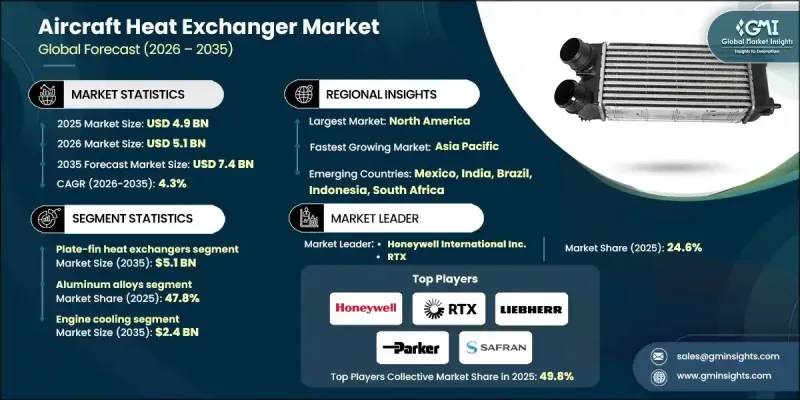
The Global Aircraft Heat Exchanger Market was valued at USD 4.9 billion in 2025 and is estimated to grow at a CAGR of 4.3% to reach USD 7.4 billion by 2035.
Market growth is propelled by rising air passenger traffic, increasing focus on fuel efficiency, the emergence of advanced air mobility, and the growing applications of UAVs and military aircraft. Rising passenger demand is creating pressure on airlines to improve aircraft performance, efficiency, and sustainability, which in turn fuels the adoption of heat exchangers. Electric and hydrogen-electric propulsion systems are driving the need for lightweight, high-performance thermal solutions that can manage substantial heat from advanced powertrains. Heat exchangers play a critical role in maintaining optimal operational performance across all aircraft systems, particularly in new-generation electric and hybrid-electric platforms, meeting the expectations of low-emission aviation and sustainable flight initiatives.
Market Scope
Start Year
2025
Forecast Year
2026-2035
Start Value
$4.9 Billion
Forecast Value
$7.4 Billion
CAGR
4.3%
The plate-fin heat exchangers segment is expected to reach USD 5.1 billion by 2035. Their compact form, high thermal efficiency, and suitability for advanced and lightweight aircraft designs have accelerated adoption. Growth is largely driven by integration with modern engines, UAVs, and electric aircraft, which require efficient heat dissipation within confined spaces.
The aluminum alloys segment held 47.8% share in 2025. Heat exchangers made from aluminum alloys are favored for their superior strength-to-weight ratio, manufacturability, and cost-effectiveness. Airlines increasingly rely on these materials across narrow-body, wide-body, and UAV platforms to reduce weight and enhance fuel efficiency. Manufacturers are expected to focus on high-strength, thermally conductive aluminum grades to support next-generation aircraft designs.
U.S. Aircraft Heat Exchanger Market generated USD 1.6 billion in 2025. Growth in this region is driven by fleet modernization, expanding commercial and regional air traffic, and rising adoption of hybrid-electric and UAV platforms. Companies are concentrating on modular, thermally optimized heat exchangers for next-generation aircraft while investing in technology to support UAVs and regional aviation expansion.
Key players operating in the Global Aircraft Heat Exchanger Market include 3D Systems, Inc., AMETEK Inc., Boyd Corporation, Conflux Technology, Essex Industries, Inc., ETP Thermal Dynamics, Honeywell International Inc., HS-Nauka, JAMCO Corporation, Liebherr Group, and Meggitt PLC. Companies in the Global Aircraft Heat Exchanger Market strengthen their position by focusing on research and development to design high-efficiency, lightweight, and thermally optimized solutions for next-generation aircraft. They are investing in advanced manufacturing techniques such as 3D printing to produce complex geometries with enhanced heat transfer efficiency. Strategic collaborations with aviation OEMs and defense contractors expand market reach and support co-development of electric and hybrid propulsion systems. Firms also emphasize modular product designs for faster integration and cost-effective maintenance, while targeting regional markets with growing air traffic and UAV adoption to secure long-term contracts and boost market presence globally.
Table of Contents
Chapter 1 Methodology
1.1 Market scope and definition
1.2 Research design
1.2.1 Research approach
1.2.2 Data collection methods
1.3 Data mining sources
1.3.1 Global
1.3.2 Regional/Country
1.4 Base estimates and calculations
1.4.1 Base year calculation
1.4.2 Key trends for market estimation
1.5 Primary research and validation
1.5.1 Primary sources
1.6 Forecast model
1.7 Research assumptions and limitations
Chapter 2 Executive Summary
2.1 Industry 360° synopsis, 2022 - 2035
2.2 Key market trends
2.2.1 Heat exchanger type trends
2.2.2 Material type trends
2.2.3 Cooling medium trends
2.2.4 Application trends
2.2.5 Aircraft type trends
2.2.6 End use trends
2.2.7 Regional trends
2.3 TAM analysis, 2026-2035
2.4 CXO perspectives: Strategic imperatives
2.4.1 Executive decision points
2.4.2 Critical success factors
2.5 Future outlook and strategic recommendations
Chapter 3 Industry Insights
3.1 Industry ecosystem analysis
3.1.1 Supplier landscape
3.1.2 Profit margin analysis
3.1.3 Cost structure
3.1.4 Value addition at each stage
3.1.5 Factor affecting the value chain
3.1.6 Disruptions
3.2 Industry impact forces
3.2.1 Growth drivers
3.2.1.1 Rising air passenger traffic
3.2.1.2 Rising demand for fuel efficiency
3.2.1.3 Growth of advanced air mobility & electrified propulsion