생체인식 시스템 시장(-2030년) : 인증 방식(지문, 홍채, 얼굴, 음성, 정맥, 장문, 서명, 다요소, 보행, 키스트로크), 제공 구분(센서, 카메라, 리더, 스캐너, 소프트웨어 및 서비스), 유형(접촉형, 비접촉형), 모빌리티별
Biometric System Market by Authentication (Fingerprint, Iris, Face, Voice, Vein, Palm, Signature, Multi-factor, Gait, Keystrokes), Offering (Sensor, Camera, Reader, Scanner, Software, Service), Contact, Contactless, Mobility - Global Forecast to 2030
상품코드:1880373
리서치사:MarketsandMarkets
발행일:2025년 10월
페이지 정보:영문 369 Pages
라이선스 & 가격 (부가세 별도)
ㅁ Add-on 가능: 고객의 요청에 따라 일정한 범위 내에서 Customization이 가능합니다. 자세한 사항은 문의해 주시기 바랍니다.
한글목차
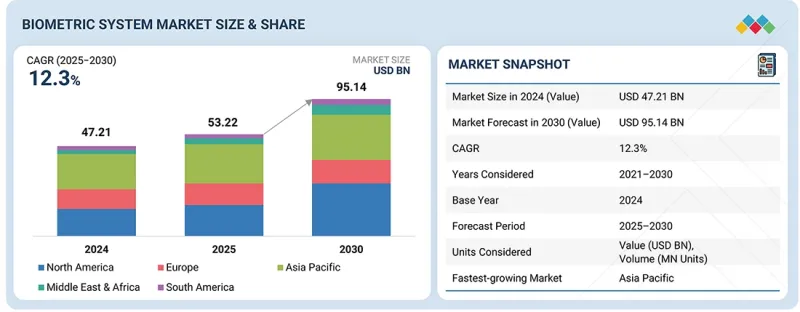
생체인식 시스템 시장 규모는 2025년 532억 2,000만 달러에서 2025-2032년 CAGR 12.3%로 성장하여 2030년에는 951억 4,000만 달러에 이를 것으로 예측됩니다.
스마트폰, 노트북, 태블릿, 웨어러블, 스마트홈 기기에 고도의 생체 인식 기능이 통합되면서 CE 제품의 생체 인식 기술에 대한 수요가 빠르게 증가하고 있습니다. 지문 센서, 얼굴 인식, 홍채 스캔, 음성 인식은 많은 기기에서 표준으로 채택되어 안전하고 편리한 사용자 액세스를 제공하는 동시에 전반적인 사용자 경험을 향상시키고 있습니다.
조사 범위
조사 대상 기간
2021-2030년
기준 연도
2024년
예측 기간
2025-2030년
단위
금액(달러)
부문
제공 구분, 유형, 산업, 지역별
대상 지역
북미, 유럽, 아시아태평양, 기타 지역
모바일 결제, 디지털 지갑, 온라인 뱅킹의 성장과 함께 소비자들이 보안과 편의성을 중시하는 가운데, 신뢰할 수 있는 생체 인증의 필요성이 가속화되고 있습니다. 또한, 스마트 워치, 피트니스 트래커와 같은 웨어러블 기기에서는 건강 매개변수 모니터링, 활동 추적, 안전한 기기 액세스를 제공하기 위해 생체 인식 센서를 점점 더 많이 활용하고 있습니다. 보안 시스템, 도어락, 홈 어시스턴트 등 스마트홈 제품도 부정 접근을 방지하기 위해 생체 인식 솔루션을 통합하고 있습니다. 디지털화의 진전, IoT 기기의 보급 확대, 개인화되고 안전한 경험을 원하는 소비자 니즈가 맞물려 괄목할 만한 성장을 견인하고 있습니다. 기술의 발전, 센서의 소형화, AI를 활용한 분석으로 보다 정확하고 원활한 인증이 가능해짐에 따라 CE 제품은 생체 인식 시스템 시장에서 높은 성장 기회로 자리매김하고 있습니다.
"소프트웨어 부문이 2025년과 2030년 시장에서 주요 점유율을 차지할 것으로 예측됩니다."
소프트웨어 부문은 고급 ID 관리, 인증 및 분석 솔루션에 대한 수요 증가로 인해 2025년과 2030년 시장에서 중요한 점유율을 차지할 것으로 예측됩니다. 생체 인식 소프트웨어는 지문, 얼굴, 홍채, 음성 인식 등 다양한 방식으로 정확한 데이터 수집, 처리 및 검증을 가능하게 합니다. 클라우드 기반의 AI 지원 소프트웨어 솔루션은 실시간 분석, 부정행위 감지, 기업 보안 시스템과의 통합을 가능하게 하며, 정부, 은행, 의료, 기업용 대규모 도입에 필수적입니다. 또한, 소프트웨어 플랫폼은 모바일 기기, IoT 네트워크, 출입통제 시스템과의 원활한 통합을 촉진하여 확장성과 운영 효율성을 향상시킵니다. 안전한 디지털 거래, 전자정부 정책, 규제 준수에 대한 강조는 첨단 생체인식 소프트웨어 솔루션의 도입을 더욱 촉진하고 있습니다. AI, 머신러닝, 패턴 인식 기술의 지속적인 발전으로 시스템의 정확성과 신뢰성이 향상되면서 전체 시장에서 소프트웨어의 중요성이 더욱 커지고 있습니다. 그 결과, 견고하고 유연하며 확장성을 갖춘 생체 인식 소프트웨어를 제공하는 벤더가 예측 기간 동안 시장 수익의 상당 부분을 차지할 것으로 예측됩니다.
"모바일 배포 부문은 2025년부터 2030년까지 연평균 성장률(CAGR)이 두드러질 것으로 예측됩니다."
이는 생체인식 기능을 통합한 스마트폰, 태블릿, 웨어러블 기기의 보급에 힘입은 바 큽니다. 지문 센서, 얼굴 인식, 홍채 스캔을 포함한 모바일 생체 인증은 기기 접속, 모바일 결제, 디지털 뱅킹, 본인 확인에 있어 안전하고 편리하며 빠른 인증을 제공합니다. 모바일 지갑, 온라인 뱅킹, 비접촉식 결제 솔루션의 이용 확대는 편리함을 유지하면서도 보안을 강화하고자 하는 사용자들 수요를 더욱 가속화시키고 있습니다. 모바일 생체 인증은 멀티 용도 기능도 지원하여 기업 및 서비스 제공업체가 모바일 앱, 기업 네트워크, 의료 플랫폼에 대한 안전한 액세스를 도입할 수 있도록 지원합니다. 모바일 센서 기술, AI 기반 인식 기술, 클라우드 통합 기술의 발전으로 정확성, 신뢰성, 사용자 경험이 향상되고 있습니다. 또한, 신흥 시장에서의 스마트폰 보급률 증가, 정부 및 기업의 모바일 기반 디지털 ID 프로그램 도입 노력으로 인해 더욱 성장하고 있습니다. 모바일 기기가 일상적인 거래, 통신, 보안 운영의 핵심으로 자리 잡으면서 모바일 부문은 생체인식 시스템 시장에서 가장 빠르게 성장할 것으로 예측됩니다.
"지역별로는 아시아태평양이 2024년 가장 큰 점유율을 차지할 것"
아시아태평양은 빠른 기술 도입, 정부 지원 정책, 보안 및 ID 관리에 대한 높은 투자로 인해 2024년 가장 큰 점유율을 차지했습니다. 중국, 인도, 일본, 한국 등의 국가에서는 대규모 디지털 ID 프로그램, 전자정부 이니셔티브, 스마트시티 프로젝트가 시행되고 있으며, 생체 인식 시스템의 광범위한 도입이 추진되고 있습니다. 방대한 인구, 스마트폰 보급률 증가, 기업 및 공공 부문의 인프라 확대가 수요를 더욱 가속화시키고 있습니다. 주요 응용 분야는 국경 보안, 법 집행 기관, 은행, 의료, 교통 등이며, 생체 인식 기술은 정확한 신원 확인, 출입 통제, 부정 방지를 보장합니다. 현지 기술 제공업체와 스타트업의 존재는 AI 기반, 비접촉식, 클라우드 통합형 생체인증 솔루션의 혁신을 촉진하고 경쟁 구도를 형성하고 있습니다. 또한, 데이터 보안과 프라이버시, 원활한 인증에 대한 소비자의 인식 개선도 도입을 촉진하고 있습니다. 기술 발전, 민관 협력, 지속적인 연구개발을 통해 이 지역 시장 우위는 앞으로도 지속될 것으로 예상되며, 벤더들에게 큰 성장 기회를 제공하는 동시에 전 세계 생체인식 시스템 도입의 주요 거점으로 자리매김할 것으로 전망됩니다.
세계의 생체 인식 시스템(Biometric Systems) 시장을 조사했으며, 시장 개요, 시장 성장에 영향을 미치는 각종 영향요인 분석, 기술 및 특허 동향, 법 및 규제 환경, 사례 분석, 시장 규모 추이 및 예측, 각종 부문별/지역별/주요 국가별 상세 분석, 경쟁 구도, 주요 기업 개요 등의 정보를 정리하여 전해드립니다.
목차
제1장 서론
제2장 주요 요약
제3장 프리미엄 인사이트
제4장 시장 개요
시장 역학
성장 촉진요인
성장 억제요인
기회
과제
제5장 업계 동향
Porter의 Five Forces 분석
밸류체인 분석
생태계 분석
가격 분석
무역 분석
2025-2026년 주요 컨퍼런스 및 이벤트
고객 사업에 영향을 미치는 동향/혼란
투자 및 자금조달 시나리오
사례 연구 분석
2025년 미국 관세의 영향
주요 기술
보완적 기술
기술 로드맵
특허 분석
생성형 AI/AI가 생체인식 시스템 시장에 미치는 영향
제7장 규제 상황
지역 규제와 컴플라이언스
제8장 고객 상황과 구매 행동
의사결정 프로세스
이해관계자와 구입 평가 기준
채택 장벽과 내부 과제
시장 수익성
제9장 생체인식 시스템 시장 : 용도별
액세스 제어 및 인증
근태 관리
본인 확인
감시 및 보안
결제 및 거래 처리
기타(부정행위 감지)
제10장 생체인식 시스템 시장 : 바이오메트릭 특성별
생물학적/생리학적
DNA/혈액
형태학적
손 기하학
얼굴
홍채
망막
목소리
행동적
GAIT
서명
키보드 입력
제11장 생체인식 시스템 시장 : 네트워크 접속별
오프라인/스탠드얼론
LAN
Wi-Fi 대응
셀룰러(4G/5G)
BLUETOOTH/NFC
제12장 생체인식 시스템 시장 : 인증 유형별
단요소 인증
지문 인식
홍채 인식
손바닥 인식
얼굴 인식
정맥 인식
서명 인식
음성 인식
기타
다중 인증
2요소
3요소
4요소
5요소
제13장 생체인식 시스템 시장 : 모빌리티별
고정형
휴대형
제14장 생체인식 시스템 시장 : 제공 구분별
하드웨어
지문 센서
리더/스캐너
카메라
기타
소프트웨어
생체인식 관리 소프트웨어
서비스
제15장 생체인식 시스템 시장 : 유형별
접촉형
비접촉형
하이브리드
제16장 생체인식 시스템 시장 : 전개 구분별
On-Premise
클라우드 기반
제17장 생체인식 시스템 시장 : 산업별
정부
국민 ID
법집행기관
국경 관리, 보안
군 및 방위
국방 기지, 군수 창고 및 제한 구역에 대한 접근 통제
군인 및 계약업체 신원 확인
무기 접근 권한 부여
얼굴 인식 기술을 활용한 감시 및 모니터링
보안 통신 인증
건강 관리
환자 신원 확인을 통한 혼동 방지
제한된 실험실/약국 내 의료진 접근 통제
전자건강기록(EHR/EMR) 인증
처방전 조제 검증
의료진 근무 시간 및 출퇴근 기록 관리
은행, 금융서비스 및 보험(BFSI)
모바일 뱅킹 앱을 위한 생체 인증
지문/홍채를 이용한 ATM 접근 및 인출 승인
계좌 개설 시 KYC 검증
행동 생체 인식 기반 사기 탐지
POS 또는 온라인 결제 시 생체 인식 결제
암호화폐
CE 제품
스마트폰
노트북 및 태블릿
게임기 및 VR 헤드셋
웨어러블
음성/얼굴 인식 기능 스마트홈 디바이스
여행 및 입국 관리
자동화 국경 통제 게이트
생체 인식 정보가 내장된 전자 여권
항공 여객 체크인 및 탑승 인증
상용 고객 프로그램 검증
출입국 관리 및 비자 처리
자동차
차량 액세스/스타트을 위한 운전자 식별(지문/얼굴)
차량 접근/시동을 위한 운전자 식별 (지문/얼굴)
생체 인식 기반 맞춤형 차량 내 설정 (좌석, 인포테인먼트)
생체 인식 시동 인증을 활용한 차량 도난 방지 보안
차량 관리 - 운전자 모니터링 및 검증
안전을 위한 알코올 감지 및 운전자 생체 인식 결합 감지
안전
홈 보안
상업 보안
기타
산업
유틸리티
스포츠
엔터테인먼트
제18장 생체인식 시스템 시장 : 지역별
아시아태평양
거시경제 전망
중국
일본
한국
인도
호주
기타
북미
거시경제 전망
미국
캐나다
멕시코
유럽
거시경제 전망
독일
영국
프랑스
이탈리아
스페인
기타
기타 지역
거시경제 전망
중동
아프리카
남미
제19장 경쟁 구도
개요
주요 시장 진출기업의 전략/강점
매출 분석
시장 점유율 분석
브랜드/제품 비교
기업 평가 매트릭스 : 주요 기업
기업 평가 매트릭스 : 스타트업/중소기업
기업 평가와 재무 지표
경쟁 시나리오
제20장 기업 개요
주요 기업
THALES
IDEMIA
NEC CORPORATION
ASSA ABLOY
FUJITSU
PRECISE BIOMETRICS
SECUNET SECURITY NETWORKS AG
AWARE INC.
COGNITEC SYSTEMS GMBH
ANVIZ GLOBAL INC.
기타 주요 기업
DAON, INC.
DERMALOG IDENTIFICATION SYSTEMS GMBH
NEUROTECHNOLOGY
INNOVATRICS
VERIDOS GMBH
ZETES
JUMIO
IPROOV
FACETEC, INC.
MITEK SYSTEMS, INC.
BEIJING KUANGSHI TECHNOLOGY CO., LTD.(MEGVII)
SENSETIME
FACEBANX
BIO-KEY INTERNATIONAL
SECURIPORT
M2SYS TECHNOLOGY
SUPREMA INC.
FULCRUM BIOMETRICS
ONESPAN
QUALCOMM TECHNOLOGIES, INC.
INTEGRATED BIOMETRICS
LEIDOS
PAPILLON
NUANCE COMMUNICATIONS, INC.
제21장 조사 방법
제22장 부록
LSH
영문 목차
영문목차
The biometric system market is projected to be valued at USD 53.22 billion in 2025 and USD 95.14 billion by 2030, registering a CAGR of 12.3% from 2025 to 2030. The demand for biometric technology in consumer electronics is rapidly increasing as smartphones, laptops, tablets, wearables, and smart home devices integrate advanced biometric authentication features. Fingerprint sensors, facial recognition, iris scanning, and voice recognition are standard in many devices, offering secure and convenient user access while enhancing overall user experience.
Scope of the Report
Years Considered for the Study
2021-2030
Base Year
2024
Forecast Period
2025-2030
Units Considered
Value (USD Billion)
Segments
By Offering, Type, Vertical and Region
Regions covered
North America, Europe, APAC, RoW
The growth of mobile payments, digital wallets, and online banking has accelerated the need for reliable biometric authentication, as consumers prioritize security and convenience. Additionally, wearable devices, such as smartwatches and fitness trackers, increasingly leverage biometric sensors to monitor health parameters, track activities, and provide secure device access. Smart home products, including security systems, door locks, and home assistants, also integrate biometric solutions to prevent unauthorized access. The combination of rising digitalization, growing adoption of IoT devices, and consumer demand for personalized, secure experiences drives significant growth. Technology advancements, miniaturization of sensors, and AI-powered analytics further enable precise and seamless authentication, positioning consumer electronics as a high-growth opportunity within the biometric system market.
"Software segment is likely to contribute a major share of the biometric system market in 2025 and 2030."
The software segment is expected to account for a significant share of the biometric system market in 2025 and 2030, driven by the growing demand for advanced identity management, authentication, and analytics solutions. Biometric software enables accurate data capture, processing, and verification across multiple modalities, including fingerprint, facial, iris, and voice recognition. Cloud-based and AI-enabled software solutions allow real-time analytics, fraud detection, and integration with enterprise security systems, making them essential for large-scale deployments in government, banking, healthcare, and enterprise applications. Additionally, software platforms facilitate seamless integration with mobile devices, IoT networks, and access control systems, enhancing scalability and operational efficiency. The increasing emphasis on secure digital transactions, e-governance initiatives, and regulatory compliance further drives the adoption of sophisticated biometric software solutions. Continuous advancements in AI, machine learning, and pattern recognition enhance system accuracy and reliability, further reinforcing the importance of software in the overall market. Consequently, vendors focusing on robust, flexible, and scalable biometric software are expected to capture a substantial portion of market revenue during the forecast period.
"Mobile deployment mode segment is expected to record a significant CAGR from 2025 to 2030."
The mobile segment is projected to register the highest CAGR in the biometric system market during the forecast period due to the widespread adoption of smartphones, tablets, and wearable devices integrated with biometric authentication features. Mobile biometrics, including fingerprint sensors, facial recognition, and iris scanning, offer secure, convenient, and fast authentication for device access, mobile payments, digital banking, and identity verification. The growing use of mobile wallets, online banking, and contactless payment solutions has further accelerated the demand, as users seek enhanced security without compromising convenience. Mobile biometrics also support multi-application functionality, enabling enterprises and service providers to deploy secure access for mobile apps, corporate networks, and healthcare platforms. Technological advancements in mobile sensors, AI-driven recognition, and cloud integration are improving accuracy, reliability, and user experience. Additionally, the rising penetration of smartphones in emerging markets and government and enterprise initiatives to adopt mobile-based digital identity programs further propel growth. As mobile devices become central to daily transactions, communications, and security operations, the mobile segment is poised to experience the fastest expansion in the biometric system market.
"Asia Pacific accounted for the largest share of the biometric system market in 2024."
Asia Pacific held the largest share of the biometric system market in 2024, fueled by rapid technological adoption, supportive government initiatives, and high investment in security and identity management. Countries such as China, India, Japan, and South Korea are implementing large-scale digital identity programs, e-governance initiatives, and smart city projects, driving widespread deployment of biometric systems. The substantial population, rising smartphone penetration, and expanding enterprise and public sector infrastructure further accelerate demand. Key applications include border security, law enforcement, banking, healthcare, and transportation, where biometrics ensure accurate identification, access control, and fraud prevention. The presence of local technology providers and startups fosters innovation in AI-powered, contactless, and cloud-integrated biometric solutions, creating a competitive market landscape. Additionally, increasing consumer awareness about data security, privacy, and seamless authentication contributes to adoption. With technological advancements, public-private collaborations, and continuous R&D, the regional market dominance is expected to continue, offering significant growth opportunities for vendors and positioning the region as a leading hub for global biometric system deployment.
By Company Type: Tier 1 - 38%, Tier 2 - 28%, and Tier 3 - 34%
By Designation: C-level Executives - 40%, Managers - 30%, and Others - 30%
By Region: North America - 35%, Europe - 35%, Asia Pacific- 20%, and RoW - 10%
Prominent players profiled in this report include Renishaw plc (UK), Keysight Technologies (US), ZEISS Group (Germany), Zygo Corporation (US), and Bruker (US).
Report Coverage
The report defines, describes, and forecasts the biometric system market based on authentication type (single-factor authentication, multi-factor authentication), offering (hardware, software), type (contact-based, contactless, hybrid), mobility (fixed, portable), deployment mode (on-premises, cloud-based), and region (North America, Europe, Asia Pacific, RoW). It provides detailed information regarding drivers, restraints, opportunities, and challenges influencing the market growth. It also analyzes competitive developments such as acquisitions, product launches, expansions, and actions carried out by key players to grow in the market.
Reasons to Buy This Report
The report will help the market leaders/new entrants with information on the closest approximations of the revenue for the overall biometric system market and the subsegments. The report will help stakeholders understand the competitive landscape and gain more insight to position their business better and plan suitable go-to-market strategies. The report also helps stakeholders understand the market's pulse and provides information on key drivers, restraints, opportunities, and challenges.
The report will provide insights into the following points:
Analysis of key drivers (Surging demand for biometric technology-enabled consumer electronics, Elevating use of biometrics in government projects to enhance security and efficiency, Escalating deployment of biometrics in security and surveillance applications due to increasing terrorism, Rising focus of automakers on enhancing vehicle safety, Pressing need to protect smart infrastructure from cyber threat), restraints (High costs associated with biometric systems, Stringent regulations related to biometric data collection, storage, and processing), opportunities (Development of AI- and ML-based biometric solutions, Collaborative strategies among participants in supply chain, Increasing number of subscribers for BaaS, Transition of businesses toward IoT and cloud technologies), and challenges (Data security concerns and shortage of technical knowledge, Detecting authorized and unauthorized users, System integration-related challenges) in the biometric system market
Product developments/innovations: Detailed insights into upcoming technologies, research & development activities, and new product launches in the biometric system market
Market developments: Comprehensive information about lucrative markets; the report analyses the biometric system market across various regions
Market diversification: Exhaustive information about new products launched, untapped geographies, recent developments, and investments in the biometric system market
Competitive assessment: In-depth assessment of market share, growth strategies, and offering of leading players, including Thales (France), IDEMIA (France), ASSA ABLOY (Sweden), NEC Corporation (Japan), Fujitsu (Japan), Precise Biometrics (Sweden), secunet Security Networks AG (Germany), Anviz Global Inc. (US), and Aware Inc. (US), in the biometric system market.
TABLE OF CONTENTS
1 INTRODUCTION
1.1 STUDY OBJECTIVES
1.2 MARKET DEFINITION
1.3 STUDY SCOPE
1.3.1 MARKETS COVERED AND REGIONAL SCOPE
1.3.2 INCLUSIONS AND EXCLUSIONS
1.3.3 YEARS CONSIDERED
1.3.4 CURRENCY CONSIDERED
1.3.5 UNIT CONSIDERED
1.3.6 LIMITATIONS
1.4 STAKEHOLDERS
1.5 SUMMARY OF CHANGES
2 EXECUTIVE SUMMARY
2.1 KEY INSIGHTS AND MARKET HIGHLIGHTS
2.2 KEY MARKET PARTICIPANTS: INSIGHTS AND STRATEGIC DEVELOPMENTS
2.3 DISRUPTIVE TRENDS SHAPING MARKET
2.4 HIGH-GROWTH SEGMENTS & EMERGING FRONTIERS
2.5 SNAPSHOT: GLOBAL MARKET SIZE, GROWTH RATE, AND FORECAST
3 PREMIUM INSIGHTS
3.1 ATTRACTIVE OPPORTUNITIES FOR PLAYERS IN BIOMETRIC SYSTEM MARKET
3.2 BIOMETRIC SYSTEM MARKET IN NORTH AMERICA, BY COUNTRY AND AUTHENTICATION TYPE
3.3 BIOMETRIC SYSTEM MARKET IN ASIA PACIFIC, BY VERTICAL
3.4 BIOMETRIC SYSTEM MARKET, BY REGION
4 MARKET OVERVIEW
4.1 INTRODUCTION
4.2 MARKET DYNAMICS
4.2.1 DRIVERS
4.2.1.1 Surging demand for biometric technology-enabled consumer electronics
4.2.1.2 Use in government projects to enhance security and efficiency
4.2.1.3 Deployment of biometrics in security and surveillance applications due to increasing terrorism
4.2.1.4 Rising focus of automakers on enhancing vehicle safety
4.2.1.5 Pressing need to protect smart infrastructure from cyberthreats
4.2.2 RESTRAINTS
4.2.2.1 High costs associated with biometric systems
4.2.2.2 Stringent regulations related to biometric data collection, storage, and processing
4.2.3 OPPORTUNITIES
4.2.3.1 Development of AI- and ML-based biometric solutions
4.2.3.2 Collaborative strategies among participants in supply chain
4.2.3.3 Increasing number of subscribers for BaaS
4.2.3.4 Transition of businesses toward IoT and cloud technologies
4.2.4 CHALLENGES
4.2.4.1 Data security concerns and shortage of technical knowledge
4.2.4.2 Detecting authorized and unauthorized users
4.2.4.3 System integration-related challenges
5 INDUSTRY TRENDS
5.1 PORTER'S FIVE FORCES ANALYSIS
5.1.1 INTENSITY OF COMPETITIVE RIVALRY
5.1.2 BARGAINING POWER OF SUPPLIERS
5.1.3 BARGAINING POWER OF BUYERS
5.1.4 THREAT OF NEW ENTRANTS
5.1.5 THREAT OF SUBSTITUTES
5.2 VALUE CHAIN ANALYSIS
5.3 ECOSYSTEM ANALYSIS
5.4 PRICING ANALYSIS
5.4.1 AVERAGE SELLING PRICE OF KEY PLAYERS, BY FINGERPRINT SENSOR TECHNOLOGY
5.4.2 AVERAGE SELLING PRICE TREND OF IRIS SCANNERS, BY KEY PLAYER
5.4.3 AVERAGE SELLING PRICE TREND OF FINGERPRINT SENSOR TECHNOLOGIES, BY REGION
5.5 TRADE ANALYSIS
5.5.1 IMPORT DATA (HS CODE 847190)
5.5.2 EXPORT DATA (HS CODE 847190)
5.6 KEY CONFERENCES AND EVENTS, 2025-2026
5.7 TRENDS/DISRUPTIONS IMPACTING CUSTOMER BUSINESS
5.8 INVESTMENT AND FUNDING SCENARIO
5.9 CASE STUDY ANALYSIS
5.9.1 EUROPEAN UNION DEPLOYS SBMS TO ENHANCE BORDER SECURITY
5.9.2 UAE FACILITATES MULTI-BIOMETRIC ENTRY/EXIT PROGRAMS FOR SMOOTH BORDER CROSSINGS
5.9.3 THALES AND GEMALTO IMPLEMENT ADVANCED BIOMETRIC SOLUTIONS TO ENHANCE ELECTORAL INTEGRITY
5.9.4 NEC IMPLEMENTS FACIAL RECOGNITION SYSTEM AT HEADQUARTERS TO SECURE ENTRY
5.10 IMPACT OF 2025 US TARIFF - BIOMETRIC SYSTEM MARKET
5.10.1 INTRODUCTION
5.10.2 KEY TARIFF RATES
5.10.3 PRICE IMPACT ANALYSIS
5.10.4 KEY IMPACTS ON VARIOUS COUNTRY/REGION
5.10.4.1 US
5.10.4.2 Europe
5.10.4.3 Asia Pacific
5.10.5 END-USE INDUSTRY IMPACT
6 STRATEGIC DISRUPTIONS THROUGH TECHNOLOGICAL ADVANCEMENTS, AI-DRIVEN IMPACT, PATENTS, AND INNOVATIONS
6.1 KEY TECHNOLOGIES
6.1.1 CLOUD-BASED BIOMETRIC SYSTEM
6.1.2 FINGER-VEIN RECOGNITION
6.1.3 3D FACE RECOGNITION
6.1.4 FINGERPRINT RECOGNITION
6.2 COMPLEMENTARY TECHNOLOGIES
6.2.1 LIVENESS DETECTION
6.2.2 MULTIMODAL BIOMETRICS
6.2.3 INTERNET OF THINGS
6.2.4 ARTIFICIAL INTELLIGENCE AND MACHINE LEARNING
6.3 TECHNOLOGY ROADMAP
6.4 PATENT ANALYSIS
6.5 IMPACT OF GEN/AI ON BIOMETRIC SYSTEM MARKET
6.5.1 INTRODUCTION
6.5.2 TOP USE CASES AND MARKET POTENTIAL
6.5.2.1 Facial recognition
6.5.2.2 Iris recognition
6.5.2.3 Palm recognition
6.5.2.4 Vein recognition
6.5.2.5 Signature recognition
6.5.3 BEST PRACTICES
6.5.3.1 Case study
6.5.4 INTERCONNECT ADJACENT ECOSYSTEM
6.5.5 ADOPTION OF AI BY CLIENTS/READINESS TO ADOPT AI
7 REGULATORY LANDSCAPE
7.1 REGIONAL REGULATIONS AND COMPLIANCE
7.1.1 REGULATORY BODIES, GOVERNMENT AGENCIES, AND OTHER ORGANIZATIONS
7.1.1.1 Other regional regulations
7.1.2 INDUSTRY STANDARDS
8 CUSTOMER LANDSCAPE & BUYING BEHAVIOR
8.1 DECISION-MAKING PROCESS
8.2 BUYER STAKEHOLDERS AND BUYING EVALUATION CRITERIA
8.2.1 KEY STAKEHOLDERS IN BUYING PROCESS
8.2.2 BUYING CRITERIA
8.3 ADOPTION BARRIERS & INTERNAL CHALLENGES
8.4 MARKET PROFITABILITY
8.4.1 REVENUE POTENTIAL
8.4.2 COST DYNAMICS
8.4.3 MARGIN OPPORTUNITIES, BY APPLICATION
9 BIOMETRIC SYSTEMS MARKET, BY APPLICATION
9.1 INTRODUCTION
9.2 ACCESS CONTROL & AUTHENTICATION
9.2.1 SECURING CRITICAL ENTRY POINTS WITH BIOMETRIC AUTHORIZATION
9.3 TIME & ATTENDANCE TRACKING
9.3.1 STREAMLINING WORKFORCE ADMINISTRATION THROUGH AUTOMATED BIOMETRIC TRACKING
9.4 IDENTITY VERIFICATION
9.4.1 DRIVING TRUST AND COMPLIANCE IN FINTECH, TELECOM, AND PUBLIC SERVICES
9.5 SURVEILLANCE & SECURITY
9.5.1 AUTOMATING PASSENGER IDENTITY MANAGEMENT AT BORDERS AND AIRPORTS
9.5.2 ENHANCING NATIONAL SECURITY THROUGH BIOMETRIC BORDER MANAGEMENT
9.6 PAYMENT & TRANSACTION PROCESSING
9.6.1 EMPOWERING CONTACTLESS TRANSACTIONS THROUGH BIOMETRIC WALLETS AND POS SYSTEMS
9.7 OTHERS (FRAUD DETECTION)
10 BIOMETRIC TRAITS OF BIOMETRIC SYSTEMS MARKET
10.1 INTRODUCTION
10.2 BIOLOGICAL/PHYSIOLOGICAL
10.2.1 DNA/BLOOD
10.2.1.1 Forensic and high security applications
10.2.1.2 Processing time and challenges
10.3 MORPHOLOGICAL
10.3.1 HAND GEOMETRY
10.3.1.1 Legacy system transition analysis
10.3.1.2 Niche applications
10.3.1.3 Palm vein
10.3.1.4 Fingerprint
10.3.2 FACE
10.3.2.1 2D
10.3.2.2 3D
10.3.2.3 AI-enhanced
10.3.3 IRIS
10.3.3.1 Near infrared vs. visible light system
10.3.3.2 Accuracy and security advantages
10.3.3.3 Adoption barriers
10.3.4 RETINA
10.3.5 VOICE
10.4 BEHAVIORAL
10.4.1 GAIT
10.4.1.1 Surveillance and security
10.4.1.2 Technological limitations
10.4.1.3 Healthcare and elderly care
10.4.2 SIGNATURES
10.4.2.1 Static vs. dynamic
10.4.2.2 Digital transformation impact
10.4.3 KEYBOARD STROKES
10.4.3.1 Enterprise security integration
10.4.3.2 Continuous authentication
11 BIOMETRIC SYSTEMS MARKET, BY NETWORK CONNECTIVITY
11.1 INTRODUCTION
11.2 OFFLINE/STANDALONE
11.3 LAN
11.4 WI-FI ENABLED
11.5 CELLULAR(4G/5G)
11.6 BLUETOOTH/NFC
12 BIOMETRIC SYSTEM MARKET, BY AUTHENTICATION TYPE
12.1 INTRODUCTION
12.2 SINGLE-FACTOR
12.2.1 FINGERPRINT RECOGNITION
12.2.1.1 AFIS
12.2.1.1.1 High reliance on biometrics for criminal identification and forensic investigations to boost demand
12.2.1.2 Non-AFIS
12.2.1.2.1 Surging deployment in educational institutions to support market growth
12.2.2 IRIS RECOGNITION
12.2.2.1 Rising demand from government sector to fuel segmental growth
12.2.3 PALM PRINT RECOGNITION
12.2.3.1 Growing concerns over security across various sectors to accelerate market growth
12.2.4 FACE RECOGNITION
12.2.4.1 Increasing use of surveillance and security applications to spur demand
12.2.5 VEIN RECOGNITION
12.2.5.1 Rising demand for high security in banking and immigration to foster growth
12.2.6 SIGNATURE RECOGNITION
12.2.6.1 Requirement for convenience in banking & finance to support market growth
12.2.7 VOICE RECOGNITION
12.2.7.1 Low operational cost, better accuracy, and simplified design to boost demand
12.2.8 OTHER SINGLE-FACTOR AUTHENTICATION TYPES
12.3 MULTI-FACTOR
12.3.1 TWO-FACTOR
12.3.1.1 Biometric smart cards
12.3.1.1.1 Rising demand for managing access to buildings, secure areas, and IT systems to drive market
12.3.1.2 Biometric PIN
12.3.1.2.1 Increasing adoption in educational institutions to fuel market
12.3.1.3 Two-factor biometric technology
12.3.1.3.1 Growing preference for multifaceted authentication to boost demand
12.3.2 THREE-FACTOR
12.3.2.1 Biometric smart card with PIN
12.3.2.1.1 Surging focus on mitigating cyber threats to foster segmental growth
12.3.2.2 Smart card with two-factor biometric technology
12.3.2.2.1 Escalating demand for sensitive data handling in healthcare and finance to propel market
12.3.2.3 PIN with two-factor biometric technology
12.3.2.3.1 Increasing instances of data breaches and identity theft to accelerate demand
12.3.2.4 Three-factor biometric technology
12.3.2.4.1 Surging deployment in government organizations and forensic labs to drive market
12.3.3 FOUR-FACTOR
12.3.3.1 Pressing need to protect sensitive systems from unauthorized access and cyberattacks to boost demand
12.3.4 FIVE-FACTOR
12.3.4.1 Need for high levels of security in susceptible and regulated sectors to fuel segmental growth
13 BIOMETRIC SYSTEM MARKET, BY MOBILITY
13.1 INTRODUCTION
13.2 FIXED
13.2.1 INCREASING SECURITY CONCERNS TO DRIVE ADOPTION OF FIXED BIOMETRIC SOLUTIONS
13.2.1.1 Access control installations
13.2.1.2 Border control and immigration systems
13.2.1.3 ATMs and kiosks
13.2.1.4 Security system blocks
13.2.1.5 Others
13.3 PORTABLE 159 13.3.1 SURGING DEMAND FROM LAW ENFORCEMENT AGENCIES TO SUPPORT MARKET GROWTH
13.3.1.1 Smartphones
13.3.1.2 Portable biometrics fitness trackers
13.3.1.3 Field authentication
13.3.1.4 Wearables
13.3.1.4.1 Smart watches
13.3.1.4.2 Fitness trackers
13.3.1.4.3 Health monitoring
14 BIOMETRIC SYSTEM MARKET, BY OFFERING
14.1 INTRODUCTION
14.2 HARDWARE
14.2.1 FINGERPRINT SENSORS
14.2.1.1 Sensor technology
14.2.1.1.1 Capacitive
14.2.1.1.1.1 Widespread adoption in smartphones, laptops, and other consumer electronics to drive market
14.2.1.1.2 Optical
14.2.1.1.2.1 Increasing adoption by smartphone manufacturers to boost demand
14.2.1.1.3 Thermal
14.2.1.1.3.1 Growing use of smart cards for payments and authentication to fuel segmental growth
14.2.1.1.4 Ultrasonic
14.2.1.1.4.1 Continuous advancements in sensing technology contribute to market growth
14.2.2 READERS & SCANNERS
14.2.3 CAMERAS
14.2.3.1 Infrared
14.2.3.2 Multispectral
14.2.4 OTHER BIOMETRIC HARDWARE
14.2.4.1 Microphones
14.2.4.2 Speakers
14.2.4.3 Connectivity ICs and AI chips
14.2.4.4 Iris recognition sensors
14.2.4.5 Processing hardware
14.2.4.5.1 Edge computing hardware
14.2.4.5.2 Cloud processing infrastructure
14.3 SOFTWARE
14.3.1 BIOMETRIC MANAGEMENT SOFTWARE
14.3.1.1 Machine learning and AI integration
14.3.1.2 Identity management software
14.3.1.3 Access control software
14.3.1.4 Database management software
14.3.1.5 Integration middleware and APIs
14.3.1.6 Cloud-based management software/platform
14.3.1.7 Others (SDKs, biometric algorithms)
14.3.2 SERVICES
14.3.2.1 Professional
14.3.2.1.1 Consulting & advisory
14.3.2.1.2 System integration
14.3.2.1.3 Installation
14.3.2.2 Managed
14.3.2.2.1 Cloud biometrics
14.3.2.2.2 Biometrics as a service
14.3.2.2.3 Maintenance & upgrades
14.3.2.2.4 Monitoring & analytics
14.3.2.3 Support services
15 BIOMETRIC SYSTEM MARKET, BY TYPE
15.1 INTRODUCTION
15.2 CONTACT-BASED
15.2.1 HIGH RELIABILITY AND ACCURACY TO CONTRIBUTE TO MARKET GROWTH
15.2.1.1 Traditional fingerprint scanners
15.2.1.2 Palm print recognition devices
15.3 CONTACTLESS
15.3.1 ADOPTION OF TOUCHLESS TECHNOLOGIES DUE TO HYGIENE CONCERNS TO ACCELERATE DEMAND
15.3.1.1 Facial recognition camera systems
15.3.1.2 Iris recognition
15.3.1.3 Voice recognition
15.4 HYBRID
15.4.1 FLEXIBILITY AND USER CONVENIENCE TO FOSTER MARKET GROWTH
15.4.1.1 Technology integration complexity
15.4.1.2 Multi-environment deployment
16 BIOMETRIC SYSTEM MARKET, BY DEPLOYMENT MODE
16.1 INTRODUCTION
16.2 ON-PREMISES
16.2.1 INCREASING CONCERNS ABOUT DATA SECURITY AND PRIVACY TO FUEL MARKET GROWTH
16.3 CLOUD-BASED
16.3.1 RISING DEMAND FOR SCALABLE AND COST-EFFECTIVE SOLUTIONS TO DRIVE MARKET
17 BIOMETRIC SYSTEM MARKET, BY VERTICAL
17.1 INTRODUCTION
17.2 GOVERNMENT
17.2.1 INCREASING ADOPTION TO SECURE CRUCIAL DATA TO CONTRIBUTE TO MARKET GROWTH
17.2.2 NATIONAL ID
17.2.2.1 National ID programs
17.2.2.2 Voter registration and authentication in elections
17.2.3 LAW ENFORCEMENT
17.2.3.1 Criminal identification and forensic investigation
17.2.3.2 Evidence management
17.2.3.3 Social welfare scheme authentication
17.2.4 BORDER CONTROL AND SECURITY
17.2.4.1 e-passport & e-visa verification
17.3 MILITARY & DEFENSE
17.3.1 PRESSING NEED TO COMPLY WITH RIGOROUS SECURITY PROTOCOLS TO BOOST DEMAND
17.3.2 ACCESS CONTROL TO DEFENSE BASES, ARSENALS, AND RESTRICTED AREAS
17.3.3 IDENTITY VERIFICATION OF MILITARY PERSONNEL AND CONTRACTORS
17.3.4 WEAPON ACCESS AUTHORIZATION
17.3.5 SURVEILLANCE & MONITORING USING FACIAL RECOGNITION
17.3.6 SECURE COMMUNICATIONS AUTHENTICATION
17.4 HEALTHCARE
17.4.1 NEED FOR RELIABILITY AND ACCURACY IN MEDICAL SETTINGS TO SUPPORT MARKET GROWTH
17.4.2 PATIENT IDENTITY VERIFICATION TO AVOID MIX-UPS
17.4.3 ACCESS CONTROL FOR MEDICAL STAFF IN RESTRICTED LABS/PHARMACIES
17.4.4 AUTHENTICATION FOR ELECTRONIC HEALTH RECORDS (EHR/EMR)
17.4.5 PRESCRIPTION DISPENSING VALIDATION
17.4.6 TIME & ATTENDANCE TRACKING OF HEALTHCARE STAFF
17.5 BFSI
17.5.1 INCREASING NEED FOR ROBUST FRAUD PREVENTION SOLUTIONS TO ACCELERATE MARKET GROWTH
17.5.2 BIOMETRIC AUTHENTICATION FOR MOBILE BANKING APPS
17.5.3 ATM ACCESS AND WITHDRAWAL AUTHORIZATION USING FINGERPRINT/IRIS
17.5.4 KYC VERIFICATION DURING ACCOUNT OPENING
17.5.5 FRAUD DETECTION VIA BEHAVIORAL BIOMETRICS
17.5.6 BIOMETRIC-ENABLED PAYMENTS AT POS OR ONLINE CHECKOUT
17.5.7 CRYPTOCURRENCY
17.6 CONSUMER ELECTRONICS
17.6.1 RISING DEMAND FOR SMARTPHONES WITH IMPROVED SECURITY FEATURES TO SUPPORT MARKET GROWTH
17.6.2 SMARTPHONES
17.6.3 LAPTOPS & TABLETS
17.6.4 GAMING CONSOLES AND VR HEADSETS
17.6.5 WEARABLES
17.6.6 SMART HOME DEVICES WITH VOICE/FACIAL RECOGNITION
17.7 TRAVEL & IMMIGRATION
17.7.1 GOVERNMENT-LED INITIATIVES TO PREVENT UNAUTHORIZED ACCESS TO SPUR DEMAND
17.7.2 AUTOMATED BORDER CONTROL GATES
17.7.3 E-PASSPORTS EMBEDDED WITH BIOMETRIC IDENTIFIERS
17.7.4 AIRLINE PASSENGER CHECK-IN AND BOARDING AUTHENTICATION
17.7.5 FREQUENT TRAVELER PROGRAM VERIFICATION
17.7.6 IMMIGRATION CONTROL AND VISA PROCESSING
17.8 AUTOMOTIVE
17.8.1 INCREASING EMPHASIS ON ENHANCING VEHICLE SECURITY TO BOOST DEMAND
17.8.2 DRIVER IDENTIFICATION FOR VEHICLE ACCESS/START (FINGERPRINT/FACE)
17.8.3 PERSONALIZED IN-VEHICLE SETTINGS (SEAT, INFOTAINMENT) BASED ON BIOMETRICS
17.8.4 ANTI-THEFT VEHICLE SECURITY USING BIOMETRIC START AUTHORIZATION
17.8.5 FLEET MANAGEMENT - MONITORING AND VERIFYING DRIVERS
17.8.6 ALCOHOL DETECTION COMBINED WITH DRIVER BIOMETRICS FOR SAFETY
17.9 SECURITY
17.9.1 HOME SECURITY
17.9.1.1 Rising adoption of IoT and wireless technologies in residential settings to drive market
17.9.1.2 Smart door locks with fingerprint/face recognition
17.9.1.3 Biometrics-enabled home alarm systems
17.9.1.4 Surveillance systems with facial recognition for intruder detection
17.9.1.5 Voice recognition for smart home assistants controlling security
17.9.2 COMMERCIAL SECURITY
17.9.2.1 Growing need to replace manual attendance tracking to drive market
17.9.2.2 Workplace access control
17.9.2.3 Biometrics-enabled visitor management systems
17.9.2.4 Multi-factor security for data centers
17.9.2.5 Surveillance & anomaly detection in corporate campuses
17.9.2.6 Secure storage/vault access
17.10 OTHER VERTICALS
17.10.1 INDUSTRIAL
17.10.1.1 Access control to hazardous areas
17.10.1.2 Worker attendance and productivity monitoring
17.10.1.3 Safety compliance (ensures machines access only for trained workers)
17.10.2 UTILITIES
17.10.2.1 Biometric authentication for control room operators
17.10.2.2 Prevention of unauthorized access to power plants, oil & gas facilities
17.10.3 SPORTS
17.10.3.1 Stadium access control for ticket holders
17.10.3.2 VIP and player identification at events
17.10.3.3 Anti-hooliganism surveillance using face recognition
17.10.4 ENTERTAINMENT
17.10.4.1 Online gaming platforms
17.10.4.2 Theme parks (fingerprint passes)
17.10.4.3 AR/VR entertainment systems
18 BIOMETRIC SYSTEM MARKET, BY REGION
18.1 INTRODUCTION
18.2 ASIA PACIFIC
18.2.1 MACROECONOMIC OUTLOOK FOR ASIA PACIFIC
18.2.2 CHINA
18.2.2.1 Increasing deployment of surveillance cameras to support market growth
18.2.3 JAPAN
18.2.3.1 Commitment to integrating biometric systems across various applications to propel market
18.2.4 SOUTH KOREA
18.2.4.1 Development of smart devices based on advanced biometric technologies to boost demand
18.2.5 INDIA
18.2.5.1 Growing need for more secure, efficient, and convenient transaction methods to spike demand
18.2.6 AUSTRALIA
18.2.6.1 Increasing use of voice recognition to streamline interactions with public to drive market
18.2.7 REST OF ASIA PACIFIC
18.3 NORTH AMERICA
18.3.1 MACROECONOMIC OUTLOOK FOR NORTH AMERICA
18.3.2 US
18.3.2.1 Increasing focus on modernizing technologies for border surveillance to fuel market growth
18.3.3 CANADA
18.3.3.1 Rising focus on upgrading immigration biometric identification to accelerate demand
18.3.4 MEXICO
18.3.4.1 Implementation of city-wide facial recognition system for public safety to spur demand
18.4 EUROPE
18.4.1 MACROECONOMIC OUTLOOK FOR EUROPE
18.4.2 GERMANY
18.4.2.1 Integration of biometrics into automotive sector to fuel market growth
18.4.3 UK
18.4.3.1 Deployment of contactless biometric scanners in high-traffic areas to foster market growth
18.4.4 FRANCE
18.4.4.1 Implementation of biometrics across finance, healthcare, and transportation sectors to drive market
18.4.5 ITALY
18.4.5.1 Adoption of advanced biometric technologies in travel & immigration sector to support market growth
18.4.6 SPAIN
18.4.6.1 Need for security enhancement due to robust tourism sector to stimulate market growth
18.4.7 REST OF EUROPE
18.5 ROW
18.5.1 MACROECONOMIC OUTLOOK FOR ROW
18.5.2 MIDDLE EAST
18.5.2.1 Advancements and investments in security infrastructure to foster growth
18.5.2.2 Bahrain
18.5.2.3 Kuwait
18.5.2.4 Oman
18.5.2.5 Qatar
18.5.2.6 Saudi Arabia
18.5.2.7 UAE
18.5.2.8 Rest of Middle East
18.5.3 AFRICA
18.5.3.1 Implementation of biometric systems for identity verification and security to boost market
18.5.3.2 South Africa
18.5.3.3 Other African countries
18.5.4 SOUTH AMERICA
18.5.4.1 National ID programs, border security, financial services, and public sector digital initiatives - key drivers
19 COMPETITIVE LANDSCAPE
19.1 OVERVIEW
19.2 KEY PLAYER STRATEGIES/RIGHT TO WIN
19.2.1 COMPETITIVE STRATEGIES INITIATIVES
19.2.2 OPERATIONAL STRATEGIC INITIATIVES
19.3 REVENUE ANALYSIS, 2020-2024
19.4 MARKET SHARE ANALYSIS, 2024
19.5 BRAND/PRODUCT COMPARISON
19.6 COMPANY EVALUATION MATRIX: KEY PLAYERS, 2024
19.6.1 STARS
19.6.2 EMERGING LEADERS
19.6.3 PERVASIVE PLAYERS
19.6.4 PARTICIPANTS
19.6.5 COMPANY FOOTPRINT: KEY PLAYERS, 2024
19.6.5.1 Company footprint
19.6.5.2 Region footprint
19.6.5.3 Authentication footprint
19.6.5.4 Mobility footprint
19.6.5.5 Offering footprint
19.6.5.6 Vertical footprint
19.7 COMPANY EVALUATION MATRIX: STARTUPS/SMES, 2024