



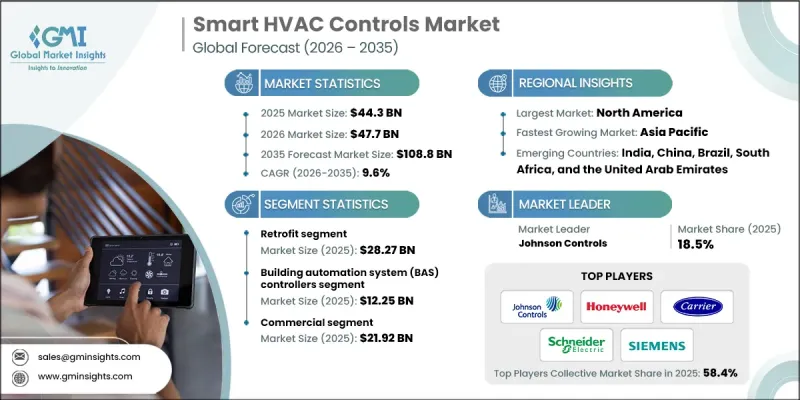
세계의 스마트 HVAC 제어 시장은 2025년에 443억 달러로 평가되었고, 2035년까지 연평균 복합 성장률(CAGR) 9.6%로 성장하여 1,088억 달러에 이를 것으로 예측됩니다.
시장 확대의 주요 요인으로는 스마트 빌딩 및 자동화 주택의 급속한 보급, 에너지 소비 및 운영 비용 절감에 대한 관심 증가, 지속가능성과 탄소 감축을 중심으로 한 정부의 규제 강화 등을 꼽을 수 있습니다. IoT 연결성, 인공지능, 데이터 분석, 클라우드 기반 HVAC 플랫폼의 지속적인 발전은 냉난방 시스템 모니터링 및 최적화 방법을 재구성하고 있습니다. 세계 각국 정부는 환경 및 경제 전략의 일환으로 지능형 빌딩 솔루션을 적극적으로 추진하고 있습니다. 규제 프레임워크는 주거용, 상업용, 산업용 건물의 에너지 성능 향상을 점점 더 요구하고 있으며, 정밀한 에너지 관리를 가능하게 하는 스마트 HVAC 제어장치에 대한 지속적인 수요를 창출하고 있습니다. 정책 입안자들은 건물 효율성 향상이 장기적인 기후 목표를 달성하는 데 중요한 역할을 한다는 것을 인식하고 지능형 HVAC 솔루션의 도입을 장려하고 있습니다. 이 시장은 센서, 자동화, 연결성, 분석을 활용하여 난방, 환기, 공조 시스템을 더 높은 정확도, 신뢰성, 효율성으로 관리할 수 있는 첨단 하드웨어와 소프트웨어의 통합 생태계를 의미합니다.
| 시장 범위 | |
|---|---|
| 개시 연도 | 2025년 |
| 예측 기간 | 2026-2035년 |
| 개시 연도 가치 | 443억 달러 |
| 예측 금액 | 1,088억 달러 |
| CAGR | 9.6% |
리노베이션 부문은 2025년 282억 7,000만 달러에 달했습니다. 리노베이션을 통해 건물 소유주는 전체 시스템을 교체하지 않고도 기존 HVAC 인프라를 지능형 제어로 업그레이드하여 자본 지출을 최소화하면서 효율성을 빠르게 향상시킬 수 있습니다. 이 접근 방식은 예산과 지속가능성의 제약 속에서 활동하는 공공 기관과 상업용 부동산 소유주에게 특히 매력적입니다. 정부 지원 건물 개보수 이니셔티브와 효율성 업그레이드 프로그램은 개보수 활동을 지속적으로 촉진하고 노후화된 건물 재고 전반에 걸쳐 스마트 HVAC 제어 솔루션에 대한 안정적인 수요를 강화하고 있습니다.
빌딩 자동화 시스템(BAS) 컨트롤러 분야는 2025년 122억 5,000만 달러 시장 규모를 기록했습니다. 이 컨트롤러는 중앙 제어 기능, 다중 빌딩 시스템의 협동 운전, 진화하는 에너지 성능 표준에 대한 적응을 가능하게 하며, 지능형 HVAC 도입의 토대가 되고 있습니다. 건물 에너지 사용량 집중 모니터링 및 보고에 대한 규제 강화는 도입을 더욱 촉진하고 있습니다. BAS 컨트롤러는 대규모의 복잡한 시설에서 고도의 분석과 자동화를 지원하면서 운영 효율성을 최적화하는 데 중요한 역할을 합니다.
북미 스마트 HVAC 제어 시장은 2025년 39.8%의 점유율을 차지했습니다. 이 지역은 성숙한 스마트홈 도입, 광범위한 상업 자동화, 지원적인 에너지 효율 정책의 혜택을 누리고 있습니다. 연방 및 주정부 차원의 인센티브 프로그램은 기존 건물의 개보수 및 신축 건물에 대한 도입을 가속화하고 있습니다. 주거, 상업 및 산업 분야에서 커넥티드 온도조절기, 센서, 데이터 기반 HVAC 플랫폼의 조기 도입은 지속가능성 목표와 운영 효율성을 지원하면서 지역 리더십을 지속적으로 강화하고 있습니다.
The Global Smart HVAC Controls Market was valued at USD 44.3 billion in 2025 and is estimated to grow at a CAGR of 9.6% to reach USD 108.8 billion by 2035.
Market expansion is driven by the rapid penetration of smart buildings and automated homes, heightened emphasis on reducing energy consumption and operating costs, and stricter government policies centered on sustainability and carbon reduction. Continuous progress in IoT connectivity, artificial intelligence, data analytics, and cloud-based HVAC platforms is reshaping how heating and cooling systems are monitored and optimized. Governments worldwide are actively promoting intelligent building solutions as part of broader environmental and economic strategies. Regulatory frameworks increasingly demand improved energy performance in residential, commercial, and industrial buildings, creating sustained demand for smart HVAC controls that enable precise energy management. Policymakers recognize that improving building efficiency plays a vital role in meeting long-term climate objectives, reinforcing the adoption of intelligent HVAC solutions. The market represents an integrated ecosystem of advanced hardware and software that uses sensors, automation, connectivity, and analytics to manage heating, ventilation, and air conditioning systems with higher accuracy, reliability, and efficiency.
| Market Scope | |
|---|---|
| Start Year | 2025 |
| Forecast Year | 2026-2035 |
| Start Value | $44.3 Billion |
| Forecast Value | $108.8 Billion |
| CAGR | 9.6% |
The retrofit segment reached USD 28.27 billion in 2025. Retrofitting allows building owners to upgrade existing HVAC infrastructure with intelligent controls without replacing entire systems, delivering quick efficiency gains while minimizing capital expenditure. This approach is particularly attractive for public institutions and commercial property owners working within budgetary and sustainability constraints. Government-backed building renovation initiatives and efficiency upgrade programs continue to stimulate retrofit activity, reinforcing steady demand for smart HVAC control solutions across aging building stock.
The building automation system controllers segment generated USD 12.25 billion in 2025. These controllers serve as the backbone of intelligent HVAC deployments by enabling centralized control, coordinated operation of multiple building systems, and compliance with evolving energy performance standards. Increasing regulatory emphasis on centralized monitoring and reporting of building energy usage is further strengthening adoption. BAS controllers play a crucial role in optimizing operational efficiency while supporting advanced analytics and automation across large and complex facilities.
North America Smart HVAC Controls Market captured a 39.8% share in 2025. The region benefits from mature smart home adoption, widespread commercial automation, and supportive energy efficiency policies. Incentive programs at both the federal and state levels are accelerating upgrades in existing buildings as well as adoption in new construction. Early deployment of connected thermostats, sensors, and data-driven HVAC platforms across residential, commercial, and industrial sectors continues to reinforce regional leadership while supporting sustainability targets and operational efficiency.
Key companies operating in the Global Smart HVAC Controls Market include Carrier Global Corporation, Honeywell International Inc., Siemens AG, Johnson Controls International plc, Schneider Electric SE, Daikin Industries Ltd., Mitsubishi Electric Corporation, Emerson Electric Co., Bosch Thermotechnology, Trane Technologies plc, Lennox International Inc., LG Electronics Inc., Delta Controls Inc., Distech Controls Inc., KMC Controls Inc., Regin Group, Aprilaire, Carel Industries, Ecobee Inc., and Nest Labs under Google LLC. Companies in the Smart HVAC Controls Market focus on strengthening their market position through continuous product innovation, strategic partnerships, and expansion of digital capabilities. Investments in IoT-enabled platforms, AI-driven analytics, and cloud-based control systems allow suppliers to deliver higher energy savings and predictive maintenance features. Firms actively collaborate with construction companies, utilities, and technology providers to integrate HVAC controls into broader smart building ecosystems. Geographic expansion and localized manufacturing help address regional regulatory requirements and reduce costs.