


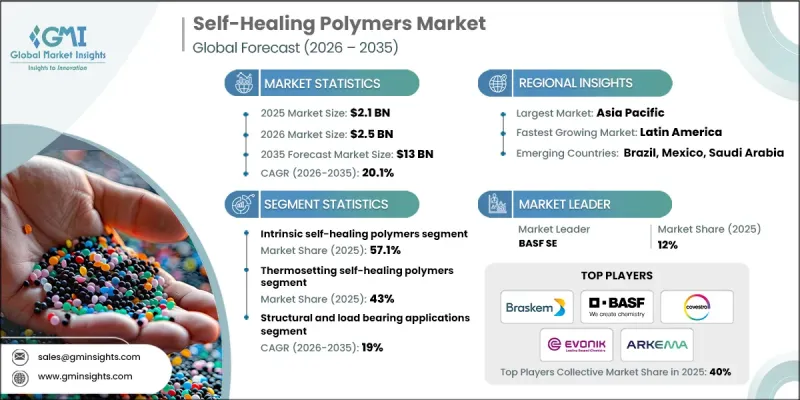
세계의 자가 치유 폴리머 시장은 2025년에 21억 달러로 평가되었고, 2035년까지 연평균 복합 성장률(CAGR) 20.1%로 성장하여 130억 달러에 이를 것으로 예측되고 있습니다.
특히 2022년부터 2025년까지 산업계가 내구성, 수명 연장, 성능 최적화에 집중하는 가운데, 자기복원성 폴리머는 초기 단계의 실험실 개념에서 상업적으로 실용적인 재료로 진화했습니다. 자가수복성 고분자에 대한 학술 및 기술 문헌의 현저한 증가는 자율적인 재료 복구를 가능하게 하는 동적 분자 네트워크 및 반응성 화학 시스템을 둘러싼 혁신이 확대되고 있음을 보여줍니다. 이러한 조사 활동의 급증은 손상 후 기능 회복이 가능한 첨단 소재에 대한 제조업체들의 관심 확대와 맞물려 있습니다. 유지보수 수요 감소, 다운타임 최소화, 장기적인 신뢰성 향상을 실현하는 재료에 대한 수요 증가가 시장을 견인하고 있습니다. 이론적 탐구에서 대량 생산으로 전환하는 개발 노력이 계속되는 가운데, 제조 기술 향상과 경제성 및 성능 우위에 대한 인식이 높아짐에 따라 자가수복성 폴리머는 보다 광범위한 고부가가치 응용 분야에 통합되고 있습니다.
| 시장 범위 | |
|---|---|
| 개시 연도 | 2025년 |
| 예측 연도 | 2026-2035년 |
| 개시 연도 가치 | 21억 달러 |
| 예측 금액 | 130억 달러 |
| CAGR | 20.1% |
산업 제조 분야에서 자기복원성 폴리머는 반복적인 재료 열화 문제를 해결하기 위해 점점 더 많이 채택되고 있습니다. 이러한 재료는 특히 고성능 분야에서 제조업체가 코팅 및 복합재료 시스템에 직접 수리 메커니즘을 통합하여 부품의 수명을 연장할 수 있게 해줍니다. 또한, 시장 수요는 단일 폴리머 시스템 내에서 여러 기능적 특성을 결합한 재료로 이동하고 있습니다. 자가복구 솔루션은 현재 기계적 복구 기능과 추가 성능 특성을 통합하도록 설계되어 첨단 소재 플랫폼 전반에 걸쳐 폭넓게 적용될 수 있도록 설계되어 있습니다. 이러한 다기능 접근 방식은 제조업체가 재료의 복잡성을 단순화하면서 전체 시스템의 효율성과 신뢰성을 향상시켜 광범위한 채택을 지원할 수 있습니다.
열경화성 자가수복 폴리머 부문은 2025년 기준 43%의 점유율을 차지할 것으로 예상되며, 2026년부터 2035년까지 연평균 19.6%의 성장률을 보일 것으로 예측됩니다. 시장 상황은 범용 소재 플랫폼에 대한 의존에서 벗어나 폴리머 시스템 선택과 최종 용도 요구 사항의 일치성이 증가하고 있음을 보여줍니다. 구조적 무결성과 표면 보호가 요구되는 응용 분야에서는 열경화성 시스템이 여전히 주류입니다. 반면, 열가소성 및 엘라스토머 시스템은 유연성이 요구되는 이용 사례를 지원합니다. 블렌딩 기술과 상호 침투 네트워크 기술은 강성, 인성, 가공 용이성, 재현성, 자가 복구 능력의 균형으로 성능을 맞춤화할 수 있어 상업적 매력을 한층 더 높였습니다.
구조 및 하중지지 용도는 2025년 29.2%의 점유율을 차지할 것으로 예상되며, 2035년까지 연평균 복합 성장률(CAGR) 19%로 확대될 것으로 전망됩니다. 총소유비용을 절감하고 가동 중단을 줄이려는 조직이 늘어나면서 구조, 보호, 전자, 바이오메디컬, 민생, 에너지 관련 부문에서 채택이 확대되고 있습니다. 하중 환경에서는 자기복원 기능이 재료 피로 및 균열 발생 억제에 기여하고, 보호 용도에서는 표면 복구 및 환경 스트레스 요인에 대한 내성이 강조됩니다. 이러한 성능상의 이점은 가혹한 작동 조건에서 통합을 계속 추진하고 있습니다.
북미 자가수복성 폴리머 시장은 2025년에는 6억 5,250만 달러, 2035년에는 19억 달러에 달할 것으로 예상되며, 연평균 19.3%의 연평균 복합 성장률(CAGR)을 보일 것으로 예측됩니다. 지역 전체의 성장은 코팅, 첨단 복합재료, 전자재료 분야의 높은 채택률과 잘 구축된 혁신 생태계가 뒷받침하고 있습니다. 미국은 소재 제조업체, 연구기관, 제조 최종 사용자 간의 긴밀한 협력을 통해 상업화 활동의 중심지 역할을 하고 있습니다. 이러한 파트너십을 통해 여러 고성능 용도의 인증 과정과 초기 단계의 도입이 가속화되고 있습니다.
The Global Self-Healing Polymers Market was valued at USD 2.1 billion in 2025 and is estimated to grow at a CAGR of 20.1% to reach USD 13 billion by 2035.
Self-healing polymers have evolved from early-stage laboratory concepts into commercially viable materials, particularly between 2022 and 2025, as industries increasingly focus on durability, lifecycle extension, and performance optimization. A noticeable rise in academic and technical publications referencing self-healing polymers indicates growing innovation around dynamic molecular networks and responsive chemical systems that enable autonomous material repair. This surge in research activity aligns with expanding industrial interest, as manufacturers seek advanced materials capable of restoring functionality after damage. The market benefits from rising demand for materials that reduce maintenance needs, minimize downtime, and improve long-term reliability. As development efforts continue to shift from theoretical exploration to scalable production, self-healing polymers are being integrated into a wider range of high-value applications, supported by improved manufacturing techniques and increasing awareness of their economic and performance advantages.
| Market Scope | |
|---|---|
| Start Year | 2025 |
| Forecast Year | 2026-2035 |
| Start Value | $2.1 Billion |
| Forecast Value | $13 Billion |
| CAGR | 20.1% |
Within industrial manufacturing, self-healing polymers are increasingly adopted to address recurring material degradation challenges. These materials enable original equipment manufacturers to enhance component longevity by embedding repair mechanisms directly into coatings and composite systems, particularly in high-performance sectors. Market demand is also shifting toward materials that combine multiple functional properties within a single polymer system. Self-healing solutions are now designed to integrate mechanical recovery with additional performance attributes, enabling broader applicability across advanced material platforms. This multifunctional approach supports wider adoption by enabling manufacturers to simplify material complexity while enhancing overall system efficiency and reliability.
The thermosetting self-healing polymers segment accounted for held 43% share in 2025 and is projected to grow at a CAGR of 19.6% from 2026 to 2035. The market landscape shows increasing alignment between polymer system selection and end-use requirements rather than reliance on generalized material platforms. Thermosetting systems remain dominant in applications requiring structural integrity and surface protection, while thermoplastic and elastomeric systems support flexibility-driven use cases. Blend and interpenetrating network technologies enable tailored performance by balancing rigidity, toughness, ease of processing, and repeatable healing capability, further strengthening their commercial appeal.
The structural and load-bearing applications held 29.2% share in 2025 and are expected to grow at a CAGR of 19% through 2035. Adoption across structural, protective, electronic, biomedical, consumer, and energy-related segments continues to expand as organizations aim to lower total ownership costs and reduce operational interruptions. In load-bearing environments, self-healing functionality helps slow material fatigue and crack development, while protective applications emphasize surface restoration and resistance to environmental stressors. These performance benefits continue to drive integration across demanding operating conditions.
North America Self-Healing Polymers Market reached USD 652.5 million in 2025 to USD 1.9 billion by 2035 at a CAGR of 19.3%. Growth across the region is supported by strong adoption across coatings, advanced composites, and electronic materials, along with a well-established innovation ecosystem. The United States remains the central hub for commercialization activity, supported by close collaboration among material producers, research institutions, and manufacturing end users. These partnerships accelerate qualification processes and early-stage deployment across multiple high-performance applications.
Prominent participants in the Global Self-Healing Polymers Market include BASF SE, Arkema S.A., Covestro AG, The Dow Chemical Company, Evonik Industries AG, Huntsman Corporation, DSM-Firmenich (formerly Royal DSM), 3M Company, Henkel AG & Co. KGaA, AkzoNobel N.V., SABIC, LG Chem Ltd., Mitsubishi Chemical Group, Toray Industries, Inc., Sumitomo Chemical Co., Ltd., and Nippon Paint Holdings Co., Ltd. Companies active in the self-healing polymers market employ a combination of strategic initiatives to strengthen their competitive positioning. Investment in research and development remains a primary focus, enabling firms to improve healing efficiency, durability, and compatibility with existing manufacturing processes. Strategic partnerships with industrial end users support faster commercialization and application-specific customization. Many companies expand production capabilities to support scaling and cost optimization. Portfolio diversification across coatings, composites, and advanced materials allows suppliers to address multiple industries. Sustainability-focused innovation, including extended material lifespans and reduced maintenance requirements, further enhances market acceptance.
( Note: the trade statistics will be provided for key countries only)